
A Registered Nurse (RN) license does not require a Bachelor of Science in Nursing (BSN). Graduating from an accredited Associate Degree in Nursing (ADN) or nursing diploma program, then passing the NCLEX-RN exam, is all you legally need to earn RN licensure in the United States. If you can you be an RN without a BSN has been your burning question, the answer is a clear yes. This article walks you through the education requirements, realistic timelines, and workforce realities so you can make a confident decision about your path forward.
What education do you need to become an RN without a BSN?
RN licensure requires graduation from an approved ADN or diploma program, not a BSN. Two program types qualify you to sit for the NCLEX-RN, and both are widely available across the country.
Associate Degree in Nursing (ADN)
An ADN is the most common non-BSN route to RN licensure. Community colleges and some universities offer ADN programs that typically run 18–24 months after you complete prerequisites. The curriculum covers pharmacology, medical-surgical nursing, pediatrics, obstetrics, and mental health, along with supervised clinical rotations. Programs must hold approval from your state's Board of Nursing and, ideally, national accreditation from the Accreditation Commission for Education in Nursing (ACEN) or the Commission on Collegiate Nursing Education (CCNE).

Nursing diploma programs
Diploma programs focus heavily on clinical training and are typically hospital-based. They prepare students for the NCLEX-RN but do not confer a college degree. Diploma programs are becoming less common as ADN and BSN routes grow, but they remain a legal and recognized pathway to RN licensure in most states.
Prerequisite courses you need first
Before entering either program, you must complete foundational college-level courses. Most programs require:
- Anatomy and Physiology I and II
- Microbiology
- Chemistry or Nutrition
- English Composition
- Statistics or College Math
- Psychology and Developmental Psychology
These prerequisites are not optional. They form the academic foundation nursing programs build on, and your grades in them directly affect your admission chances.
Pro Tip: Take prerequisites at an accredited community college or through a self-paced online provider accepted by your target nursing school. Finishing them faster gets you into the program sooner.
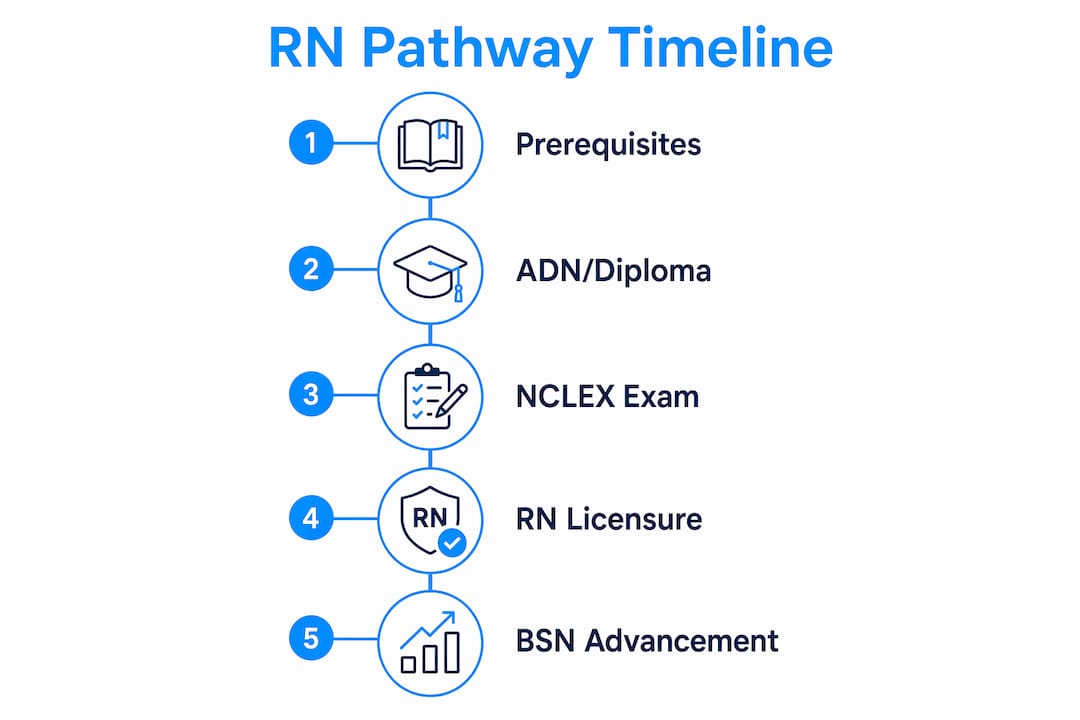
Once you graduate from an approved ADN or diploma program, you are legally eligible to sit for the NCLEX-RN exam. Passing that exam is what makes you a licensed RN, regardless of whether you hold an ADN or a BSN.
How do ADN, diploma, and BSN timelines compare?
The time it takes to become an RN varies significantly depending on the route you choose. Here is a direct comparison:
| Program type | Typical duration | Degree conferred | Estimated cost range |
|---|---|---|---|
| ADN | 18–24 months (plus prerequisites) | Associate degree | Lower, community college rates |
| Nursing diploma | 18–24 months | No degree | Varies by hospital program |
| Traditional BSN | 4 years | Bachelor's degree | Higher, university tuition |
| Accelerated BSN | 12–18 months (for degree holders) | Bachelor's degree | Higher, intensive format |
ADN programs are faster and more affordable than traditional four-year BSN programs. That time and cost difference is real and meaningful for students who need to enter the workforce quickly.
The biggest bottleneck for most students is not the nursing program itself. Prerequisite courses like Anatomy and Physiology, Microbiology, and Statistics are often the application bottleneck, and completing them through self-paced online providers can shorten your total timeline by 6–12 months. That is a significant head start.
If you already hold a bachelor's degree in another field, an accelerated BSN is worth considering. It compresses the BSN into 12–18 months. But if you are starting fresh and want the fastest path to RN licensure, the ADN route wins on time and cost.
Pro Tip: Map out your prerequisites before applying to any nursing program. Knowing exactly which courses each school requires prevents wasted semesters on courses that do not transfer.
What are the workforce realities for an RN without a BSN?
Holding an ADN gets you through the door at most hospitals and healthcare facilities. The practical picture is more nuanced once you are inside.
Many hospitals encourage ADN-prepared nurses to pursue RN-to-BSN bridge programs within 2–5 years of being hired. This is not always a formal requirement, but it is a common expectation, especially at larger health systems. Magnet-designated hospitals, which earn recognition from the American Nurses Credentialing Center (ANCC) for nursing excellence, often set internal targets for BSN-prepared staff. That creates a soft requirement even where no legal mandate exists.
Here is what the workforce picture looks like for ADN-prepared RNs:
- Entry-level positions: Widely available. Most hospitals, clinics, long-term care facilities, and home health agencies hire ADN-prepared RNs.
- Specialty units: Some intensive care, labor and delivery, and emergency departments prefer or require BSN preparation, though this varies by employer.
- Leadership and management roles: BSN-prepared nurses generally earn higher salaries and have more access to leadership and specialized positions. An ADN gets you licensed; a BSN expands where you can go.
- Bridge programs: Flexible online RN-to-BSN programs let working nurses advance their education without leaving their jobs. Many employers even offer tuition reimbursement for this.
The practical strategy most experienced nurses recommend: get your ADN, get licensed, get hired, and then pursue your BSN while working. You build clinical experience and earn income while advancing your credentials. That is a smarter sequence than waiting four years to enter the workforce.
Can someone with a GED become an RN without a BSN?
Yes. GED holders are accepted on equal footing with high school diploma holders by most nursing schools. The GED alone does not exempt you from prerequisites, but it qualifies you to enroll in college-level courses and apply to ADN or diploma programs.
The path for a GED holder looks like this:
- Earn your GED if you have not already. Most community colleges accept it for enrollment.
- Enroll in prerequisite courses at a community college. Focus on Anatomy and Physiology, Microbiology, and other required sciences.
- Maintain a strong GPA. Nursing program admissions are highly competitive, and a strong GPA in prerequisites drives acceptance more than program length alone.
- Apply to accredited ADN or diploma programs. Submit your transcripts, any required entrance exam scores (such as the TEAS or HESI A2), and letters of recommendation.
- Complete the nursing program and graduate. This typically takes 18–24 months after prerequisites.
- Pass the NCLEX-RN. Once you pass, you are a licensed RN. Your GED versus high school diploma is irrelevant at that point.
The total timeline from GED to RN licensure typically runs 3–4 years when you factor in prerequisites. That is comparable to a traditional BSN for many students, but the cost is substantially lower when you use community college pricing for both prerequisites and the ADN program itself.
Nursing is genuinely accessible to non-traditional students. The field cares about your clinical competence and your NCLEX-RN score, not the type of diploma you held at 18.
Key Takeaways
Becoming an RN without a BSN is a legal, practical, and widely used pathway that requires an accredited ADN or diploma program and a passing NCLEX-RN score.
| Point | Details |
|---|---|
| BSN is not required for RN licensure | An ADN or nursing diploma plus a passing NCLEX-RN score earns you full RN licensure. |
| ADN programs run 18–24 months | Prerequisites add time, but self-paced online courses can shorten the total timeline by 6–12 months. |
| GED holders qualify for ADN programs | Most nursing schools treat a GED as equivalent to a high school diploma for admission purposes. |
| Workforce entry is open to ADN nurses | Most hospitals and clinics hire ADN-prepared RNs, though Magnet hospitals may expect BSN completion within 2–5 years. |
| BSN works best as a career advancement step | Pursuing an RN-to-BSN bridge program after licensure is a practical strategy, not a prerequisite for practice. |
The BSN-or-nothing myth is holding students back
The loudest voices in nursing education often make it sound like a BSN is the only real path to becoming a nurse. That narrative is wrong, and it costs the profession qualified candidates every year.
I have watched students delay their nursing careers by two or three years because they believed an ADN was somehow a lesser credential. It is not. The NCLEX-RN does not ask what degree you hold. Patients do not ask either. What matters is whether you can think critically, act quickly, and provide safe care.
The smarter play is to get licensed as fast as you responsibly can, get into a clinical environment, and build real skills. The ADN route does exactly that. Yes, you will likely need to complete a BSN bridge program at some point if you want leadership roles or Magnet hospital positions. But doing that while employed, with tuition reimbursement and actual patient experience, is far better than spending four years in a classroom before you have ever touched a patient.
The one area where I see ADN students stumble is prerequisites. Students underestimate how competitive nursing program admissions are. A B in Anatomy and Physiology can cost you a seat. Treat every prerequisite like it is the most important class you will ever take, because for nursing school admission, it is.
— Caleb
Recallos helps nursing students pass the NCLEX-RN
Earning your RN license, whether through an ADN or BSN program, ends at the same place: the NCLEX-RN exam. That exam tests critical nursing competencies, and how you prepare for it matters.

Recallos is built specifically for nursing and healthcare students who need focused, high-yield exam preparation. The platform offers adaptive quizzes that adjust to your weak areas, so you spend time on what actually needs work rather than reviewing content you already know. Recallos also includes exam prediction tools that help you study strategically, not just broadly. Developed by practicing nurses and CRNAs, every question aligns with real NCLEX blueprints. Visit Recallos to start building the daily practice habits that get you licensed.
FAQ
Can you be an RN without a BSN degree?
Yes. Graduating from an accredited ADN or nursing diploma program and passing the NCLEX-RN exam qualifies you for full RN licensure in all U.S. states. A BSN is not a legal requirement for licensure.
How long does it take to become an RN with an ADN?
ADN programs typically take 18–24 months to complete after finishing prerequisite courses. Prerequisites add another 6–12 months, making the total timeline roughly 2–3 years from starting college.
Do hospitals hire RNs without a BSN?
Most hospitals hire ADN-prepared RNs for entry-level positions. Magnet-designated hospitals may expect nurses to complete a BSN within 2–5 years of hire, but this is an internal expectation rather than a legal requirement.
Can a GED holder become an RN?
Yes. Most nursing schools accept a GED as equivalent to a high school diploma. GED holders must still complete all required prerequisite courses before applying to an ADN or diploma program.
What is the NCLEX-RN and who needs to take it?
The NCLEX-RN is the national licensing exam every aspiring RN must pass, regardless of whether they completed an ADN, diploma, or BSN program. You can learn more about taking the NCLEX and current exam options for 2026.