
What is the NCE for CRNA, and what do you need to know?

The National Certification Examination (NCE) is the official credentialing exam administered by the National Board of Certification and Recertification for Nurse Anesthetists (NBCRNA) that every aspiring CRNA must pass to earn the credential. It is not a knowledge recall quiz. The NBCRNA designs it to assess whether you can apply integrated anesthesia practice knowledge at an entry-level professional standard.
Key facts at a glance:
- Question count: 100 to 170 questions, delivered as a computerized adaptive test (CAT)
- Time limit: up to three hours, no extensions
- Adaptive format: The exam adjusts question difficulty based on your responses in real time
- No backtracking: Once you submit an answer, it is locked. You cannot revisit it
- Unscored items: several pretest questions are embedded throughout and are indistinguishable from scored ones
- Credential earned: Passing grants you the CRNA designation, recognized across all U.S. states
The adaptive nature means two candidates can sit the same exam and see different question counts. What matters is demonstrating consistent competence across the content domains, not finishing at a specific number.
Table of Contents
- Eligibility requirements you must meet before applying
- How the NCE exam is structured and scored
- How to prepare effectively for the NCE
- Official NBCRNA support and contact resources
- Recallos gives you a smarter path to NCE readiness
- Key Takeaways
Eligibility requirements you must meet before applying
The NBCRNA sets clear prerequisites. Missing any one of them delays your application, so confirm each before you submit.
- Active RN license: You must hold a current, unrestricted registered nurse license in every state where you are licensed. A restricted or lapsed license disqualifies you
- Accredited program completion: You must have graduated from a COA-accredited nurse anesthesia program within the previous two calendar years
- Application documentation: The application requires electronic signatures and supporting program documentation submitted through the NBCRNA portal
- Eligibility notification: Once NBCRNA confirms your eligibility, you receive an "Exam Authorized" status, which unlocks scheduling through Pearson VUE
- Attempt limits: You may attempt the NCE multiple times per year within a limited period following graduation
- Eligibility deadline: If you do not pass within the eligibility period, you lose eligibility and must meet new requirements to reapply
Monitor your email closely after submitting. Eligibility notification depends on timely receipt of your program and licensure documentation, and delays in that paperwork push back your testing window.
How the NCE exam is structured and scored
Question types and format
The NCE is not a straightforward multiple-choice test. Question types include:
- Standard four-option multiple choice
- Calculation questions requiring arithmetic under time pressure
- Drag-and-drop ordering items
- Hotspot questions on anatomical images or diagrams
- Graphics and short video-based scenarios
The Several unscored pretest items are scattered throughout and look identical to scored questions. Treat every question as if it counts, because you cannot tell which ones do.
Content domains and weighting
The exam tests four weighted domains. Aligning your study time to these proportions is one of the most practical things you can do:
| Domain | Relative Weight |
|---|---|
| General Principles of Anesthesia | largest share |
| Surgical Procedures and Special Populations | significant share |
| Anesthesia for Obstetrics and Pediatrics | notable share |
| Professional Issues and Special Topics | notable share |
General Principles of Anesthesia carries the largest share at 35%. Spending equal time across all four domains is a common mistake that costs candidates on test day.
Passing standard update for 2026
Effective July 1, 2026, the NBCRNA raised the passing standard to the mid-80% range. This change reflects updated entry-level competency benchmarks and is designed to protect the value of the CRNA credential. If you are testing after that date, plan your preparation around the higher threshold.
| Exam Feature | Detail |
|---|---|
| Question range | 100–170 questions |
| Maximum time | up to three hours |
| Passing standard (post-July 1, 2026) | raised to a higher level reflecting updated competency standards |
| Attempts allowed | Up to 4 per year |
| Eligibility window | 2 years post-graduation |
How to prepare effectively for the NCE
Start early, not the week before graduation
The candidates who struggle most are the ones who treat NCE prep as a post-graduation sprint. Starting during your clinical rotations builds the kind of question fluency that cramming simply cannot replicate. Consistent daily practice across months outperforms a two-week intensive every time.
Use the NBCRNA Self-Evaluation Examination (SEE) as your diagnostic baseline
The SEE is specifically designed to mirror NCE conditions and give you a clear picture of where your knowledge gaps are before you sit the real exam. Use your SEE results to identify which domains need the most attention, then weight your study time accordingly. Do not ignore a weak domain because you find it less interesting.
Practice under realistic conditions
The no-backtracking rule catches candidates off guard more than almost any other feature of the exam. If your practice sessions let you revisit and change answers, you are building habits that will hurt you on test day. Simulate the actual conditions: timed, sequential, no going back. Practicing in a no-backtrack format is not just good advice; it is the only way to build the decision-making confidence the exam demands.
Use adaptive tools to close specific gaps
Generic question banks treat every topic equally. Adaptive platforms adjust to your performance and push harder on the areas where you are weakest. Recallos, built by practicing nurses and CRNAs, offers daily high-yield practice with personalized weak-area review and progress tracking. You can also upload your own notes to generate custom quizzes aligned to the NCE blueprint, which is especially useful for domain-specific review.
Pro Tip: Weight your daily practice sessions to mirror the exam's domain breakdown. Spend roughly 35% of your question time on General Principles of Anesthesia, not an equal quarter across all four domains. That single adjustment can meaningfully shift your score distribution.
Avoid these common preparation mistakes
- Treating all domains as equally weighted
- Relying solely on passive reading without active question practice
- Skipping timed simulations until the final week
- Ignoring the SEE results and studying by feel instead of data
Official NBCRNA support and contact resources
Knowing where to go when you have questions saves real time during the application process.
- NBCRNA main portal: All applications, eligibility status, and documentation submission happen at nbcrna.com. This is your primary hub
- Pearson VUE: Once you receive "Exam Authorized" status, schedule your test date through Pearson VUE's online portal or by phone
- NCE Handbook: The official NCE Handbook covers eligibility, test-day procedures, accommodations, and retake policies in full detail. Download it before you apply
- Results timeline: Preliminary results are available at the test center immediately after you finish. Official mailed results arrive within 2–4 weeks
- Special accommodations: Requests for testing accommodations must be submitted through NBCRNA before scheduling. Documentation requirements are outlined in the handbook
- Appeals process: If you believe a scoring or eligibility decision is incorrect, the NBCRNA has a formal appeals procedure detailed on their website
For the most current content outline and any policy updates, always check the official NBCRNA site directly. Third-party summaries, including this one, can lag behind official revisions.
Recallos gives you a smarter path to NCE readiness
Passing the NCE on your first attempt takes more than reading the right textbooks. It takes daily practice that adapts to where you actually are, not where you hope you are.
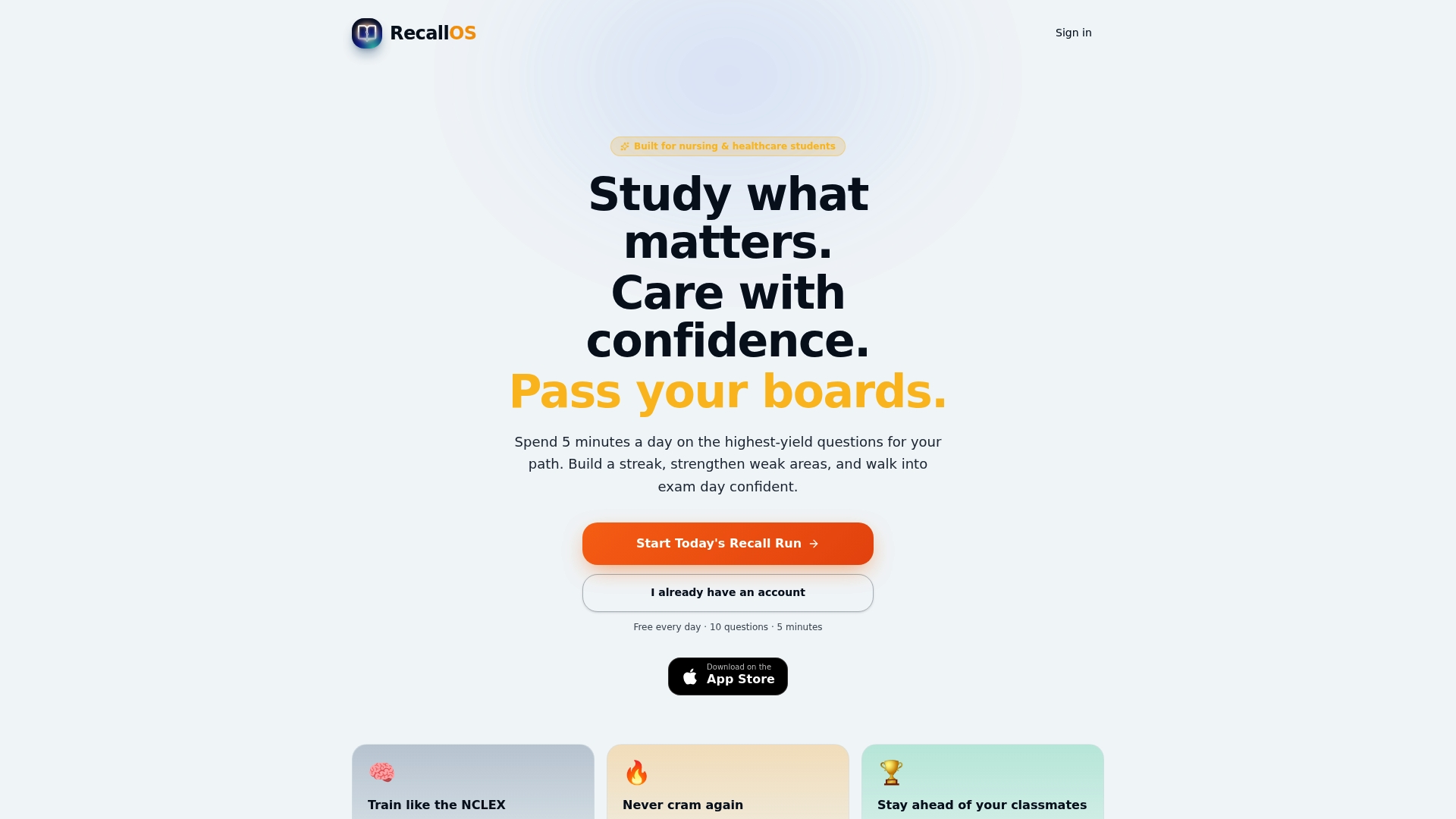
Recallos was built by practicing nurses and CRNAs who know exactly what the exam demands. The platform delivers high-yield daily questions mapped to the NCE blueprint, adapts to your weak areas automatically, and lets you upload your own clinical notes to generate custom quizzes and summaries. The Panic Mode feature replicates the no-backtrack, timed pressure of the actual exam so that test day feels familiar, not foreign. Progress tracking and streak rewards keep your study consistent across the months that actually matter. Start your free trial at recallos.co and see where your gaps are before the real exam does.
Key Takeaways
The NCE is a high-stakes adaptive exam requiring consistent, domain-weighted preparation starting well before graduation, with the 2026 passing standard now set at the mid-80% range.
| Point | Details |
|---|---|
| Exam format | 100–170 adaptive questions, 3-hour max, no backtracking allowed once an answer is submitted |
| Unscored items | 30 pretest questions are mixed with scored items; treat every question as if it counts |
| Domain weighting | General Principles of Anesthesia accounts for 35% of the exam; study time should reflect that |
| Eligibility window | Up to 4 attempts per year within 2 years of graduating from a COA-accredited program |
| Recallos | Adaptive daily practice mapped to the NCE blueprint, built by practicing nurses and CRNAs |