
For nursing students who need to pass the Next Generation NCLEX, Recallos is the strongest NCLEX RN question bank choice for adaptive, NGN-ready daily practice. It combines adaptive learning, daily high-yield questions written by practicing nurses and CRNAs, and personalized remediation that converts your weak spots into targeted review material.
Three features set it apart from generic quiz apps:
- NGN-style case practice and alternate formats: Recallos supports case-based study workflows that mirror the clinical judgment demands of unfolding case studies, matrix items, and partial-credit scoring.
- Adaptive CAT simulation: The platform adjusts difficulty in real time, replicating the variable-length CAT behavior of the actual NCLEX-RN.
- Deep distractor rationales + remediation: Every missed question feeds a personalized review cycle, not just a static answer key.
Start with Recallos's free daily access: run a mixed adaptive set of 85 items and one NGN-style case study before committing to a subscription. The actual NCLEX-RN is a Computer Adaptive Test that can range from 85 to 150 items and stops when a 95% confidence threshold is reached against the passing standard, with a maximum time limit of five hours.
Pro Tip: Don't skip the free tier. Run at least one full adaptive session before buying anything. The way a platform handles your wrong answers tells you more than any features page.
Table of Contents
- What does a complete NCLEX RN question bank need to include?
- How do you pick the right NCLEX RN question bank for your study stage?
- How should you use a Q-bank to prepare for the NCLEX-RN?
- What should you expect from pricing and trial options?
- How do you read Q-bank analytics and know when you're ready?
- Why is Recallos a strong choice for NCLEX-RN question bank practice?
- Key Takeaways
- What students actually find useful in a Q-bank
- Recallos: your NGN-ready daily practice partner
- Sources and further reading
What does a complete NCLEX RN question bank need to include?
Not every quiz app is a real NCLEX RN question bank. The difference shows up fast once you know what to look for.
NGN item types and partial scoring
The Next Generation NCLEX uses item types that most older Q-banks simply don't have: unfolding case studies, bow-tie items, matrix/grid questions, extended multiple response, drop-down, drag-and-drop, highlight, and trend items. Many of these use polytomous (partial-credit) scoring, meaning you can earn partial points rather than all-or-nothing. A Q-bank that only offers traditional multiple-choice is not preparing you for the actual exam. Check that the platform explicitly supports partial scoring and that NGN items render correctly, especially on desktop, since some interactive NGN elements are desktop-only.

CAT realism
The NCLEX-RN is a Computer Adaptive Test delivered through Pearson VUE. It runs a variable number of items, stops when the algorithm reaches confidence against the passing standard, and allows up to five hours. A Q-bank that only lets you take fixed 25-question quizzes is not simulating that experience. Look for adaptive exam modes that dynamically adjust item difficulty and allow sessions of varying length. The CAT mechanics matter: if the simulator doesn't replicate stop rules, you won't build the endurance or decision-making habits the real exam demands.

Question volume and content breadth
The NCLEX test plan organizes content into four major Client Needs categories: Safe and Effective Care Environment (Management of Care; Safety and Infection Control), Health Promotion and Maintenance, Psychosocial Integrity, and Physiological Integrity (Basic Care and Comfort; Pharmacological and Parenteral Therapies; Reduction of Risk Potential; Physiological Adaptation). A solid Q-bank maps every question to these Client Needs categories and shows you your distribution so you know where you're thin.
Quality of explanations
This is where most students underinvest their attention. A strong Q-bank doesn't just tell you the right answer. It explains why each distractor is wrong, links that explanation to a concise high-yield summary, and makes that material easy to export for spaced review. Distractor rationales paired with "Vital Concept" summaries are the gold standard because they address the exact reasoning errors that trip students up on test day.
Customization and study modes
You need topic filters (study pharmacology separately from pediatrics), a tutor mode that shows explanations after each question, a timed exam mode, and daily question features that build consistency. Without these, you're either drilling randomly or cramming in unsustainable blocks.
UX, platform support, and updates
NGN items are complex to render. Test the mobile experience before you pay. Some platforms handle drag-and-drop and matrix items poorly on small screens. Also ask when the question bank was last updated. The NCSBN revised the test plan in 2023, and any Q-bank that hasn't aligned its content to that blueprint is giving you outdated practice.
Pro Tip: When evaluating any Q-bank, open a free NGN sample case on desktop first, then on your phone. If the item types break or feel clunky on mobile, that's a real problem for your daily study routine.
How do you pick the right NCLEX RN question bank for your study stage?
Your study stage changes what you need from a Q-bank. A student eight weeks out needs different tools than someone cramming for a retake in two weeks.
Match features to your timeline
- Early learning (8+ weeks out): Prioritize explanation depth and topic filters. You want to understand why answers are right or wrong, not just drill volume. Look for tutor mode, distractor rationales, and the ability to filter by Client Needs subcategory.
- Consolidation (4–6 weeks out): Shift toward mixed adaptive sets and NGN case practice. You should be running full CAT simulations and reviewing analytics to find persistent weak areas.
- Final readiness (1–2 weeks out): Full-length CAT sims (85–150 items) and timed NGN case studies only. You're building stamina and confirming your readiness signal, not learning new content.
Decision checklist
Before you buy, confirm these:
- Does the platform include all NGN item types (bow-tie, matrix, unfolding case studies, drag-and-drop)?
- Does it support partial-credit scoring on NGN items?
- Can you run a variable-length adaptive CAT (minimum 85, maximum 150 items)?
- Are distractor rationales included for every question?
- Does it map questions to NCSBN Client Needs categories?
- Is there a free trial or sample set that includes at least one NGN case?
- Does it work well on your primary device (mobile or desktop)?
- What is the subscription model: monthly, short-term pass, or bundled?
Questions to ask during a free trial
- Run one NGN unfolding case study. Does partial scoring work? Do items render correctly?
- Start a CAT simulation. Does difficulty visibly adapt? Does it stop before 150 if you're performing consistently?
- Check the analytics screen. Can you see performance by Client Needs category and by subtopic?
- Contact support with a question. How fast do they respond?
How to evaluate sample questions quickly
Look for three things: distractor rationales (not just "this is wrong"), partial-credit behavior on matrix or extended multiple-response items, and alignment to the NCJMM (Next-Generation Clinical Judgment Measurement Model) framework. The NCJMM maps clinical judgment through six steps: Recognize Cues, Analyze Cues, Prioritize Hypotheses, Generate Solutions, Take Action, and Evaluate Outcomes. A well-designed NGN item will test one or more of these steps explicitly.
How should you use a Q-bank to prepare for the NCLEX-RN?
Having access to a strong Q-bank is only half the equation. How you use it determines whether you pass.
Three study timelines
8-week plan (recommended):
- Weeks 1–2: Topic-based tutor mode, 30–40 questions per day by Client Needs category. Read every distractor rationale. Convert missed questions to flashcards.
- Weeks 3–4: Mixed adaptive sets of 50–75 questions. Start one NGN case study per day. Review analytics weekly.
- Weeks 5–6: Full CAT simulations (85–150 items). Two NGN case studies per session. The actual NCLEX‑RN allows a candidate between 85 and 150 items during its adaptive exam process. Identify and drill weak-topic clusters.
- Weeks 7–8: Full-length timed exams. One 5-hour simulation per week. Spaced review of flagged weak areas only.
4-week plan: Compress weeks 1–2 into the first week (topic filters + tutor mode), then move directly to mixed CATs and daily NGN cases for weeks 2–3. Week 4 is full-length sims only.
2-week crash plan: Mixed adaptive sets of 75–85 questions daily, two NGN cases per day, and one full-length CAT simulation every three days. Focus exclusively on your weakest Client Needs categories. A daily question habit matters more than marathon sessions at this stage.
Daily and weekly routines
Build a consistent daily rhythm: 30–45 minutes of mixed adaptive questions in the morning, one NGN case study in the afternoon, and a 15-minute spaced review of flagged cards before bed. Weekly, run one full CAT simulation (85–150 items) and review your analytics dashboard to identify any category where your percent-correct is dropping or stagnant.
Using analytics to close weak areas
Don't just note your overall score. Drill into Client Needs subcategories. If Pharmacological and Parenteral Therapies is consistently below your average, pull a targeted topic-specific review and convert those missed questions into flashcards for spaced repetition. Weak areas don't close by doing more random questions. They close by doing targeted questions and reviewing the rationale every time you miss one.
NGN-specific practice habits
Partial-credit strategy matters. On matrix and extended multiple-response items, avoid over-selecting. Choosing every plausible option costs you partial credit on items where precision is scored. Practice reading the stem carefully to identify exactly which clinical judgment step is being tested, then answer only what the item asks.
Pro Tip: Simulate test day at least once before you schedule your exam. Block a full 5-hour window, use desktop for NGN items, and don't pause. The cognitive load of five hours of adaptive testing is something you need to experience before the real thing.
What should you expect from pricing and trial options?
Pricing for NCLEX RN question banks varies widely, and the cheapest option is rarely the best value.
Typical pricing shapes
Most platforms offer one of three models:
- Monthly subscription: Flexible, but costs add up if you study for several months. Usually the most expensive per-month option.
- Short-term pass (30–90 days): Common for NCLEX prep. Better value if you have a defined study window.
- Bundled packages: Question bank plus video lectures, flashcards, or live tutoring. Higher upfront cost but potentially better value if you'll use all components.
Features that often sit behind paywalls: full-length CAT simulations, NGN case studies, detailed analytics dashboards, and unlimited question access. Free tiers typically offer a limited daily question count or a sample set.
What a free trial should include
A trial that doesn't show you NGN items is not a real trial. Before you pay, confirm the free access includes:
- At least one complete NGN unfolding case study with partial scoring
- A short adaptive CAT simulation (even 25–30 items) that adapts difficulty
- Full distractor rationales on every question
- A sample analytics view showing performance by category
- Mobile rendering of at least one drag-and-drop or matrix item
Trial checklist
- Test NGN item rendering on both desktop and mobile.
- Run a short adaptive set and confirm difficulty changes.
- Check that distractor rationales appear for every question, not just correct answers.
- Submit a support question and note the response time.
- Review the cancellation and refund policy before entering payment details.
Pricing caveats
Watch for auto-renewal on monthly subscriptions. Some platforms charge for device access separately or limit the number of devices. If you're purchasing through an app store (Apple or Google), refund policies are governed by the store, not the platform, which can complicate disputes.
How do you read Q-bank analytics and know when you're ready?
Analytics are only useful if you know what you're looking at.
Key metrics to track
| Metric | What it tells you | What to do with it |
|---|---|---|
| Percent correct by Client Needs | Where your knowledge is strong or thin | Drill weak subcategories with targeted sets |
| Trend line over time | Whether you're improving, plateauing, or declining | Adjust study intensity if trend flattens for 5+ days |
| Time per question | Whether you're rushing or overthinking | Target 60–90 seconds per item; flag outlier questions |
| CAT simulation length | How quickly the algorithm reaches confidence | Longer sims (closer to 150) suggest borderline performance |
| Weak-topic clusters | Persistent low-scoring subtopics | Convert to flashcards; run topic-specific drills |
Readiness signals
You're approaching test-day readiness when: your trend line has been stable or improving across at least three full CAT simulations, your percent-correct is consistent across all four Client Needs categories, and you have no more than one or two persistent weak subtopics. A single strong CAT result is not a readiness signal. Consistency across multiple full-length simulations is.
How many sims before you schedule?
A practical rule: complete multiple full-length CAT simulations and several NGN case studies before scheduling your exam date. If your results are inconsistent across those three sims, run two more before booking.
Predicted pass probability
Some platforms display a predicted pass probability. Treat this as a directional signal, not a guarantee. Vendor pass-rate claims need context: they reflect aggregate outcomes across all users, not your individual trajectory. A rising trend line and consistent CAT performance matter more than a single percentage on a dashboard.
Using remediation tools
When analytics flag a weak area, don't just re-read notes. Use spaced repetition: convert missed questions into flashcards, schedule them for review at increasing intervals (1 day, 3 days, 7 days), and re-test with a fresh topic-specific set after each cycle. Pediatric nursing and pharmacology are the two Client Needs areas where students most often find persistent gaps late in prep.
Why is Recallos a strong choice for NCLEX-RN question bank practice?
Recallos maps directly to the checklist that matters for NGN-ready NCLEX prep.
Feature match
| Feature | What Recallos offers |
|---|---|
| Adaptive learning | Adjusts difficulty in real time based on your performance history |
| NGN-style case practice | Case-based study workflows that build clinical judgment across the NCJMM framework |
| Distractor rationales | Deep explanations for wrong answers, linked to high-yield concept summaries |
| Daily practice | High-yield daily questions with streak tracking and rewards to build consistency |
| Progress analytics | Personalized weak-area identification and remediation tools |
| Mobile app | Full app experience for daily practice; desktop recommended for complex NGN items |
| Free access | Limited free daily questions available before committing to a subscription |
Built by nurses, for nurses
Recallos was developed by practicing nurses and CRNAs. That matters because the questions reflect real clinical reasoning, not textbook abstraction. The content aligns with the NCSBN exam blueprint, and the adaptive quiz engine converts your performance data into personalized review cycles rather than generic topic lists.
What to check during your Recallos trial
- Run one mixed adaptive set of 85 items and review the analytics breakdown by Client Needs category.
- Practice one NGN-style case study and confirm partial-credit scoring behavior.
- Check the weak-area remediation: does it generate targeted flashcards or review sets from your missed questions?
- Test the mobile experience for daily question sessions.
Recallos also supports peer challenges and streak-based motivation, which helps with the consistency problem that derails most NCLEX prep. Showing up every day for 30 minutes beats a six-hour weekend session followed by three days off.
Key Takeaways
The strongest NCLEX RN question bank for NGN-ready practice combines adaptive CAT simulation, full NGN item type support with partial scoring, and deep distractor rationales that feed personalized remediation.
| Point | Details |
|---|---|
| NGN item types are non-negotiable | Confirm bow-tie, matrix, unfolding case studies, and partial scoring before buying. |
| CAT realism requires variable length | Only platforms simulating adaptive exams with a range of 85 to 150 items replicate real test conditions. |
| Distractor rationales close knowledge gaps | Explanations for wrong answers, linked to high-yield summaries, accelerate learning faster than re-reading notes. |
| Analytics drive readiness decisions | Three consistent full-length CAT sims and five NGN cases are a practical minimum before scheduling. |
| Recallos fits the checklist | Adaptive daily practice, clinical-judgment case workflows, and nurse-authored content make Recallos a strong NGN-ready option. |
What students actually find useful in a Q-bank
Most students buy a Q-bank for the question count. They stay for the rationales.
The feature that consistently reduces test anxiety isn't the number of questions available. It's knowing, after every wrong answer, exactly why you were wrong and what concept you need to revisit. That feedback loop is what builds clinical judgment, and clinical judgment is what the NGN is actually testing.
The NGN learning curve is steeper than most students expect. Unfolding case studies require you to hold multiple pieces of patient information across several linked items, update your clinical picture as new data arrives, and make decisions under time pressure. Practicing that skill once a week isn't enough. It needs to be a daily habit, even if it's just one case study per session.
The other thing students underestimate is the value of consistency over volume. Thirty focused minutes every day, with full rationale review, outperforms a four-hour cramming session with no review. A platform that supports daily streaks and short adaptive sets isn't just a nice feature. It's the architecture of a study habit that actually sticks.
Recallos: your NGN-ready daily practice partner
Most NCLEX prep tools give you questions. Recallos gives you a system. Built by practicing nurses and CRNAs, it delivers adaptive daily practice that adjusts to your performance, surfaces your weak areas, and converts missed questions into targeted review material. You get NGN-style case-based workflows, deep distractor rationales, streak tracking to keep you consistent, and a mobile app that fits into a real student schedule.
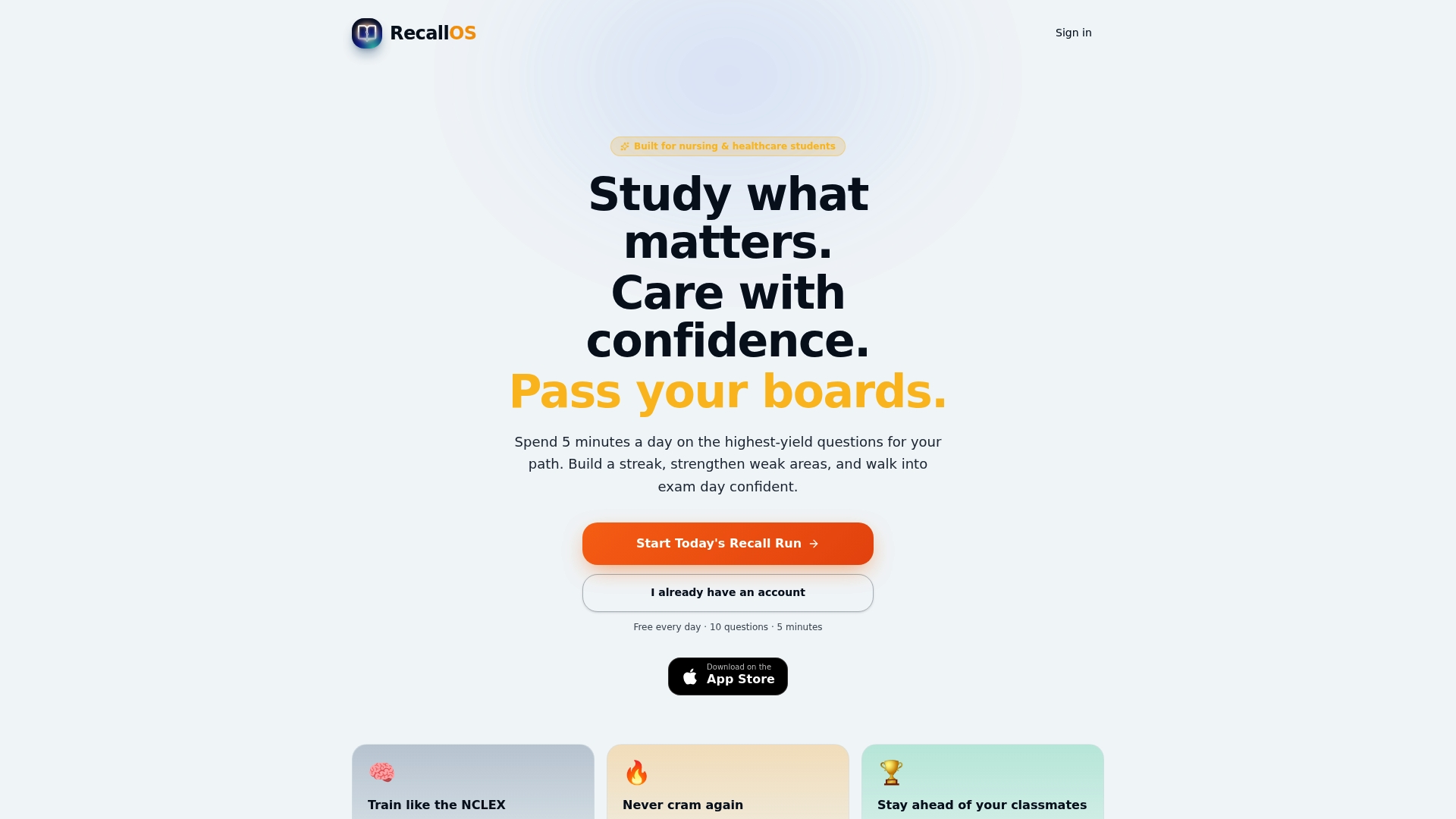
Getting started takes three steps: sign up for free access at Recallos, run one mixed adaptive set of 85 items and experience the variable CAT exam length, then practice two NGN-style case studies and review your weak-area breakdown. That first session tells you more about your readiness than any practice test score. Check out the adaptive quiz examples to see how the engine works before you commit.
Sources and further reading
Authoritative references used in this article and recommended for deeper study:
- NCSBN 2023 NCLEX-RN Test Plan (PDF) — the official content outline and Client Needs category distribution; consult this before choosing any Q-bank.
- NCSBN NextGen NCLEX information — official source for NGN item type descriptions, scoring rules, and exam updates.
- University of Maryland NextGen NCLEX Library — curated academic resources on NGN item types and clinical judgment measurement.
- OpenExamPrep: Free NCLEX-RN Practice Questions (NGN 2026) — free NGN sample questions and CAT mechanics explainer.
- RegisteredNursing.org: NCLEX-RN Practice Questions with Rationales — free practice questions mapped to Client Needs categories.
- Recallos: NCLEX Exam Practice Questions 2026 RN Study Guide — comprehensive guide to using practice questions effectively for NCLEX-RN prep.
- Recallos: The CAT Exam for Nursing — explainer on CAT stop rules, item counts, and how to simulate test conditions.
- Recallos: NCLEX Question a Day — daily question workflow guide for building consistent exam confidence.
- Recallos: Drag and Drop NCLEX Questions — practical drills for NGN drag-and-drop and matrix item types.
- Recallos: NCLEX Pediatric Review — targeted review for one of the most commonly weak Client Needs subtopics.
This article is general study guidance, not professional licensing advice. Confirm current NCLEX exam rules and test plan details directly with NCSBN before scheduling your exam.