
NCLEX testing dates in 2026 are not fixed on a calendar. The exam is available year-round through Pearson VUE, Monday through Saturday, with candidates scheduling their own appointments within a validity window called the Authorization to Test (ATT). Understanding how the ATT works is the single most important step in planning your NCLEX exam schedule 2026. Miss that window and you lose your fees, restart the application process, and add weeks to your timeline. This guide breaks down exactly how the system works, when you can realistically sit for the exam, and how to pick the date that gives you the best shot at passing.
How the ATT determines your NCLEX test dates in 2026
The Authorization to Test is the official document that unlocks your ability to schedule the NCLEX. Your state's Board of Nursing (BON) issues the ATT after verifying your eligibility, and Pearson VUE delivers it to your email. Without it, you cannot book a seat at any test center.
The ATT is not open-ended. Most states issue a 90-day ATT window, but some states are shorter. Texas, for example, gives candidates 75 days. A handful of states issue 60-day windows. You must sit for the exam before your ATT expires, with no exceptions and no automatic extensions.

Missing your ATT expiration is expensive. Reapplication and fees can total up to $600, and some states require a full new BON application cycle. A small number of states allow one hardship reissuance, but that is rare and never guaranteed. Treat your ATT expiration date like a hard deadline.
Here is what the ATT process covers:
- Eligibility verification. Your BON confirms your nursing program completion, transcripts, and background check before issuing the ATT.
- Fee payment. You pay the Pearson VUE exam fee ($200 for RN or PN) before the ATT is generated.
- Email delivery. The ATT arrives by email and also appears in your Pearson VUE online account.
- Scheduling access. Once you have the ATT, you log into Pearson VUE and select your test center, date, and time.
- Validity countdown. Your ATT window starts the day it is issued, not the day you schedule your exam.
Pro Tip: Save your ATT email in a dedicated folder and add the expiration date to your phone calendar the moment you receive it. Set three reminders: at day 30, day 60, and day 75 of your window.
What is the typical timeline from graduation to exam day?
Most nursing students underestimate how long the process takes between walking across the stage and sitting down at a Pearson VUE test center. The typical timeline runs 4–8 weeks from graduation to exam day, with the best-case scenario landing around four weeks.
Here is how that timeline breaks down step by step:
- Submit your BON application. Do this before or at graduation, not after. Many students wait until the ceremony is over, which adds unnecessary days to the clock.
- Fingerprint and background clearance. This step takes 7–10 days in most states. Some states process faster; a few take longer if there are any flags.
- Official transcripts. Your nursing school sends transcripts directly to the BON. This typically takes 1–2 weeks after your final grades post.
- BON review and approval. Once all documents arrive, the BON reviews your file and approves your eligibility. This stage varies by state workload.
- ATT issuance. After BON approval, Pearson VUE generates and emails your ATT. Most candidates receive their ATT 2–4 weeks after graduation.
- Schedule your exam. Log into Pearson VUE, select your test center and date, and confirm your appointment. Scheduling typically takes 1–3 weeks after ATT receipt, depending on test center availability in your area.
- Exam day. Arrive at your Pearson VUE test center with your ATT and a valid government-issued ID.
Pro Tip: Submit your BON application and pay your Pearson VUE fee at the same time, even before graduation. The BON and Pearson VUE processes run in parallel, so starting both early cuts your wait time significantly.
The biggest delay most candidates face is waiting on transcripts. Talk to your nursing school's registrar office before graduation and ask exactly when transcripts will be sent. Some schools batch-send transcripts weeks after commencement, which pushes your entire timeline back.
When are test centers busiest, and does it affect your date?
Test center availability is not uniform across the year. Peak demand months are may through july and january, driven directly by nursing school graduation cycles. Off-peak months, specifically september, october, and december, offer more open slots and shorter waits. During peak periods, urban test centers can have 4–12 week waits for preferred appointment times.
| Period | Demand level | Typical wait for appointment | Best strategy |
|---|---|---|---|
| May through July | High | 4–12 weeks in urban areas | Book immediately after ATT receipt |
| January | High | 3–8 weeks | Schedule within first week of ATT |
| February through April | Moderate | 1–3 weeks | Standard mid-window approach works |
| September through December | Low | Days to 1 week | More flexibility in date selection |
Regional differences matter as much as timing. A test center in a major metro area like Chicago or Houston fills up far faster than one in a smaller city. Rural test centers often have more availability but require travel planning.
If your preferred test center has no open slots within your ATT window, consider these options:
- Search test centers in neighboring cities or counties within driving distance.
- Check for cancellations by logging into Pearson VUE early in the morning, when slots often open up.
- Travel to alternate test centers in the same state or a neighboring state to reduce wait time.
- Book a less preferred time slot to secure your date, then monitor for better openings.
Practical strategies to pick the best NCLEX test date
Choosing the right date within your ATT window is not just about availability. It is about balancing preparation time against the risk of running out of window. The mid-window approach is the most reliable strategy: schedule your exam around day 60 of a 90-day ATT, and book your appointment around day 30.
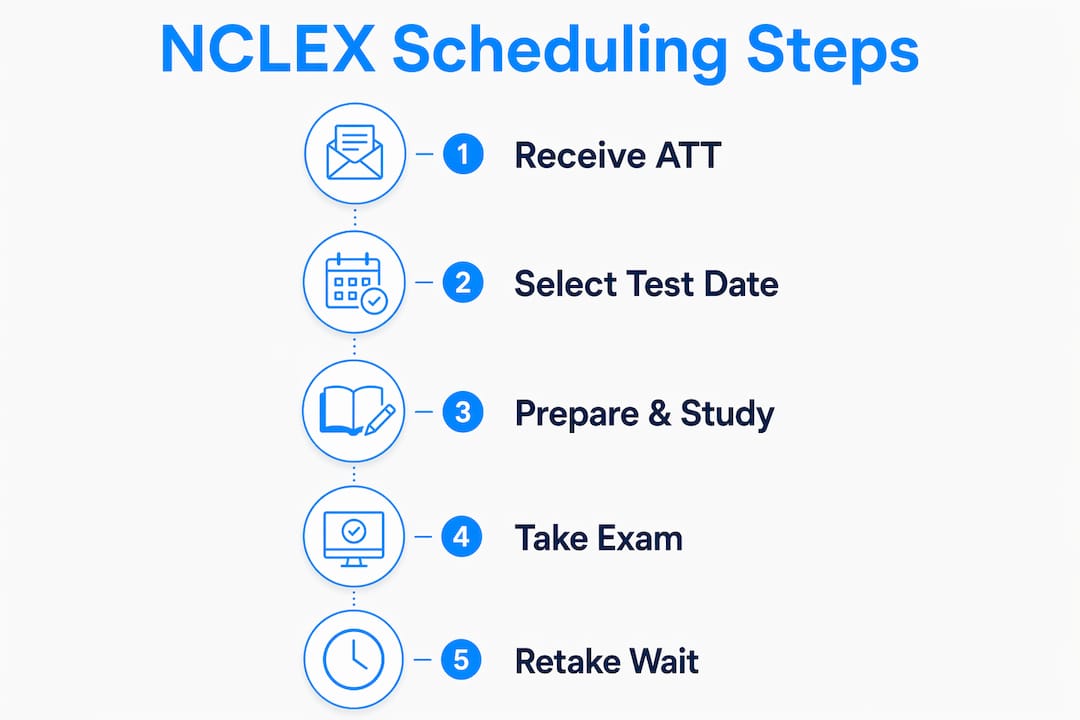
This approach gives you roughly 30 days of focused study after booking, plus a 30-day buffer at the end of your window if you need to reschedule. Booking too early risks sitting before you are ready. Booking too late leaves no room to move the date if something comes up.
Specific tactics that reduce risk and improve your scheduling experience:
- Choose mid-week slots. Tuesday, Wednesday, and Thursday appointments tend to have better availability than Mondays and Fridays.
- Book mid-morning start times. Pearson VUE test centers typically offer 8:00 AM, 9:00 AM, 1:00 PM, and 2:00 PM start times. The 9:00 AM slot is often the sweet spot: you avoid early-morning rush stress and finish before afternoon fatigue sets in.
- Set three calendar reminders. Mark your ATT expiration date and set alerts at day 30, day 60, and day 75 to stay on track.
- Understand the rescheduling policy. Pearson VUE allows rescheduling without a fee if you do it more than 24 hours before your appointment. Changes within 24 hours incur a fee.
- Act immediately if your ATT is delayed. Check your spam folder first, then verify your Pearson VUE account status, then contact your BON and Pearson VUE directly. Do not wait more than two weeks after graduation before following up.
Pro Tip: If you need to retake the NCLEX, note that retakes require a minimum 45-day wait from your previous test date, plus a new registration and fees. Some states add remediation requirements. Factor this into your study plan from the start.
The NCLEX 2026 test window system rewards candidates who plan ahead. Treat your ATT like a countdown clock from the moment it arrives.
Key Takeaways
The NCLEX exam calendar 2026 is driven entirely by your ATT window, not by fixed test dates, making early application and mid-window scheduling the two most critical decisions you will make.
| Point | Details |
|---|---|
| ATT controls your schedule | Your ATT validity window (60–90 days by state) sets the outer boundary for all exam scheduling. |
| Apply before graduation | Submitting your BON application early cuts 1–2 weeks off your wait for the ATT. |
| Mid-window booking is safest | Schedule your exam around day 60 and book your slot around day 30 to keep a buffer. |
| Peak months mean longer waits | May through July and January see the highest demand; off-peak months offer faster access. |
| Missing ATT is costly | Letting your ATT expire without testing can cost up to $600 in reapplication fees. |
Why I think most candidates approach NCLEX scheduling backwards
Caleb here. After watching hundreds of nursing students go through this process, the pattern is consistent: most people treat scheduling as something they will figure out after they feel ready to test. That thinking is backwards, and it costs people real money.
The smarter move is to submit your BON application and Pearson VUE fee before you graduate, treat the ATT arrival as your official start date, and book your exam slot within the first week of receiving it. You do not have to feel 100% ready to book. You just need to secure the date. Preparation fills the time between booking and test day.
The candidates who struggle most are the ones who wait for a "perfect" feeling before scheduling. That feeling rarely comes, and meanwhile their ATT window shrinks. I have seen students lose their entire ATT window to indecision, pay the reapplication fees, and then pass on the retake after two more weeks of study. The extra study time helped, but it cost them $600 and six weeks they did not need to lose.
Pick your date strategically. Use the mid-window approach. Set your calendar reminders. Then put your head down and study.
— Caleb
How Recallos fits into your NCLEX prep timeline
Once you have your ATT and your exam date locked in, the real work begins. Knowing when you are testing is only half the equation. Knowing what to study each day between now and that date is where most students lose ground.

Recallos is built specifically for nursing and healthcare students preparing for the NCLEX. The platform delivers high-yield daily practice questions aligned to the actual NCLEX blueprint, developed by practicing nurses and CRNAs who know what the exam actually tests. Recallos tracks your weak areas and surfaces them repeatedly until they stick, so you are not wasting study time on content you already know. If your exam date is approaching fast, the Panic Mode feature focuses your final days on the highest-priority material. You can try Recallos free and turn your notes into a personalized study pack today.
FAQ
When can I schedule my NCLEX exam in 2026?
You can schedule your NCLEX exam as soon as you receive your Authorization to Test (ATT) from Pearson VUE. The exam is available year-round, Monday through Saturday, with no fixed test dates.
How long is my ATT valid?
ATT validity depends on your state. Most states issue a 90-day window, but some states like Texas issue 75 days, and others issue 60 days. You must test before your ATT expires or reapply and pay all fees again.
What happens if I miss my ATT expiration date?
Missing your ATT expiration means you forfeit your exam fees and must restart the full application process. Reapplication costs can reach up to $600, and some states require a new BON application cycle before a new ATT is issued.
How far in advance should I book my NCLEX appointment?
Book your appointment around day 30 of your ATT window and aim to test around day 60. This approach gives you adequate study time and a buffer to reschedule if needed without risking ATT expiration.
How long do I have to wait before retaking the NCLEX?
A minimum 45-day waiting period applies between NCLEX attempts. Some states add remediation requirements before allowing a retake, so check your state BON's specific rules before planning a second attempt.