
Treat every single option in a SATA question as its own true or false statement, and your accuracy on select-all-that-apply items jumps almost overnight. This is the one shift that separates students who guess-and-hope from students who reason their way to the right combination, and it works because the NCLEX doesn't ask you to pick "the best answer" on SATA items. It asks you to judge each choice on its own clinical merit.
Here's the checklist to run on every SATA item you see, whether it's in a practice bank or on the actual exam:
- Read the stem twice. The first read orients you, the second tells you the exact task (assess, intervene, prioritize, teach).
- Underline or mentally flag the key task words: "immediate," "priority," "further teaching needed," "contraindicated."
- Go option by option and mark each one true or false against the stem, ignoring the other choices entirely while you do it.
- Cross out any option that's false for the client in the stem, even if it's a true statement in general.
- Recount your true options against the clinical picture before you submit. Does the number of correct answers make clinical sense?
- Watch for absolute or priority language in the stem. It usually narrows the field more than you'd expect.
In the final sixty seconds before a SATA-heavy block, rehearse just one thing: the reminder that partial credit does not exist on the NCLEX Next Generation format, so a rushed guess on a single option can cost you the whole item.
Pro Tip: When you're down to the wire on time, evaluate the options you're most confident about first (true or false), then spend your remaining seconds only on the genuinely ambiguous ones. Committing early to the easy calls prevents the common trap of re-reading the whole question bank from scratch and losing your pacing.
Key Takeaways
Mastering SATA questions comes down to evaluating each option independently as true or false, then applying priority language and clinical frameworks before finalizing your answer set.
| Point | Details |
|---|---|
| Evaluate options independently | Treat every choice as its own true/false statement instead of comparing them to each other. |
| Isolate the stem's task | Identify whether you're selecting complications, interventions, or teaching gaps before reading options. |
| Use priority language as a filter | Words like "immediate" or "contraindicated" narrow the correct answer set more than general knowledge alone. |
| Track error patterns weekly | Log accuracy, time per item, and recurring mistake types to target the next practice session. |
| Practice with adaptive tools | RecallOS builds daily SATA blocks around your specific weak areas and tracks progress automatically. |
Table of Contents
- What Are SATA Questions on the NCLEX?
- Core SATA Strategies You Should Apply Every Time
- Worked SATA Examples With Step-by-Step Rationales
- Common Mistakes Students Make on SATA Items
- A Practice Plan That Actually Builds SATA Skill
- Why I Trust This Method Over Shortcuts
- How RecallOS Fits Into Your SATA Practice Plan
- Frequently Asked Questions
- Sources
What Are SATA Questions on the NCLEX?
A select-all-that-apply question asks you to identify every correct option from a list, not just one. Unlike traditional multiple choice, there's no "most correct" answer to hunt for. There can be two correct options out of five, or five out of six. That structural difference is exactly why option-by-option evaluation beats pattern-matching or process-of-elimination habits carried over from single-answer items.
Scoring on SATA items on the computer adaptive test format has generated plenty of myths among students, and it's worth getting the source right instead of trusting exam-prep folklore. The NCSBN's own explanation of current scoring models is the authoritative reference on how items and item types get evaluated, and it's worth reading directly rather than relying on secondhand claims about partial credit or scoring curves. The safest working assumption for your studying is that every option matters, and you should never leave one unmarked hoping it "doesn't count."
You'll run into a few common variants of the format as you work through practice questions:
- Classic multi-response items: pick 2, 3, or an unspecified number of correct answers from a list of 5 to 8.
- Multi-step clinical task items: select all the appropriate nursing interventions, in sequence or as a group, for a specific scenario.
- Contrast lists: choose all findings that indicate a complication, versus all findings that are expected or benign.
The American Nurses Association's guidance on NCLEX preparation emphasizes that familiarity with question formats, not raw content knowledge alone, is what separates students who feel prepared from those who freeze on test day. That's especially true for SATA, where the format itself is the challenge as much as the content.
Core SATA Strategies You Should Apply Every Time
Here's the full method, step by step, with the reasoning behind each move so it sticks under exam pressure.
-
Read the stem twice and isolate the task. The first pass gives you the scenario. The second pass tells you what you're actually being asked to do. Are you selecting signs of a complication, appropriate interventions, or teaching points that need reinforcement? Missing the task word is the single fastest way to answer a well-known clinical fact incorrectly.
-
Convert every option into its own true/false statement. This is the canonical strategy taught across nearly every serious NCLEX prep resource, and for good reason: it stops you from unconsciously grouping options together or picking a "theme" among the choices. Ask, "Is this true for this specific client, in this specific situation?" one option at a time. A widely referenced SATA strategy guide makes the same point: options evaluated in isolation produce more reliable answers than options evaluated as a set.
-
Eliminate options that are false in the specific context of the stem, even when they're true in a general clinical sense. This is where SATA items get sneaky. An intervention might be textbook-correct for a stable patient but wrong for the actively hemorrhaging one in front of you.
-
Use priority and absolute language to narrow further. Words like "immediate," "first," "contraindicated," or "avoid" usually signal that the question wants a tighter, more specific set of answers than a general knowledge dump would produce.
-
Recheck the full set before submitting. Does your selected combination make clinical sense together? If you've selected five out of six and one option feels like a stretch, revisit it with fresh eyes.
On pacing: most NCLEX candidates should budget slightly more time per SATA item than a single-answer item, roughly 90 seconds to two minutes depending on option count, since you're evaluating multiple discrete claims instead of one. If you find yourself past two minutes and still uncertain, mark your best combination and move on. Perfectionism on one item at the cost of ten others is a losing trade.
Pro Tip: When two options look nearly identical, isolate the one differing word or phrase. SATA writers often build near-duplicate options where only the timing, route, or population differs, and that single word is usually the whole test.
Pro Tip: Run your final answer set through a quick clinical framework check: does it respect airway, breathing, circulation order? Does it prioritize safety over comfort? Does it distinguish an acute finding from a chronic, expected one? If your selections violate one of these frameworks, go back and re-evaluate.
Watch for these high-risk mistakes as you practice: overselecting because more answers "feels safer," falling into pattern guessing where you assume a certain number of options is always correct, and misreading pivot words like "except" or "not" buried mid-stem.

Worked SATA Examples With Step-by-Step Rationales
Seeing the method applied to real items is where the strategy actually clicks. Here are three representative stems, worked start to finish.
Example 1: Post-operative safety. A nurse is caring for a client 12 hours after abdominal surgery. Which findings require immediate follow-up? Select all that apply.
- Urine output of 25 mL/hour for the past two hours
- Temperature of 99.1°F (37.3°C)
- Pain rated 8/10 unrelieved by prescribed medication
- Serosanguineous drainage on the surgical dressing
- Absent bowel sounds four hours post-op
- Heart rate of 118 beats per minute
Correct answers: 1, 3, 6.
Walking through it: urine output under 30 mL/hour (option 1) signals possible hypovolemia and is true for this client, so it stays. A temperature of 99.1°F (option 2) is within a normal early post-op range, so mark it false and eliminate it. Unrelieved severe pain (option 3) is true and demands follow-up regardless of surgery type. Serosanguineous drainage (option 4) is an expected finding in the first day after surgery, so it's false for "requires immediate follow-up" and gets cut. Absent bowel sounds at four hours (option 5) is expected immediately post-op and not yet concerning, so it's false. A heart rate of 118 (option 6) is true and could indicate pain, bleeding, or early shock.
The checklist in action here: task word was "immediate follow-up," not "abnormal," which is why expected post-op findings like drainage and quiet bowel sounds got eliminated even though they sound alarming to a less experienced reader.
Example 2: Medication safety. A client is prescribed warfarin. Which statements indicate a need for further teaching? Select all that apply.
- "I'll take vitamin K supplements if my diet is low in leafy greens."
- "I should watch for unusual bruising or bleeding."
- "I can take ibuprofen for headaches as needed."
- "I need regular blood tests to check my INR."
- "I'll keep my green vegetable intake roughly consistent."
Correct answers: 1, 3.
Statement 1 is false as a safe practice statement, meaning it does indicate a need for further teaching, since supplementing vitamin K can counteract warfarin's effect. Statement 2 is true and appropriate, so it does not indicate a teaching gap and gets eliminated. Statement 3 is false as a safe statement, since ibuprofen increases bleeding risk with warfarin, so it counts as a teaching need. Statement 4 is true and correct, eliminate it. Statement 5 is also true and reflects correct guidance about consistent, not eliminated, vitamin K intake.
This item flips the usual logic: you're selecting the statements that are clinically wrong, so converting each to true/false against "is this correct patient understanding" keeps you from accidentally picking the accurate statements instead.
Example 3: Pediatric assessment. A nurse assesses an infant with suspected dehydration. Which findings support this assessment? Select all that apply.
- Sunken fontanelle
- Six wet diapers in the past 24 hours
- Dry mucous membranes
- Capillary refill of 4 seconds
- Weight gain of 0.5 lb since the last visit
Correct answers: 1, 3, 4.
Sunken fontanelle, dry mucous membranes, and delayed capillary refill are all classic, true dehydration indicators. Six wet diapers in 24 hours is a normal hydration sign, so it's false for "supports dehydration" and gets eliminated. Weight gain, not loss, contradicts a dehydration picture entirely, so it's false too.
What to practice next after an item like this: pediatric-specific baseline values, since normal ranges for infants differ enough from adult norms that misapplied adult thresholds are a common source of wrong answers.
Common Mistakes Students Make on SATA Items
Most repeated errors on SATA questions trace back to a handful of habits. Fix the habit, and the error rate drops with it.
- Grouping options instead of isolating them. Fix: physically cover or ignore the other choices while evaluating one option at a time.
- Misreading the stem's actual task. Fix: state the task back to yourself in one sentence before looking at any option ("They want signs of complication, not expected findings.")
- Selecting an option because it's partially true. Fix: if any part of the statement is false for this client, mark the whole option false.
- Overselecting out of anxiety, treating more answers as safer. Fix: require a specific clinical reason for every option you keep, not just an absence of a reason to cut it.
- Ignoring priority or absolute language in the stem. Fix: circle words like "first," "immediate," or "contraindicated" before you touch the answer choices.
- Pattern guessing based on past tests, assuming SATA items always have a certain number of correct answers. Fix: evaluate this stem on its own merits every time; the correct count genuinely varies.
- Skipping the recheck step, submitting the first pass without a final sanity check on the full combination.
- Rushing pediatric, obstetric, or population-specific items using adult-baseline assumptions. Fix: flag population-specific stems and mentally reset your normal-value ranges before evaluating.
One cognitive bias worth naming directly: pattern-seeking. Your brain wants to find a shortcut, like "SATA always has three right answers" or "the longest option is usually correct." Neither is reliably true, and leaning on either habit will eventually cost you an item you otherwise knew cold. The fix isn't willpower, it's repetition: the more real SATA items you work through option-by-option, the less your brain reaches for a shortcut that isn't there.
A Practice Plan That Actually Builds SATA Skill
Strategy without repetition fades fast. Nurseslabs' library of practice questions and rationale reviews reflects a broader consensus among test-prep authorities: frequent, focused practice with rationale review builds the pattern recognition that raw content review alone can't.
Here's a practical 14-day block you can repeat and extend to 28 days as your test date approaches:
| Day | Focus Activity |
|---|---|
| Mon | Warm-up: 10 mixed questions, then a SATA-only block, review every rationale |
| Tue | Content review of one weak topic area, then 10 SATA questions on that topic |
| Wed | Mixed block (SATA and single-answer), track time per item |
| Thu | Rest from new content; redo missed SATA items from Monday and Wednesday |
| Fri | Focused SATA block on a second weak area |
| Sat | Full mixed practice set, 30 questions, simulate exam pacing |
| Sun | Light review day: read rationales only, no new questions |
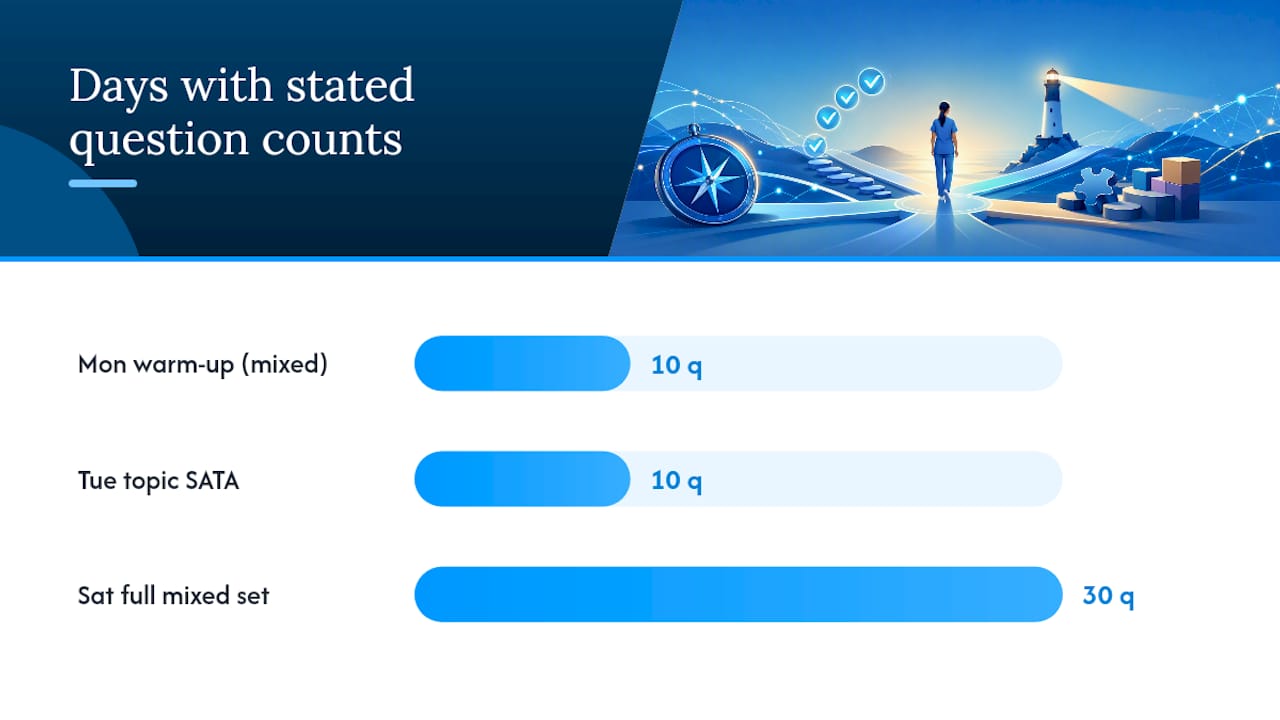
Track three numbers weekly: your accuracy percentage on SATA-only blocks, your average time per SATA item, and a running tally of which error type keeps showing up (misread stem, overselection, missed priority language). That third metric matters more than raw accuracy alone, because it tells you exactly which habit from the mistakes list above still needs work.
Aim for a substantial number of SATA-specific questions across your first two weeks before shifting most of your volume to mixed blocks that mirror actual exam pacing. Increase complexity once your SATA-only accuracy holds steady above your personal target for three consecutive sessions, not before. Going to harder, more ambiguous items too early just reinforces guessing habits instead of clean reasoning.
Why I Trust This Method Over Shortcuts
I've spent a good chunk of my time working on RecallOS's exam content, building and refining questions against real NCLEX blueprints alongside practicing nurses, and the pattern is consistent across thousands of student attempts: the students who treat SATA as a series of true/false judgments outperform the ones hunting for a "trick" to the format. There isn't one. The format rewards clean, repeatable reasoning more than any shortcut ever will.
What surprises most students is how fast this improves once they stop trying to out-clever the question and just apply the checklist, item after item, without exception. Confidence on SATA doesn't come from a lucky streak. It comes from doing the boring, repeatable version of this correctly enough times that it stops feeling boring and starts feeling automatic.
Keep your practice measurable, keep it daily, and let the numbers, not your gut feeling, tell you when you're ready.
How RecallOS Fits Into Your SATA Practice Plan
You don't need generic trivia. You need daily reps on the exact question type that's costing you points, and that's precisely where an adaptive tool earns its place in your routine. RecallOS builds daily practice around your specific weak areas instead of serving you the same random mix everyone else gets, which matters most on a format like SATA where the errors tend to repeat until they're specifically targeted.
The adaptive quiz examples show how a focused SATA block adjusts in real time based on which option types trip you up, whether that's overselecting, missing priority language, or misjudging population-specific norms. Instead of guessing which weak area to hit next, the platform's exam prediction feature flags where your accuracy is lagging so your next study session targets that gap directly.
Slot RecallOS into the practice plan above by replacing your Tuesday and Friday focused blocks with an adaptive SATA session tied to your tracked error type. Streaks and progress metrics give you the same weekly numbers this article recommends tracking, without a separate spreadsheet. Built by practicing nurses and CRNAs against real exam blueprints, it's designed for exactly the kind of measurable, repeatable practice that turns SATA from your weakest format into one of your strongest. Try a free session and see where your current weak spots actually are.
Frequently Asked Questions
How many options are usually correct on a SATA question? There's no fixed number. It can range from two correct answers out of five to five out of six, which is exactly why grouping or pattern-based guessing fails. Evaluate each option on its own clinical merit rather than assuming a typical count.
Is there partial credit for select-all-that-apply questions? Don't study assuming partial credit exists. The safest approach, and the one supported by NCSBN's own scoring guidance, is to treat every option as fully consequential to the item's outcome.
What's the biggest difference between SATA and single-answer strategy? Single-answer strategy often involves picking the "best" choice among several reasonable ones. SATA strategy requires judging each option independently as true or false for the specific client in the stem, with no comparison between choices needed.
How much time should I spend on each SATA question during practice? Aim for roughly 90 seconds to two minutes per item, slightly more than a single-answer question, since you're evaluating multiple discrete claims. If you're consistently running over during practice, that's a signal to slow down your rationale review rather than your live test pace.
How many practice questions do I need before I feel confident with SATA? There's no universal number, but a reasonable target is 100 to 150 SATA-specific questions in your first two weeks of focused practice, shifting to mixed blocks once your accuracy on SATA-only sets is holding steady.
Should I change my answer if I second-guess myself on a SATA item? Only if your recheck reveals a genuine clinical reason to change an option, like realizing a finding is population-specific or noticing you missed a pivot word in the stem. Second-guessing without a specific reason usually hurts more than it helps.