
What is the teach-back method?
The teach-back method is a communication technique where healthcare providers ask patients to explain medical information back in their own words. The goal is not to test whether the patient remembered correctly. It is to verify whether you explained it clearly enough.
That distinction matters more than most clinicians realize. When a patient cannot explain their discharge instructions, the problem is rarely their memory. It is almost always the explanation. Teach-back makes that visible, which is exactly why the Agency for Healthcare Research and Quality (AHRQ) and the National Quality Forum both endorse it as a cornerstone evidence-based health literacy intervention.
Here is what the method does in practice:
- Confirms patient understanding before they leave the clinical encounter
- Identifies gaps in provider communication, not patient intelligence
- Supports medication adherence, safe self-management, and follow-through on care plans
- Reduces preventable readmissions and complications from misunderstood instructions
- Applies across every care setting: primary care, hospital discharge, specialty clinics, and telehealth
Used correctly, teach-back adds only 1–2 minutes to a patient encounter. That is a small investment for what it prevents.
Table of Contents
- How to implement the teach-back method effectively
- Why the evidence behind teach-back is hard to ignore
- How teach-back applies to nursing education and exam prep
- Real-world examples of teach-back in action
- Tailoring teach-back for diverse patient populations
- How to measure whether your teach-back interactions are working
- Key Takeaways
- Why teach-back is worth the discomfort of changing your habits
How to implement the teach-back method effectively
The mechanics are straightforward, but the execution takes deliberate practice. Here is how to build it into your clinical workflow without it feeling forced or adding friction.
Start with the right framing. Before asking a patient to explain anything back, set the tone. AHRQ recommends framing the ask around your own clarity, not the patient's recall. Something like: "I want to make sure I explained this well. Can you tell me in your own words what you'll do when you get home?" That single shift reduces patient anxiety and increases willingness to participate.
Use the chunk-and-check technique. Do not wait until the end of a long explanation to ask for teach-back. Break information into small segments and check understanding after each one. The chunk-and-check approach prevents cognitive overload and catches confusion before it compounds. Cover one concept, ask for teach-back, clarify if needed, then move to the next.

Ask open-ended questions only. Closed questions like "Do you understand?" invite a reflexive "yes" that tells you nothing. Open-ended questions like "What will you tell your family about your new medication?" require the patient to actually retrieve and organize the information. Open-ended questions are what separate genuine comprehension from the "parrot effect," where patients repeat your exact words without real understanding.
Add the show-me method for procedural tasks. For anything hands-on, such as insulin injection technique, inhaler use, or wound care, verbal teach-back is not enough. Ask the patient to demonstrate the task. Watching someone perform a skill reveals gaps that a verbal explanation never would.
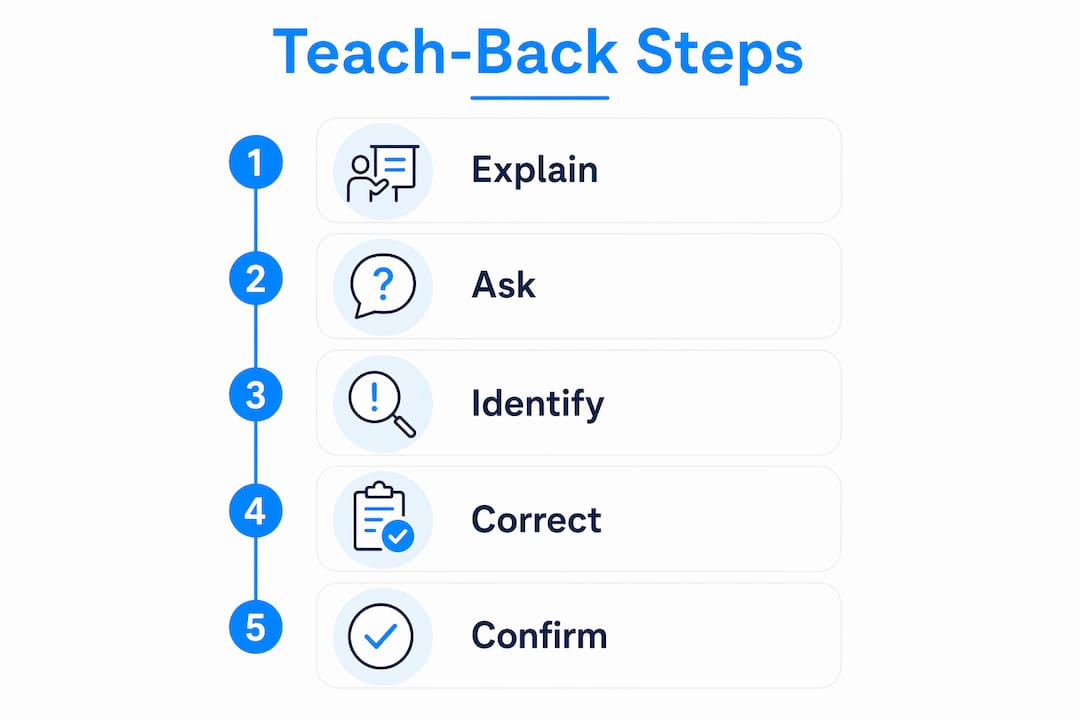
Iterate until understanding is confirmed. Teach-back is a loop, not a one-time check. Explain, ask, listen, clarify, and ask again. If a patient's teach-back reveals a gap, that is not a failure. It is the method working exactly as intended.
Common barriers and how to get past them:
- "It takes too long." Starting with one patient per shift builds the habit without disrupting flow. AHRQ's Quick Start Guide specifically recommends starting small to ease adoption.
- "Patients feel embarrassed." The provider-responsibility framing above solves this almost entirely.
- "I don't know how to respond when teach-back fails." Treat it as useful data. Reframe your explanation using simpler language, a visual, or an analogy, then ask again.
Pro Tip: Never ask "Did you understand?" at the end of a teach-back session. Instead, close with "What questions do you still have?" That phrasing assumes there are questions, which makes patients far more likely to voice real concerns.
Why the evidence behind teach-back is hard to ignore
The outcomes data for this technique is consistent across clinical settings and patient populations. Teach-back has demonstrated improved medication adherence, better health outcomes, reduced readmission rates, and enhanced patient satisfaction. Teach-back has demonstrated benefits including improved medication adherence, better health outcomes, reduced readmission rates, and enhanced patient satisfaction.
Key finding: Teach-back reduces patient misunderstandings that cause repeat visits, complications, and medication errors, which ultimately saves clinicians time in the long run.
Beyond individual patient encounters, the organizational benefits are substantial. Organizations that adopt teach-back see improvements in risk management and cost-efficiency, two metrics that hospital administrators and quality officers pay close attention to. Fewer misunderstandings mean fewer adverse events, fewer liability exposures, and lower costs tied to preventable readmissions.
Patient satisfaction scores also tend to rise. When patients feel genuinely heard and understood, their experience of care improves. Teach-back is one of the few communication interventions that simultaneously improves clinical outcomes and patient experience metrics.
How teach-back applies to nursing education and exam prep
The logic of teach-back does not stop at the bedside. It transfers directly into how healthcare students learn and how educators should teach.
When a nursing instructor explains a pharmacology concept and then asks a student to restate it in their own words, that is teach-back in an educational context. The feedback loop is identical: explain, verify, clarify, reassess. Students who engage with material this way retain it more deeply than those who passively read or highlight.
This matters for exam readiness in a specific way. NCLEX questions are not testing recall of memorized facts. They test whether you can apply a concept to a clinical scenario you have never seen before. That requires genuine understanding, not surface-level familiarity. Teach-back, as a learning strategy, builds exactly the kind of understanding NCLEX rewards.
Here is how to apply teach-back principles to your own study practice:
- After reading a concept, close the book and explain it aloud as if you were teaching a patient
- If you stumble, that is your gap. Go back, re-read, and try again
- Use practice questions not just to test recall but to identify where your explanation breaks down
- Ask a study partner to teach-back a concept to you, then correct and refine together
Teaching the teach-back method in healthcare education enhances student comprehension, retention, and exam readiness. Recallos applies this principle directly: its adaptive question engine identifies weak areas and routes you back to them, mimicking the clarify-and-reassess loop that makes teach-back effective clinically. The exam prediction tools surface the concepts most likely to appear on your next exam, so your study time targets real gaps rather than comfortable material.
Pro Tip: Before an OSCE or clinical skills assessment, practice by teaching the procedure to a peer and asking them to teach it back to you. The gaps in their explanation will reveal the gaps in yours.
Real-world examples of teach-back in action
Discharge after heart failure hospitalization. A nurse explains fluid restriction and daily weight monitoring to a patient being discharged. Instead of handing over a printed sheet and asking if there are questions, she says: "Before you go, can you walk me through what you'll do if your weight goes up by more than two pounds overnight?" The patient initially describes calling his doctor in the morning. The nurse clarifies that a two-pound overnight gain warrants a same-day call, not a wait-until-morning approach. That correction, caught through teach-back, likely prevented a readmission.
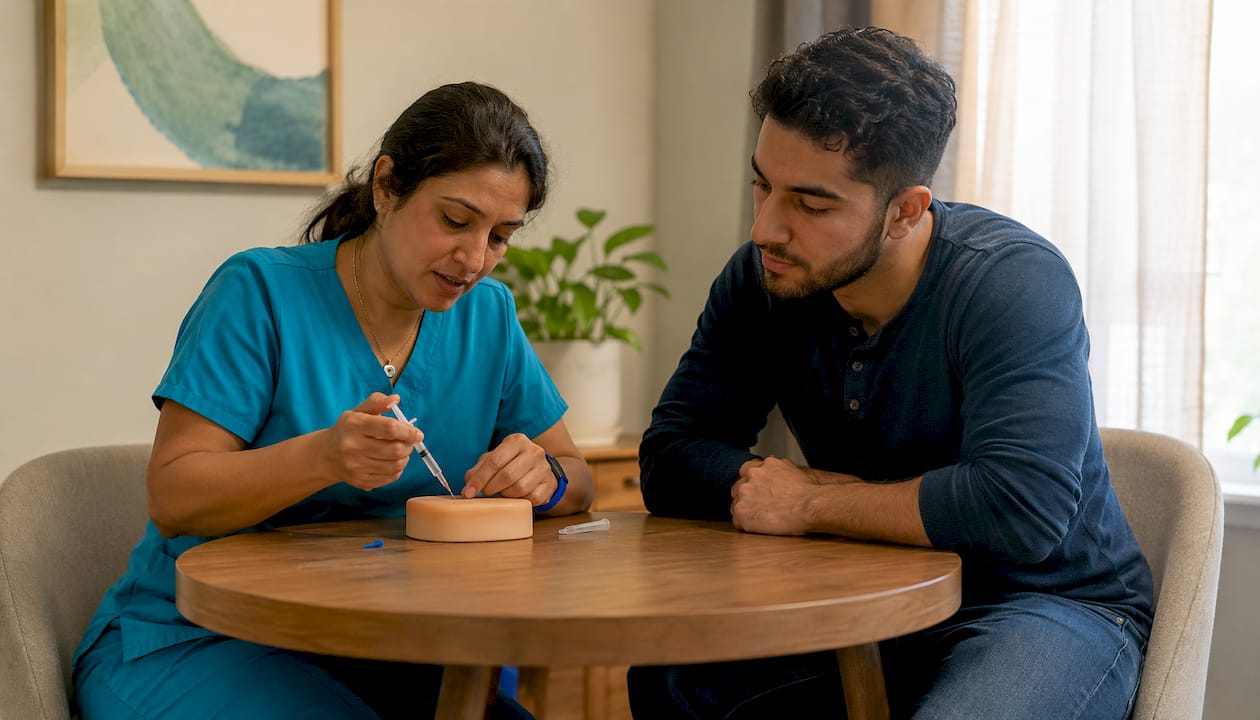
Insulin self-injection in a newly diagnosed diabetic. A diabetes educator demonstrates subcutaneous injection technique, then asks the patient to demonstrate it back. The patient holds the syringe at the wrong angle. Without the show-me component, that error would have gone home with him. The educator corrects the technique on the spot, and the patient leaves with a skill he can actually perform safely.
Pediatric medication dosing. A pediatric nurse explains acetaminophen dosing to a parent based on the child's weight. She then asks: "Just so I know we're on the same page, how much would you give and how often?" The parent's answer reveals she was planning to use a teaspoon measure from her kitchen drawer rather than the calibrated syringe provided. A simple clarification prevents a dosing error.
Each of these examples follows the same structure: explain, ask for teach-back, identify the gap, correct it, and confirm. The clinical context changes; the method does not.
Tailoring teach-back for diverse patient populations
A one-size approach does not hold up across the range of patients you will encounter. Literacy levels, language backgrounds, cultural communication norms, and health anxiety all shape how teach-back needs to be delivered.
For patients with low health literacy, plain language is non-negotiable. Avoid medical jargon entirely. Use short sentences, common words, and concrete examples. The show-me method is especially valuable here because it bypasses verbal complexity and confirms understanding through action. Visual aids, diagrams, and written summaries in large print reinforce what was said.
For patients with limited English proficiency, work with a qualified medical interpreter, not a family member who happens to speak the language. Ask the interpreter to convey your teach-back question directly, and listen for the patient's own words rather than a summary. Be aware that some languages have no direct equivalent for certain medical concepts, so the interpreter may need to paraphrase. Confirm understanding through demonstration whenever possible.
For older adults, cognitive load is a real consideration. Keep each chunk small. Repeat key points without making the patient feel patronized. Involve a family caregiver in the teach-back when the patient consents, since caregivers often manage medications and follow-up appointments at home.
For patients who seem reluctant to engage, the provider-responsibility framing is your best tool. Emphasize that their feedback helps you do your job better. Some patients, particularly those from communities with historical mistrust of healthcare systems, may need more time and a warmer relational approach before they feel safe enough to say "I don't understand."
Personalized education approaches, similar to what personalized education plans use in academic settings, recognize that no two learners process information the same way. The same principle applies at the bedside.
How to measure whether your teach-back interactions are working
Knowing the technique is one thing. Knowing whether it is actually improving your practice is another.
At the individual encounter level, the most direct measure is whether the patient's teach-back reveals a gap that you then correct. Track this informally: how often does your first explanation require clarification? If the answer is rarely, either your explanations are genuinely clear or your teach-back questions are too easy. Push toward more specific, open-ended prompts and see what surfaces.
At the practice or unit level, AHRQ offers the Conviction and Confidence Scale, a self-assessment tool that helps clinicians evaluate their own comfort and skill with teach-back. Periodic use of the "Are You Using Teach-Back?" survey across a clinical team gives leadership a baseline and tracks adoption over time.
Outcome metrics worth monitoring include 30-day readmission rates for conditions where discharge education is a known factor, medication error rates, and patient satisfaction scores on communication-related items. These are not teach-back-specific metrics, but consistent improvement in them after a teach-back initiative is a meaningful signal.
Peer observation is underused and highly effective. Having a colleague observe a teach-back interaction and provide structured feedback catches habits, such as leading questions or rushed explanations, that self-assessment misses. Practice questions that accelerate learning work on the same principle: external feedback reveals what internal review cannot.
Key Takeaways
The teach-back method works because it shifts the burden of clarity from the patient to the provider, and that shift is what actually improves outcomes.
| Point | Details |
|---|---|
| Teach-back verifies understanding | Patients explain information in their own words, confirming the provider's explanation was clear. |
| It adds only 1–2 minutes | Used correctly, teach-back adds only 1–2 minutes to a patient encounter. |
| Open-ended questions are required | Closed questions like "Do you understand?" produce reflexive agreement, not real comprehension. |
| Outcomes improve measurably | Evidence links teach-back to better medication adherence, reduced readmissions, and higher patient satisfaction. |
| It applies to education too | Nursing students who use teach-back as a study strategy build the applied understanding NCLEX demands. |
Why teach-back is worth the discomfort of changing your habits
There is a version of this conversation that most clinical educators skip: the part where teach-back feels awkward before it feels natural. New adopters often report that the first few attempts feel scripted, that patients look surprised, or that the whole thing slows them down in ways that feel unsustainable. That experience is real, and pretending otherwise does not help anyone.
What actually happens over time is that the technique becomes invisible. The framing becomes second nature. The open-ended question stops feeling like a script and starts feeling like how you talk. And the moments when teach-back catches a genuine misunderstanding, which happen more often than most clinicians expect, stop feeling like extra work and start feeling like the whole point of the encounter.
The deeper value of teach-back is what it does to your self-awareness as a communicator. Every time a patient's teach-back reveals a gap, you learn something about how you explained it. That feedback loop, applied consistently, makes you a better clinician in ways that extend well beyond any single patient interaction. The National Quality Forum frames it this way: effective teach-back requires provider self-reflection on communication clarity, turning it into a tool for professional growth.
For nursing students, the parallel is direct. The habits you build now, including how you explain, how you check understanding, and how you respond when comprehension fails, are the habits you will carry into practice. Starting with teach-back as a study strategy, not just a clinical skill, builds both simultaneously.
Institutional support matters too. Units that designate a teach-back champion, build it into orientation, and share success stories create the conditions where adoption actually sticks. Individual motivation gets you started. Culture keeps it going.