
The TEAS 7 and HESI A2 are the two primary nursing school entrance exams used by programs across the United States, and knowing which one your school requires changes everything about how you prepare. The TEAS 7, developed by ATI, is a standardized exam with strict sectional time limits. The HESI A2, published by Elsevier, is modular and customizable, meaning each nursing program selects which sections it requires. Mastering the teas hesi distinction early is the single most important step you can take before opening a single study guide.
1. Confirm your program's exact exam requirements first
The choice of exam is dictated by your nursing program, so verify requirements early before you study anything. This sounds obvious, but most students skip it and pay for it later. Some programs require TEAS 7. Others require HESI A2. A few require both.
For HESI A2, the stakes of skipping this step are especially high. Students waste time studying all possible HESI sections rather than the specific modules their program requires. That is the single biggest efficiency mistake in HESI preparation. Call the admissions office, check the program website, and write down exactly which sections are required before you build your study plan.

2. Understand the score benchmarks for each exam
Score expectations differ between the two exams. Many nursing programs require a minimum composite score of 75%+ on the HESI A2 for admission, with some programs requiring 75–80%+ per individual section. TEAS 7 composite benchmarks typically fall in the 60–75%+ range depending on the school. Knowing your target score before you start studying gives you a concrete finish line.
These benchmarks also tell you how much margin you have. A program requiring 80% on every HESI section leaves almost no room for weak spots. A program accepting a 62% TEAS composite gives you more flexibility. Use that information to calibrate how deeply you need to study each content area.
3. Use official practice materials from ATI and Elsevier
Official practice tests from ATI and Elsevier best simulate real exam conditions and question formats. No third-party resource replicates the exact interface, question style, or difficulty calibration of the actual exams. ATI sells official TEAS practice tests directly on its website. Elsevier offers HESI practice exams through its Evolve platform.
Start with at least one official practice test before you do anything else. Your score on that first test is your baseline. It tells you which content areas need the most work and which ones you can maintain with lighter review. Skipping this step means you are studying blind.
Pro Tip: Buy the official practice test before you buy any prep book. Your diagnostic score is worth more than any study guide's table of contents.
4. Master the science content for TEAS 7
Science is where many students underestimate TEAS 7. TEAS covers anatomy, physiology, biology, chemistry, and scientific reasoning in a single 50-question Science section with a 60-minute time limit. That is a wide range of content under serious time pressure. HESI, by contrast, splits these subjects into separate modules, which lets you focus on one topic at a time.
For TEAS 7, you cannot afford to be weak in any science subdomain. Anatomy and physiology typically carry the most weight, but chemistry and biology questions appear regularly. Build a study schedule that rotates through all science topics weekly rather than spending two weeks on A&P and ignoring chemistry.
5. Apply active recall and spaced repetition for vocabulary
Adaptive quiz approaches and spaced repetition greatly enhance retention of vocabulary and science content for both exams. This is especially true for the HESI A2 Vocabulary section, which tests medical terminology that most pre-nursing students have never seen before. Flashcards work, but only if you use them with spaced repetition, meaning you review cards at increasing intervals based on how well you know them.
Active recall means testing yourself before you feel ready. Reading notes is passive. Closing the book and writing down everything you remember is active recall. The discomfort of not knowing an answer during practice is exactly what builds long-term memory. Tools that quiz you adaptively, adjusting difficulty based on your performance, replicate this effect automatically.
Pro Tip: Use a spaced repetition system for HESI vocabulary starting at least six weeks before your exam date. Medical terms require multiple exposures over time, not one cramming session.
6. Adapt your time management strategy to each exam's format
TEAS 7 enforces strict sectional time limits, while HESI A2 often allows flexible pacing within the total exam duration. That difference changes how you practice. For TEAS, you need to train yourself to move at a fixed pace per question and per section. For HESI, you can redistribute time across the exam if one section takes longer than expected.
Here is how to build pacing skills for each exam:
- Time yourself on every practice session. Never do practice questions without a timer running.
- Calculate your per-question time budget. For TEAS Science, that is roughly 72 seconds per question.
- Practice flagging and moving on. Spending four minutes on one question destroys your section score.
- Run at least two full-length timed mock exams before test day. Stamina matters as much as content knowledge.
- For HESI, practice allocating extra time to your weakest module rather than spending equal time on every section.
Pro Tip: Set a phone timer for each section during practice. The physical act of watching time run down trains your brain to pace itself under real exam pressure.
7. Prioritize the HESI vocabulary section
Most students focus entirely on math and science and treat the HESI Vocabulary section as an afterthought. That is a mistake. The Vocabulary section tests medical and anatomical terms that appear nowhere in standard high school curricula. A weak vocabulary score can pull your composite below the program's minimum even if your science and math scores are strong.
Build a dedicated vocabulary list from HESI-specific prep materials. Focus on prefixes, suffixes, and root words. Knowing that "brady" means slow and "tachy" means fast lets you decode dozens of terms you have never seen before. That pattern recognition is faster to build than memorizing individual words one by one.
8. Review rationales after every practice question
Practice tests with immediate feedback and rationale review deepen understanding beyond memorization and improve critical thinking for all question formats. Reading the explanation for every question, including the ones you got right, is the highest-value activity in exam prep. You may have gotten a question right for the wrong reason. The rationale tells you why the correct answer is correct and why the wrong answers are wrong.
This matters especially for TEAS 7's "Select All That Apply" questions. These questions have no partial credit and require you to understand the underlying concept, not just recognize a correct-sounding answer. Rationale review builds the conceptual understanding that multiple-select questions demand.
Pro Tip: Keep a running error log. Write down every question you missed, the correct answer, and the reason you got it wrong. Review that log the week before your exam.
9. Know the retake policies before you test
Most nursing schools allow multiple attempts for both exams but enforce waiting periods, such as 14 days for TEAS and 30 or more days for HESI, and limit attempts per year. Not knowing these rules before you sit for the exam is a serious planning risk. If you fail and need to retake quickly, a 30-day waiting period can push your application past a program's deadline.
Check your program's specific retake policy, not just the testing company's general policy. Some programs limit you to two or three total attempts regardless of the testing company's rules. Score validity also varies. Some programs only accept scores from the past two years. Confirm both the attempt limit and the score expiration date before you register.
10. Prepare for both exams simultaneously if needed
Both TEAS and HESI are equally respected by admissions committees, so if you are applying to programs that require different exams, you need a plan for studying both. The good news is that the core content overlaps significantly. Math, reading comprehension, and basic science appear on both exams. You are not starting from scratch for each one.
Here is how to manage dual preparation without burning out:
- Identify the shared content first. Build your foundation in math and reading, which transfers directly to both exams.
- Schedule exam-specific modules separately. HESI vocabulary and TEAS science reasoning require targeted practice that does not overlap.
- Prioritize by deadline. Study hardest for whichever exam comes first, then shift focus.
- Use your NCLEX study habits as a model. The discipline that works for NCLEX prep transfers directly to entrance exam preparation.
Key Takeaways
Effective TEAS and HESI preparation requires confirming your program's exact requirements, targeting official practice materials, and building pacing skills specific to each exam's format.
| Point | Details |
|---|---|
| Confirm requirements first | Know which HESI modules or TEAS sections your program requires before studying anything. |
| Use official practice tests | ATI and Elsevier practice exams best simulate real conditions and question formats. |
| Target science and vocabulary | TEAS science breadth and HESI medical vocabulary are the most commonly underestimated sections. |
| Practice timed pacing | TEAS enforces strict sectional limits; train with a timer on every practice session. |
| Know retake rules early | Waiting periods of 14–30+ days can affect your application timeline if you need to retest. |
What I actually tell students who ask me where to start
Most prep advice treats TEAS and HESI as interchangeable. They are not. The students I see struggle most are the ones who bought a generic "nursing entrance exam" prep book and studied everything in it equally. That approach works fine for a standardized test with a fixed blueprint. It fails badly for HESI, where your program might only require four of the possible ten modules.
My honest recommendation is to treat your first official practice test as the most important study session you will ever do. Your diagnostic score tells you more than any prep book's chapter outline. It shows you exactly where your time will pay off. Students who skip the diagnostic and go straight to content review often spend weeks strengthening areas that were already fine while their real weak spots stay weak.
The other thing I push hard on is rationale review. Students who read every explanation, right or wrong, consistently outperform students who just track their score percentage. The rationale is where the actual learning happens. A correct answer without understanding is just luck you cannot replicate under pressure.
One more thing worth saying directly: test anxiety is a real performance factor, not an excuse. Students who practice under timed conditions regularly arrive at test day with a calmer baseline. The timer stops feeling like a threat when you have sat under it dozens of times already.
— Caleb
Recallos: built for focused nursing exam prep
Recallos is a study tool built specifically for nursing and healthcare students, developed by practicing nurses and CRNAs who know exactly what these exams demand.
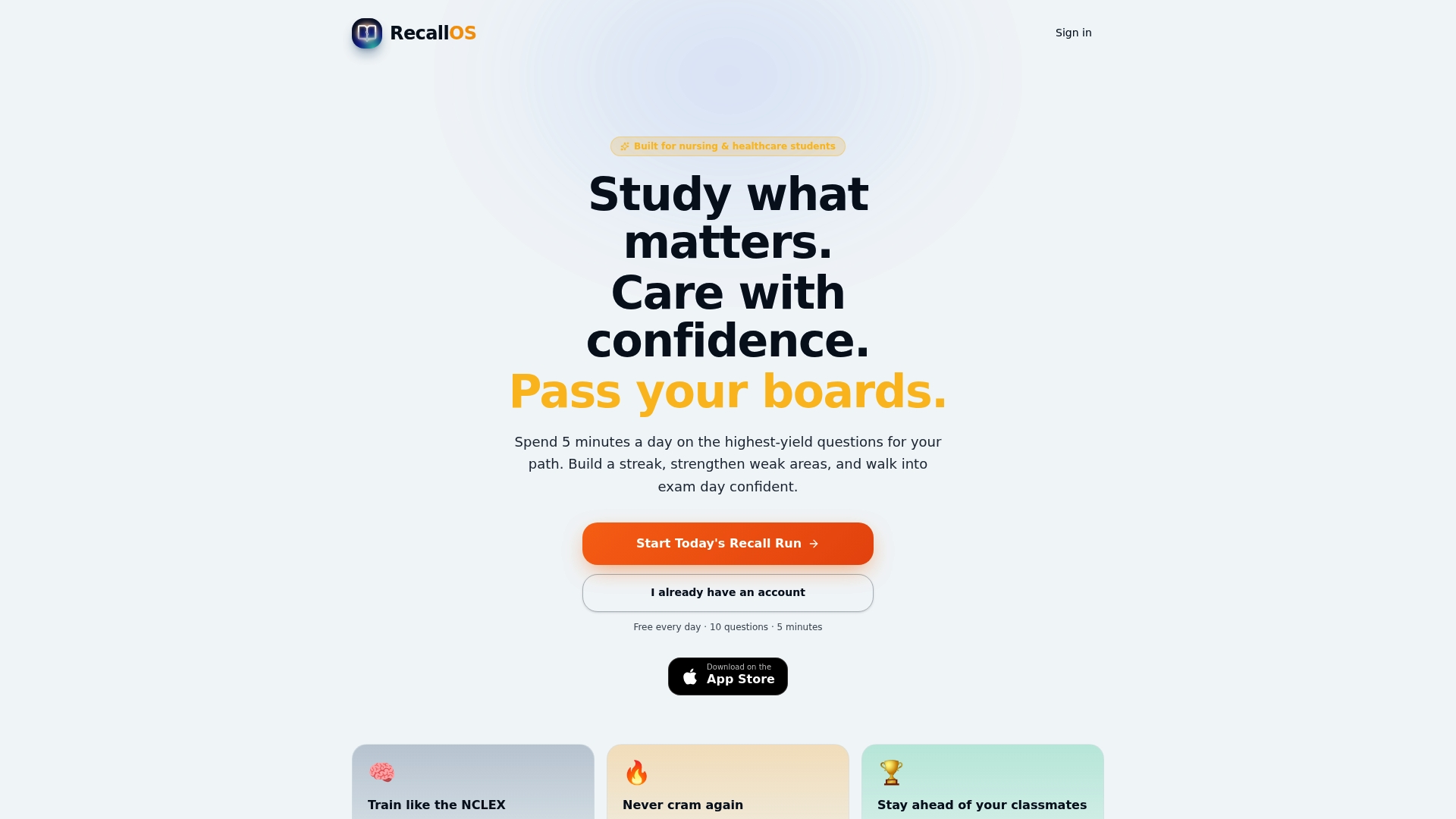
Recallos delivers adaptive quizzes that adjust to your weakest topics automatically, so you spend your study time where it actually moves your score. Features like Exam Predictions surface the content most likely to appear on your exam based on your performance patterns. Every question comes with a rationale, and your progress is tracked through streaks and rewards that keep daily practice consistent. If you are preparing for TEAS, HESI, or NCLEX, Recallos gives you a focused, personalized path from your current score to your target score.
FAQ
What is the difference between TEAS and HESI A2?
The TEAS 7, developed by ATI, is a standardized exam with fixed sections and strict time limits. The HESI A2, published by Elsevier, is modular, meaning each nursing program selects which sections it requires.
Which exam is harder, TEAS or HESI?
TEAS 7 is generally considered harder due to its strict sectional time limits and advanced question formats like "Select All That Apply." HESI difficulty varies based on which modules your program requires.
What score do I need to pass the HESI A2?
Many programs require 75–80%+ per section on the HESI A2. Check your specific program's requirements, as minimums vary by school.
How many times can I retake the TEAS or HESI?
Most schools allow multiple attempts but enforce waiting periods of 14 days for TEAS and 30 or more days for HESI, with annual attempt limits. Confirm your program's specific policy before registering.
Should I use official prep materials or third-party books?
Official practice materials from ATI and Elsevier best replicate real exam conditions. Use them as your primary resource, and supplement with third-party materials only for content areas where you need extra depth.