
What are therapeutic communication techniques?
Therapeutic communication is a purposeful interpersonal process using verbal and nonverbal methods to support patient well-being and encourage active participation in care. Unlike casual conversation, every exchange has a clinical intention: to help the patient feel heard, reduce distress, and move toward better health outcomes. The concept traces back to Florence Nightingale, who insisted that trusting nurse-patient relationships were themselves a form of healing.
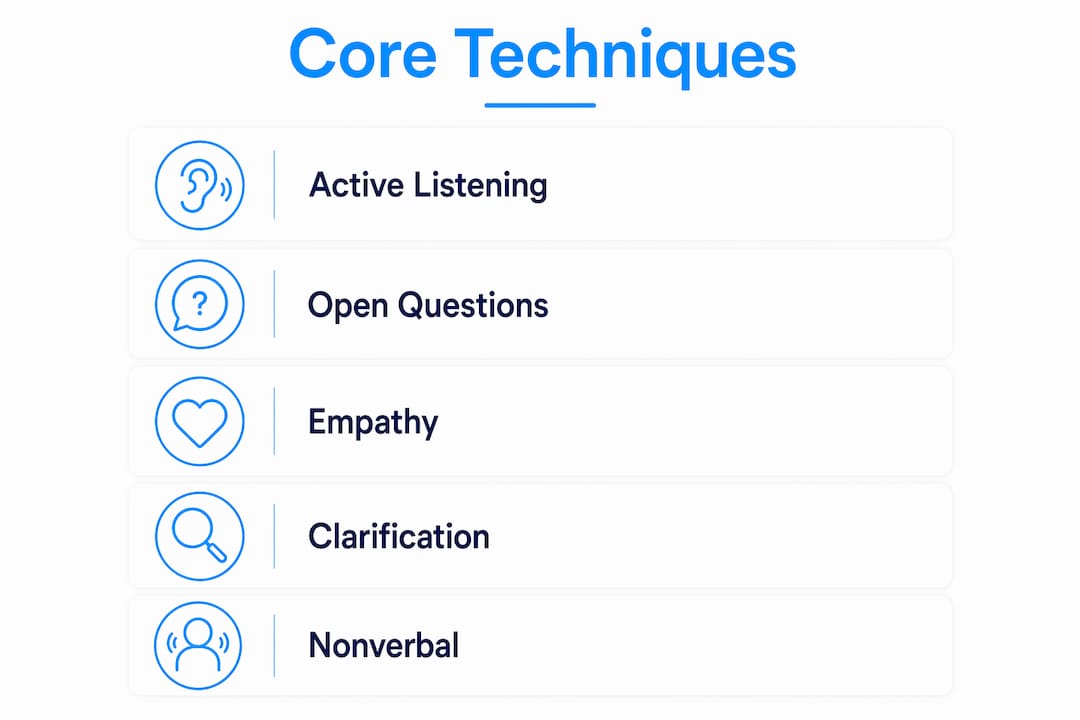
The core techniques nurses rely on include:
- Active listening: Communicating genuine interest through verbal cues ("I see," "go on") and nonverbal signals like nodding, maintaining appropriate eye contact, and an open posture.
- Providing silence: Deliberately pausing to give patients space to process thoughts, gather courage to share, or simply feel less rushed.
- Open-ended questions: Prompts like "Tell me what's been on your mind" that invite patients to direct the conversation rather than answer yes or no.
- Clarification: Asking patients to expand on ambiguous statements so the nurse understands exactly what is being communicated.
- Paraphrasing: Restating the patient's words in slightly different language to confirm understanding and signal that the nurse is truly listening.
- Acceptance: Acknowledging what a patient has said without judgment, which is not the same as agreement. A simple "Yes, I hear you" can be enough.
- Nonverbal communication cues: Body language, facial expressions, proximity, and touch all carry meaning that either reinforces or undermines spoken words.
Together, these methods build the trust that makes honest dialogue possible. Patients who feel genuinely heard are more likely to share symptoms accurately, follow treatment plans, and engage as partners in their own care.
Why does therapeutic communication matter in patient care?
The purpose of therapeutic communication is to facilitate emotional support, promote patient autonomy, and improve clinical outcomes. It is not a soft skill layered on top of "real" nursing work. It is the mechanism through which nurses gather accurate histories, identify hidden concerns, and help patients make informed decisions about their care.
Empathy sits at the center of this. Communicating with empathy and unconditional positive regard has been shown to improve patient healing, reduce symptoms of depression, and decrease medical errors. That last point tends to surprise people. Errors often trace back to incomplete or misunderstood information, and patients who feel dismissed are less likely to correct a misunderstanding or volunteer a critical detail.
The goals of therapeutic communication go beyond a single conversation. They include promoting honest dialogue, recognizing and validating patient feelings, supporting the patient's own problem-solving rather than directing decisions, and building the kind of rapport that sustains a therapeutic relationship across multiple encounters. Nurses who communicate therapeutically also help patients identify their own coping strategies and set realistic care goals, which supports long-term adherence.
Pro Tip: Tailor your approach to each patient. Age, literacy level, cultural background, and emotional state all shape how a person receives information. What feels warm and reassuring to one patient may feel intrusive to another. Adjust your pace, vocabulary, and physical proximity accordingly.
What are the core techniques, with clinical examples?
The techniques of therapeutic communication described in the American Nurse, the official journal of the American Nurses Association, cover a wide range of verbal and nonverbal approaches. Here is how each one works in practice.
Verbal techniques
- Active listening: A patient says, "I don't know if I can handle this diagnosis." The nurse maintains eye contact, leans slightly forward, and responds, "What happened next?" rather than immediately offering reassurance. The feedback loop, where the nurse restates and verifies the patient's message, is what separates active from passive listening.
- Open-ended questions / broad openings: "What's been weighing on you most today?" opens the floor. The patient decides what matters, not the nurse.
- Clarification: Patient: "I feel useless to everyone." Nurse: "Can you give me an example of a time you felt that way?" This prevents the nurse from assuming and helps the patient articulate something they may not have fully formed yet.
- Focusing: A patient mentions almost in passing that they are scared to go home. The nurse picks it up: "You said you're anxious about going home. Tell me more about that." Patients do not always know which detail is clinically significant.
- Paraphrasing: Patient: "I've been way too busy today." Nurse: "Participating in physical and occupational therapy has kept you busy." It confirms understanding without parroting words back verbatim.
- Restating: Patient: "The nurses hate me here." Nurse: "You feel as though the nurses dislike you?" The slight reframe invites the patient to reflect rather than defend.
- Summarizing: After a longer exchange, the nurse recaps the key points and ends with "Does that sound right?" This gives the patient explicit permission to correct anything.
- Offering hope: "I remember you told me how well you coped with difficult situations before." This is grounded in the patient's own history, not a generic "You'll be fine," which is false reassurance and actively damages trust.
- Offering humor: Used carefully and calibrated to the patient's own sense of humor, a light moment can reduce tension and build connection. The key word is calibrated.
- Confronting: Reserved for the working phase after trust is established. If a patient says they "barely drink" but previously described blacking out every weekend, the nurse can gently present that inconsistency. Confrontation done too early or too bluntly destroys rapport.
Nonverbal techniques
The SOLER mnemonic gives nurses a practical framework for nonverbal active listening: Sit squarely, Open posture, Lean forward, Eye contact, Relax. Each element signals presence and engagement without a single word spoken.

Therapeutic touch, such as holding a patient's hand during a painful procedure, communicates care powerfully. However, cultural beliefs, trauma history, and individual preference all affect whether touch is welcome. Always read the patient's response and adjust.
One important nuance: for patients with psychotic disorders or paranoia, sustained eye contact and close physical proximity can feel threatening rather than reassuring. In those situations, a moderate distance and a right-angle seating arrangement often work better than the standard SOLER setup.
How do you apply these techniques in real clinical settings?
Knowing a technique and using it under pressure are two different things. Clinical settings introduce noise, time constraints, and patients who are frightened, angry, or cognitively impaired. The following practical steps help bridge that gap.
- Set a clear goal before the conversation. Decide whether you are gathering history, providing education, or offering emotional support. The goal shapes which techniques you reach for first.
- Monitor your own nonverbal behavior. Checking your watch, crossing your arms, or angling your body toward the door all communicate disengagement, even if your words say otherwise.
- Avoid nontherapeutic responses. False reassurance, unsolicited advice, and "why" questions are the most common pitfalls. Telling a patient "everything will be fine" shuts down honest communication. Asking "Why didn't you take your medication?" puts them on the defensive. The goal is to elicit the patient's own thinking, not to direct it.
- Replace medical jargon with plain language. "Your myocardial infarction risk is elevated" lands differently than "Your heart is under a lot of stress right now." Match vocabulary to the patient's education level and adjust based on their responses.
- Use motivational interviewing for behavior change. Motivational interviewing is a specific communication skill that explores a patient's personal motivation for changing a behavior, using reflective listening and empathy rather than persuasion. It works particularly well for patients who are ambivalent, those who say "I want to quit smoking, but..." The word "but" is the opening. What follows it is the real conversation.
- Adapt for diverse patients. Cultural sensitivity is not a checklist item. It means genuinely attending to how a patient's values, beliefs, and communication norms shape what they say and what they leave unsaid. For patients with language differences, trained medical interpreters are required for important clinical conversations. Family members should not serve as translators, because medical terms may not translate accurately and sensitive information may be withheld.
- Manage escalation with de-escalation techniques. For agitated or aggressive patients, verbal de-escalation overlaps heavily with standard therapeutic techniques: calm tone, open body language, moderate distance, and awareness of exits. The goal is to balance provider safety with patient comfort, not to win an argument.
For patients with psychosis, the most useful approach is to understand what the experience means to the patient rather than debating whether it is real. Active listening for the patient's feelings about their beliefs, and validating the distress those experiences cause, keeps the conversation open. Challenging delusions directly tends to entrench them.
What do expert guidelines say about therapeutic communication?
Therapeutic communication is not a rigid script. It is a flexible set of guidelines tailored to each patient's unique needs, culture, and clinical condition. That flexibility is what makes it applicable across every specialty and care setting.
The Interprofessional Education Collaborative (IPEC), developed in partnership with the American Association of Colleges of Nursing, the American Association of Colleges of Osteopathic Medicine, the American Association of Colleges of Pharmacy, the American Dental Education Association, the Association of American Medical Colleges, and the Association of Schools of Public Health, published expert consensus guidelines on interprofessional collaborative practice. Those guidelines identify active listening, openness, and self-awareness as critical competencies for effective communication and collaboration across care teams.
The interprofessional dimension matters more than it might seem. When two treating professionals fail to communicate with each other, patient treatment satisfaction drops measurably. Patients also sometimes split care teams into "good" and "bad" providers, a dynamic that consistent, unified messaging from all team members can prevent. Tools like SBAR (Situation, Background, Assessment, Recommendation) and TeamSTEPPS give teams structured formats for sharing information efficiently without losing the compassionate tone that therapeutic communication requires.
For nurses specifically, the American Nurses Association has long recognized therapeutic communication as one of the most vital elements in nursing practice. The working phase of the nurse-patient relationship, where most clinical time is spent, depends entirely on the communication foundation built during the orientation phase. Nurses act as facilitators by using open-ended questions to help patients explore their feelings and set their own care goals, which supports autonomy rather than dependency.
The practical takeaway for challenging situations: in cases involving psychosis, agitation, or aggression, the same core principles apply, but the physical setup changes. Sitting at a right angle rather than directly facing the patient, maintaining a moderate distance, and keeping an awareness of exits all reduce the risk of escalation while preserving the therapeutic relationship.
Key Takeaways
Therapeutic communication techniques are the foundation of effective patient-centered care, combining specific verbal methods and deliberate nonverbal behaviors to build trust, reduce distress, and improve clinical outcomes.
| Point | Details |
|---|---|
| Core techniques are specific and learnable | Active listening, open-ended questions, paraphrasing, silence, and acceptance each serve a distinct clinical purpose. |
| Empathy reduces errors | Communicating with empathy and unconditional positive regard improves patient healing, reduces depression symptoms, and decreases medical errors. |
| Nonverbal behavior carries equal weight | The SOLER framework guides nurses in using body language to signal genuine engagement during patient interactions. |
| Nontherapeutic responses actively harm trust | False reassurance, unsolicited advice, and "why" questions shut down honest communication and should be avoided. |
| Interprofessional consistency matters | Unified, compassionate messaging across the entire care team prevents patient splitting and improves treatment satisfaction. |
Build your clinical communication skills with Recallos
Mastering therapeutic communication techniques takes more than reading about them. You need to practice applying them under exam conditions, recall the distinctions between techniques quickly, and recognize nontherapeutic responses before they appear on the NCLEX.
Recallos is built specifically for nursing and healthcare students preparing for exactly that. Developed by practicing nurses and CRNAs, the platform delivers high-yield daily questions aligned to real exam blueprints, with personalized review of the areas where you are weakest. You can upload your own notes and generate adaptive quizzes that target the gaps in your knowledge rather than covering ground you already own.
If therapeutic communication is a topic you want to lock in before exam day, Recallos gives you the repetition and feedback loop to do it.