
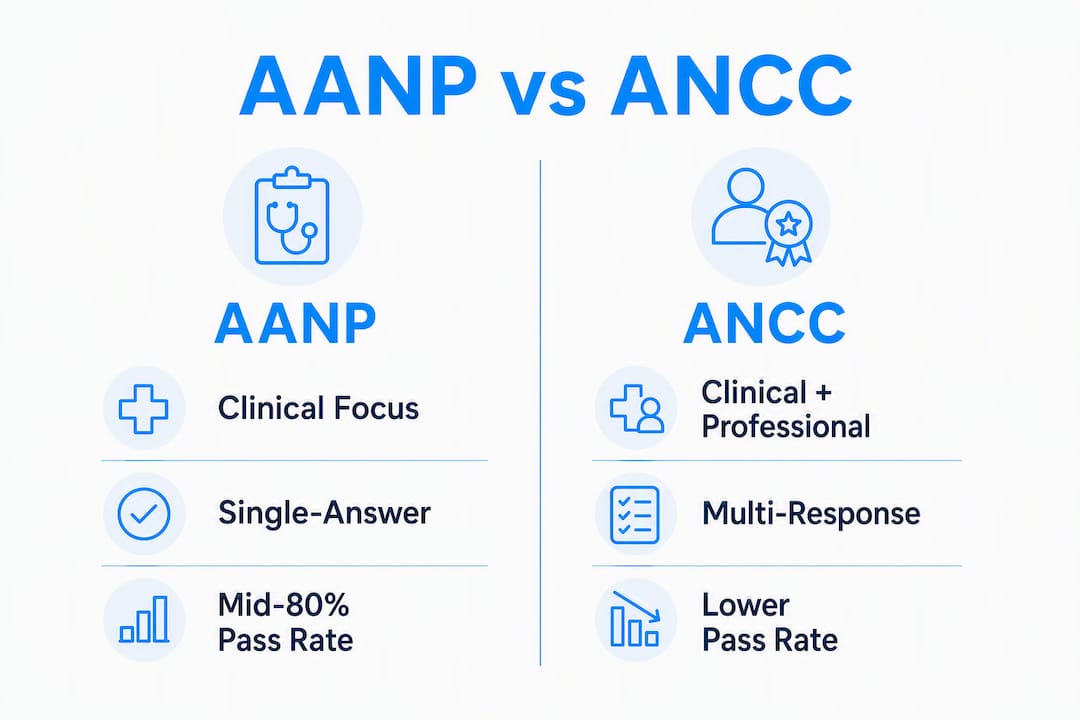
Choose the AANP exam if you want 100% clinical, single-answer multiple-choice testing. Choose the ANCC exam if you want a credential that folds in professional role, health policy, and mixed item formats. Both certifications are nationally recognized and accepted for NP licensure in all 50 U.S. states — so this decision is really about fit, not access.
Quick picks:
- Go AANP if you're a clinically focused graduate who thinks in differential diagnoses and wants a straightforward multiple-choice exam.
- Go ANCC if you're heading toward academic, federal, or leadership roles and can handle mixed item types like multiple-response and hotspot questions.
- Go dual if your target employer lists a preference or your specialty is only available through one board.
AANP first-time pass rates for FNP historically trend in the mid-80% range, while ANCC pass rates have been lower for some specialties (for example, 74% in a past period). Neither test is consistently easier than the other overall. That gap reflects format complexity as much as content difficulty. The official exam blueprints live at AANPCB and ANCC — read them before you register.
Table of Contents
- How do AANP and ANCC compare side by side?
- What does the AANP exam actually test?
- What does the ANCC exam actually test?
- How do you choose between AANP and ANCC?
- Exam logistics: the numbers you need to plan
- How do exam format differences change the way you study?
- Key Takeaways
- The experiment I'd run before registering
- Structured prep that maps to both exams
- Useful sources and where to verify official details
How do AANP and ANCC compare side by side?
The two exams cover overlapping clinical ground but diverge sharply on format, scope, and specialty availability.
| Dimension | AANP Certification Exam (AANPCB) | ANCC Certification Exam |
|---|---|---|
| Exam focus | 100% clinical: assessment, diagnosis, treatment, pharmacology | Clinical + professional role, policy, research, leadership |
| Question format | Single-answer multiple-choice only | Mixed: MCQ, multiple-response, hotspot, drag-and-drop |
| Total questions | 150 (135 scored, 15 pretest) | 175 (150 scored, 25 pretest) |
| Time limit | 3 hours | 3.5 hours |
| Scoring | Pass/Not Pass at test center | Scaled score (numerical) reported |
| Specialties offered | FNP-C, AGPCNP, ENP, PMHNP (AANPCB) | FNP-BC, AGACNP, AGPCNP, PMHNP (ANCC) |
| Unique specialty | Emergency Nurse Practitioner (ENP) | Adult-Gerontology Acute Care (AGACNP) |
| Employer notes | Widely accepted; strong in clinical/primary care settings | Preferred by some federal employers (e.g., VA) |
| Recertification | Every 5 years; CE-hour based | Every 5 years; CE-hours with pharmacology requirement |
150 vs. 175 questions. 3 hours vs. 3.5 hours. That extra half-hour and 25 questions on the ANCC exam aren't just logistics — they reflect a broader content scope that demands a different kind of preparation.
The core takeaway: AANP keeps you in clinical territory the entire exam. ANCC asks you to shift gears between patient scenarios and systems-level reasoning. Which gear shift feels natural to you matters more than most candidates realize.

What does the AANP exam actually test?
The AANP Certification Board (AANPCB) builds its exams entirely around clinical competency. Every question is a patient scenario testing assessment, differential diagnosis, treatment planning, or pharmacology. There are no policy questions, no leadership theory items, no research methodology prompts.

Format and logistics: The AANP Certification Exam runs 150 total questions — 135 scored and 15 unscored pretest items you won't be able to identify. You get 3 hours. All items are traditional single-best-answer multiple-choice. You see your Pass/Not Pass result before you leave the test center.
Specialties available through AANPCB include:
- Family Nurse Practitioner Certification Exam (AANPCB) — the FNP-C credential, covering family and individual practice across the lifespan
- Adult-Gerontology Primary Care Nurse Practitioner Certification Exam (AANPCB) — the AGPCNP credential for primary care across the adult lifespan
- Emergency Nurse Practitioner Certification Exam (AANPCB) — the ENP credential, a specialty not widely available through other boards
- Psychiatric Mental Health Nurse Practitioner Certification Exam (AANPCB) — the PMHNP pathway through AANPCB
Pros for clinical-track candidates:
- Single item format means zero format-shift anxiety on test day
- Clinical reasoning maps directly to what you practiced in clinical rotations
- Immediate pass/fail result reduces post-exam uncertainty
- ENP specialty is a genuine differentiator for emergency-focused NPs
Cons to weigh:
- If your career path involves academic appointments, federal employment, or policy work, the credential's narrower scope may not signal what those employers want
- No numerical score means less feedback if you need to retake
Practical prep notes for AANP-style items:
- Practice in timed blocks of 50 clinical questions — the exam rewards pacing, not just accuracy.
- Drill differential diagnosis by organ system; AANPCB items often hinge on one distinguishing clinical feature.
- Pharmacology is heavily tested — know mechanism, contraindications, and monitoring parameters, not just drug names.
- Use the official AANPCB candidate handbooks to confirm the exact content blueprint for your specialty before building your study plan.
What does the ANCC exam actually test?
The ANCC (American Nurses Credentialing Center) takes a broader view of NP competency. Clinical judgment is still the majority of the exam, but ANCC explicitly weights professional role domains — health policy, research, evidence-based practice, and leadership. Candidates comfortable with systems-level thinking tend to find this framing familiar; those coming straight from intensive clinical rotations sometimes find the nonclinical items disorienting.
Format and logistics: The ANCC Certification Exam runs 175 total questions — 150 scored and 25 pretest. Time limit is 3.5 hours. Unlike AANP, ANCC uses mixed item types: standard multiple-choice alongside multiple-response (select all that apply), hotspot, and drag-and-drop items. You receive a scaled numerical score, which gives you performance feedback even if you don't pass.
ANCC's numerical scoring is a real advantage if you need to retake. Knowing which content domains dragged your score down lets you study with precision rather than guessing where you went wrong.
Specialties available through ANCC include:
- Family Nurse Practitioner Certification Exam (ANCC) — the FNP-BC credential
- Adult-Gerontology Primary Care Nurse Practitioner Certification Exam (ANCC) — primary care across the adult lifespan
- Adult-Gerontology Acute Care Nurse Practitioner Certification Exam (ANCC) — the AGACNP credential for hospital-based acute care roles
- Psychiatric-Mental Health Nurse Practitioner Certification Exam (ANCC) — the PMHNP-BC pathway
Pros for leadership- or policy-track candidates:
- Numerical score reporting provides diagnostic feedback
- ANCC AGACNP is the go-to credential for acute care hospital roles
- Some federal employers, including the Department of Veterans Affairs, have historically shown preference for ANCC credentials in job postings
- ANCC FNP-BC carries strong recognition in academic and research settings
Cons to weigh:
- Mixed item formats increase cognitive load; multiple-response items penalize guessing strategies that work on single-best-answer questions
- Nonclinical domains require deliberate, separate study — they don't come naturally from clinical rotations alone
- Slightly longer exam and more pretest items mean more sustained focus
Two practical notes on how employers read these credentials: clinical private-practice and community health employers rarely distinguish between FNP-C and FNP-BC. Federal and VA system employers, and academic nursing programs hiring clinical faculty, more often specify ANCC or show a preference for it in postings.
How do you choose between AANP and ANCC?
Run through this checklist before you register. Five questions, honest answers.
-
What's your testing style? Ask yourself: do mixed formats (select all that apply, hotspot) stress you out, or do you find them manageable with practice? If the idea of non-MCQ items adds anxiety on top of already-hard content, AANP's single format is a real advantage. Next step: take one 25-question ANCC mixed-format block and time yourself — see how the format feels before you commit.
-
Where does your career point? Clinical primary care, urgent care, or emergency NP practice? AANP's clinical depth and the ENP specialty make it a natural fit. Academic appointment, VA employment, or a leadership role in a health system? ANCC's professional-role domains and federal employer preference tip the scale. Next step: pull three job postings for your target role and check whether they specify a credential.
-
Does your specialty exist on both boards? Emergency NP practice runs through AANPCB; acute care adult-gerontology (AGACNP) runs through ANCC. If your specialty is only offered by one board, the decision is made for you. Some specialties are available only through one certifying body, so check the full specialty list before assuming you have a choice.
-
What do your target employers actually want? Most employers accept both. But some federal employers have historically preferred ANCC, and some hospital systems specify AGACNP through ANCC for acute care roles. Never assume — verify with the actual job posting or HR department. If you're unsure, ANCC's broader scope rarely closes a door that AANP would open.
-
What's the long-term cost and CE burden? Both boards require renewal every five years. ANCC specifies a CE-hour breakdown that includes pharmacology hours and carries its own renewal fees; AANP has its own CE-hour requirements. The difference is modest but real over a 20-year career. Next step: download the renewal requirements for both boards and compare the CE categories against your likely practice setting.
Edge cases worth naming: If you're genuinely split, consider sitting for one exam now and adding the second credential later. Dual certification is not uncommon among NPs who move between clinical and academic roles. Start with the exam that matches your immediate job market, then layer the second credential when your career trajectory clarifies.
Exam logistics: the numbers you need to plan
| Spec | AANP Certification Exam (AANPCB) | ANCC Certification Exam |
|---|---|---|
| Total questions | 150 | 175 |
| Scored questions | 135 | 150 |
| Pretest (unscored) | 15 | 25 |
| Time limit | 3 hours | 3.5 hours |
| Scoring model | Pass/Not Pass (preliminary at test center) | Scaled numerical score |
| Recertification interval | Every 5 years | Every 5 years |
| CE requirements | CE-hour based (see AANPCB handbook) | CE-hours including pharmacology hours |
| Scheduling | Prometric test centers | Prometric test centers |
| Retake policy | Per AANPCB candidate handbook | Per ANCC certification handbook |
One logistics detail that trips up more candidates than you'd expect: your name on your government-issued ID must match your testing profile exactly. A mismatch at a Prometric test center can force a reschedule and extra fees — verify your profile before exam day, not the morning of.
Both exams are administered at Prometric centers. Both boards require graduation from an accredited NP program, active RN licensure, and a supervised clinical practicum; ANCC historically lists specific graduate-level prerequisite course expectations in its candidate requirements. For exact fees, retake windows, and current CE breakdowns, go directly to the AANPCB candidate handbooks and the ANCC Certification Handbook — fee schedules change, and third-party sources lag behind.
How do exam format differences change the way you study?
The content overlap between AANP and ANCC is real — both follow the same clinical logic: assess, diagnose, plan, evaluate. The study strategy diverges because ANCC asks you to apply that logic across a wider domain and in unfamiliar item formats.
For AANP prep, concentrate on:
- High-yield clinical scenarios by specialty (family medicine, adult-gerontology, emergency)
- Differential diagnosis drills organized by chief complaint
- Pharmacology: mechanism, contraindications, monitoring, and drug interactions
- Timed 50-question blocks to build pacing stamina for a 3-hour exam
For ANCC prep, add these layers:
- Policy and evidence-based practice questions — these require a different reasoning mode than clinical scenarios
- Leadership and professional role content from the ANCC Test Content Outline
- Dedicated practice with multiple-response, hotspot, and drag-and-drop items using ANCC-style question banks
- Scaled-score interpretation: understand which content domains carry the most weight
Pro Tip: Multiple-response items on the ANCC exam penalize the guessing strategies that work on single-best-answer questions. The fix is deliberate format practice, not more content review. Run 20-question multiple-response-only blocks until you stop second-guessing yourself on "select all that apply" stems — that format discomfort is almost always the source of lost points, not content gaps.
What the item difference looks like in practice:
An AANP-style item presents a 45-year-old with chest pain, gives you vitals and an EKG strip, and asks for the most appropriate next step. One right answer, four plausible distractors.
An ANCC-style professional role item might describe a nurse practitioner leading a quality improvement initiative and ask which evidence-based framework best supports the proposed change — then ask you to select all that apply from a list of implementation steps. Same clinical intelligence required, but the reasoning layer is systems-level, and the format demands a different approach. Practicing adaptive quizzes that surface your weak content domains helps you allocate study time where the exam actually tests you, rather than reviewing what you already know.
For candidates preparing for specialty-track exams like the Emergency Nurse Practitioner Certification Exam (AANPCB) or the Adult-Gerontology Acute Care Nurse Practitioner Certification Exam (ANCC), the specialty certification differences across advanced practice roles are worth understanding before you commit to a study plan.
Key Takeaways
Both AANP and ANCC certifications open the same licensure doors in all 50 states, so the right choice comes down to your testing style, career track, and specialty availability.
| Point | Details |
|---|---|
| Format is the real differentiator | AANP uses single-answer MCQ only; ANCC adds multiple-response, hotspot, and drag-and-drop items. |
| Question counts and time | AANP: 150 questions in 3 hours; ANCC: 175 questions in 3.5 hours (150 scored and 25 pretest for ANCC; 135 scored and 15 pretest for AANP). |
| Career alignment matters | AANP suits clinical and primary care tracks; ANCC is preferred by some federal employers and academic settings. |
| Specialty availability decides for some | ENP is AANPCB-only; AGACNP is ANCC-only — check your specialty before choosing. |
| Recallos for exam prep | Recallos maps daily practice questions to AANP and ANCC blueprints, with adaptive review targeting your weak areas. |
The experiment I'd run before registering
Before you pay the application fee, spend one weekend running a simple test. Pull a 50-question AANP-style clinical block from any reputable question bank — timed, no pausing. Note how many questions you miss because of content gaps versus how many you miss because of pacing. Then pull a 25-question ANCC mixed-format block that includes at least 8 multiple-response items. Same tracking: content misses versus format misses.
If your ANCC block produces significantly more format-driven errors than content errors, that's useful data. It means the ANCC exam's cognitive load is a real variable for you, not just a theoretical concern. You can close that gap with targeted format practice, but it takes deliberate work on top of your content review.
If both blocks feel roughly equivalent in difficulty, look at your career goals and employer preferences instead of exam style. At that point, the decision belongs to your five-year plan, not your test-day nerves.
One more thing to track: how you feel at minute 45 of each block. Sustained focus under time pressure is a skill, and the ANCC's extra 30 minutes and 25 questions are not trivial for candidates who fatigue mentally in the third hour. That's not a reason to avoid ANCC — it's a reason to train for it specifically.
Structured prep that maps to both exams
There are three realistic prep paths: self-study with question banks, instructor-led review courses, and adaptive app-based practice. Each suits a different candidate.
Self-study with a dedicated question bank works well if you're disciplined, have 8–12 weeks, and already know your weak content areas. Instructor-led courses (live or recorded) add structure and expert explanation, which helps candidates who struggle with nonclinical ANCC domains. Adaptive app-based prep fills the gap between those two: it surfaces your weak areas automatically and keeps daily practice focused on what the exam actually tests.

Recallos is built by practicing nurses and CRNAs specifically to map study sessions to exam blueprints. For NP candidates, that means daily high-yield questions aligned to AANPCB and ANCC content outlines, adaptive spaced repetition that keeps surfacing the topics you miss, and mixed-format practice sets that prepare you for ANCC's multiple-response and hotspot items. The platform also generates custom quizzes and summaries from your own uploaded notes, so your clinical rotation materials become part of your prep.
Disclosure: Recallos is the publisher of this article. If you want to see how adaptive practice works before committing to a subscription, start with a free session at RecallOS and run one blueprint-mapped block for your target exam.
Useful sources and where to verify official details
Rules, fees, and CE requirements change. Before you register for either exam, confirm current details directly from the primary sources:
- AANPCB Exam Overview — official exam format, scheduling, and Prometric rules
- AANPCB Candidate Handbooks — FNP, AGNP, PMHNP, and ENP handbooks with eligibility, fees, and blueprints
- ANCC Certification Handbook (PDF) — complete candidate requirements, scoring, and renewal policies
- ANCC Certifications Overview — full specialty list and application entry points
- Spring Arbor University: AANP vs. ANCC Overview — accessible third-party comparison
- NursePractitionerOnline: ANCC vs. AANP Key Differences — detailed breakdown of format, scoring, and career implications
Check those pages before scheduling your exam, not after. Fee schedules and CE breakdowns are the details most likely to have changed since any article was published.
This article provides general educational information about NP certification exams. It is not professional licensing advice. Confirm current eligibility requirements, fees, and policies directly with AANPCB and ANCC before applying.