
Take the NCLEX roughly 6 to 8 weeks after graduation, once you're consistently passing full-length, timed practice tests. That's the window where clinical knowledge is still sharp, cohort pass rates tend to be stronger, and the scheduling math actually works in your favor.
Two constraints shape that window:
- ATT and state processing: Most states require about 45 days after graduation before you can schedule through Pearson VUE, and some state boards run slower than that. Request your ATT the day you graduate.
- Knowledge decay: Testing within 2–3 months of graduation correlates with higher pass rates. Waiting beyond six months meaningfully increases the risk of forgetting material you spent years building.
If you haven't taken a timed diagnostic yet, do it this week as part of your CASPer test prep to build strong test-day strategies. Your score tells you whether you're on track for a 6-week sprint or need a longer runway.
Key Takeaways
Testing within 6–8 weeks of graduation, once you're consistently passing full-length timed simulations, gives you the strongest combination of knowledge retention, cohort advantage, and career momentum.
| Point | Details |
|---|---|
| Optimal timing window | Test 6–8 weeks after graduation while clinical knowledge is still fresh and active. |
| ATT and state delays | Request your ATT on graduation day; state processing can take two to six weeks or more. |
| Readiness benchmark | Pass 2–3 consecutive full-length, timed simulations before booking your exam date. |
| Test-day logistics | The NCLEX runs up to five hours with 75–150 questions; the clock includes breaks. |
| Recallos for prep | Recallos adapts daily practice to your weak areas, built by nurses and CRNAs for the current NCLEX blueprint. |
Table of Contents
- Why the best time to take the NCLEX matters more than most students realize
- How to build your scheduling timeline from graduation to test day
- How to tell whether you're actually ready to schedule
- Morning or afternoon? Picking the right time of day to test
- Is there a best month or season? What the pass-rate data actually shows
- What to expect on exam day: timing, questions, and check-in rules
- Scheduling mistakes and myths that cost candidates their first attempt
- A practical 6–8 week study plan for the recommended timing window
- How to use practice resources effectively, including Recallos
- What I've noticed about candidates who pass on the first attempt
- Sources
Why the best time to take the NCLEX matters more than most students realize
Timing isn't just a calendar question. It affects how much you remember, who you're competing against in the data, and how quickly you start earning a nursing salary.
The most direct factor is knowledge freshness. Nursing school loads you with pharmacology, pathophysiology, and clinical judgment that fades faster than most students expect. The NCLEX tests applied reasoning, not rote recall, but that reasoning depends on a foundation of content you've recently worked through. Students who delay by four or five months often find themselves re-learning material they once knew cold, adding weeks of remediation to a study plan that should have been a polish, not a rebuild.
There's also a cohort effect worth understanding. NCSBN publishes quarterly pass-rate data that shows measurable variation across testing periods. The quarters with higher pass rates aren't evidence that the exam gets easier in spring. They reflect who's testing: fresh graduates with recent coursework tend to cluster in certain windows, while later-testing cohorts include more repeat testers and candidates who delayed significantly. The exam's difficulty is adaptive and consistent; the cohort composition shifts.
On the career side, every week you wait is a week you're not licensed, not onboarding, and not getting paid. Most hospital new-grad programs have cohort start dates. Miss the one that aligns with your graduation and you may wait months for the next opening.
| Factor | Effect of testing early (6–8 weeks) | Effect of testing late (4+ months) |
|---|---|---|
| Content retention | High; material still active | Declining; re-learning required |
| Cohort pass-rate context | Typically stronger cohort | More mixed cohort composition |
| Career start | Faster licensure and onboarding | Delayed start, possible cohort miss |
| Study burden | Focused review of weak areas | Full content re-review often needed |
The six-month mark is a real inflection point. Candidates who test within 2–3 months of graduation consistently show stronger outcomes than those who wait. Beyond six months, knowledge decay becomes a significant headwind.
How to build your scheduling timeline from graduation to test day
The scheduling process has more moving parts than most students expect, and the bottleneck is almost never Pearson VUE. It's your state board.
Here's how the sequence typically works:
- Graduate and submit your application to your state board of nursing. Do this the day you walk.
- Wait for your Authorization to Test (ATT). State processing times vary widely. Some boards send ATTs within two weeks; others take six or more. Check your state board's website for current processing estimates.
- Schedule through Pearson VUE once your ATT arrives. In most states, the earliest you can sit is about 45 days after graduation, though your ATT may arrive before that window opens.
- Pick a date that fits your study plan. If your ATT arrives at week three and you need six weeks of focused prep, book for week seven or eight. Don't let the ATT sit unused for months.
Kaplan recommends scheduling 1–2 months after graduation for most candidates, which aligns with the 6–8 week window. The practical ceiling is around three months. Beyond that, you're fighting knowledge decay rather than building on it.
Before you book, check three things:
- Your state board's current ATT processing time (search "[your state] board of nursing ATT timeline")
- Your ATT expiration date (most are valid for 90 days; don't let one expire)
- Whether your target test date falls near a major personal obligation (family events, work shifts, moving)
For a detailed state-by-state breakdown of scheduling steps, the NCLEX testing dates guide covers current processing notes and booking windows.
How to tell whether you're actually ready to schedule
The most common scheduling mistake isn't waiting too long. It's booking a date based on a feeling of readiness rather than evidence of it.
The primary readiness metric is full-length, timed simulation performance. Not a 25-question quiz. Not a topic-specific drill. A complete, timed NBME-style exam that mirrors the five-hour window and the question volume you'll face on test day. Run two or three of these. If you're passing consistently across all of them, you're ready to book. If your scores are erratic, that inconsistency is telling you something.
Signals that say you're ready:
- Passing scores on 2–3 consecutive full-length, timed simulations
- Stable or improving performance in previously weak content areas
- Question bank percentile holding above your target threshold
- Pacing at roughly 1–2 minutes per question without rushing the final block
- You feel nervous but not panicked; anxiety is normal, dread is a signal
Signals that say wait:
- Wide score swings between simulations (a 20-point range is a red flag)
- One or two content areas still showing consistent misses
- You haven't completed a full-length timed sim at all
- Acute life stressors that would make test week genuinely unmanageable
Pro Tip: Run your final full-length simulation at the same time of day you plan to test. If you're booking an 8 AM slot, do your last sim at 8 AM. Your brain performs differently at different hours, and conditioning that timing matters more than most prep guides acknowledge.
For a structured approach to NCLEX practice tests that mirror the NGN format, use resources built around the current exam blueprint, not older question banks.
Morning or afternoon? Picking the right time of day to test
There's no universally correct answer here, but there is a correct answer for you specifically.
The NCLEX is a cognitive endurance event. You'll be making clinical judgment calls for up to five hours. That means you want to test when your brain is naturally at its sharpest, not when you're fighting your own circadian rhythm.

Community discussions among NCLEX candidates show a split between morning and afternoon preferences, with no clear winner. Early birds who wake up alert and focused tend to prefer 8 AM slots. Candidates who need an hour or two to fully wake up often do better with a 10 AM or noon start. The data here is anecdotal, but the underlying principle is solid: pick the time when you'd want to take a hard exam, not the time that's most convenient for parking.
Practical factors to weigh when choosing your slot:
- How long is your commute? Arriving stressed from traffic is a worse start than a slightly later slot.
- Do you have childcare or other morning obligations that would add pressure?
- When do you typically do your best studying? That's your cognitive peak.
- Have you been practicing at that time of day? If not, start now.
Weekday vs. weekend is mostly a logistics question. Test centers are open both, and the exam itself doesn't change. Pick the day that gives you the cleanest run-up: good sleep the night before, no competing obligations, and a morning or afternoon that matches your peak.
Is there a best month or season? What the pass-rate data actually shows
The short answer: season matters less than readiness, but the data is worth understanding so you don't misread it.
NCSBN's quarterly pass-rate reports show variation across testing periods. Historically, quarters that capture the bulk of fresh graduates, typically late spring and early summer following May and December graduation cycles, tend to show stronger aggregate pass rates. The fourth quarter, when more delayed and repeat testers are in the pool, often shows lower aggregate rates.
What the data actually reflects: Cohort composition, not exam difficulty. The NCLEX uses computer-adaptive testing calibrated to a consistent standard. A quarter with more fresh graduates looks better in the aggregate because fresh graduates, on average, pass at higher rates than candidates who've delayed significantly.
| Quarter | Typical cohort composition | Pass-rate pattern |
|---|---|---|
| Q2 (Apr–Jun) | High proportion of spring fresh grads | Tends toward stronger aggregate rates |
| Q3 (Jul–Sep) | Mix of summer grads and some delayed testers | Moderate |
| Q4 (Oct–Dec) | More delayed testers and repeat candidates | Often lower aggregate rates |
| Q1 (Jan–Mar) | December grads plus some delayed candidates | Variable |
Use this data as a gentle nudge toward testing sooner rather than later. Don't use it to pick a specific month and delay until then. A candidate who's consistently passing simulations in October should test in October, not wait until April chasing a cohort effect.
What to expect on exam day: timing, questions, and check-in rules
The NCLEX has a five-hour maximum testing window, and the exam delivers between roughly 75 and 150 questions depending on your performance. The computer-adaptive format means the exam ends when it has enough data to make a pass/fail determination, not when you hit a fixed question count.
The five-hour clock includes everything: check-in time, the optional tutorial, any breaks you take, and the exam itself. Breaks don't pause the clock.
What to bring and expect at check-in:
- A valid, unexpired government-issued photo ID that exactly matches your ATT registration name
- Arrive at least 30 minutes early; late arrivals may be turned away
- No personal items in the testing room: no phones, no notes, no food or drinks
- You'll be photographed and palm-scanned; lockers are provided for your belongings
Pacing on the exam:
Blueprint Prep's test-taking strategy guidance is clear on one point: you cannot skip questions and return to them. Each question must be answered before you move on. A target of roughly 1–2 minutes per question is a useful benchmark. The test duration varies with the number of questions, typically ranging from a shorter test at the minimum question count to a longer session near the maximum. Practice at that pace so the clock doesn't become a distraction on test day.
For a deeper look at how the computer-adaptive format affects timing and question delivery, the CAT exam guide for nursing explains the mechanics in plain terms.
Pro Tip: Take at least one break, even if you feel fine. Stand up, breathe, and reset. Candidates who push through without stopping often hit a wall in the final third of the exam.
Scheduling mistakes and myths that cost candidates their first attempt
Most avoidable failures trace back to a handful of predictable errors.
The biggest myth: there's a magic test-center time slot. There isn't. Choosing 8 AM because someone on Reddit passed at 8 AM is not a strategy. Choosing 8 AM because you're sharpest in the morning and you've been practicing at 8 AM is a strategy. The difference is whether the decision is based on your own data or someone else's anecdote.
Common scheduling mistakes:
- Booking before your ATT is approved (you can't schedule without it, and trying wastes time)
- Scheduling so close to a major life event that your final prep week is compromised
- Ignoring your state board's processing timeline and assuming it'll be fast
- Letting your ATT expire by waiting too long to book after it arrives
- Booking a date before completing even one full-length timed simulation
Red flags that should make you move your date:
- Your simulation scores are inconsistent across the last two or three attempts
- You have a content area with persistent misses and haven't addressed it
- A significant personal stressor (illness, family crisis, major move) is landing in your test week
Pro Tip: "One more week of review" is only worth it if you have a specific, identified weak area to address. If you're reviewing broadly because you're anxious, that week won't move your score. Book the date and use the week to sharpen what you know.
A practical 6–8 week study plan for the recommended timing window
This plan assumes you graduate, request your ATT immediately, and target a test date 6–8 weeks out.
- Week 1: Diagnostic baseline. Take a full-length, timed practice exam under real conditions. Score it, identify your three weakest content areas, and build the rest of your plan around them.
- Week 2: Targeted weak-area review. Work through your lowest-scoring content areas using high-yield question sets. Aim for 75–100 questions per day with review of every rationale, not just the ones you got wrong.
- Week 3: Broad content sweep. Move through remaining content areas at a faster pace. Use spaced-repetition tools to reinforce material from week 2 while adding new content.
- Week 4: Second full-length simulation. Run another timed, full-length exam. Compare to week 1. If you're improving and passing, stay on schedule. If scores are flat or declining, extend your plan by one week and identify what's not sticking.
- Week 5: Question bank sprint. Shift to mixed-topic question sets that mirror the NCLEX's adaptive format. Target 100+ questions per day. Track your accuracy by category, not just overall.
- Week 6: Final simulation and logistics. Run your third full-length timed sim at the exact time of day you're scheduled to test. After that, no new content. Spend the remaining days reviewing weak-area rationales, confirming your test-center logistics, and getting your sleep schedule right.
- Final week: Light review only. Confirm your ID, test-center address, and arrival time. Sleep 7–8 hours each night. Eat a real breakfast on test day. Don't open a new question bank the night before.
Daily practice habits that compound over six weeks:
- Use a daily NCLEX question habit to maintain momentum on days between major study blocks
- Review every rationale, correct and incorrect, not just the ones you missed
- Log weak areas in writing so you can track whether they're actually improving
Pro Tip: If your week-4 simulation shows a meaningful drop from week 1, don't panic and extend by a month. Add one focused week on the specific content area that dropped, then retest. One bad sim is data, not a verdict.
How to use practice resources effectively, including Recallos
The most effective prep combines three things: a strong question bank for daily volume, full-length timed simulations for endurance and pacing, and a spaced-repetition system for weak-area retention. Most candidates do the first two and skip the third, which is why weak areas stay weak.
How to structure your resource use:
- Question bank: Use an NCLEX RN question bank built around the current NGN blueprint. Aim for 75–100 questions per day in mixed-topic mode, not topic-isolated drills, once you're past week 2.
- Full-length sims: Run at least three before your test date. Time them. Don't stop early.
- Spaced repetition: Flag every question you miss and every concept you're shaky on. Review those items on a schedule, not randomly.
- Flashcards: Use high-yield NCLEX flashcards for pharmacology and lab values, the two areas where rote retention still matters alongside clinical reasoning.
Recallos fits naturally into this structure. Built by practicing nurses and CRNAs, it delivers daily high-yield questions aligned to the NCLEX blueprint, tracks your weak areas automatically, and uses adaptive review to surface the content you're most likely to miss. The streak and progress-tracking features keep daily practice consistent across a 6–8 week plan, which is where most self-directed prep falls apart. You can upload your own notes and generate custom quizzes, summaries, and exam predictions from your own material.
Pro Tip: Use Recallos's weak-area tracking as your weekly check-in. If the same category keeps surfacing after two weeks of targeted review, that's the signal to change your approach, not just do more questions in that area.
What I've noticed about candidates who pass on the first attempt
The pattern that separates them from candidates who struggle
Candidates who pass on their first attempt almost always share one habit: they ran full-length, timed simulations before they felt ready. Not after. They used the discomfort of an early sim to identify gaps while there was still time to close them.

The candidates who struggle tend to do the opposite. They review content extensively, feel increasingly confident, and then schedule based on that confidence rather than on simulation data. When the actual exam runs longer or harder than expected, the gap between "I know this material" and "I can perform under five hours of adaptive pressure" becomes visible.
There's also a timing pattern worth naming directly. Candidates who wait four or five months after graduation often spend the first half of that time not studying, then compress everything into the final six weeks anyway. The delay didn't add preparation time; it added anxiety and knowledge decay. The six-week window works not because it's the minimum, but because it forces a focused, structured approach that longer timelines rarely produce.
If you're reading this and you've already been out of school for three months without testing, the answer isn't to wait longer. It's to take a diagnostic today, build a four-to-six week plan from your actual score, and book a date.
Recallos gives you a structured path from graduation to test day
Most candidates know they need to study. The harder problem is studying the right things, at the right pace, without losing momentum across six or eight weeks. That's the gap Recallos is built to close.
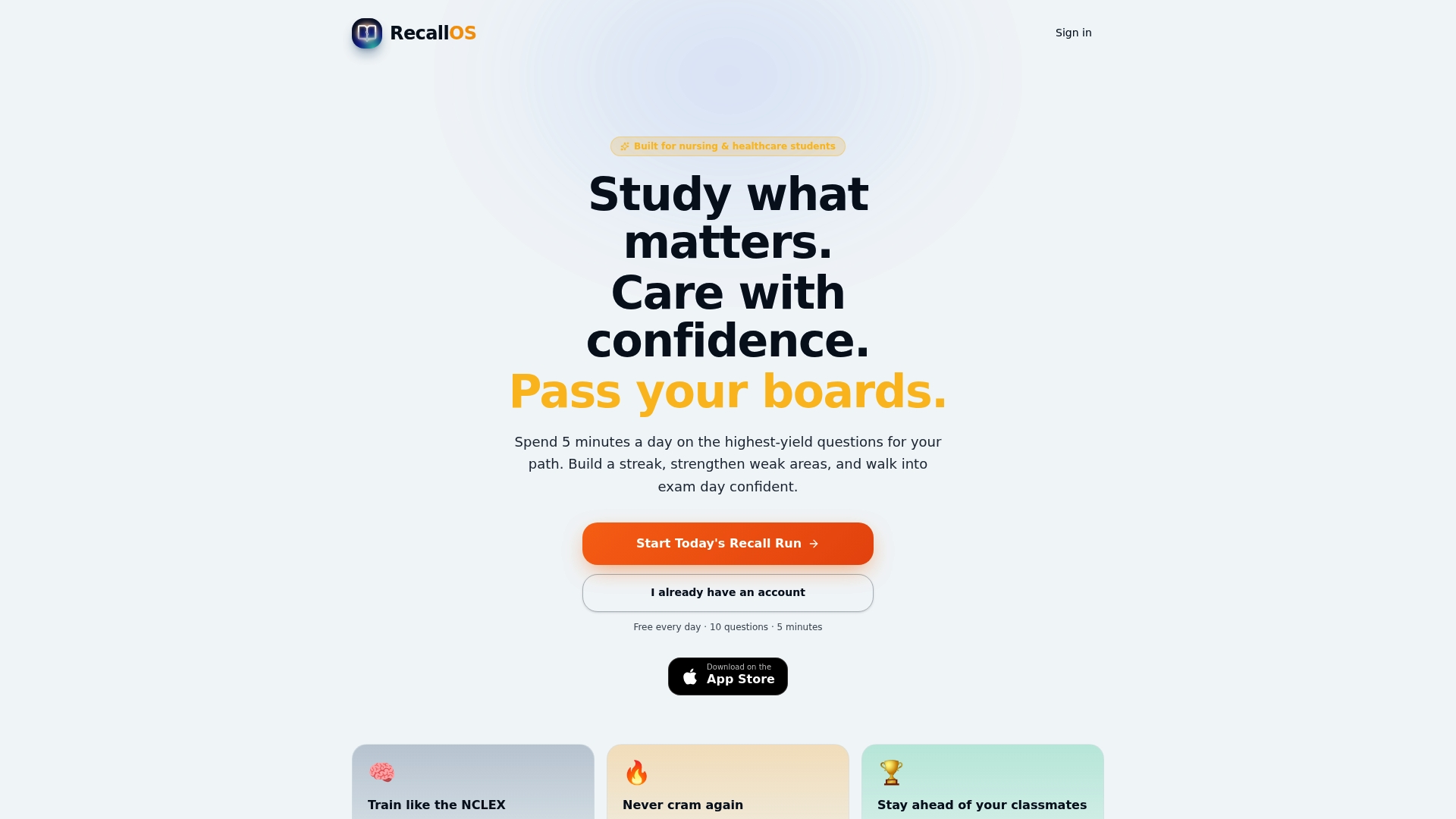
Recallos delivers daily high-yield NCLEX questions adapted to your performance, automatically surfaces your weak areas, and lets you build custom quizzes and study packs from your own notes. Every question is aligned to the current NCLEX blueprint, developed by practicing nurses and CRNAs who know what the exam actually tests. Streak tracking and progress dashboards keep your six-week plan on track even when motivation dips.
Try Recallos free and run your first adaptive session today. You'll see your weak areas flagged within the first session, which is exactly the data you need to build a test date around.
Sources
- NCLEX pass rates | National Council of State Boards of Nursing (NCSBN)
- Tips on How to Pass the NCLEX Exam | ANA
- When Do You Take the NCLEX? Best Time to Schedule & Pass | MedLifeMastery
- Top NCLEX test taking strategies | Blueprint Prep Blog
Pass-rate charts are useful context, not a scheduling strategy. Read them as cohort data, not as evidence that one month is easier than another.