For gravity infusions, the gtt/min rate equals volume in mL multiplied by the tubing's drop factor in gtt/mL, divided by time in minutes. For pump-controlled infusions, the mL/hr rate equals volume in mL divided by time in hours. Both formulas depend on knowing your tubing's drop factor and your exact time frame, so confirm those two details before you calculate anything else.
TL;DR:
- Using the correct drop factor from the tubing package is essential, as misreading it causes systematic errors in infusion rates.
- Microdrip tubing at 60 gtt/mL simplifies calculations, often making drops per minute equal to milliliters per hour, which speeds bedside math.
- When programming pumps, converting minutes to hours before dividing volume in milliliters by time provides accurate mL/hr rates, especially for non-standard durations.
- Correct calculation of medication infusion rates requires knowing the drug concentration, patient weight, and order specifics, with overconcentration risking overdose.
- Physical observation, manual drop counting, and verification of order details remain critical to ensure safe and accurate infusion management.
Table of Contents
- Why the drop factor changes everything
- Core formulas and how to verify them with dimensional analysis
- Worked examples you can practice with
- Converting medication orders into mL/hr
- Common calculation errors and how to catch them before they harm a patient
- Using calculators and apps without losing your own skills
- Quick reference cheat sheet
- Adjusting drip rates for pediatric, adult, and fluid-overload patients
- How fluid thickness and temperature can throw off your count
- How to manually count and confirm your drip rate
- Troubleshooting occlusions, air bubbles, and other drip problems
- A note on practice, speed, and what actually keeps patients safe
- A study tool built around the calculations you'll actually be tested on
- Sources
- FAQ
Why the drop factor changes everything
The drop factor is the number of drops it takes to deliver 1 mL of fluid through a specific tubing set, and it is printed on the tubing package, not chosen by the nurse. Get this number wrong and every downstream calculation fails, even if your math is otherwise perfect.
Common drop factors fall into two families, according to the StatPearls chapter on IV drip rate calculation:
- Macrodrip tubing: 10, 12, 15, or 20 gtt/mL, used for routine adult fluid infusions.
- Microdrip tubing: 60 gtt/mL, used for pediatric patients, critical medications, or any infusion where precise low-volume delivery matters.
Microdrip tubing is useful because at 60 gtt/mL, the math simplifies: gtt/min often equals mL/hr, which cuts out a conversion step entirely.
Pro Tip: Check the tubing package every time, even if you use the same brand daily. A single facility can stock multiple drop factors, and assuming the wrong one is one of the most common sources of dosing errors.
Core formulas and how to verify them with dimensional analysis
The gravity formula is straightforward: multiply volume in mL by the drop factor in gtt/mL, then divide by time in minutes. Dimensional analysis shows why this works, because the mL units cancel and you're left with gtt/min, which is exactly what you're solving for. If you set up the equation and the units don't cancel to gtt/min, you've made a setup error before you ever touch a calculator.

For pump-controlled infusions, mL/hr equals volume in mL divided by time in hours. If your order gives you minutes instead of hours, convert first: divide minutes by 60 to get hours, or multiply your minute-based rate by 60 to annualize it into an hourly rate.
A 2 to 1 relationship is common: microdrip tubing at 60 gtt/mL makes gtt/min numerically equal to mL/hr, which means you can skip a conversion step entirely when using microdrip sets.
A few shortcuts speed up bedside math for common macrodrip factors:
- At 15 gtt/mL, divide mL/hr by 4 to get gtt/min.
- At 20 gtt/mL, divide mL/hr by 3 to get gtt/min.
- At 10 gtt/mL, divide mL/hr by 6 to get gtt/min.
These divisors come from the drop factor's relationship to 60 minutes per hour, and memorizing them saves time on exams and during busy shifts.
Worked examples you can practice with
Practicing with real numbers builds the speed you need for exams and clinical shifts. Here are five problems covering both gravity and pump scenarios.
- Gravity, 15 gtt/mL: Infuse a standard adult maintenance fluid over several hours. Calculation involves multiplying the volume by the drop factor and dividing by time to find gtt/min, which typically results in a rate appropriate for common adult infusions.
- Gravity, 20 gtt/mL: Infuse a moderate volume over a typical time frame. Calculation uses the formula of volume times drop factor divided by time to get gtt/min, resulting in a rate commonly used in clinical practice.
- Gravity, 60 gtt/mL (microdrip): Infuse a smaller volume over one hour. The calculation shows that drops per minute often equal mL per hour with microdrip tubing, simplifying bedside math.
- Pump, hours given directly: Infuse a given volume over several hours using a pump, calculated by dividing volume by time in hours to find mL/hr, which pumps deliver with typical rounding.
- Pump, minutes given: Infuse a set volume over a time given in minutes, requiring conversion of minutes to hours before dividing volume by hours to get mL/hr for pump programming.
For gravity infusions, always round to the nearest whole drop since you can't physically count a fraction of a drop. For pump rates, follow your institution's rounding policy, since some pumps accept tenths of a mL/hr and others round to the nearest whole number.
Converting medication orders into mL/hr
Medication infusions add a layer of complexity because the order comes in a dose unit (mcg/kg/min, mg/hr, or units/hr) that must be converted into a pump-programmable mL/hr rate. The first step is always finding the concentration: total drug amount divided by total volume in the bag.
Once you know the concentration, the Medscape IV drip rate calculator reference outlines the structure for weight-based conversions:
- For mcg/kg/min orders: mL/hr equals dose times patient weight in kg times 60, divided by concentration in mcg/mL.
- For fixed units/hr orders: mL/hr equals ordered dose divided by concentration in units/mL.
Here's a worked example: a patient weighing 70 kg is ordered a drug at 5 mcg/kg/min, mixed at a concentration of 400 mcg/mL. Calculation: (5 × 70 × 60) ÷ 400 = 52.5 mL/hr. Most pumps round this to 52.5 or 53 mL/hr depending on institutional policy. Always double-check your bag's actual mixed concentration against the standard your facility uses, since a nonstandard mix invalidates the entire calculation.
Common calculation errors and how to catch them before they harm a patient
Most infusion errors trace back to a handful of repeat mistakes: using the wrong drop factor because nobody checked the tubing, confusing mg with mcg in a medication order, or entering a rate into the wrong pump field (mL/hr instead of a bolus volume, for example). Each of these can cause an infusion to run far faster or slower than intended.
The ISMP guidance on smart infusion pumps points out that custom concentrations entered without hard minimum-concentration alerts have led to serious overdoses, and that bypassing a pump's drug library removes many of the safety checks built into the system.
Calculation accuracy alone doesn't guarantee patient safety: the FDA's infusion pump safety guidance notes that device, software, and labeling failures are common contributors to infusion-related harm, separate from any math error.
Before starting any infusion, verify:
- The order matches the bag label, drug, concentration, and route.
- The tubing drop factor matches what you used in your calculation.
- The pump mode and drug library selection match the ordered infusion type.
Using calculators and apps without losing your own skills
Calculators and pump-integrated dosing tools speed up arithmetic and reduce simple math errors, but they can't verify that you entered the right concentration or selected the correct drug library. Treat any calculator output as a starting point, not a final answer.
- Always double-check the units you entered match the order's units exactly.
- Never skip a manual verification step, especially for high-alert medications.
- Build a personal reference table of rates you calculate often, since recognizing a familiar number is faster than recalculating it from scratch.
Quick reference cheat sheet
Keep these formulas and values on hand for fast recall during exams or busy shifts.
| Calculation type | Formula | Notes |
|---|---|---|
| Gravity drip rate | (Volume mL × drop factor gtt/mL) ÷ time in minutes | Round to nearest whole drop |
| Pump flow rate | Volume mL ÷ time in hours | Convert minutes to hours first if needed |
| Weight-based mcg/kg/min to mL/hr | (Dose × weight kg × 60) ÷ concentration mcg/mL | Confirm concentration against facility standard |
| Macrodrip, 15 gtt/mL | mL/hr ÷ 4 | Quick shortcut, no calculator needed |
| Macrodrip, 20 gtt/mL | mL/hr ÷ 3 | Quick shortcut, no calculator needed |
| Microdrip, 60 gtt/mL | gtt/min equals mL/hr | Avoids fractional-drop issues |
When a gravity calculation produces a fractional drop, switching to microdrip tubing or a pump usually resolves the problem more cleanly than rounding aggressively.
Adjusting drip rates for pediatric, adult, and fluid-overload patients
The formula never changes, but the numbers you plug into it should reflect the patient in front of you. Pediatric patients typically require microdrip tubing precisely because their fluid volumes are small enough that a macrodrip set would deliver fluid in large, imprecise increments. A miscalculation of even a few mL/hr matters far more in a 10 kg child than in a 90 kg adult.
Patients with fluid overload risk, including those with heart failure or renal impairment, often have orders for slower rates or smaller total volumes, and these orders deserve extra scrutiny before programming a pump. A rate that looks unremarkable for a healthy adult can push a compromised patient into pulmonary edema.
Adults with normal renal and cardiac function generally tolerate standard macrodrip rates, but "standard" is not a substitute for reading the specific order. Every adjustment should still run through the same formula, with the only changes being the volume, time, or drop factor the clinical situation calls for. When a rate seems unusually fast or slow for the fluid and diagnosis, that's a signal to recheck the order rather than assume the math is right.
How fluid thickness and temperature can throw off your count
The standard drip rate formulas assume a fluid that flows like water, but not every IV fluid behaves that way. Thicker fluids, such as certain blood products or concentrated dextrose solutions, flow more slowly through the same tubing at the same calculated rate, which means your calculated gtt/min may not match what you actually observe dripping into the chamber.
Cold fluids, including refrigerated blood products, are also more viscous than fluids at room temperature, and that added resistance can slow the actual flow rate below what the formula predicts. This is one reason blood administration sets use a different, wider-bore tubing than standard crystalloid sets.
None of this changes the formula itself. What it changes is your responsibility to observe the actual drip chamber after you set the rate, rather than trusting the calculated number blindly. If you calculate a rate but the fluid clearly isn't dripping at that pace, the physical reality in front of you takes priority over the math on paper, and the tubing, fluid viscosity, or a partial occlusion is worth checking before you assume your calculation was wrong.
How to manually count and confirm your drip rate
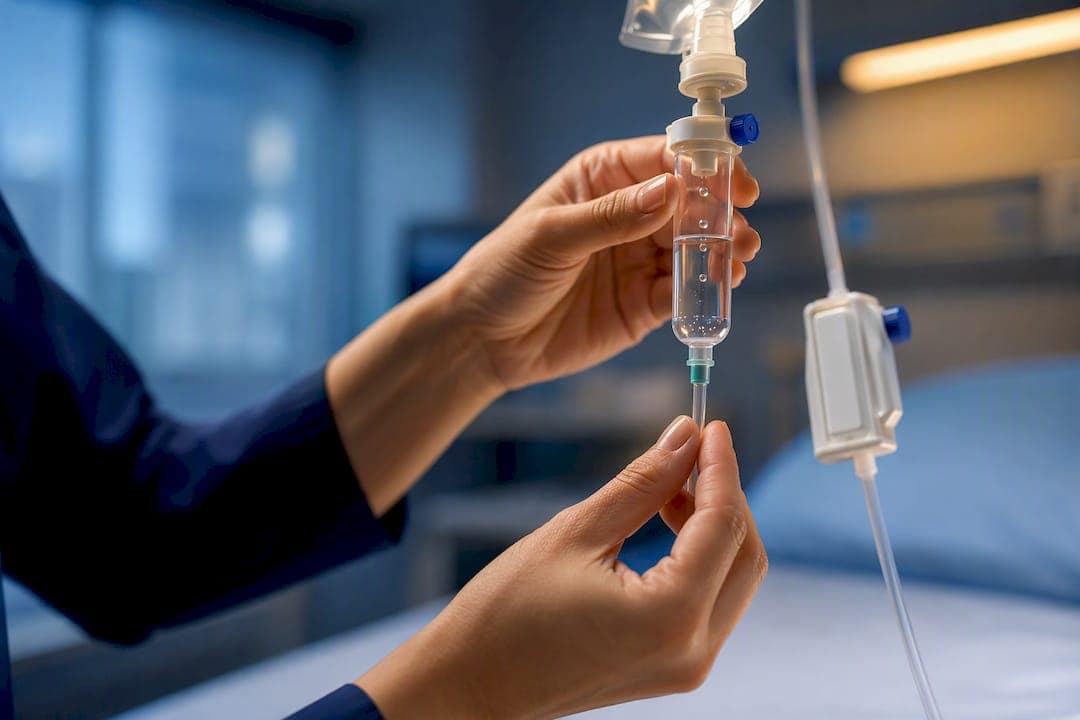
Counting drops by hand is still a core skill, especially in settings without pumps or as a manual double-check when something seems off. Watch the drip chamber and count drops for a full 15 seconds, then multiply by 4 to get drops per minute, or count for a full 60 seconds if you have the time and want a more accurate figure.
Position yourself at eye level with the drip chamber so you don't misjudge the rate from an angle, and make sure the chamber is filled to the correct level, usually about a third to half full, since an overfilled chamber makes individual drops hard to distinguish. If your manual count doesn't match your calculated rate, adjust the roller clamp gradually and recount rather than making one large adjustment and assuming it's correct.
This manual counting method pairs naturally with the dimensional analysis approach described in nursing refresher materials, which recommends using unit cancellation to double-check your formula setup before you ever touch the roller clamp. Combining both, a formula check and a physical drop count, catches errors that either method alone might miss.
Troubleshooting occlusions, air bubbles, and other drip problems
A drip rate that suddenly slows or stops usually points to one of a few common culprits. Occlusions can occur anywhere along the line, from a kinked tube to a clot at the catheter tip, and most pumps will alarm for this, but gravity infusions rely on you to notice the slowing chamber. Checking the entire line from bag to insertion site, including any clamps that may have been bumped closed, resolves many of these cases without needing to restart the IV.
Air bubbles in the tubing are a common concern, particularly during setup or when a bag runs dry before a bag change. Small amounts of air are generally not dangerous in a peripheral IV, but larger volumes warrant clearing the line before continuing, and any suspected air in a central line should be treated as urgent. Priming the tubing fully before spiking a new bag and tapping out visible bubbles before connection prevents most of this problem before it starts.
A drip rate that's faster than expected without any clamp adjustment can indicate the roller clamp has loosened or that positional changes in the patient's arm have affected gravity flow, particularly with an IV site below heart level. Rechecking your calculation, then rechecking the clamp position and site, resolves the majority of unexpected rate changes.

A note on practice, speed, and what actually keeps patients safe
Speed on drip rate calculations comes from repetition, not memorization of one lucky formula sheet. Daily practice with varied problems builds the pattern recognition that makes exam questions and bedside math faster. No amount of speed replaces checking the order, weight, concentration, tubing, and pump mode before you start an infusion.
— Caleb
A study tool built around the calculations you'll actually be tested on
Textbooks explain the formulas, but getting fast and accurate at them takes repeated practice with problems that mirror what you'll see on exams. A study tool was built to keep daily practice aligned with real exam blueprints, including calculation-heavy topics like IV drip rates.

The platform offers daily high-yield questions and personalized review of weak areas to help users practice topics such as drip rate math until they improve. You can also upload your own course notes to generate practice questions tailored to how your program teaches the material. Visit RecallOS to start a daily practice run.
Sources
- Smart Pump Custom Concentrations Without Hard “Low Concentration” Alerts - PMC
- ISMP guidelines for optimizing safe implementation and use of smart infusion pumps
- FDA — Infusion pumps and safety guidance
- Chapter: IV drip rate calculation – StatPearls / NCBI Bookshelf
FAQ
What is the drip rate for an IV of 100 mL over 30 minutes?
The answer depends on your tubing's drop factor, since the formula is (volume mL times drop factor gtt/mL) divided by time in minutes. The infusion rate in gtt/min varies based on the specific volume, time, and drop factor values.
How do I determine an IV flow rate?
For a pump, divide the total volume in mL by the total time in hours to get mL/hr, converting minutes to hours first if the order is given in minutes. For a gravity infusion, use the drip rate formula instead, since gravity infusions are measured in drops per minute rather than a pump's mL/hr setting.
How do you determine drip rate for a gravity infusion?
Multiply the volume to be infused in mL by the tubing's drop factor in gtt/mL, then divide that number by the total infusion time in minutes. Always confirm the drop factor printed on the tubing package first, since using the wrong drop factor produces a systematically incorrect rate even when the rest of the math is correct.
What is a typical IV infusion rate?
There's no single typical rate, since it depends entirely on the fluid ordered, the patient's condition, and the total volume and time specified by the prescriber. Routine adult maintenance fluids commonly use standard macrodrip rates, but pediatric, cardiac, and renal patients often require substantially slower rates based on their specific orders.
Can a calculator replace manual drip rate verification?
A calculator speeds up the arithmetic, but it cannot confirm you entered the correct concentration, drop factor, or pump mode. Both the ISMP and FDA point to verification steps, such as confirming the bag label and drug library selection, as necessary alongside any calculated number.