
The twelve lab values you need to lock in first include common electrolytes, glucose, kidney function markers, blood components, coagulation times, blood gas values, and cardiac markers, all within their typical adult reference ranges. The single most effective way to memorize lab values for NCLEX is spaced repetition combined with clinical-action pairing: every time you drill a number, you attach the red-flag scenario and the nursing action to it. The number alone fades; the number tied to "hold the medication, call the provider, monitor the ECG" sticks.
Your top-priority starting list:
- Electrolytes: Na⁺, K⁺, Ca²⁺ (8.5–10.5 mg/dL), Mg²⁺ (1.5–2.5 mEq/L)
- Glucose and kidney function: fasting glucose, BUN, creatinine
- CBC basics: hemoglobin, hematocrit, platelets, WBC (4,500–11,000/µL)
- Coagulation: PT/INR, aPTT (25–35 sec)
- ABG core: pH, PaCO₂, HCO₃⁻ (22–26 mEq/L)
- Cardiac and drug levels: troponin, digoxin (0.5–2.0 ng/mL), lithium (0.6–1.2 mEq/L)
Pro Tip: Don't memorize ranges in isolation. For every value you drill, finish the flashcard with one clinical action: "K⁺ 6.2 → hold potassium supplements, get an ECG, notify the provider." That action is what the NCLEX actually tests.
Key takeaways
Pairing each lab value with one nursing action — not just the number — is the single most effective way to convert a cheat sheet into NCLEX-ready recall.
| Point | Details |
|---|---|
| Start with 12 core values | Electrolytes, glucose, CBC basics, coagulation, ABG core, and troponin cover most NCLEX lab-value questions. |
| Use clinical-action pairing | Attach one nursing action to every value you drill — that action is what the NCLEX actually tests. |
| Follow the spaced repetition cadence | Review new values at 1, 3, 7, and 14 days to build durable retention of critical thresholds. |
| Apply the three-tier framework | Sort values as normal, abnormal-but-not-immediate, or critical to answer priority questions faster. |
| Recallos for daily practice | Recallos delivers adaptive spaced repetition and custom lab-value flashcards built from your own notes. |
Table of Contents
- How to memorize NCLEX lab values: the complete cheat sheet
- High-yield memorization strategies that actually stick
- How lab values appear on NCLEX questions
- A 4-week study plan to lock in NCLEX lab values
- Printable cheat sheet and tools for rapid review
- What studying lab values actually taught me about the exam
- Recallos makes daily lab-value drills automatic
- Sources
How to memorize NCLEX lab values: the complete cheat sheet
The table below groups values the way the NCLEX uses them — by panel, with normal adult ranges, critical thresholds, and the nursing actions each critical value should trigger. Use it as your daily drill reference, not just a one-time read.
CBC reference ranges are drawn from MedlinePlus. A1C thresholds follow CDC guidance, and lipid targets reflect American Heart Association recommendations.
Age, gender, and pregnancy caveats
Normal ranges shift in ways the NCLEX occasionally tests directly:
- Hemoglobin: Men run 14–17 g/dL; women run 12–16 g/dL. Pregnant patients often drop to 11 g/dL and still fall within acceptable range.
- Creatinine: Older adults may have reduced muscle mass, so a "normal" creatinine can mask declining kidney function. Trend matters more than a single value.
- Platelets: Pregnancy can cause mild thrombocytopenia (100,000–150,000/µL) that is not automatically pathological.
- WBC: Newborns have naturally elevated WBC counts (9,000–30,000/µL). Pediatric ranges differ significantly from adult norms. For a deeper look at pediatric-specific values, the NCLEX pediatric review guide covers those caveats in detail.
- Glucose: Pregnancy targets are tighter. A fasting glucose above 92 mg/dL during pregnancy warrants follow-up.
Pro Tip: When an exam stem gives you a lab value, always check whether the patient is pregnant, elderly, or a child before deciding if the number is truly abnormal. The NCLEX builds those details into the stem for a reason.
A note on units: Most NCLEX questions use mg/dL for glucose and cholesterol, mEq/L for electrolytes, and g/dL for hemoglobin. If you see mmol/L on a practice resource, multiply by 18 to convert glucose to mg/dL (e.g., 5.5 mmol/L × 18 = 99 mg/dL). The exam itself will use the unit in the stem — always apply the range that matches the unit given.
High-yield memorization strategies that actually stick
Raw memorization of 26 lab ranges is a losing strategy. The NCLEX PrePro cheat sheet makes the point clearly: coupling a small core list with one nursing action per value anchors recall and improves exam performance far more than drilling numbers alone. Here is how to build that into your daily study.
The four techniques worth your time
- Spaced repetition: Review a value at 1, 3, 7, and 14 days after first learning it. Nurse recommends this exact cadence for retaining discrete facts like lab ranges. After day 14, move the card to a monthly review pile.
- Active recall: Close the cheat sheet and write the range from memory, then check. Passive re-reading feels productive but builds almost no durable recall.
- Clinical-action pairing: Every flashcard has three fields: the value, the red-flag threshold, and the nursing action. Never drill one without the other two.
- Interleaving: Mix electrolyte cards with ABG cards with coagulation cards in a single session. Blocked practice (all potassium, then all sodium) feels easier but produces weaker retention.
Three mnemonics that hold up under pressure
-
"SALT" for hyponatremia symptoms (Na⁺ < 135): Seizures, Anorexia, Lethargy, Thirst (absent). When sodium drops below 120, seizure precautions go up immediately.
-
"MURDER" for hyperkalemia (K⁺ > 5.0): Muscle weakness, Urine (oliguria), Respiratory distress, Decreased cardiac contractility, ECG changes, Reflexes decreased. The ECG change — peaked T-waves — is the NCLEX's favorite sign to test.
-
"ROME" for ABG interpretation: Respiratory Opposite, Metabolic Equal. If pH and PaCO₂ move in opposite directions, it's respiratory. If pH and HCO₃⁻ move in the same direction, it's metabolic. Apply this before you try to name the disorder.
A 10-minute daily drill you can copy
- Pull 10 random lab-value flashcards (mix panels).
- State the normal range aloud without looking.
- State the critical threshold and one nursing action.
- Mark cards you hesitated on — those go into tomorrow's first review slot.
- Finish with two NCLEX-style practice questions that use a lab value as the decision trigger.
Ten minutes done consistently beats a two-hour cram session every time.
How lab values appear on NCLEX questions
The NCLEX rarely asks "what is the normal range for potassium?" It asks what you do when the value is abnormal. Understanding the computerized adaptive testing format helps here: the exam escalates difficulty based on your answers, so lab-value questions often appear in priority, hold/give, and trending formats.
Common question patterns
- Hold/give: "The patient's digoxin level is 2.4 ng/mL. Which action does the nurse take first?" → Hold the dose, assess for toxicity signs (nausea, visual changes, bradycardia), notify the provider.
- Priority: "Which patient does the nurse assess first?" with four patients, one of whom has a critical lab value. The critical value almost always wins.
- Anticipate the order: "The nurse anticipates which provider order for a patient with a potassium of 2.8 mEq/L?" → Potassium replacement, cardiac monitoring.
- Trending: "A patient's creatinine was 1.0 mg/dL yesterday and is 1.8 mg/dL today. What does the nurse do?" → Trend matters. A rising creatinine signals worsening renal function even when the second value is still near normal.
Three sample NCLEX-style stems
Stem 1: A patient on heparin therapy has an aPTT of 95 seconds. What is the nurse's priority action? Rationale: aPTT above 70 seconds on heparin indicates supratherapeutic anticoagulation. Hold the infusion and notify the provider.
Stem 2: A patient reports muscle cramps and weakness. Serum potassium is 2.9 mEq/L. Which order does the nurse implement first? Rationale: Hypokalemia below 3.0 mEq/L requires replacement. Oral or IV potassium replacement is the priority, with cardiac monitoring.
Stem 3: A patient's troponin I is 0.8 ng/mL (reference < 0.04 ng/mL). The nurse anticipates which action? Rationale: Any troponin elevation signals myocardial injury. Repeat troponin in 3–6 hours, obtain a 12-lead ECG, and notify the provider immediately.
Lab-value action pairs: quick reference
| Lab Value | Abnormal Finding | Priority Nursing Action |
|---|---|---|
| Potassium | < 3.0 mEq/L | Replace K⁺, cardiac monitoring, assess muscle strength |
| Potassium | > 6.0 mEq/L | Hold K⁺-raising meds, ECG, notify provider |
| Sodium | < 120 mEq/L | Seizure precautions, fluid restriction or hypertonic saline |
| INR | critical high INR | Hold warfarin, assess for bleeding, vitamin K antidote |
| Glucose | < 50 mg/dL | Administer 15g fast-acting carbohydrate or D50W IV |
| Hemoglobin | < 7 g/dL | Assess for active bleeding, prepare for transfusion |
| Troponin | Any elevation | 12-lead ECG, repeat troponin, notify provider |
| Platelet count | < 100,000/µL | Bleeding precautions, avoid IM injections, fall precautions |
The NurseZee three-tier framework — normal, abnormal-but-not-immediate, critical — is a clean mental model for sorting these. On any multi-patient priority question, the critical-tier value answers the question.
What to spot first on any lab-value stem:
- Is the value critical (life-threatening threshold)?
- Is there a trend (two values given, moving in a dangerous direction)?
- Does the patient have a condition that changes the expected range (pregnancy, age, chronic disease)?
- What medication is the patient on that this value directly affects?
A 4-week study plan to lock in NCLEX lab values
This schedule assumes 15–30 minutes of focused lab-value study per day alongside your broader NCLEX prep. It follows the evidence-informed structure recommended by Nurse.org for building durable recall. For a full NGN-ready framework, the NCLEX fundamentals study plan pairs well with this schedule.
-
Week 1 — Core electrolytes and glucose: Learn Na⁺, K⁺, Ca²⁺, Mg²⁺, and fasting glucose. Build one flashcard per value with normal range, critical threshold, and nursing action. Drill daily using active recall. End each session with two practice questions using those values.
-
Week 2 — CBC, BUN, creatinine, and coagulation: Add hemoglobin, hematocrit, platelets, WBC, BUN, creatinine, PT/INR, and aPTT. Review Week 1 cards at the start of each session (spaced repetition). Practice 5 NCLEX-style hold/give and priority questions daily.
-
Week 3 — ABGs, A1C, lipids, and drug levels: Add the full ABG set (pH, PaCO₂, HCO₃⁻, PaO₂), A1C, total cholesterol/LDL/HDL, troponin, digoxin, lithium, and phenytoin. Practice ABG interpretation using ROME. Mix all panels in daily drills (interleaving). Add trending questions to your practice set.
-
Week 4 — Mixed practice and weak-area targeting: No new values. Run timed 20-question sets that include lab-value stems across all panels. Track which values you still hesitate on and pull those cards back to daily review. Aim for consistent, confident recall before moving to full-length practice tests.
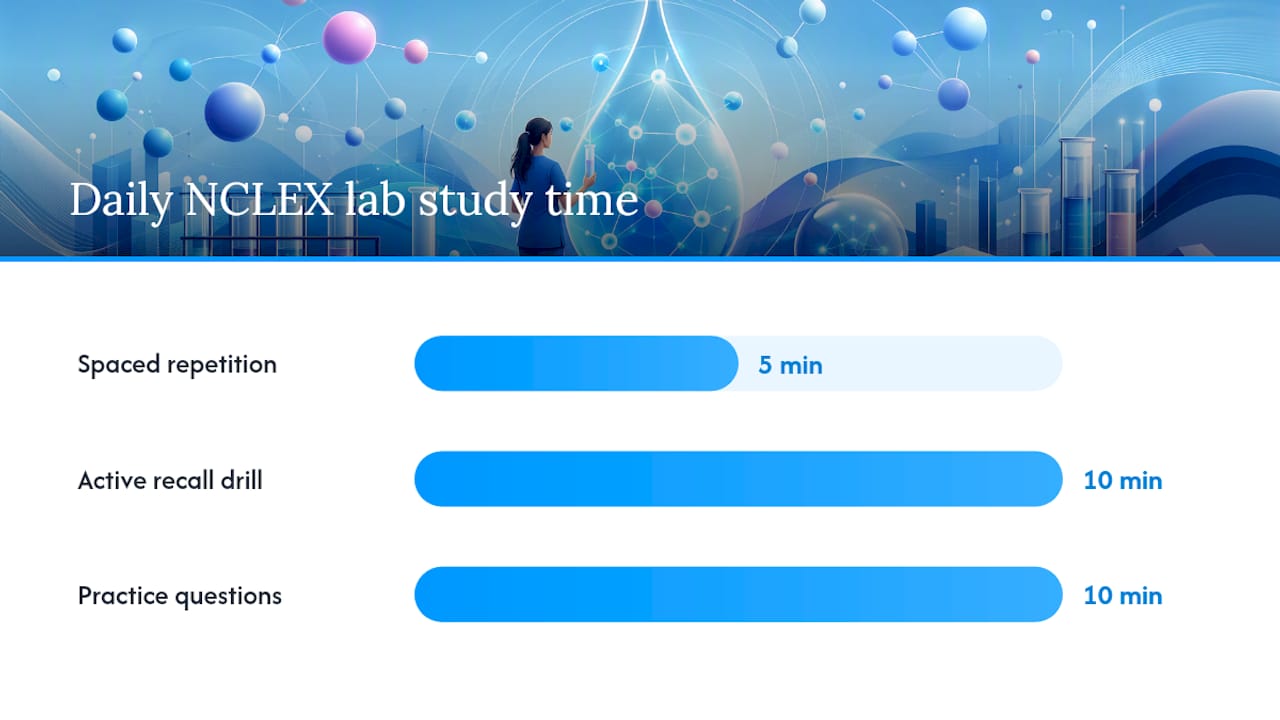
Daily routine (15–30 minutes):
- 5 minutes: spaced repetition review of previous cards
- 10 minutes: active recall drill on current week's values
- 10 minutes: 2–5 NCLEX-style practice questions with lab-value triggers
Progress check: By the end of Week 2, you should recall all electrolyte ranges and nursing actions without looking. If you're below that, extend Week 4 by one week before shifting to full-length tests.
Pro Tip: If your exam is fewer than four weeks away, compress the plan: do Weeks 1 and 2 in the first week, Weeks 3 and 4 in the second. Prioritize electrolytes and coagulation above everything else — they appear most frequently in NCLEX priority and hold/give questions.
Printable cheat sheet and tools for rapid review
A one-page printable cheat sheet should contain exactly what you need for a 5-minute rapid review: all panels grouped in the same order as the table above, critical thresholds highlighted (red or bold), and one nursing action per critical value. Keep it to one side of a single sheet. Print two copies: one for your study space, one to fold into your clinical badge holder during rotations.
The Nurseslabs normal lab values reference is one of the most widely used compiled references for nursing students and covers CBC, BMP/CMP, ABGs, coagulation, and therapeutic drug levels in a format close to what you'd build yourself.
Resource types worth using:
- Flashcard apps with spaced repetition: Any app that schedules cards based on your performance beats a static deck. Build your own cards using the three-field format (value, threshold, action) rather than relying on pre-made decks that often omit the nursing action.
- ABG flowcharts: A visual decision tree (pH → respiratory or metabolic? → compensated or uncompensated?) is faster to use under timed conditions than a written rule. Print one and tape it next to your cheat sheet.
- Daily question habit: A question-a-day practice habit keeps lab-value recall active between full study sessions without requiring a large time block.
- Timed tests vs. rapid-fire recall: Use timed full-length tests to simulate exam pressure and identify gaps. Use rapid-fire flashcard drills (under 30 seconds per card) to build the automatic recall that timed tests demand.
Warning: Reference ranges vary by laboratory and institution. On the NCLEX, always use the range provided in the exam stem when one is given. If no range is provided, apply the standard values from your cheat sheet. Never assume your clinical site's ranges match the exam's.
What studying lab values actually taught me about the exam
Most nursing students approach lab values the way they approached anatomy: memorize the list, pass the test, move on. That approach works for anatomy. It fails for lab values, because the NCLEX never asks you to recite a number. It asks what you do when the number is wrong.
The shift that changes everything is treating each value as a clinical decision, not a fact. When you drill potassium, you're not memorizing 3.5–5.0. You're memorizing: below 3.0, the heart is at risk, replace it and watch the monitor. Above 6.0, the heart is also at risk, hold everything that raises it and get an ECG. The number is just the trigger. The action is the answer.
There's also something worth saying about exam stress and lab values specifically. Students often feel behind on this topic because the list looks long. It isn't. Twelve core values, drilled with their actions over four weeks, covers the vast majority of what the NCLEX tests. The anxiety comes from treating the full reference table as the study target instead of the twelve high-yield values that drive most questions. Start small, build the action pairs, and the rest of the table fills in naturally.
Recallos makes daily lab-value drills automatic
Knowing the study method is one thing. Doing it every day without burning out is another. Recallos was built by practicing nurses and CRNAs specifically for this problem: it delivers high-yield daily practice questions mapped to the NCLEX blueprint, with adaptive spaced repetition that surfaces the values you keep missing and backs off the ones you've locked in.

Upload your own lab-value notes and Recallos generates custom flashcards, quizzes, and summaries from them — so your three-field cards (value, threshold, action) become part of your daily drill automatically. The streak and progress-tracking system keeps the 15-minute daily habit from slipping. Peer challenges add a competitive edge that solo flashcard apps can't replicate.
If the 4-week plan above is your roadmap, Recallos is the engine that runs it. Recallos and see your weak-area gaps close within the first week.
Sources
Ranges in any published reference are starting points. Always apply the value given in the exam stem when one is provided.
- MedlinePlus — Complete blood count (CBC)
- American Heart Association — Cholesterol management guide (PDF)
- Nurseslabs — Normal Lab Values: Complete Reference Cheat Sheet
This article is general information, not a substitute for advice from a qualified doctor. Consult a qualified healthcare professional about your own circumstances before acting on anything here.