
The 2026 NCLEX-RN Test Plan sharpens emphasis on clinical judgment and multi-client prioritization. It's a refinement, not a redesign. The 2026 NCLEX-RN Test Plan takes effect April 1, 2026, so any exam sat on or after that date follows the updated blueprint.
The single highest-value move you can make right now: stop drilling isolated recall questions and start practicing NGN-style, multi-client clinical-judgment sets.
- Effective date: April 1, 2026
- Format retained: Computerized Adaptive Testing (CAT), 85–150 items, five-hour limit
- Action item: shift study time toward case-based clinical judgment, not flashcard memorization
Pro Tip: If more than half your current study sessions are single-answer recall drills, you're preparing for the wrong exam. NGN case sets reward reasoning under ambiguity, not fact retrieval.
Key Takeaways
The 2026 NCLEX-RN Test Plan rewards practiced clinical judgment across multi-client scenarios far more than it rewards memorized facts.
| Point | Details |
|---|---|
| Effective date | The 2026 test plan applies to exams taken on or after April 1, 2026. |
| Format unchanged | CAT delivery, 85–150 items, and the five-hour limit remain exactly as before. |
| CJ item structure | Expect 18 case-study items plus roughly 10% stand-alone clinical-judgment questions. |
| Pass/fail logic | Exams end via the 95% confidence rule, the max-length rule, or the R.O.O.T. rule. |
| Prep resource | Recallos offers adaptive, NGN-style daily practice mapped to the 2026 blueprint categories. |
Table of Contents
- What Changed in the 2026 NCLEX Blueprint
- Which NGN Question Formats You Need to Drill
- How CAT Scoring and Pass/Fail Rules Actually Work
- Study Priorities That Actually Move the Needle
- An 8-Week Study Plan for the 2026 Test Plan
- What to Expect on NCLEX Test Day
- What the 2026 Update Really Means for You
- How Recallos Helps You Train for NGN Clinical Judgment
- Sources
What Changed in the 2026 NCLEX Blueprint
Nothing about the exam's bones moved. The NCSBN kept the CAT delivery model, the 85 to 150 item range, and the five-hour time limit intact. What changed is language and weight, not architecture.
The updates that actually matter for your prep:
- One Client Needs category was renamed to Safety and Infection Prevention and Control, tightening its scope around risk reduction.
- Activity-statement wording across categories was revised to reflect updated clinical practice expectations, including sharper language on equitable, unbiased care.
- Clinical-judgment measurement stayed structurally the same: three six-item case-study sets (18 items total) plus roughly 10% stand-alone clinical-judgment items, per the NCLEX-RN Test Plan.
- Category weightings still trace back to the 2024 RN Practice Analysis, reviewed on a three-year cycle, so nothing here is arbitrary guesswork by test writers.
The practical upshot: if you trained on a 2023 or 2024 blueprint, your foundation still holds. You need to layer in updated scenario language around safety, infection control, and equity-focused decision-making, not relearn the exam from scratch.
Which NGN Question Formats You Need to Drill
Next Generation NCLEX items measure the Clinical Judgment Measurement Model, a framework that tracks how you recognize cues, analyze them, prioritize hypotheses, generate solutions, take action, and evaluate outcomes. Each format below tests a different link in that chain.
- Case studies (six-item sets): A single evolving patient scenario tests the full judgment cycle from cue recognition to outcome evaluation.
- Stand-alone clinical-judgment items: Shorter scenarios isolating one or two steps of the judgment model.
- Extended multiple-response: Select-all-that-apply items with partial-credit scoring in NGN formats.
- Extended drag-and-drop and matrix/grid: Sequencing actions or matching interventions to findings across a grid.
- Hotspot/highlight items: Identifying relevant data within a chart, note, or image.
- Bowtie and trend items: Mapping cause, action, and outcome, or tracking a client's status across multiple time points.
Pro Tip: Practice these formats with a visible timer running. Untimed accuracy on a bowtie item tells you nothing about whether you'll finish a six-item case set inside your pacing window on exam day.
How CAT Scoring and Pass/Fail Rules Actually Work
Computerized adaptive testing recalculates your ability estimate after every response, then selects the next item to match both that estimate and unmet test-plan category requirements. Every candidate answers 15 unscored pretest items mixed in unnoticed, so no exam is purely scored content.
Three scenarios end the test, per the Candidate Bulletin:
- 95% confidence interval rule: the computer is statistically certain you're above or below passing.
- Maximum-length rule: you hit 150 items, and the final ability estimate decides the outcome.
- Run-Out-Of-Time (R.O.O.T.): time expires before either rule triggers, and your last several ability estimates determine the result.
Getting close to 150 items doesn't mean you're failing. It often just means the algorithm needs more data to reach the 95% confidence threshold.
Study Priorities That Actually Move the Needle
Third-party review of failed attempts points to one recurring pattern: candidates treat the NCLEX like a fact-recall exam when it's built to measure reasoning under real clinical ambiguity. That mismatch, not lack of content knowledge, sinks otherwise well-prepared candidates.
Redirect your practice hours toward these five skills, in order of exam weight:
- Cue recognition: spotting which data points in a scenario actually matter.
- Cue analysis: connecting findings to likely causes before jumping to interventions.
- Multi-client prioritization: deciding which of three or four patients needs attention first.
- Delegation judgment: matching tasks to RN, LPN, or UAP scope correctly.
- Timely reassessment: recognizing when a plan isn't working and adjusting.
First-time, U.S.-educated RN candidates passed at 86.7% in 2025, with meaningful state-by-state variation. That gap often traces back to how programs weight NGN-style practice, not raw content coverage.
Pro Tip: When you review a missed case study, write out which step of the judgment model you got wrong (recognizing cues vs. prioritizing hypotheses). Vague "I need to study more" notes don't fix a specific reasoning gap.

Pro Tip: Practice multi-client scenarios with a hard two-minute cap per item. Real prioritization pressure looks nothing like untimed review.
An 8-Week Study Plan for the 2026 Test Plan
A balanced practice mix across question banks and mock exams beats binging any single resource. Here's a compact structure to adapt around your schedule:
- Weeks 1 to 2: Foundation review of high-yield content gaps, paired with light daily NGN item exposure using an NCLEX question a day approach.
- Weeks 3 to 4: Heavier NGN-format drilling, including bowtie, matrix, and extended multiple-response items, plus early multi-client case practice.
- Weeks 5 to 6: Timed mixed quizzes combining traditional and NGN formats, using a full NCLEX RN question bank for volume.
- Week 7: A full-length CAT-style NCLEX practice test under real time constraints, followed by targeted remediation on weak categories.
- Week 8: Light review, weak-area cleanup, and rest before test day.
Track three metrics weekly: accuracy on NGN case sets, average time per item, and percent correct on prioritization and delegation questions specifically. Those three numbers tell you more than an overall percentage score ever will.
What to Expect on NCLEX Test Day
Arrive early with acceptable ID matching your Pearson VUE registration exactly. Check-in includes a palm vein scan and a signed agreement, and the total appointment window runs five hours including any breaks.
- Bring one primary and one secondary form of ID with matching name and signature.
- Expect an optional break after roughly two hours, then again at four hours.
- Don't rush case-study sets just because the timer feels tight. Pacing evenly matters more than finishing early.
- Sleep and a normal breakfast beat a last-minute cram session the morning of your appointment.
What the 2026 Update Really Means for You
I'll say what most guides won't: the 2026 update doesn't punish you for what you don't know. It punishes passive studying. Candidates who drill pediatric-specific or fundamentals content through realistic case scenarios, tracked consistently, see measurable gains fast.
How Recallos Helps You Train for NGN Clinical Judgment
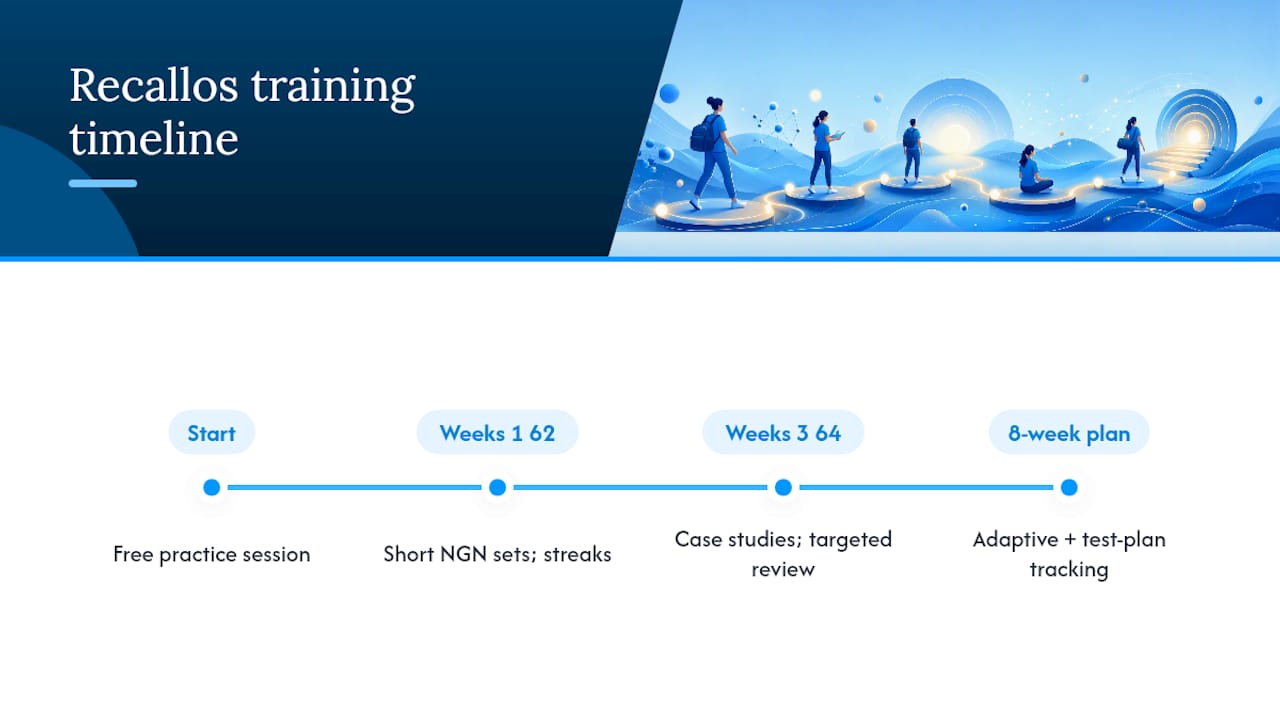
Recallos builds daily practice around exactly the skills the 2026 blueprint rewards: cue recognition, prioritization across multiple clients, and delegation reasoning, not isolated trivia recall. Its adaptive quizzes adjust to your weak areas automatically, which maps directly onto the 8-week plan above without you having to hunt for the right question mix yourself.

The daily streak system keeps you doing short NGN-format sets consistently through weeks one and two, when momentum matters most. As you move into heavier case-study practice in weeks three and four, Recallos surfaces personalized review of the categories where you're missing prioritization or delegation items, so remediation targets your actual gaps rather than generic weak spots. Built by practicing nurses and CRNAs, the question sets track the official test-plan categories rather than guessing at what "feels" high-yield.
If you're building your 8-week timetable now, start with a free practice session on Recallos and see where your clinical-judgment accuracy actually stands before test day arrives.
Sources
Check these directly for updates rather than relying on secondhand summaries.
- 2026 NCLEX-RN Test Plan | NCSBN
- NCLEX pass rates by state: Where 1st-time RN candidates fared best, worst in 2025