
High-yield, NCLEX-aligned digital flashcards with spaced repetition and integrated question rationales are the most effective study tool for passing the NCLEX-RN. Three reasons stand out: they map directly to the NCSBN test plan, they force active recall instead of passive reading, and built-in analytics show you exactly where you're losing points before exam day does.
- Top reasons to use digital flashcards with spaced repetition: NCSBN alignment keeps your study time on tested content; active recall modes (typing, quiz) build durable memory faster than re-reading; progress tracking surfaces weak areas so you fix them before the exam.
- Immediate next step: If you have four or more weeks to prep, start with Recallos for adaptive, nurse-authored daily practice. If you need a free starting point today, a free interactive deck with over 300 cards and four study modes gets you moving in minutes.
Pro Tip: Don't start with a random Quizlet set. The first question to ask any flashcard source is: "Does this map to the current NCSBN test plan?" If the answer isn't clearly yes, skip it.
Table of Contents
- Where can you find NCLEX-RN flashcards?
- What features actually matter in NCLEX-RN flashcards?
- How to study with flashcards for maximum recall
- Free vs. paid flashcards: when is it worth upgrading?
- Why Recallos stands out for NCLEX-RN prep
- Which flashcard approach fits your timeline?
- Key Takeaways
- The part most students get wrong about flashcards
- Recallos gives you adaptive NCLEX prep from day one
- Useful sources and further reading
Where can you find NCLEX-RN flashcards?
Four main formats exist, and each comes with real tradeoffs.

Adaptive mobile and web apps are the strongest option for most students. Platforms like Recallos pair flashcards with adaptive scheduling, daily high-yield question feeds, and progress dashboards. The content updates with the exam blueprint, and you can upload your own notes to generate custom cards. The tradeoff is cost: most adaptive apps require a subscription.

Publisher and review-course bundles combine flashcards with Q-banks, video lessons, and study planners. Kaplan's self-paced prep and UWorld's NCLEX prep both include digital flashcards as part of broader packages. These bundles are thorough, but you're paying for the whole ecosystem whether you use every piece or not.
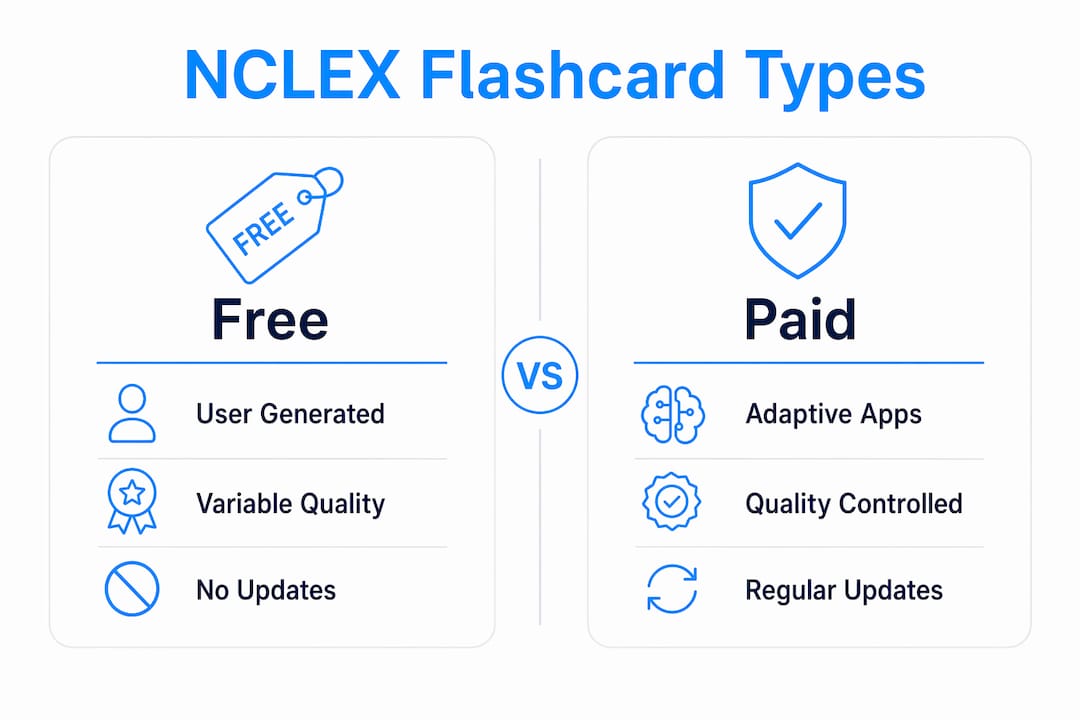
User-generated sets (Quizlet and similar) are free and fast to access. Quality varies wildly. Some community decks are excellent; others contain outdated content or outright errors. Without a nurse or educator reviewing the cards, you're trusting a stranger's notes.
Physical flashcard kits work well for commuters or anyone who studies away from screens. They're portable and require no battery. The obvious downside: no spaced repetition algorithm, no analytics, and updates require buying a new deck.
| Format | Quality control | Update frequency | Integrates with Q-bank | Portability |
|---|---|---|---|---|
| Adaptive app | High (nurse/educator authored) | Frequent | Yes | High (mobile) |
| Publisher bundle | High | Periodic | Yes | Moderate |
| User-generated (Quizlet) | Variable | User-dependent | No | High (mobile) |
| Physical deck | Moderate | Rare | No | Excellent |
What features actually matter in NCLEX-RN flashcards?
Not every deck is worth your time. These are the features that move the needle on exam performance.
- NCSBN test plan alignment: Cards should map to the current Client Needs categories. If a deck doesn't mention Physiological Integrity or Management of Care, it's not built for the NCLEX.
- Spaced repetition and adaptive scheduling: The algorithm should surface cards you're weak on more often. Passive flipping through a static deck doesn't build lasting recall.
- Active-recall modes: Flip mode is fine for learning. Type/recall and quiz modes are what actually prepare you for exam pressure. Forcing recall outperforms re-reading for long-term retention.
- Rationales for every answer: A card that just says "correct answer: B" teaches nothing. The rationale is where the learning happens, especially for pharmacology and priority questions.
- NGN-style practice items: The 2026 NCLEX includes Next Generation NCLEX (NGN) formats: extended drag-and-drop, matrix grids, and bow-tie questions. Your flashcard tool should include or integrate these.
- Progress tracking: Streaks, mastery percentages, and weak-card flags tell you where to spend the next session. Without tracking, you'll keep reviewing what you already know.
- Pharmacology depth: Drug class groupings, mechanism, side effects, and nursing watch points should be explicit. Pharm is one of the highest-yield areas on the exam.
- Regular content updates: The NCSBN revises its test plan. A deck last updated in 2022 may miss current NGN weighting and clinical judgment priorities.
Pro Tip: Check the "About" or "Authors" page before committing to any deck. Cards created or reviewed by practicing nurses, nurse educators, or CRNAs carry significantly more credibility than anonymous community content.
How to study with flashcards for maximum recall
The most effective routine combines short daily active-recall sessions with spaced repetition and weekly NGN-style practice tests. Thirty minutes of focused flashcard work beats two hours of passive review every time.
Daily routine (20–30 minutes):
- Open your adaptive app and complete the day's spaced-repetition queue first (roughly 10–15 minutes). These are cards the algorithm flagged as due for review.
- Spend the remaining time on a new topic block, using type/recall mode rather than flip mode.
- Log any cards you missed. Most apps do this automatically; if yours doesn't, tag them manually.
Weekly structure (6-week sample):
| Week | Focus | Flashcard goal | Integration |
|---|---|---|---|
| 1–2 | Management of Care, Safety | Master core priority/delegation cards | 1 timed NGN practice set |
| 3–4 | Physiological Integrity (basic care, pharm) | Chunk pharm by drug class | 2 Q-bank sessions per week |
| — | Physiological Integrity (reduction of risk, adaptation) | Target weak-card backlog | Daily NGN drill practice |
| 6 | Full review + weak areas | Mastery check on all categories | 2 full timed practice exams |
The NCSBN test plan weights Physiological Integrity across multiple subcategories and Management of Care as the single largest subcategory (roughly 15–21%). Spend at least half your flashcard time there.
A few practical habits that compound over time: use typing mode when you think you know a card (it exposes gaps flip mode hides), chunk pharmacology by drug class rather than alphabetically, and time-box every session. Forty-five minutes of unfocused review is less useful than 20 minutes with a clear category target.
Pro Tip: Schedule flashcard review during low-cognitive-load windows, like morning coffee or a commute, and save full practice tests for when you're mentally fresh. Mixing the two in the same sitting drains the stamina you need for timed exam simulation.
Pair your flashcard routine with a daily NCLEX question habit to build clinical judgment alongside raw recall.
Free vs. paid flashcards: when is it worth upgrading?
Free flashcards cover the basics and work well for short-term review or early-stage prep. Paid adaptive systems add the features that matter most when time is short: adaptive algorithms, deeper analytics, larger item banks, and integrated NGN practice.
What free options typically include:
- Over 300 cards covering major NCLEX categories
- Basic flip and quiz modes
- NCSBN category organization (the better free decks)
- No spaced repetition algorithm
What paid tiers typically add:
- Larger card banks (some platforms offer 3,440+ cards with adaptive scheduling)
- Spaced repetition that adjusts to your performance
- Integrated Q-bank or NGN practice items
- Detailed analytics (mastery by category, weak-card flags, streaks)
- Custom card creation from uploaded notes
Typical cost shapes:
- Free: Community decks, limited daily access on some apps
- One-time purchase: Physical decks or PDF bundles, usually $20–$50
- Monthly subscription: Adaptive apps, typically in the range of $15–$40/month
- Course bundle: Flashcards + Q-bank + video, often $200–$500+ for full access
When to pay: If your test date is less than four weeks out and your Q-bank performance is inconsistent, a paid adaptive system is worth the cost. The analytics alone will save you from studying the wrong things in the final stretch.
The rule of thumb: free decks are a starting point, not a strategy. If you need to pass on a specific date, adaptive scheduling and targeted remediation are not optional extras.
Why Recallos stands out for NCLEX-RN prep
Recallos delivers NCLEX-aligned, adaptive flashcards and integrated analytics built specifically for nursing and healthcare students. The content is developed by practicing nurses and CRNAs, which means the cards reflect how the exam actually tests clinical judgment, not just textbook definitions.
Core features:
- Adaptive spaced repetition: The system tracks which cards you miss and resurfaces them on an optimized schedule, so weak areas get more attention automatically.
- Custom uploads: You can upload your own notes and generate flashcards, quizzes, and summaries from your own class materials.
- Daily high-yield question feed: Each session includes exam-focused questions tied to current NCSBN priorities, not random trivia.
- Streaks and mastery tracking: Progress metrics keep you accountable and show category-level mastery so you know when a topic is actually ready.
- NGN-style item support: The platform supports next-generation question formats aligned to the 2026 exam blueprint.
- Exam predictions: Adaptive review identifies your highest-risk areas and surfaces them before the exam does.
Recallos was built by nurses who understood that the gap between knowing content and passing the NCLEX comes down to how you practice, not how much you read. The adaptive engine targets that gap directly.
The 2026 RN study guide on the Recallos blog maps daily practice recommendations to current NCSBN priorities, giving you a ready-made study pathway alongside the app. A free trial and limited free daily access let you test the platform before committing to a subscription.
Which flashcard approach fits your timeline?
Your best option depends on how much time you have and how you learn.
-
Two weeks or less until your test: Use a mobile adaptive app with analytics every day. Focus exclusively on your weak categories. Skip broad review; the algorithm will surface what needs work. Physical decks and Quizlet sets are too slow for this timeline.
-
Four to eight weeks of prep: This is the sweet spot for a full adaptive system. Pair daily flashcard sessions with two Q-bank blocks per week and at least one NGN practice set. Check your NCLEX testing date and work backward to set weekly mastery targets.
-
Long-term review (8+ weeks): Start with a free interactive deck to identify baseline gaps, then move to a paid adaptive app once you know which categories need the most work. Use the early weeks to build pharmacology fluency by drug class.
-
Repeat test-taker targeting weak categories: Skip general review entirely. Pull your previous score report, identify the lowest-performing NCSBN categories, and use an adaptive app's category filter to drill those areas exclusively. Pair with pediatric or specialty topic reviews as needed.
Key Takeaways
High-yield NCLEX-RN flashcards with spaced repetition, NCSBN alignment, and integrated rationales give nursing students the fastest, most reliable path to exam-day confidence.
| Point | Details |
|---|---|
| Prioritize NCSBN-aligned content | Physiological Integrity and Management of Care deserve the most study time. |
| Use active-recall modes | Type/recall and quiz modes build durable memory; passive flipping does not. |
| Pair flashcards with NGN practice | Flashcards build recall; timed NGN sets measure clinical judgment under pressure. |
| Upgrade to paid when time is short | Less than four weeks out with inconsistent Q-bank scores? Adaptive analytics are worth the cost. |
| Recallos for adaptive, nurse-authored prep | Recallos combines adaptive spaced repetition, custom uploads, and daily high-yield questions aligned to the 2026 NCLEX blueprint. |
The part most students get wrong about flashcards
Most nursing students treat flashcards as a passive review tool. They flip through a deck the night before a weak-category Q-bank session, feel vaguely reassured, and move on. That's not studying. That's checking a box.
The research on active recall is clear: forcing yourself to retrieve an answer, especially by typing it out, builds far stronger memory traces than reading the answer on the back of a card. The students who pass on the first attempt aren't the ones who reviewed the most cards. They're the ones who tested themselves on the hardest cards, repeatedly, until the answer came fast and clean.
There's also a content quality problem that doesn't get enough attention. A lot of popular Quizlet decks circulating in nursing school Facebook groups haven't been updated for the NGN format. They test recognition of isolated facts, not the clinical reasoning the 2026 NCLEX actually measures. Using an outdated deck isn't just inefficient; it can actively train the wrong thinking pattern.
The fix is straightforward: choose a deck or app built by nurses, verify it maps to the current NCSBN test plan, and use the hardest recall mode available from day one. The discomfort of not knowing an answer immediately is the point. That friction is what builds the memory.
Recallos gives you adaptive NCLEX prep from day one
Most flashcard tools make you do the work of figuring out what to study next. Recallos does that for you. Built by practicing nurses and CRNAs, it delivers daily high-yield questions and adaptive flashcard review tied directly to the 2026 NCLEX blueprint, so every session targets the gaps that actually cost you points.
What you get from day one:
- Adaptive spaced repetition that resurfaces weak cards on the right schedule
- Custom flashcard generation from your own uploaded notes and class materials
- NGN-style practice items aligned to the current exam format
- Streaks and mastery tracking so you always know where you stand
Free daily access is available with no commitment. When you're ready for full adaptive review and exam predictions, paid tiers start at a straightforward monthly rate. Try Recallos today and see which categories your adaptive review flags first.
Useful sources and further reading
- FREE Interactive NCLEX-RN Flashcards 2026 — Over 300 cards organized by NCSBN Client Needs categories with four study modes; a strong free starting point.
- NCSBN 2026 NCLEX-RN Test Plan — The authoritative source for current exam weighting, NGN formats, and Client Needs categories.
- Recallos adaptive quiz examples — Live demonstration of how adaptive review targets weak areas in real study sessions.
- Recallos exam predictions — Shows how the platform identifies high-risk content areas before your test date.
- NCLEX 2026 RN Study Guide (Recallos blog) — Daily practice pathways and topic breakdowns aligned to the 2026 NCLEX blueprint.
- Osmosis Ultimate NCLEX-RN Guide — Comprehensive free resource covering test strategy, content review, and study planning from a recognized medical education publisher.
- Kaplan NCLEX-RN Self-Paced Course — Publisher bundle with flashcards, Q-bank, and study planner; useful reference for understanding what full-featured paid prep includes.