Nursing isolation precautions are the Standard and Transmission-Based Precautions nurses apply at first patient contact to interrupt pathogen spread. The moment you suspect a transmissible condition, act before lab results confirm it.
First-contact action checklist:
- Apply Standard Precautions to every patient, every time
- Mask the source patient if respiratory symptoms are present
- Identify the likely transmission route (contact, droplet, or airborne) from the clinical picture
- Implement the appropriate Transmission-Based Precaution tier at triage, not after confirmation
- Assign a private room or initiate cohorting if a private room is unavailable
- Document precaution level, start time, and rationale in the chart immediately
Table of Contents
- 1. Standard precautions are the baseline for every patient encounter
- 2. Transmission-Based Precautions: start them early, adjust as you learn more
- 3. Contact precautions: what to do at the bedside
- 4. Droplet precautions: masks, distance, and common pathogens
- 5. Airborne precautions: respirators, negative pressure, and ventilation standards
- 6. Patient placement, cohorting, and transport rules
- 7. Donning and doffing PPE: the correct sequence matters
- 8. When to discontinue precautions and how to document it
- 9. The nurse's role in enforcement, communication, and visitor management
- 10. One-page nursing flow: triage through discontinuation
- Key Takeaways
- What isolation precautions actually teach us about nursing judgment
- Recallos helps you retain isolation precaution steps for the NCLEX
- Authoritative sources and further reading
1. Standard precautions are the baseline for every patient encounter
Standard Precautions apply to blood, body fluids, secretions, excretions (except sweat), non-intact skin, and mucous membranes — regardless of diagnosis or perceived risk. They are not optional for "low-risk" patients.
Core elements every nurse must apply:
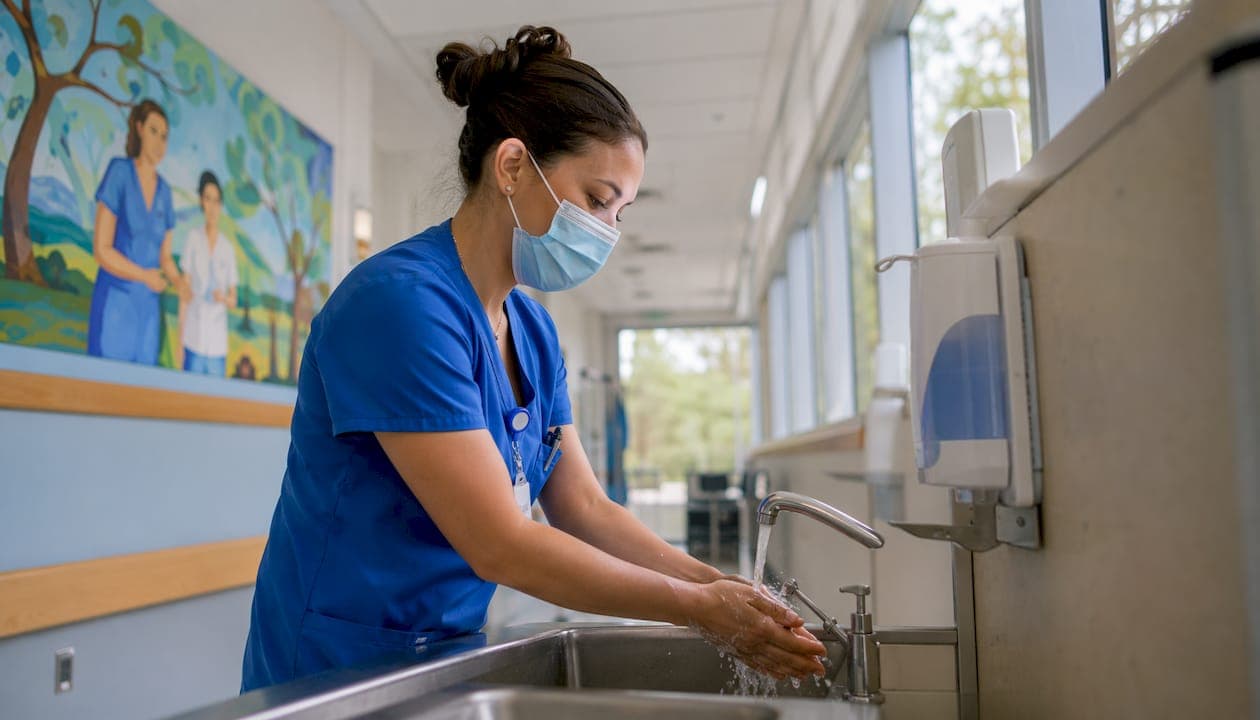
- Hand hygiene: Before and after patient contact, after glove removal, before a clean/aseptic procedure, after body-fluid exposure, and after touching patient surroundings
- PPE selection: Match to the exposure risk — gloves for contact with body fluids, gown if clothing may be soiled, mask and eye protection if splash or spray is likely
- Safe injection practices: One needle, one syringe, one patient — never reuse
- Respiratory hygiene: Offer masks and tissues to coughing patients at entry; post signage
- Equipment handling: Clean and disinfect shared equipment between patients
One rule that trips up students: soap and water is mandatory when caring for patients with Clostridioides difficile or norovirus. Alcohol-based hand rubs do not kill spores. The NursingCenter pocket card flags this explicitly as a high-yield exam point.
Pro Tip: Tie hand hygiene to a physical trigger, not a mental checklist. Remove gloves, perform hand hygiene, then move — make it a single motion so it never gets skipped under time pressure.
2. Transmission-Based Precautions: start them early, adjust as you learn more
Transmission-Based Precautions layer on top of Standard Precautions. They are not a replacement. The CDC recommends a syndromic approach: start precautions based on the clinical picture at triage, then modify once the pathogen is confirmed.
Triage triggers to start precautions empirically:
- Fever plus rash → consider Contact and/or Airborne
- Productive cough, known TB exposure, or immunocompromised status → Airborne
- Influenza-like illness → Droplet
- Diarrhea plus recent antibiotic use or healthcare exposure → Contact
| Transmission route | Precaution tier | Core PPE |
|---|---|---|
| Direct/indirect contact | Contact | Gown + gloves |
| Large respiratory droplets | Droplet | Surgical mask |
| Small airborne particles | Airborne | Fit-tested N95 + AIIR |
Early identification at triage is the first line of defense. Implementing precautions at first contact reduces in-facility spread while awaiting test results.
3. Contact precautions: what to do at the bedside
Contact Precautions apply when patients have wound drainage, uncontrolled secretions, fecal incontinence, or infections with resistant organisms such as MRSA or VRE.
Step-by-step bedside procedure:
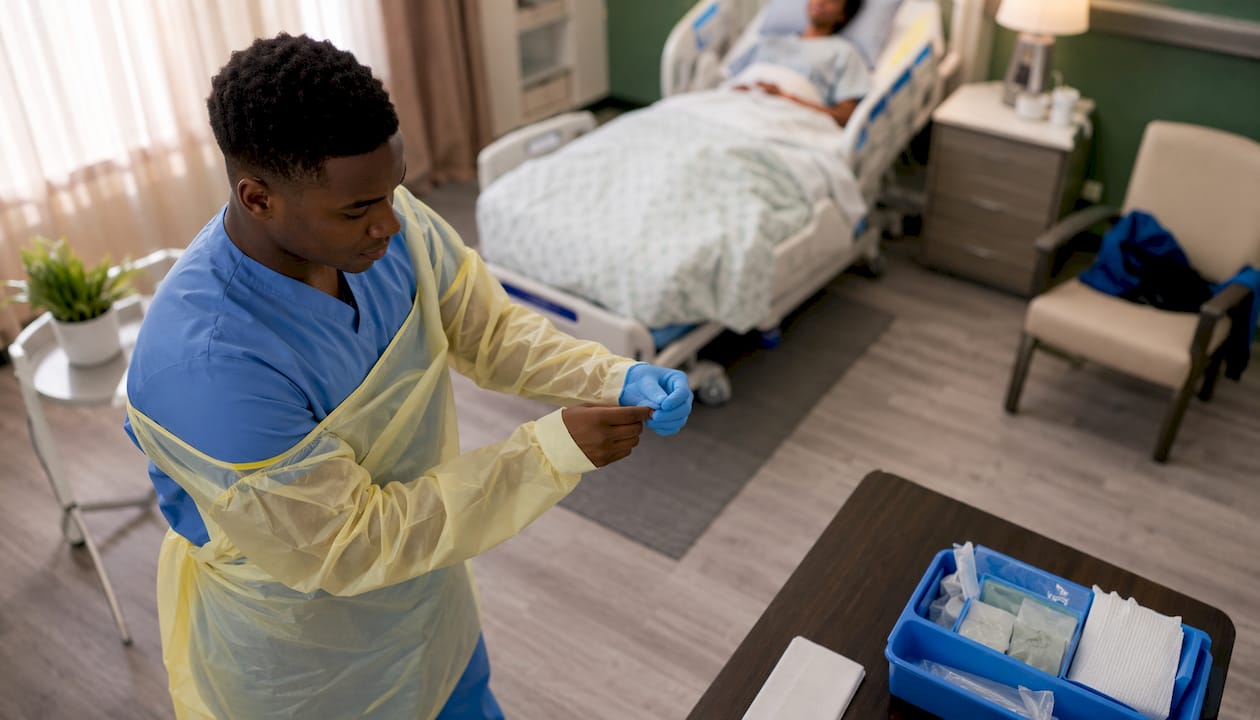
- Don gown and gloves before entering the room
- Change gloves after contact with high-contamination areas (wound, stool) before touching clean surfaces
- Use dedicated or single-use equipment (stethoscope, blood pressure cuff) — disinfect shared equipment before use on another patient
- Clean high-touch surfaces at least daily and before reuse, per CDC environmental cleaning guidance
- Remove gown and gloves before leaving the room; perform hand hygiene immediately after
C. difficile specifics:
- Use soap and water for hand hygiene — alcohol rubs are ineffective against spores
- Clean surfaces with a sporicidal agent (e.g., bleach-based disinfectant)
- Dedicate equipment to the patient for the duration of isolation
Pro Tip: When caring for multiple patients on Contact Precautions in sequence, change your gown and gloves completely between rooms. Carrying organisms on your gown from room to room is one of the most common cross-contamination errors on clinical units.
4. Droplet precautions: masks, distance, and common pathogens
Droplet transmission occurs via large particles (greater than 5 microns) that travel short distances and do not remain suspended in air. Specialized ventilation is not required, which distinguishes Droplet from Airborne Precautions.
Droplet Precautions nursing rules:
- Don a surgical mask before entering the room; add eye protection if splash risk exists
- Have the patient wear a mask when leaving the room for procedures or transport
- Maintain at least 3 feet of spatial separation if a private room is unavailable and a curtain is drawn
- Common pathogens: influenza, pertussis, meningococcal disease, and mumps
Pro Tip: On the NCLEX, "droplet" questions often hinge on the mask type. A surgical mask is correct for droplet; an N95 is required for airborne. Getting that distinction wrong costs points — and in practice, it costs patient safety.
5. Airborne precautions: respirators, negative pressure, and ventilation standards
Airborne Precautions apply to pathogens carried on particles 5 microns or smaller that remain suspended in air. The three classic examples are Mycobacterium tuberculosis, measles, and varicella (chickenpox).
AIIR engineering requirements:
| Requirement | Standard |
|---|---|
| Room pressure | Negative relative to surrounding areas |
| ACH — new construction/renovation | 12 air changes per hour |
| ACH — existing facilities | ≥6 air changes per hour |
| Air exhaust | Directly outside or HEPA-filtered before recirculation |
Sources: CDC isolation precautions guidance and AIA/FGI ventilation standards.
Respirator and room entry steps:
- Don a fit-tested, NIOSH-approved N95 respirator (or higher) before entering
- Perform a user seal check every time
- Enter the AIIR and close the door immediately
- After leaving, close the door, then remove the N95 in the anteroom or hallway per facility policy
- Perform hand hygiene after respirator removal
If an AIIR is unavailable: Place the patient in a private room with the door closed, apply a surgical mask to the patient, and arrange transfer to an AIIR-equipped facility as soon as possible. Transmission-Based Precautions can be adapted across care settings while maintaining the core intent.
6. Patient placement, cohorting, and transport rules
A private room is the first choice for any patient on Transmission-Based Precautions. When that is not possible, CDC recommendations allow cohorting only with patients confirmed to have the same organism.
Placement and cohorting rules:
- Prioritize private rooms for patients with airborne pathogens, then droplet, then contact
- Cohort only after clinical risk assessment and confirmed organism match
- Maintain at least 3 feet between beds and draw curtains when cohorting droplet patients
- Never cohort immunocompromised patients with infectious patients
Transport rules:
- Limit transport to clinically necessary moves
- Apply source control (surgical mask on patient, cover wounds or lesions)
- Notify the receiving department before transport so they can prepare
- Clean transport equipment immediately after use
Pro Tip: Document every placement decision: why a private room was or was not used, cohorting rationale, and who was notified. That record protects the patient, the unit, and you.
7. Donning and doffing PPE: the correct sequence matters
Getting the order wrong during doffing is how nurses contaminate themselves. The sequence is not arbitrary.
Donning order:
- Hand hygiene
- Gown (fully cover torso, tie at neck and waist)
- Mask or respirator (fit-check if N95)
- Eye protection (goggles or face shield)
- Gloves (extend over gown cuffs)
Doffing order (one safe example):
- Remove gloves first (most contaminated surface), perform hand hygiene
- Remove gown (roll outward, away from body), perform hand hygiene
- Remove eye protection (handle by the band or earpiece, not the front)
- Exit the room, then remove the N95 by the straps — never touch the front
- Perform hand hygiene after every removal step
Fit-testing is required before any nurse enters an AIIR. Facilities must maintain a written respirator program that includes initial fit-testing, annual retesting, and documented user training, per NCLEX infection control guidance.
Pro Tip: Practice the full don/doff sequence during unit drills, not just during an actual exposure event. Muscle memory under stress is what prevents self-contamination when you are rushing.
8. When to discontinue precautions and how to document it
Discontinuation criteria depend on the pathogen. Some use symptom-based criteria (e.g., influenza precautions end when the patient has been afebrile for 24 hours and symptoms have resolved). Others require negative test results, such as TB, where two consecutive negative sputum smears are typically required before precautions are lifted. Always follow current CDC guidance and your facility's infection control policy for the specific organism.
Documentation checklist when precautions are active or discontinued:
- Reason for isolation and suspected or confirmed organism
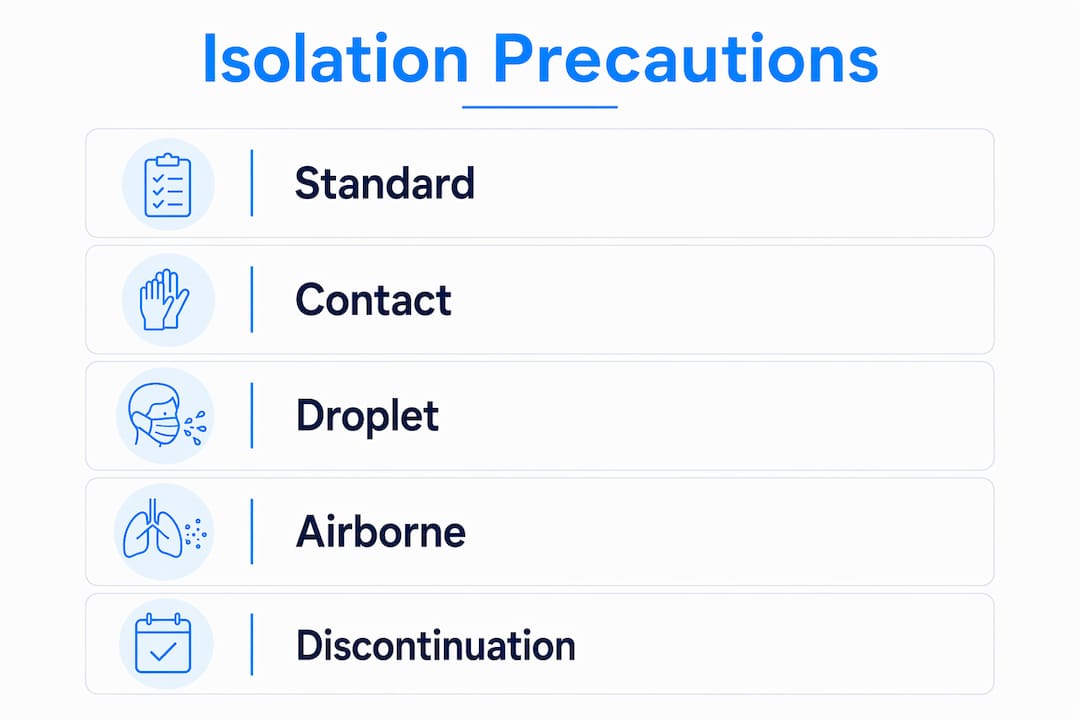
- Precaution level (Standard, Contact, Droplet, Airborne, or combination)
- Date and time precautions were initiated
- Date and time precautions were discontinued and the clinical basis for that decision
- Notification to receiving teams during handoff or transfer
- Environmental services notification when precautions end so terminal cleaning can be completed
Clear documentation is not just a regulatory requirement. It is how the next nurse, the transport team, and the cleaning staff know what to do without having to ask.
9. The nurse's role in enforcement, communication, and visitor management
Nurses are the primary enforcers of isolation precautions at the bedside. That means modeling correct PPE use, catching breaks in technique, and making sure visitors do not inadvertently carry pathogens out of the room.
Nurse responsibilities:
- Identify patients who need precautions at triage and initiate them without waiting for an order
- Enforce PPE compliance for all staff entering the room, including physicians and ancillary staff
- Screen visitors at the room entrance and instruct them on PPE use and hand hygiene
- Limit visitors when the patient's condition or the pathogen risk warrants it
- Use unit huddles, sign-out notes, and bed-board flags to keep the full team informed
Infection prevention is team-based: nurses must enforce precautions for staff and visitors alike. Signage at the room entrance reduces how often you have to repeat instructions verbally.
Pro Tip: Use a 30-second teach-back with visitors before they enter: "Tell me what you'll do before you touch anything in the room." It takes less time than you think and catches misunderstandings before they become exposures. Therapeutic communication skills make this feel natural rather than confrontational.
10. One-page nursing flow: triage through discontinuation
Use this sequence at the point of care or as an exam study anchor.
Isolation precautions nursing flow:
- Triage: Assess symptoms, identify likely transmission route, apply Standard Precautions immediately
- Transmission-Based Precautions: Implement empirically based on clinical syndrome before lab confirmation
- Patient placement: Assign private room; cohort only with same confirmed organism if no room available
- Don PPE: Follow the correct sequence (hand hygiene → gown → mask/respirator → eye protection → gloves)
- Bedside care: Dedicate equipment, clean high-touch surfaces, change PPE between contamination zones
- Transport: Source control on patient, notify receiving team, clean equipment after
- Doff PPE: Follow correct doffing sequence with hand hygiene at each step
- Documentation: Record precaution level, start/end times, clinical basis, and team notifications
- Discontinuation: Apply pathogen-specific criteria (symptom-based or test-based); notify environmental services for terminal cleaning
Pro Tip: Print this flow, laminate it, and keep it in your badge holder during clinical rotations. Facility-specific rules (AIIR availability, local testing protocols) should be added in the margins.
Key Takeaways
Correct nursing isolation precautions require applying Standard Precautions universally, initiating Transmission-Based Precautions at first contact based on clinical syndrome, and matching PPE and room requirements precisely to the transmission route.
| Point | Details |
|---|---|
| Start precautions early | Implement Transmission-Based Precautions at triage, before lab confirmation, using the syndromic approach. |
| Match PPE to the route | Contact needs gown and gloves; Droplet adds a surgical mask; Airborne requires a fit-tested N95 and an AIIR. |
| AIIR ventilation targets | 12 air changes per hour for new construction/renovation; at least 6 for existing facilities. |
| Doffing order prevents self-contamination | Remove gloves first, then gown, then eye protection; remove the N95 after leaving the room. |
| Recallos for exam prep | Recallos builds adaptive quizzes around isolation precaution sequences to reinforce the exact steps tested on the NCLEX. |
What isolation precautions actually teach us about nursing judgment
The clinical guidelines are clear. The harder skill is judgment: knowing when to act before you have confirmation, how to enforce precautions without alienating colleagues, and how to explain isolation to a frightened patient in a way that does not feel punitive.
Most nurses learn the PPE sequence quickly. What takes longer is the habit of initiating precautions at triage rather than waiting for a positive culture. That delay is where healthcare-associated transmission happens. The syndromic approach the CDC recommends is not a workaround — it is the intended standard, and it requires nurses to trust their clinical read of a situation.
Isolation also carries a psychological cost for patients. Being confined to a room, visited less often, and surrounded by staff in full PPE is disorienting and sometimes frightening. Scheduled check-ins, clear explanations of why precautions are in place, and family education within the precaution framework all reduce that burden without compromising safety. These are not soft extras. They are part of competent nursing care.
For educators: competency checks on don/doff sequences should happen during orientation and annually, not just when a new outbreak appears. A nurse who has not practiced the sequence under observation may be doing it wrong without knowing it.
Recallos helps you retain isolation precaution steps for the NCLEX
Knowing the guidelines is one thing. Retaining them under exam pressure is another. Recallos is built by practicing nurses and CRNAs specifically to close that gap, with adaptive daily quizzes that target your weak areas, spaced repetition of high-yield sequences like donning/doffing, and one-page study templates you can generate from your own notes.

For isolation precautions specifically, Recallos surfaces the exact decision points the NCLEX tests: mask type by transmission route, C. difficile hand hygiene rules, AIIR ventilation figures, and doffing sequence traps. The platform tracks your progress through streaks and rewards so you can see exactly where your retention is solid and where it needs another pass. This article is clinical guidance; Recallos is the study layer that makes it stick. Try an adaptive module and see which isolation precaution steps you actually have locked in.
This article is general educational information, not a substitute for your facility's infection control policy or professional clinical judgment. Always verify current criteria with CDC guidance and your institution's infection preventionist.
Authoritative sources and further reading
- CDC Isolation Precautions Guideline — the 2007 foundational guideline, still the primary US reference for healthcare settings
- CDC Standard and Transmission-Based Precautions — practical guidance on PPE selection, AIIR requirements, and engineering standards
- CDC Transmission-Based Precautions overview — triage triggers, syndromic approach, and cohorting guidance
- CDC Isolation Precautions Recommendations (Section IV) — patient placement prioritization and cohorting criteria
- NursingCenter Isolation Precautions Pocket Card (June 2025) — high-yield bedside reference for hand hygiene triggers, PPE rules, and C. difficile specifics
- NurseZee NCLEX Infection Control Precautions — exam-focused PPE sequencing, common NCLEX traps, and respirator handling rules
- Recallos NCLEX Study Guide — adaptive practice questions aligned with the NCLEX blueprint, including infection control topics