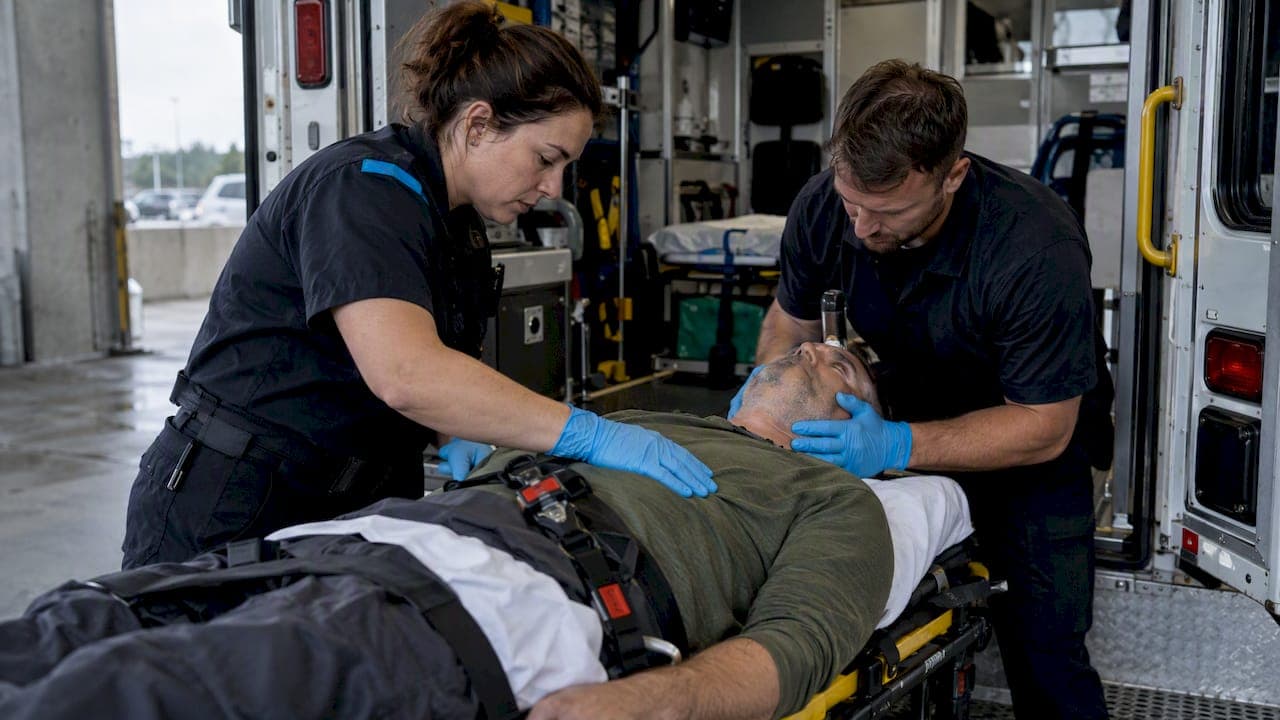
The validated sequence for any trauma patient is ABCDE: Airway with cervical spine protection, Breathing, Circulation with hemorrhage control, Disability, and Exposure, performed in that order while bleeding control and scene safety happen at the same time. Life threats get treated the moment they are found, not after the full exam is finished. If the patient's condition changes at any point, the primary survey starts over.
TL;DR:
- Ensuring rapid hemorrhage control through direct pressure, wound packing, or tourniquets is critical, especially on the scene or during initial assessment.
- The primary survey must be repeated immediately if the patient's mental or physical condition worsens, emphasizing the continuous loop of assessment.
- Applying a pelvic binder and intraosseous access can significantly speed stabilization and blood flow management when IV veins are hard to access quickly.
- Scene safety and environmental hazards are prioritized before assessment, with early delegation and actions like pressure or airway maneuvers performed immediately.
- Using bedside tools like E-FAST and rapid imaging guides urgent interventions and determines whether the patient needs to go directly to surgery or a diagnostic scan.
Table of Contents
- Scene size-up and the first ten seconds at the patient's side
- The primary survey, letter by letter: assess and act
- Hemorrhage control and circulation-focused interventions
- Secondary survey and focused history: SAMPLE and OPQRST
- Adjuncts and diagnostics: E-FAST, imaging, and labs
- Field triage and transport decisions
- Common pitfalls and cognitive traps to avoid
- Practice strategies that turn steps into reflexes
- A clinician-teacher's take on building real judgment
- Study trauma assessment the way you will actually use it
- FAQ
- Sources
Scene size-up and the first ten seconds at the patient's side
Before anyone touches the patient, the scene itself gets read. From the doorway or the vehicle door, a provider is scanning for mechanism of injury, obvious hemorrhage, work of breathing, and mental status, all in the first few seconds of contact. A patient who is combative, posturing, or silent and still tells you as much as one who is screaming.
Team safety comes first because an injured provider helps no one. Gloves and eye protection go on before contact, and if there is any chance of arterial spray, a gown does too. Hazards like unstable vehicles, traffic, or violence get controlled or the patient gets moved to a safer spot before assessment continues.
A good team leader delegates in seconds: one person manages the airway and c-spine, another applies direct pressure or a tourniquet to obvious bleeding, a third preps monitoring and transport. Delegation beats doing everything solo, especially with more than one patient.
Certain actions happen on approach, before the formal primary survey even starts, because they cannot wait:
- Apply direct pressure to any visible, significant external bleeding.
- Pack deep wounds with gauze if direct pressure alone is not controlling flow.
- Place a tourniquet high and tight on an extremity with life-threatening hemorrhage that packing does not control.
- Apply a pelvic binder when pelvic instability or a high-risk mechanism suggests pelvic fracture with internal bleeding.
These four actions are the practical start of circulation management, even though circulation is technically the third letter in the sequence. Missing bleeding is missing a life threat.
The primary survey, letter by letter: assess and act
Airway, with the neck protected
Airway comes first because a patient cannot survive long without one, and every airway maneuver in trauma assumes a possible cervical spine injury until proven otherwise. A provider checks patency by listening for speech or noise, looking for foreign material, blood, or swelling, and watching chest movement.
If the airway is compromised, the jaw thrust (not a head tilt, chin lift) opens it while a second provider holds manual in-line stabilization of the neck. An oropharyngeal airway (OPA) helps in an unresponsive patient without a gag reflex. When these measures fail, or when the patient cannot protect the airway because of declining consciousness, burns, or facial trauma, rapid sequence intubation is the next step. A surgical airway, with cricothyrotomy landmarks identified at the cricothyroid membrane between the thyroid and cricoid cartilage, is the last resort when intubation is not possible.
Breathing and ventilation
Breathing assessment is look, listen, feel: look at chest rise and symmetry, listen for equal breath sounds, feel for crepitus or instability. A tension pneumothorax (absent breath sounds, tracheal deviation, distended neck veins, hypotension) needs immediate needle decompression, followed by a chest tube. Flail chest, where a segment of ribs moves independently of the chest wall, usually means underlying lung contusion and may need positive-pressure support.
Oxygen delivery ranges from a nasal cannula to a non-rebreather mask to bag-valve-mask ventilation, chosen by how much work the patient's own breathing can still do.
Circulation and hemorrhage control
Stopping bleeding comes before fluid or blood replacement, and the order is always direct pressure, then wound packing, then a tourniquet if the first two fail. Pulse quality, skin color, capillary refill, and mental status reveal shock before blood pressure numbers do, because blood pressure can hold until a patient has lost a serious volume.

Two large-bore IVs are the default access; when peripheral veins are not obtainable quickly, intraosseous (IO) access becomes the faster route for fluids and blood products, since a provider should not spend more than about 60 to 90 seconds chasing a vein. Transfusion triggers depend on vital signs and response to initial fluids, not on a single lab value. A pelvic binder, placed at the level of the greater trochanters, stabilizes a suspected pelvic fracture and limits ongoing internal blood loss.
Disability: the neurologic snapshot
Disability is a fast neurologic check: AVPU (alert, verbal, pain, unresponsive) or the full Glasgow Coma Scale, pupil size and reactivity, and gross movement of all four extremities. A GCS of 8 or below generally means the airway needs protecting. Any mechanism or finding suggesting spinal cord injury (neck or back pain, numbness, weakness) means the collar and backboard or scoop stretcher stay on until imaging clears the spine.
Exposure and environmental control
Full exposure, cutting away clothing if necessary, finds occult wounds on the back, axillae, and groin that a clothed exam will miss. Exposure also cuts the other way: a hypothermic trauma patient bleeds more and clots worse, so warmed blankets and fluids go on as soon as the exam is done. Stop undressing and move to definitive care the moment a life threat is identified; exposure is not a mandate to fully disrobe an unstable patient before treating what is already found.
- Confirm airway patency and protect the cervical spine simultaneously.
- Assess breathing, treat tension pneumothorax or flail chest immediately.
- Control hemorrhage, assess perfusion, establish IV or IO access.
- Check neurologic status with AVPU or GCS and pupils.
- Expose fully, find occult injuries, then prevent heat loss.
Pro Tip: Say each letter out loud as you work through it, even in simulation. Narrating the sequence is what keeps a dramatic injury from pulling your attention away from a quieter, deadlier one.
Hemorrhage control and circulation-focused interventions
Hemorrhage is the most common preventable cause of death after injury, which is why stopping it outranks almost everything else in the circulation step. Wound packing means stuffing gauze directly into the wound cavity, not just laying it over the surface, then holding firm pressure for at least a few minutes. A tourniquet goes two to three inches above the wound, never over a joint, tightened until bleeding stops, with the application time written on the device itself or on the patient's skin in marker.
- Pack deep wounds fully, then apply sustained direct pressure.
- Write the exact tourniquet application time on the device or the patient.
- Place a pelvic binder at the trochanters for suspected pelvic fracture.
- Choose IO access when IV access is not fast or obtainable.
- Activate a massive transfusion protocol early in patients with ongoing hemorrhagic shock.
Transport of severely injured adults to a Level I trauma center is linked to a roughly 25% reduction in mortality compared with care at non-trauma centers, which is part of why rapid hemorrhage control and fast transport decisions matter as much as the exam itself.
Permissive hypotension, allowing a lower-than-normal blood pressure in certain penetrating trauma patients until bleeding is surgically controlled, is a strategy used in some systems to avoid diluting clotting factors and raising pressure against an unrepaired vessel. It is protocol-dependent and not a universal rule for every bleeding patient.
Secondary survey and focused history: SAMPLE and OPQRST
Once the primary survey is complete and immediate threats are managed, the secondary survey is a methodical head-to-toe exam, including a log-roll to check the back, spine, and posterior surfaces for wounds or step-offs that a supine exam would miss.
- Inspect and palpate the head and face for fractures, bleeding, or instability.
- Check the neck for tracheal deviation, jugular distension, or tenderness.
- Examine the chest for symmetry, crepitus, and breath sounds bilaterally.
- Palpate the abdomen and pelvis for tenderness, rigidity, or instability.
- Assess all four extremities for deformity, pulses, and sensation.
- Log-roll to inspect the back and spine, then return to a neutral position.
SAMPLE, or AMPLE in some systems, structures the history: Allergies, Medications, Past medical history, Last meal, and Events leading to the injury. Each answer changes management directly. A patient on an anticoagulant changes the threshold for a head CT after even a minor fall. A recent meal changes airway management choices before sedation. The events leading up to the injury, a fall from standing versus a fall from a roof, change how aggressively occult injury gets ruled out.
OPQRST (Onset, Provocation, Quality, Radiation, Severity, Time) works well for a conscious patient describing pain or a focal complaint, like chest pain after a motor vehicle collision. It is not usable in an unresponsive patient, where the secondary survey and bystander or family history carry the weight instead.
Adjuncts and diagnostics: E-FAST, imaging, and labs
Bedside tools answer the question a stable exam cannot: is there hidden bleeding right now. E-FAST (Extended Focused Assessment with Sonography for Trauma) is a rapid ultrasound exam that looks for free fluid in the abdomen, pericardial tamponade, and pneumothorax, and it can be repeated at the bedside as the patient's status changes.
- A positive E-FAST in an unstable patient usually means going straight to the operating room, not the CT scanner.
- A stable patient with an equivocal or negative E-FAST generally proceeds to CT for a more detailed look.
- Chest x-ray is fast and useful for an unstable patient; chest CT gives more detail but requires a patient stable enough to leave the resuscitation bay.
- Head CT is indicated for any significant head injury, especially with a lowered GCS, loss of consciousness, or anticoagulant use.
| Test | Best used for | Typical setting |
|---|---|---|
| E-FAST | Free fluid, tamponade, pneumothorax | Bedside, unstable patient |
| Chest x-ray | Rapid chest survey | Unstable or rapid triage |
| CT (head, chest, abdomen) | Detailed injury mapping | Stable, transportable patient |
| Type and cross, CBC | Blood availability, baseline counts | All significant trauma |
| Lactate or base deficit | Occult shock, perfusion status | Suspected hemorrhage |
| Coagulation studies | Bleeding risk, anticoagulant effect | Anticoagulated or bleeding patients |
Labs rarely change the first five minutes of care, but a type and cross starts the clock on blood availability, and lactate or base deficit can reveal shock in a patient whose blood pressure still looks normal.
Field triage and transport decisions
Where a trauma patient goes matters as much as what is done for them in the first minutes. The CDC's field triage guidelines organize the decision into four steps, each one escalating the urgency of transport to a higher-level trauma center.
- Step One, physiologic criteria: GCS of 13 or less, systolic blood pressure under 90, or respiratory rate under 10 or over 29 all trigger transport to the highest-level trauma center available.
- Step Two, anatomic criteria: penetrating injuries to the head, neck, or torso, flail chest, or a visibly unstable pelvis.
- Step Three, mechanism: falls from significant height, high-speed collisions, or ejection from a vehicle.
- Step Four, special considerations: age extremes, anticoagulant use, and pregnancy, all of which lower the threshold for trauma center transport even without meeting the earlier steps.
Transport of severely injured adults to a Level I trauma center is associated with a 25% reduction in mortality according to findings from the National Study on Costs and Outcomes of Trauma, which is the core reason triage criteria push toward bypassing closer, lower-level hospitals when they are met.
An older adult on blood thinners who falls from standing height might not meet Step One or Step Two criteria at all, yet Step Four alone can justify trauma center transport because age and anticoagulation change the risk of occult bleeding.
Common pitfalls and cognitive traps to avoid
Tunnel vision is the most common documented failure in trauma care: a provider fixates on an obvious, dramatic wound (an open fracture, a scalp laceration pouring blood) and misses a quieter airway or breathing problem. Patient safety reviews point to disciplined ABCDE adherence as the fix, not better instincts.
The primary survey is a loop, not a line. Any deterioration, a drop in mental status, new difficulty breathing, a falling pulse, means returning to A and working through the sequence again rather than continuing down the secondary survey.
For learners, a few habits separate competent performance from shaky performance in a skills station or on shift:
- Time-box the secondary survey so it does not swallow time needed for repeat primary assessments.
- Narrate findings out loud during practice; instructors and team members are listening for what you noticed, not just what you did.
- Document interventions with times, especially tourniquet application and medication administration, since this gets reviewed closely afterward.
Pro Tip: Practice the sequence with a stopwatch running. If your primary survey takes longer than 90 seconds on a straightforward manikin case, you are pausing to think instead of reacting from memory.
Practice strategies that turn steps into reflexes
Knowing the ABCDE sequence on paper and executing it under stress are different skills, and the gap closes with repetition, not re-reading. Short, frequent scenario drills, five to ten minutes with a focused debrief afterward, build faster primary-survey performance than long, infrequent sessions. Running the same sequence against a timed checklist, with roles assigned and swapped, trains the delegation skills that real scenes demand.
Targeted review matters more than broad review. A provider who freezes on cricothyrotomy landmarks or forgets pelvic binder placement under pressure should spend practice time there specifically, using tools like the RecallOS weak-spot review to find those gaps instead of guessing at them.
A clinician-teacher's take on building real judgment
Protocols give you a starting sequence, not the full answer. The hardest part of trauma care is recognizing when context should change your pace, slow down for an anxious patient, speed up when the scene itself is unsafe. Team drills and honest debriefs build that judgment faster than solo study ever will. I would rather a new provider practice the sequence badly a hundred times than memorize it perfectly once.
— Caleb
Study trauma assessment the way you will actually use it
RecallOS builds daily practice around the material that actually shows up on EMT, paramedic, and nursing certification exams, including the ABCDE sequence, GCS scoring, and field triage criteria covered here. The Daily Recall Run gives you short, repeated scenario-style questions instead of random trivia, and weak-spot review pushes airway algorithms or pelvic stabilization back in front of you until they stick.

If you have your own lecture slides, protocol sheets, or case notes, Upload Notes turns them into custom practice questions built around your program's specific material. Start a Daily Recall Run today or upload your first set of notes to see how the review maps to your weak spots.
This article is general information, not a substitute for advice from a qualified doctor. Consult a qualified healthcare professional about your own circumstances before acting on anything here.
FAQ
How do you work through trauma in a clinical assessment?
Clinicians work through physical trauma using the ABCDE primary survey (Airway, Breathing, Circulation, Disability, Exposure), treating each life threat as it is found before moving to the next step. Hemorrhage control and scene safety happen at the same time as this sequence, not after it, per the standard primary survey framework.
What is the clinical definition of trauma?
In emergency care, trauma refers to physical injury caused by an external force, such as a collision, fall, or penetrating wound, severe enough to require structured assessment and intervention. Injury remains a major cause of death and a significant source of emergency department visits, which is part of why standardized assessment protocols exist.
What are the stages of recovery after a traumatic event?
Definitions vary across sources, but psychological recovery after trauma is commonly described in phases that include an initial impact or shock response, a period of processing and adjustment, and longer-term integration or reorganization. This question concerns psychological recovery rather than the physical trauma assessment steps covered above, and specific staging frameworks differ by clinical model.
What are some examples of traumatic events?
Common examples include motor vehicle collisions, falls from height, penetrating injuries like gunshot or stab wounds, and significant blunt force impacts from sports or workplace accidents. Each of these mechanisms factors directly into field triage decisions about which hospital a patient should be transported to.
When should you repeat the primary survey during trauma care?
The primary survey should be repeated any time a patient's condition changes, including a drop in mental status, new breathing difficulty, or a weakening pulse. Because ABCDE functions as a continuous loop rather than a one-time checklist, providers return to Airway and work through the sequence again rather than continuing with the secondary survey.
Sources
- ATLS/Trauma care overview (NCBI Bookshelf)
- Guidelines for Field Triage of Injured Patients (CDC)
- AHRQ Patient Safety Network case (Missing trauma)