
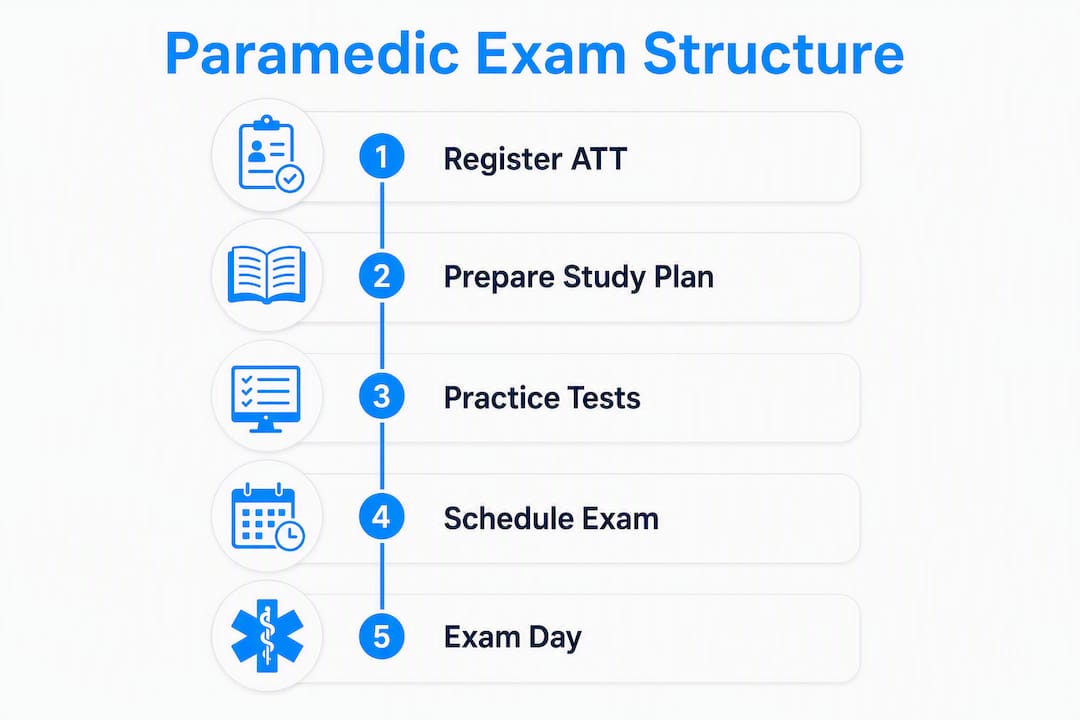
The NREMT Paramedic cognitive exam is a computer-adaptive test (CAT) that measures entry-level paramedic competency, and your first move is not to open a textbook. It is to confirm your program completion with the National Registry of EMTs (NREMT) and secure your Authorization To Test (ATT) before you can even book a Pearson VUE slot. Without the ATT, nothing else in your prep plan matters.
Once that paperwork is in motion, here is what you are preparing for:
- Format: Computer-adaptive test delivered at an authorized Pearson VUE testing center
- Length: 110–150 items, with about 20 unscored pilot questions embedded throughout
- Time limit: 3 hours and 30 minutes
- Clinical baseline: The NREMT recommends studying American Heart Association (AHA) guidelines and the National EMS Education Standards alongside your program textbooks
- Immediate action: Confirm eligibility with the NREMT, receive your ATT, then schedule your Pearson VUE appointment
Pro Tip: Start a dedicated error log on day one of prep. Every question you miss gets tagged by failure mode: knowledge gap, misread stem, or distractor trap. That log becomes your most valuable study asset in weeks 4 through 6.
Recallos supports this kind of targeted prep with adaptive daily questions and automatic spaced repetition, so you spend more time drilling your actual weak areas and less time re-reading content you already know.
Table of Contents
- What does the NREMT Paramedic exam format look like?
- What content domains does the paramedic exam test?
- How should you structure a 6-week study plan?
- How do you use practice tests effectively for a CAT exam?
- What should you expect on exam day at Pearson VUE?
- Which resources should you actually use to prepare?
- Key Takeaways
- The part of paramedic prep most candidates get backwards
- Recallos gives you adaptive paramedic prep from day one
- Useful sources
What does the NREMT Paramedic exam format look like?
The exam's CAT engine is the single most important thing to understand before you sit down to study. It does not deliver a fixed set of questions. Instead, it adjusts item difficulty in real time based on your responses, continuing until it can statistically determine whether you meet entry-level competency, meaning two candidates can take exams of different lengths and both pass.
| Feature | Details |
|---|---|
| Minimum items | 110 |
| Maximum items | 150 |
| Unscored pilot items | about 20 (embedded, unidentifiable) |
| Time limit | 3 hours 30 minutes |
| Delivery platform | Pearson VUE authorized testing centers |
| Item types | Multiple-choice, multiple-response, technology-enhanced, scenario-linked |
| ATT validity | Check current NREMT handbook for your window |
| Retake policy | Waiting periods apply; repeated failures may require remedial documentation |
Item types go beyond standard four-option multiple-choice. You will encounter multiple-response questions (select all that apply), drag-and-drop ordering, and scenario-linked clusters where two or three questions share a single patient case. Technology-enhanced items can include audio strips or rhythm interpretation embedded directly in the question.
Pearson VUE test-center procedures are strict. You must present acceptable identification, sign a non-disclosure agreement before the exam begins, and complete a short tutorial. That tutorial has a maximum time allotment, and failing to complete the non-disclosure agreement within the allowed window can count as a used attempt. Arrive early, know your ID requirements, and read the NREMT Paramedic Candidate Handbook before you schedule.
Your ATT window also shapes your study timeline. Book your Pearson VUE appointment only when you are genuinely ready, not just when the ATT arrives. Scheduling too early is one of the most common and most preventable reasons candidates fail.
What content domains does the paramedic exam test?
The exam tests six major content domains, and they are not weighted equally. Clinical judgment carries the heaviest emphasis, which means the exam rewards decision-making and synthesis far more than recall of isolated facts.

Clinical judgment
This domain asks you to integrate patient presentation, history, and assessment findings into a treatment decision. Questions rarely ask "what is the drug dose?" in isolation. They ask what you do next for a specific patient with specific vitals and a specific mechanism. Practicing case-based scenarios and working through decision trees produces better results here than extra hours memorizing drug cards.
Medical, OB/GYN, and pediatrics
Medical questions span toxicology, behavioral emergencies, endocrine crises, and obstetric complications. Pediatric items test weight-based dosing recognition and developmental differences in assessment. Both areas reward candidates who can apply AHA guidelines to specific patient presentations rather than recite them.
Cardiology and resuscitation
12-lead ECG interpretation, ACLS algorithms, and post-resuscitation care are consistently high-yield. The AHA guidelines for CPR and advanced cardiovascular life support are the clinical baseline the NREMT explicitly recommends, so know them cold. Rhythm recognition under time pressure is a skill, not just knowledge, and it requires repetition.
Airway, respiration, and ventilation
Airway management scenarios test sequencing: when to use BVM, when to intubate, how to confirm placement, and how to manage a failed airway. Ventilator management and capnography interpretation appear regularly.
Trauma
Trauma questions focus on mechanism, rapid assessment, and prioritization. Hemorrhage control, tension pneumothorax recognition, and spinal motion restriction decisions are common stems. Expect scenario-linked items that require you to sequence interventions correctly.
EMS operations
Incident command, mass casualty triage (START/JumpSTART), and hazmat operations round out the exam. These are lower-weight but still tested, and candidates who skip them entirely sometimes lose points they cannot afford.
Commonly missed subtopics include pharmacology dosing recognition (not just drug names), 12-lead interpretation for STEMI equivalents, and the specific criteria that differentiate stable from unstable presentations in cardiac and respiratory emergencies. These appear across multiple domains and reward candidates who practice them in scenario form.
How should you structure a 6-week study plan?
A structured, progressive schedule outperforms marathon cramming every time. The framework below is built around the CAT format: early weeks build the knowledge base, middle weeks target weak areas, and the final stretch focuses on timed simulation and mental sharpness.
-
Week 1: Baseline and foundation. Take a full-length diagnostic practice exam under timed conditions before studying anything. Score it by domain, not just overall. That baseline tells you where to invest the most time. Then spend the week reviewing core content in your highest-deficit areas: airway algorithms, cardiac rhythms, and pharmacology fundamentals.
-
Week 2: Systematic content review. Work through all six domains in order, spending roughly 90 minutes per session. Use your program textbooks and AHA guidelines for clinical content. Do 30–40 practice questions daily, reviewing every single answer, right or wrong.
-
Week 3: Targeted drilling. Pull your error log from weeks 1 and 2. Build study blocks around your three weakest domains. Run category-specific question sets (cardiology only, trauma only) rather than mixed exams. Aim for 50 questions per session with full review.
-
Week 4: Scenario integration. Shift from isolated questions to scenario-linked sets and case-based practice. Practice the two-pass approach: first pass identifies life threats and eliminates obviously wrong options; second pass selects the best differential. This builds speed without sacrificing accuracy.
-
Week 5: Full-length timed simulations. Run at least two full-length, 150-item timed exams on a desktop or laptop, in a quiet room, with no interruptions. Treat each one like the real test. Review every missed item the same day. Track whether your error types are shifting (fewer knowledge gaps, more distractor traps is a good sign).
-
Week 6: Polish and readiness check. One more full simulation early in the week. Spend the remaining days on light review of your persistent weak spots, skills practice, and mental preparation. No new content after day 4 of this week.
Daily session structure: 60–90 minutes of questions, 30 minutes of focused review, and 15 minutes of skills or algorithm rehearsal. Total study time of roughly 2–3 hours per day is sustainable for working adults without burning out before test day.
Pro Tip: Aim to answer each practice question in about 60 seconds. If a clinical scenario takes you three minutes to work through in practice, you will run out of time on exam day. Speed is a trainable skill, not a personality trait.

Weekly deliverables to track: one baseline or full-length simulation per week (weeks 1, 5, and 6), daily question counts logged, error log updated after every session, and at least one skills lab or simulation session per week with a partner or instructor.
How do you use practice tests effectively for a CAT exam?
Practice tests are not just checkpoints. They are your primary study tool, and how you review them matters more than how many you take.
The CAT format changes what "good practice" looks like. On a fixed-form exam, finishing 150 questions and scoring 80% tells you something clear. On a CAT, the exam stops when competency is determined, so your score on a fixed-form practice test is a proxy, not a perfect mirror. What matters more is whether you are getting harder items right and whether your error rate on clinical judgment questions is dropping.
Build your practice cadence around the 6-week plan. Weeks 1 and 2 use shorter category drills (30–50 questions). Weeks 3 and 4 mix category drills with 75-item mixed sets. Weeks 5 and 6 shift to full 150-item timed simulations. Never take a practice exam without reviewing every question afterward, including the ones you got right. Correct answers reached through faulty reasoning are a liability on test day.
The review workflow that separates passing candidates from failing ones is specific. For every missed question: identify the failure mode (did you not know the content, misread the stem, or fall for a distractor?), write a one-line remediation note in your error log, and revisit that topic within 24 hours. Distractor analysis is especially valuable. NREMT items are written to make two options look equally plausible. Understanding why the wrong answer was wrong is as important as knowing why the right one was right.
Simulate test conditions on a computer, not a phone. Practicing on a phone undermines pacing and the visual layout of scenario-linked items. Use a desktop or laptop, set a timer for 3.5 hours, and sit in a quiet room. The physical and cognitive conditions of practice should match the real thing as closely as possible.
One more thing about the CAT: encountering progressively harder items during the exam is a positive signal, not a sign you are failing. Correct answers trigger harder questions. If you notice the items getting more complex mid-exam, stay the course. Changing your approach because the questions feel harder is one of the most common self-sabotage moves on test day.
What should you expect on exam day at Pearson VUE?
Logistics matter more than most candidates realize. A procedural mistake on test day can forfeit your attempt, and that means waiting through a retake window and potentially completing remedial documentation.
Before you arrive:
- Confirm your ATT is valid and matches the appointment date exactly
- Bring two forms of acceptable ID; the primary ID must be government-issued with a photo and signature
- Arrive at least 30 minutes early; late arrivals may be turned away
- Leave prohibited items (phones, notes, food, watches) in your car or a locker
At check-in:
- You will be photographed and asked to sign a non-disclosure agreement
- The tutorial period is short; use it to orient yourself to the interface, not to review content
- Failing to complete the non-disclosure agreement within the allowed time can count as a used attempt
During the exam:
- Budget roughly 60 seconds per question as a working pace
- If a question stumps you, make your best clinical decision and move on; the CAT does not allow you to go back
- Flag items you are uncertain about only if the interface allows review within that session
- Do not interpret a long exam (close to 150 items) as failure; it means the algorithm needs more data points to confirm competency
Managing anxiety:
- Box breathing (4 counts in, hold 4, out 4, hold 4) takes 30 seconds and measurably reduces acute stress response
- Anchor yourself to the patient in the scenario, not to the question count
- Treat each item as independent; a hard question does not predict the next one
Retake rules apply if you do not pass. Paramedic candidates face designated waiting periods between attempts, and repeated failures can trigger a requirement for remedial training documentation before retesting. Know the current policy from the NREMT handbook before you schedule, so a failed attempt does not catch you off guard financially or logistically.
Which resources should you actually use to prepare?
The NREMT does not endorse specific commercial prep materials, which means the field is wide open and the quality varies enormously. Here is how to build a resource stack that is actually grounded in the exam.
Official must-reads first. The NREMT Paramedic Candidate Handbook and the official Paramedic Test Plan are non-negotiable starting points. They define eligibility, exam mechanics, and the content domains with their approximate weightings. Read both before you spend a dollar on any prep material.
AHA guidelines for clinical content. The AHA CPR and ACLS guidelines are the clinical baseline the NREMT explicitly recommends. For cardiology, resuscitation, and airway content, these guidelines are the authority. Any prep material that contradicts them is wrong.
What to look for in a question bank. A large item bank (ideally 1,000+ questions), randomized full-length simulations, domain-specific drill modes, and detailed answer explanations that explain why each distractor is wrong. Analytics that show your performance by domain over time are a significant advantage because they make your error log semi-automatic.
Textbooks and review courses. Your paramedic program textbook remains relevant for foundational content. Structured review courses add value in weeks 1 through 3 when you need systematic content coverage. After that, scenario-based practice and simulation should dominate.
Where Recallos fits. Recallos is built for exactly this kind of high-stakes healthcare exam prep. Its adaptive quiz engine automatically prioritizes the questions you are most likely to miss, schedules spaced repetition without you having to manage a flashcard deck, and generates custom study packs from your own notes and uploaded materials. For paramedic candidates, that means you can upload your program notes and get targeted quizzes mapped to the NREMT content domains. The peer challenge feature also adds accountability, which matters during a 6-week plan when motivation tends to dip around week 3.
For the study strategies that apply across high-stakes healthcare exams, the TEAS and HESI exam prep guide covers study-block structure and timed practice methods that translate directly to NREMT prep.
Key Takeaways
Passing the NREMT Paramedic exam requires securing your ATT first, following a structured 6-week plan, simulating full timed exams, and rigorously reviewing every error by failure mode.
| Point | Details |
|---|---|
| Confirm ATT before anything | Eligibility must be approved by the NREMT before you can book a Pearson VUE appointment. |
| Know the CAT mechanics | The exam includes between 110 and 150 items to be completed within about three and a half hours, with about 20 of those items being unscored pilot questions; encountering harder questions mid-exam indicates correct performance, not failure. |
| Follow a progressive schedule | Build from content foundation to targeted drills to full timed simulations across 6 weeks. |
| Review every wrong answer | Tag each missed question by failure mode and remediate within 24 hours for maximum retention. |
| Use Recallos for adaptive drilling | Recallos prioritizes your weak areas automatically and generates custom study packs from your own notes. |
The part of paramedic prep most candidates get backwards
Most candidates treat practice tests as checkpoints. They take one, see a score, feel good or bad about it, and move on. That is the wrong frame entirely.
The score on a practice exam is almost irrelevant compared to what you do in the 45 minutes after you finish it. The candidates who pass are the ones who treat review as the primary activity and the test itself as the trigger for that review. A missed question is not a failure. It is a data point that tells you exactly where to spend the next hour.
The other thing most guides underemphasize is the CAT mindset shift. Every other exam you have taken in your life rewarded persistence on hard questions. The NREMT CAT does not. You cannot go back. Spending four minutes on a single item while the clock runs is a strategy that fails, and no amount of content knowledge saves you from it. The skill of making a confident clinical decision in about 60 seconds and moving on is trainable, but only if you practice it explicitly. Most candidates never do.
Clinical judgment is the heaviest domain, and it is also the one most resistant to passive studying. Reading about patient assessment does not build the pattern recognition that the exam tests. Working through hundreds of scenario-based questions, reviewing the reasoning behind each one, and building a mental library of clinical presentations does. That is the work. Everything else is preparation for the work.
Recallos gives you adaptive paramedic prep from day one
Textbooks cover the content. Practice banks give you questions. What most paramedic candidates are missing is a system that learns which topics they keep getting wrong and keeps drilling those specifically, without requiring them to manually manage a study schedule.

Recallos does that automatically. Upload your program notes and it generates targeted quizzes mapped to NREMT content domains. The adaptive engine surfaces your weak-area questions more frequently, schedules spaced repetition in the background, and tracks your streak so you stay consistent across all 6 weeks. In weeks 1 through 4, use Recallos for daily adaptive drills after your content review sessions. In weeks 5 and 6, pair it with full-length timed simulations to sharpen both knowledge and pacing. A typical Recallos session runs 15–20 minutes of high-yield questions followed by instant explanations, which fits cleanly into the daily study block structure outlined above.
Try Recallos free and run your first adaptive paramedic quiz today. You will see your weak domains mapped within the first session.
Useful sources
Every policy, eligibility rule, and clinical guideline in this guide can change. Verify current requirements directly from official sources before you register or schedule.
- NREMT Paramedic Candidate Handbook: the authoritative source for exam mechanics, ATT eligibility, content domains, and retake policy. Read this before anything else.
- American Heart Association (AHA) CPR and ACLS Guidelines: the clinical baseline the NREMT explicitly recommends for resuscitation, cardiac, and airway content. Available at heart.org.
- Pearson VUE testing center information: scheduling, ID requirements, and test-center procedures are detailed on the Pearson VUE website and within the NREMT Candidate Handbook. Confirm your nearest authorized center before booking.
- EMS Interstate Compact (emscompact.gov): if you plan to practice across state lines, the EMS Compact governs reciprocity and licensure portability for NREMT-certified providers.
- National EMS Education Standards: the NREMT cites these as the curriculum baseline alongside AHA guidelines. Your program should have aligned its content to these standards, but reviewing them directly confirms you have not missed a tested domain.
Official documents are the only reliable source for eligibility windows, ATT validity periods, and retake waiting times. Prep guides, including this one, summarize those rules, but the NREMT handbook is the version that governs your actual attempt.