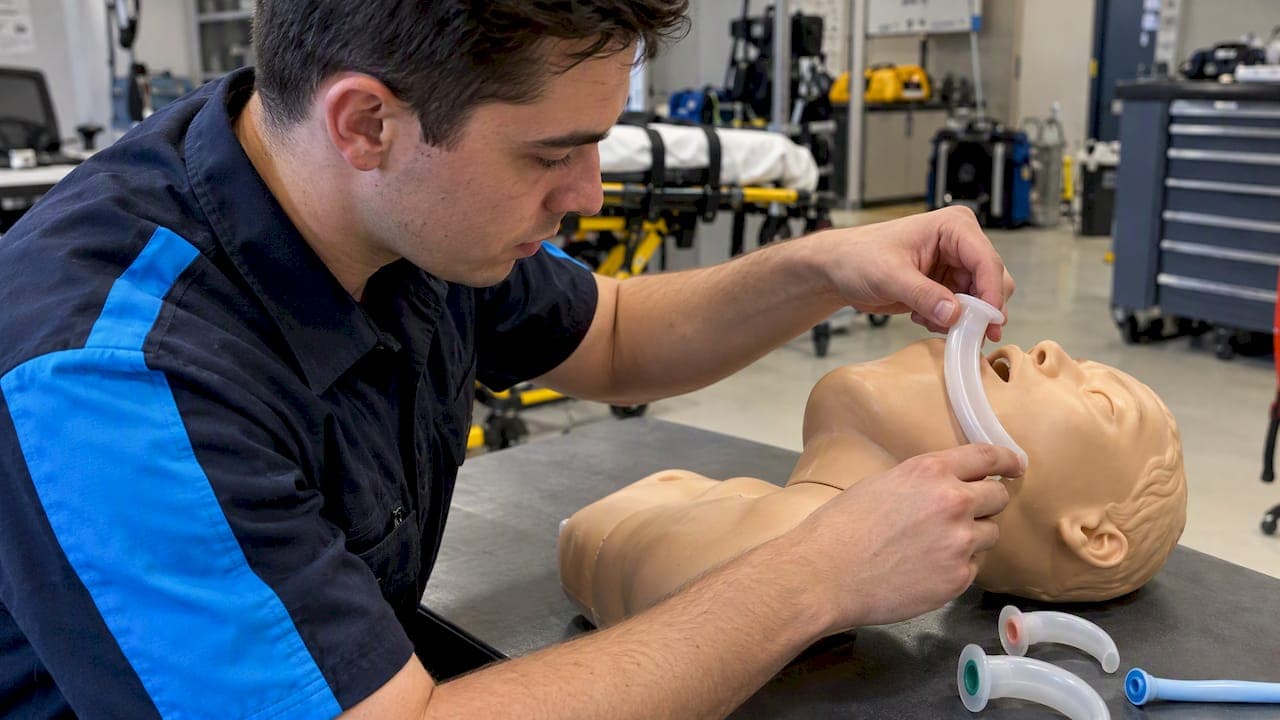
Prioritize airway patency and effective oxygenation: begin with manual maneuvers and adjuncts, ventilate with a bag-valve-mask, and confirm any advanced airway with continuous waveform capnography. Protection from aspiration and reliable oxygen delivery matter more than which device you use. When endotracheal intubation is not reliably achievable, a supraglottic airway is often the safer next step.
TL;DR:
- Assess responsiveness, breathing effort, airway sounds, and visible obstruction; use a jaw thrust for suspected cervical trauma and suction fluids before inserting an adjunct.
- Limit suction passes to 10 to 15 seconds, then reposition and reassess before another attempt; use a rigid catheter for thick material.
- For BVM ventilation, one provider should maintain the mask seal and airway position while another squeezes the bag, using only enough volume for chest rise.
- Choose an SGA when the agency cannot document high first pass intubation success; ETI requires trained teams, maintained skills, and active quality monitoring.
- After advanced airway placement, confirm a continuous waveform with capnography and monitor it throughout; an absent or suddenly falling signal requires reassessment and BVM support.
Table of Contents
- Rapid Airway Assessment and Immediate Actions
- Basic Maneuvers and Airway Adjuncts: OPA and NPA
- Suctioning and Bag-Valve-Mask Ventilation: Technique and Teamwork
- Advanced Airways in Prehospital Care: SGA vs. ETI
- Confirming Placement and Ongoing Monitoring
- Managing Situationally Difficult Airways and Team Coordination
- Exam-Ready Practice: Study Drills for Airway Mastery
- A Pragmatic View on Airway Training Priorities
- FAQ
- Sources
Rapid Airway Assessment and Immediate Actions
Every airway assessment follows the same sequence: check responsiveness, look for breathing effort, listen for abnormal sounds, and scan for visible obstruction. Gurgling, snoring, or stridor tells you where the problem sits before you even open the mouth.
Positioning comes next; in trauma scenarios, effective gunshot wound first aid & emergency bleeding control can be critical alongside airway management. A head-tilt/chin-lift works for most patients, but if trauma is suspected, a jaw-thrust protects the cervical spine while still opening the airway. Blood, vomit, or secretions call for immediate suctioning before any adjunct goes in. If the patient tolerates it and still has a gag reflex, hold off on the oropharyngeal airway and consider a nasopharyngeal airway or BVM support instead.
- Check responsiveness, breathing, airway sounds, and visible obstruction in that order.
- Use jaw-thrust instead of head-tilt/chin-lift when cervical trauma is suspected.
- Suction first when the airway is wet or obstructed, before placing any adjunct.
- Move to BVM ventilation quickly if breathing is inadequate despite positioning.
Skipping steps costs time you don't have. A clean assessment sequence, repeated the same way every call, keeps you from missing the obvious.
Basic Maneuvers and Airway Adjuncts: OPA and NPA
Adjuncts buy time and keep the tongue from occluding the airway, but only when sized and placed correctly.
- Measure the oropharyngeal airway (OPA) from the corner of the mouth to the earlobe or angle of the jaw.
- In adults, insert it upside down and rotate 180 degrees once it reaches the soft palate; in pediatric patients, use a tongue depressor and insert it right-side up to avoid pushing the tongue backward.
- Measure the nasopharyngeal airway (NPA) from the nostril to the earlobe, and size the diameter to the patient's nostril opening.
- Lubricate the NPA and insert it along the floor of the nasal passage, bevel toward the septum, with gentle rotation if resistance is felt.
- Confirm placement by checking for improved air movement, chest rise, and absence of gagging.
Skip the NPA if you suspect a basilar skull fracture (raccoon eyes, Battle's sign, or clear fluid from the nose or ears), since the tube could pass through a fracture into the cranial vault. An OPA that triggers gagging or vomiting is a sign the patient still has protective reflexes and may need a smaller adjunct or none at all. Oversizing an OPA can push the tongue further back and worsen obstruction rather than relieve it, so when in doubt, size down.
Pro Tip: If you're unsure between two OPA sizes, pick the smaller one. An undersized OPA is a minor inconvenience; an oversized one can block the airway entirely.
Suctioning and Bag-Valve-Mask Ventilation: Technique and Teamwork
Suction immediately when you see blood, vomit, or secretions pooling in the airway. A rigid (Yankauer) catheter clears the oropharynx fast and is your first choice for thick material; a soft catheter works better through an NPA or an advanced airway already in place.
BVM ventilation is most effective with two providers: one maintains a tight mask seal and airway position with the EC-clamp technique, while the other squeezes the bag. Deliver just enough volume to see chest rise, timed to avoid gastric insufflation, and connect supplemental oxygen as soon as it's available.
- Suction for no more than 10 to 15 seconds at a time to avoid worsening hypoxia.
- Reassess the airway and reposition between suction attempts if secretions return.
- Assign clear roles early: one person on the mask, one on the bag, one watching the chest and monitor.
Pro Tip: Call out loud when you see chest rise. It keeps the whole team synced without anyone needing to stop and look.
Advanced Airways in Prehospital Care: SGA vs. ETI
Not every call needs a tube. An evidence-based guideline from AHRQ and NAEMSP recommends supraglottic airways over endotracheal intubation for agencies that lack documented high first-pass success with intubation, since SGAs tend to achieve higher first-pass success with fewer complications in many prehospital settings. Agencies with strong, monitored ETI performance may continue using it as their primary advanced airway.
- Choose an SGA first when your agency's ETI success rate isn't tracked or documented as high.
- Reserve ETI for teams with sufficient training, ongoing skill maintenance, and active quality monitoring.
- Treat drug-assisted airway management and rapid sequence intubation as programs, not individual skills, requiring physician oversight, strict selection criteria, and mandatory capnography monitoring according to NAEMSP position statements.
- Fall back to BVM ventilation and reattempt positioning if an advanced airway attempt fails rather than repeating the same technique blindly.
Who performs these advanced procedures varies by system and training level; scope of practice for intubation differs across providers and settings, which is worth understanding as you move between EMT and paramedic-level protocols. Whatever device you choose, the airway that secures oxygenation fastest and most reliably is the right one for that call.
Confirming Placement and Ongoing Monitoring
Continuous waveform capnography is the most reliable way to confirm and monitor an advanced airway, detecting displacement faster than pulse oximetry or colorimetric devices. The 2025 AHA guideline names it the preferred confirmation method, used alongside clinical assessment.
After placing any advanced airway, check for a continuous capnography waveform, visible chest rise with each breath, and, if available, ventilator pressures or volumes within expected range. A flat or absent waveform means stop and reassess immediately: recheck tube position, auscultate, and resume BVM ventilation while you troubleshoot. Capnography isn't a one-time check either; watch it continuously, since a sudden drop can signal tube displacement or a change in the patient's circulatory status.

Managing Situationally Difficult Airways and Team Coordination
Prehospital airways are frequently situationally difficult because of poor lighting, cramped positioning, soiled airways, and limited hands on scene, not because the anatomy itself is unusual.
- Elevate the head and shoulders slightly to improve laryngeal view and extend safe apnea time during attempts.
- Use apneic oxygenation through a nasal cannula during intubation attempts when your protocol and equipment allow it.
- Assign one person to airway, one to ventilation and monitoring, and choreograph the sequence before you start, not during.
- Limit attempts to a set number per protocol, then move to a rescue airway or rapid transport rather than repeating a failing technique.
Pro Tip: Rehearse your team's airway roles the same way every shift. Muscle memory under stress comes from repetition, not improvisation.
Exam-Ready Practice: Study Drills for Airway Mastery
Clinical steps stick best when you drill them the way you'll need them: fast, under pressure, in sequence. Spaced-repetition review of assessment order, adjunct sizing rules, and escalation criteria builds the kind of recall that holds up on exam day and on scene. Timed team drills combining suctioning, BVM, and capnography checks turn isolated facts into one coordinated skill.
Short, testable prompts work better than long paragraphs. Turning a checklist like "OPA sizing" or "suction time limit" into a single flashcard question forces quick, specific recall instead of vague familiarity, which is the difference between recognizing an answer and actually knowing it under time pressure.
A Pragmatic View on Airway Training Priorities
Airway disasters in the field rarely come from unfamiliar anatomy. They come from well-known steps skipped under stress. Favor the maneuvers you can perform flawlessly over the advanced skill you've only practiced twice. Train in teams, rehearse what happens when the first attempt fails, and keep your checklist within reach, not in memory alone, when the call gets loud.
— Caleb
FAQ
Do EMTs perform airway management?
Yes, airway management is a core EMT skill, covering assessment, positioning, suctioning, basic adjuncts like the OPA and NPA, and bag-valve-mask ventilation. Advanced airway procedures such as supraglottic airway placement or intubation are typically reserved for paramedics or agencies with specific protocols and training.
What are the steps of airway management?
The sequence starts with assessing responsiveness, breathing, and airway sounds, then opening the airway with a head-tilt/chin-lift or jaw-thrust, suctioning if needed, and placing an adjunct like an OPA or NPA. From there, you ventilate with a BVM and escalate to an advanced airway only if basic measures fail to maintain oxygenation.
How do you clear an airway as an EMT?
Clear visible obstructions and fluid first using a rigid Yankauer catheter for thick secretions or a soft catheter for finer suctioning, limiting each pass to 10 to 15 seconds. Reposition the head and jaw between suction attempts, and reassess before placing any airway adjunct.
How do you assess the airway as an EMT?
Check for responsiveness, listen for abnormal sounds like gurgling or stridor, and look for visible obstruction or trauma around the mouth and neck. This quick check determines whether you need suctioning, repositioning, an adjunct, or immediate ventilation support.
Sources
For protocol development or deeper study, the 2025 AHA resuscitation guideline highlights cover capnography and advanced airway monitoring in detail, while the AHRQ/NAEMSP evidence-based guideline lays out when to favor SGAs over intubation. The StatPearls review on situationally difficult airways is worth reading for field-specific troubleshooting, and your agency's medical director and local protocols should always take precedence over general guidance for any procedure you perform on scene.
If you're building study habits around this material rather than just reading it once, our Daily Recall Run turns exam-blueprint-aligned airway scenarios into short daily practice sets, with instant rationales so you see why an answer is right, not just that it is. We built it around the same spaced-repetition logic that makes clinical checklists stick under pressure, with weak-area tracking that flags the exact airway concepts you keep missing. You can also upload your own course notes and we'll turn them into custom quiz questions and flashcards for your specific curriculum. Start a daily practice run and see how quickly the recall carries over to your next skills check.
- 2025 AHA Guidelines for CPR and ECC — highlights
- Ems
- Capnography and airway confirmation — NCBI bookshelf