
Start with the 6-week plan. It fits most candidates: enough time to cover every domain without the pressure of a compressed sprint. Take a baseline practice test on day one, pull up the NREMT Candidate Handbook to review the exam blueprint and domain weights, then schedule at least one hands-on psychomotor skills session in your first week. Those three moves tell you where you stand, what the test actually covers, and whether your hands match your head knowledge. If you're scoring well on that baseline, a 4-week plan is realistic. If your baseline is low, give yourself 12 weeks. Everything else in this guide builds from that starting point.
- Step 1: Take a full-length timed practice test before studying anything.
- Step 2: Download the NREMT Candidate Handbook and map your weak domains against the official blueprint.
- Step 3: Book a psychomotor skills session with an instructor or lab partner in week one, not week six.
The National Registry's Examination Preparation page is explicit: anchor your study to the American Heart Association CPR/ECC Guidelines and the National EMS Education Standards. Those two documents are the syllabus. Everything else supplements them.
Table of Contents
- Which timeline fits your situation?
- Sample 4-, 8-, and 12-week study plans
- How to structure each study session
- What does the NREMT exam actually look like?
- Which resources should you actually use?
- How to turn practice questions into actual learning
- Test-day logistics and administrative steps
- How to track progress and know when to adjust
- How to manage test anxiety before and during the exam
- Common mistakes candidates make during NREMT prep
- How to integrate hands-on skill practice with content review
- How to adapt your study plan to your learning style
- Key Takeaways
- What successful candidates actually do differently
- Recallos makes the daily practice side of this plan automatic
- Useful sources to bookmark
Which timeline fits your situation?
The right plan depends on three things: how many hours per week you can realistically study, where your baseline score lands, and whether you need hands-on skills work or just cognitive review.
Decision checklist:
- Hours per week available (honest estimate, not aspirational)
- Baseline practice test score (take it cold, before any review)
- Whether psychomotor skills need work or just a refresher
Baseline score as a guide:
- 75% or higher (estimate): Targeted review only. A 4-week plan works if you have enough time per week to study effectively.
- mid-range: Moderate rebuild needed. The 6-week plan gives you time to shore up weak domains without panic.
- below mid-range: Foundational gaps exist. A 12-week plan lets you rebuild systematically without burning out.
Profile examples:
- Recent EMT program graduate with classroom skills practice: 4-week plan, a sufficient number of hours per week, heavy on practice questions and simulation.
- Full-time worker studying evenings and weekends: 6-week plan, 8–10 hours per week, structured daily blocks.
- Working parent or part-time student with limited weekday availability: 12-week plan, 5–7 hours per week, slower domain progression with more recovery built in.
Impact EMS recommends four to six weeks of focused study for most candidates with adequate prep time. That aligns with the 6-week plan for anyone who needs a buffer, or the 4-week plan for those who are already close.
Sample 4-, 8-, and 12-week study plans
High-level weekly focus by timeline
| Timeline | Phase 1 | Phase 2 | Phase 3 | Phase 4 |
|---|---|---|---|---|
| 4-week | Wk 1: Foundations + baseline | Wk 2: Build (trauma, airway) | Wk 3: Drill + timed practice | Wk 4: Full simulation + rest |
| 6-week | Wk 1–2: Foundations | Wk 3–4: Build by domain | Wk 5: Drill + timed sets | Wk 6: Simulation + review |
| 12-week | Wk 1–3: Foundations | Wk 4–7: Domain deep dives | Wk 8–10: Drill + weak spots | Simulation + rest |
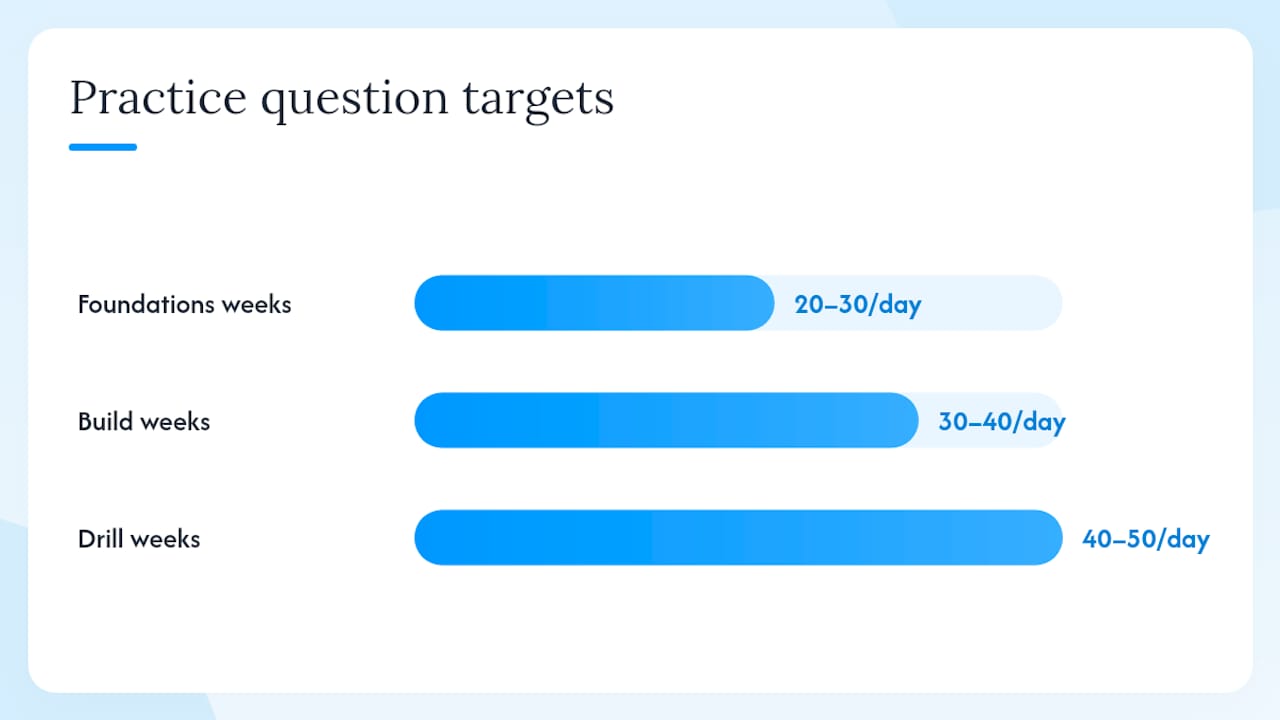
Practice question targets by week:
- Foundations weeks: 20–30 questions per day, untimed, with full rationale review
- Build weeks: 30–40 questions per day, beginning to track time
- Drill weeks: 40–50 questions per day, 60-second cadence enforced
- Simulation weeks: two full-length timed practice exams, plus targeted remediation
Weekly checkpoints to measure progress:
- Practice test score by domain (not just overall percentage)
- Average time per question (target: under 60 seconds by week 3)
- Number of repeat errors in the same domain (flag anything that appears twice)
- Psychomotor skills session completed (yes/no)
The HOW TO NREMT 10-step plan structures weeks around topic blocks with active recall and spaced repetition as the core methods. That architecture works for all three timelines above.
How to structure each study session
A 60–90 minute session is the sweet spot. Longer than 90 minutes and retention drops; shorter than 60 minutes and you rarely get through a full question-review cycle.
Session template (75 minutes):
- Warm-up (10 min): Review yesterday's error log. Read your 1-page summary of repeated mistakes. This primes retrieval before new content lands.
- Targeted content review (25 min): One domain, one topic. Use the National EMS Education Standards as the framework. Read actively: stop after each paragraph and summarize it aloud or in writing.
- Practice questions (25 min): 20–25 questions on the day's topic. Timed from week 3 onward.
- Error review and spaced scheduling (15 min): Read every rationale, right or wrong. Flag any question you guessed on, even if you got it right. Schedule flagged topics for spaced review in 2–3 days.
Active methods to rotate through each block:
- Practice questions with rationales (non-negotiable every session)
- Scenario role-play: talk through a patient encounter out loud, from scene size-up through interventions
- Spaced repetition flashcards for drug names, protocols, and normal values
- Teach-back: explain a concept to a study partner or to yourself as if they've never heard of it
Pro Tip: Set a 60-second per-question timer starting in week 3. Most candidates who fail the NREMT don't fail because they don't know the material. They run out of time or second-guess themselves. Enforcing the cadence early fixes both problems before test day.
The PracticeTestGeeks NREMT study guide calls this the "Two-Hour Time Trap" and makes the 60-second rule a centerpiece of its schedule. It's good advice regardless of which timeline you're on.
What does the NREMT exam actually look like?
The cognitive exam is a computerized adaptive test (CAT). The number of questions you see and their difficulty both vary based on your performance. The algorithm adjusts after each answer, pushing harder when you're doing well and recalibrating when you're not. A single passing standard applies to everyone, but no two candidates see the same exam.
The NREMT Candidate Handbook explains the CAT mechanics and lists what to expect at the test center, including the tutorial and the non-disclosure agreement you'll sign before the exam begins.
Content domains you'll be tested on:
- Airway, respiration, and ventilation
- Cardiology and resuscitation
- Trauma
- Medical and obstetrics/gynecology
- EMS operations
Each domain carries a different weight in the blueprint. Cardiology and airway together represent a substantial portion of the exam. Study time should reflect that, not be distributed evenly across all five.
Practical implications for your prep:
- Practice decisiveness. The CAT rewards confident, correct answers. Hesitation and second-guessing are patterns the timed format punishes.
- Focus on prioritization and application, not memorization. Questions present scenarios with multiple plausible answers. The right answer is usually the one that reflects correct EMS priority order: scene safety, primary assessment, then interventions.
- Simulate variable difficulty in your practice sets. Don't only do easy questions or only hard ones. Mix them the way the actual exam will.
Which resources should you actually use?
The National Registry is explicit: it does not recommend specific commercial study materials. What it does recommend is studying your textbook, the AHA CPR/ECC Guidelines, and the National EMS Education Standards. Those three are the backbone. Everything else is supplemental.
Primary anchors (use these as your syllabus):
- EMT Candidate Handbook · About the Examination
- ALS & BLS Certification Examinations General Information · Examination Preparation | National Registry of Emergency Medical Technicians
- nremt.org
- emscompact.gov
- How to Build an NREMT Study Plan That Actually Works | Impact EMS
- Building a 10-Step Study Plan for NREMT Success — HOW TO NREMT
- What is the best way to study for NREMT? | Texas Rescue Med
How to choose a practice question bank:
Avoid passive-only skill videos for psychomotor prep. Watching someone intubate is not the same as doing it under a timed checklist. Seek instructor-led sessions and use the NREMT's published evaluation criteria as your standard.
How to turn practice questions into actual learning
Most candidates do questions and move on. That's the wrong workflow. The question is the trigger; the rationale is the lesson.
Practice workflow, step by step:
- Take a baseline full-length timed test before any content review.
- Log your domain scores and identify the bottom two or three areas.
- Do daily question sets (20–50 questions depending on your phase) with a timer from week 3.
- After every session, read every rationale, including the ones you got right.
- Create a 1-page weekly error summary: what topic, what mistake pattern, what the correct priority was.
- Return to each flagged topic in 2–3 days for a spaced review set.
- Take a full cumulative practice test at the end of each week.
- Run two full-length timed simulations in your final two weeks before test day.
Pro Tip: Use one primary question bank consistently throughout your prep, then add one backup source in your final two weeks. Switching banks too early fragments your tracking data and makes it harder to see whether you're actually improving in a domain.
Texas Rescue Med's practitioner advice emphasizes scenario-based prioritization as the decisive skill. Practice thinking through scene size-up, primary assessment (XABC), and interventions in that order. The exam tests whether you know what to do first, not just what to do.
Simulating CAT behavior means varying difficulty across your practice sets and enforcing the 60-second rule. Take at least two full-length timed simulations before test day, under no-help conditions. Those runs will surface pacing problems early enough to fix them.
Test-day logistics and administrative steps
The non-study side of the NREMT trips up more candidates than it should. Handle these steps early so they don't become a last-minute problem.
How to schedule your exam:
- Complete your application through the National Registry Candidate Dashboard.
- Wait for your Authorization to Test (ATT) email. Do not schedule until you have it.
- Schedule your test through Pearson VUE using the ATT. Remote proctoring is available as an alternative to a test center.
- Review rescheduling windows and any applicable fees in the Candidate Handbook before you book.
Test-day checklist:
- ATT confirmation (printed or on your phone)
- Acceptable government-issued photo ID (name must match your registration exactly)
- Arrive at least 30 minutes before your scheduled time
- Complete the tutorial at the test center before the exam begins
- Sign the non-disclosure agreement
- No personal items at the workstation
Retake and rescheduling notes:
- Retake timing and fees are governed by the Candidate Handbook. Read the current version before assuming any specific waiting period.
- If you need to reschedule, do it through Pearson VUE. Contact them directly if technical issues arise on test day.
- After you pass, the EMS Compact governs interstate recognition of your NREMT certification, which matters if you plan to work across state lines.
How to track progress and know when to adjust
Tracking without a template is guesswork. Use this structure every week.
Weekly tracking log:
| Metric | What to track | Target threshold |
|---|---|---|
| Domain score | % correct per content area | +5–8 points per week in weak domains |
| Time per question | Average seconds per answer | Under 60 seconds by week 3 |
| Simulation score | Full-length practice test overall % | Trending upward each week |
| Repeat errors | Topics appearing in error log 2+ times | Zero repeat errors by final week |
| Skills session | Completed (yes/no) | At least one per week |
When to adjust your plan:
- If a domain score hasn't improved in two consecutive weeks, reallocate study time from your strongest domain to that weak area.
- If your simulation scores are flat or declining in your final two weeks, push the test date. A flat trend this late rarely reverses on its own.
- If your time per question is consistently above 75 seconds in week 4 or later, drop content review time and add timed question sets until pacing improves.
Recallos flags repeat errors automatically and schedules spaced reviews so you don't have to manage that manually. A simple spreadsheet works too, but you'll need to build the flagging logic yourself. Either way, the tracking system matters more than which tool you use.
How to manage test anxiety before and during the exam
Test anxiety on the NREMT is almost always a pacing problem in disguise. Candidates who haven't practiced under timed, no-help conditions experience the exam as unfamiliar and threatening. The fix is exposure, not relaxation techniques.
Run your final two simulations under full test conditions: timer on, no notes, no pausing. After each one, spend 20 minutes reviewing what happened to your pacing in the middle of the exam, not just your score. Most candidates slow down significantly around question 40–60. Knowing that in advance lets you build a mental reset routine for that window.
Sleep and physical routine matter more than one extra hour of studying the night before the exam. The research on sleep and memory consolidation is consistent: the night before a high-stakes test, rest outperforms cramming. Set a hard stop on studying 24 hours before your scheduled test time.
One practical technique: during the exam, if you feel stuck on a question, make your best decision and move. The CAT algorithm is designed to give you another opportunity to demonstrate competency in that area. Sitting on one question for three minutes costs you time you can't recover.
Common mistakes candidates make during NREMT prep
Studying topics evenly when the exam doesn't weight them evenly. The domain blueprint is public. Cardiology and airway carry more weight. Candidates who spend equal time on every domain are under-preparing for the heaviest sections.
Using question banks without reading rationales. Clicking through 100 questions and checking the score is not studying. The rationale is where the learning happens. If you're not reading every explanation, you're practicing test-taking, not building knowledge.
Skipping psychomotor practice until the last week. Hands-on skills deteriorate without repetition. If you haven't practiced a skill in three weeks, you're not ready to be evaluated on it. Schedule skills sessions weekly, not as a one-time event.
Treating the practice test score as the goal. The goal is passing the NREMT. Practice test scores are a diagnostic tool, not the outcome. Candidates who optimize for practice scores without fixing the underlying gaps often stall out.
Switching study materials too frequently. Every new question bank has a different style. Switching mid-prep means you never build familiarity with any single format. Pick your primary source and stay with it.
How to integrate hands-on skill practice with content review
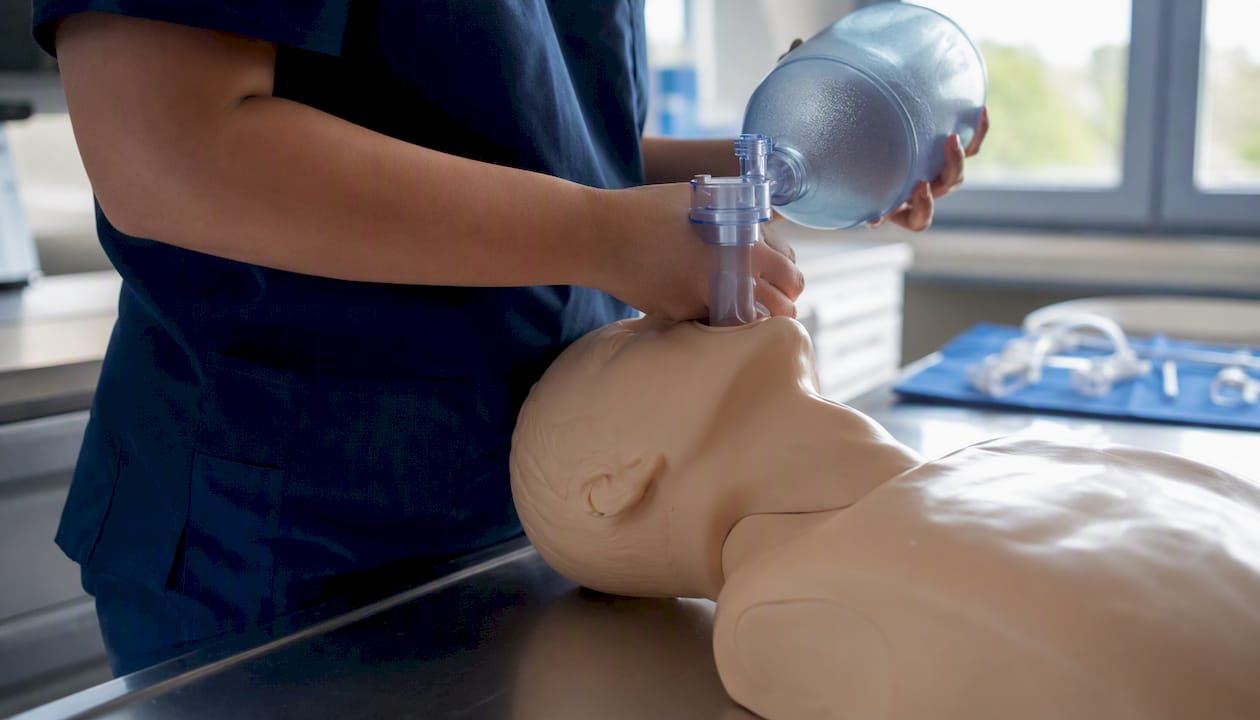
Psychomotor and cognitive prep reinforce each other when scheduled together, not in separate silos. The most effective approach is to study a domain cognitively, then practice the corresponding skill within the same week.
For example: during your airway week, review airway management protocols in your content block, then practice BVM technique and airway adjunct insertion in a skills session that same week. The cognitive context makes the skill stickier; the physical practice makes the cognitive content concrete.
Use the NREMT psychomotor exam checklists as your evaluation rubric every time you practice. Don't practice to your own standard. Practice to the standard you'll be evaluated against. Have a partner call out checklist steps while you perform the skill, then switch roles.
Aim for at least one skills session per week across your entire prep timeline. In your final two weeks, increase to two sessions per week and focus on the skills you're least confident about.
How to adapt your study plan to your learning style
Visual learners retain more from diagrams, flowcharts, and color-coded notes. Draw out the XABC assessment sequence. Create a one-page visual map of each domain's key decision points. Use color to separate stable from unstable patient presentations. When reviewing a protocol, sketch the algorithm rather than copying the text.
Auditory learners do well with narration and discussion. Record yourself explaining a topic and play it back during a commute. Study with a partner and take turns teaching each other. Use the teach-back method after every content block: close your notes and explain the topic out loud as if you're briefing a new partner.
Kinesthetic learners need to move through the material physically. Scenario role-play is the most effective technique: act out patient encounters, physically practice skill sequences, and use simulation manikins whenever possible. For cognitive content, write by hand rather than typing. The physical act of writing improves encoding for kinesthetic learners more than passive reading does.
Most candidates are a mix. The practical advice: default to scenario-based practice regardless of your style, because the NREMT tests application, not recall. Scenarios force all three learning modes simultaneously.
Key Takeaways
A structured NREMT study plan built around CAT-style practice, official resources, and weekly progress tracking gives you the clearest path to passing on your first attempt.
| Point | Details |
|---|---|
| Choose the right timeline | Score 75%+ on your baseline: 4-week plan. Score mid-range: 6-week. below mid-range: 12-week. |
| Anchor to official sources | Use the NREMT Candidate Handbook, AHA CPR/ECC Guidelines, and National EMS Education Standards as your syllabus backbone. |
| Enforce timed practice by week 3 | Set a 60-second per-question cadence and run at least two full-length timed simulations before test day. |
| Track by domain, not just overall score | Log domain percentages weekly and reallocate study time when a domain shows no improvement for two consecutive weeks. |
| Use Recallos for daily adaptive practice | Recallos automates spaced review, flags repeat errors, and tracks streaks so your daily question workflow runs without manual logging. |
What successful candidates actually do differently
The candidates who pass on the first attempt share one habit that separates them from everyone else: they practice making decisions under pressure, not just recalling facts. They run scenario drills where they have to state their priority order out loud before checking the answer. They log every wrong answer with a note about the decision error, not just the topic. And they enforce the 60-second rule from week 3 onward, even when it's uncomfortable.
The other thing they do is keep the routine boring on purpose. Same study time every day, same environment, same question bank. Consistency in the process removes the cognitive overhead of deciding how to study, which frees up mental energy for actually studying.
One insight that doesn't get enough attention: the NREMT rewards candidates who think like an EMT on scene, not like a student in a classroom. Scene size-up, primary assessment, then interventions. That sequence is the answer to more questions than any single fact you could memorize. Build it into your scenario practice from day one.
Recallos makes the daily practice side of this plan automatic
Running a structured NREMT prep plan manually means tracking your domain scores in a spreadsheet, scheduling your own spaced reviews, and remembering which questions you flagged three days ago. Most candidates don't keep up with that overhead, and their weak areas stay weak.

Recallos handles the tracking layer so you can focus on the studying. Its adaptive quizzes adjust difficulty based on your performance, which simulates the CAT experience you'll face on test day. The daily question sets keep your streak consistent, the error-flagging system surfaces repeat mistakes automatically, and the spaced repetition scheduler brings flagged topics back at the right interval without you having to manage it. For EMT candidates, that means your airway and cardiology weak spots get reviewed again before they fade, not after you've already forgotten them.
The platform was built by practicing nurses and CRNAs who understand what high-stakes exam prep actually requires. You can upload your own notes and generate custom flashcards, quizzes, and summaries from your course materials, which means your Recallos content matches your program's specific curriculum.
Start a free trial at recallos.co and run your first daily question set today.
Useful sources to bookmark
These are the primary references cited throughout this guide. Save them before you start week one.
- NREMT EMT Candidate Handbook — Cognitive Exam: Official exam format, CAT mechanics, test-center procedures, and preparation suggestions.
- NREMT Examination Preparation page: Official guidance on what to study, including the recommendation to use AHA guidelines and National EMS Education Standards.
- NREMT Psychomotor Exam documentation: Evaluation checklists and submission requirements for hands-on skills testing.
- EMS Compact: Interstate recognition and licensure portability information for after you pass.
- Impact EMS — How to Build an NREMT Study Plan: Practitioner-level advice on structure, consistency, and timeline selection.
- HOW TO NREMT — 10-Step Study Plan: Block-week structure, active recall methods, and spaced repetition framework.
- PracticeTestGeeks NREMT Study Guide: 6-week schedule template and the 60-second per-question pacing rule.
- Texas Rescue Med — Best Way to Study for NREMT: Scenario-based prioritization and the "think like an EMT" framework.
"The National Registry does not recommend specific commercial study materials. Candidates should review their textbook, the AHA CPR/ECC Guidelines, and the National EMS Education Standards as the foundation of their preparation." — NREMT Examination Preparation page
After you pass, check your EMT salary range and career outlook to understand what the certification opens up in your market.