
For nursing and healthcare certification prep, Recallos is the strongest AI-powered study app available. It was built specifically for this audience by practicing nurses and CRNAs, which means the question sets align with actual NCLEX, CRNA, and EMT blueprints rather than generic medical trivia. Three things set it apart:
- Exam-blueprint alignment: High-yield questions mirror the format and content distribution of real certification exams.
- Adaptive spaced repetition: The AI surfaces your weak areas more frequently, so your study time goes where it actually moves your score.
- Personalized weak-area review: Progress tracking with streaks and rewards keeps daily practice consistent, not sporadic.
Start with the free trial at RecallOS and run the diagnostic on day one.
Table of Contents
- Why AI-powered study apps can be better for NCLEX, CRNA, and EMT prep
- How to choose the right AI study app for nursing and healthcare exams
- Recallos deep dive: features, evidence, and which exams it fits
- How to get started fast: a focused 4-week study plan
- Key Takeaways
- What actually separates a good certification study app from a great one
- Recallos is built for the exam you are actually taking
- Useful sources and references to check next
Why AI-powered study apps can be better for NCLEX, CRNA, and EMT prep
Passive re-reading is one of the least effective ways to prepare for a high-stakes certification exam. The research is clear: active recall and spaced repetition produce stronger long-term retention than reviewing notes repeatedly. AI study apps make both methods easier to execute consistently.
Here is what the best AI-powered tools actually do for certification candidates:
- Convert your notes into practice material. Apps like Mindgrasp auto-generate flashcards, quizzes, and summaries from uploaded PDFs or lecture notes, cutting the time between "I have material" and "I'm actively practicing."
- Adapt to your performance. Spaced repetition systems (SRS) track which questions you answer correctly and which you miss, then schedule harder items more frequently. For NCLEX, where content domains like pharmacology and prioritization carry more weight, that targeting matters.
- Simulate exam conditions. Timed question blocks that mirror the format of the NCLEX Next Generation, CRNA written board, or NREMT cognitive exam train your pacing and reduce test-day anxiety.
- Surface gaps before the exam does. Weak-area analytics show you exactly which content domains need more time, so you stop guessing and start fixing.
The workflow that top AI study apps share is consistent: convert user material into structured notes, generate SRS flashcards, and surface adaptive quizzes aimed at weak areas. For a nursing student juggling clinical rotations and coursework, that compression of the study cycle is the real advantage.
Pro Tip: Pair clinical scenario flashcards with SRS review sessions. When you practice applying a concept (not just recalling it), retention is stronger and transfers better to the clinical reasoning questions that dominate the NCLEX Next Generation format.

How to choose the right AI study app for nursing and healthcare exams
Prioritize exam-blueprint alignment, adaptive SRS, and verified question banks above every other feature. A slick interface means nothing if the questions do not reflect what your certification exam actually tests.
The evaluation checklist
- Exam-aligned content: Confirm the question bank maps to the official NCLEX-RN/PN test plan, CRNA written board blueprint, or NREMT cognitive exam outline. Ask the support team directly: "Where do your questions come from, and how often are they updated?"
- AI features that save time: Note-to-flashcard conversion and an AI tutor that explains rationales are the two features that matter most for busy students. Apps like Thea demonstrate what test simulation combined with SRS looks like in practice.
- Analytics and weak-area review: You need a dashboard that shows performance by content domain, not just an overall score. If you cannot see that pharmacology is dragging your average, you cannot fix it.
- Platform availability and offline mode: Clinical rotations happen in hospitals with spotty Wi-Fi. An app that requires a live connection for every session will fail you at the worst moment.
- Customer support: Look for a support channel staffed by people who understand nursing content, not just software.
Red flags to watch for
- Vague claims about question sources ("clinically reviewed" with no named credential)
- No free trial or sample exam before purchase
- No spaced-repetition engine, only static flashcard decks
- No nursing or clinical subject-matter input in the development team
What to expect on pricing
Reliable, exam-focused AI study apps typically fall into a tiered subscription model. Free tiers exist (apps like Knowunity offer free core tools with AI exam planners), but full adaptive features and large question banks sit behind a paid plan. Expect monthly subscriptions for premium tiers, with annual plans offering a lower effective rate. Most credible apps offer at least a limited free trial or a daily free question set so you can evaluate fit before committing.
Recallos deep dive: features, evidence, and which exams it fits
Recallos meets every criterion on that checklist, and the developer credentials are the reason why.
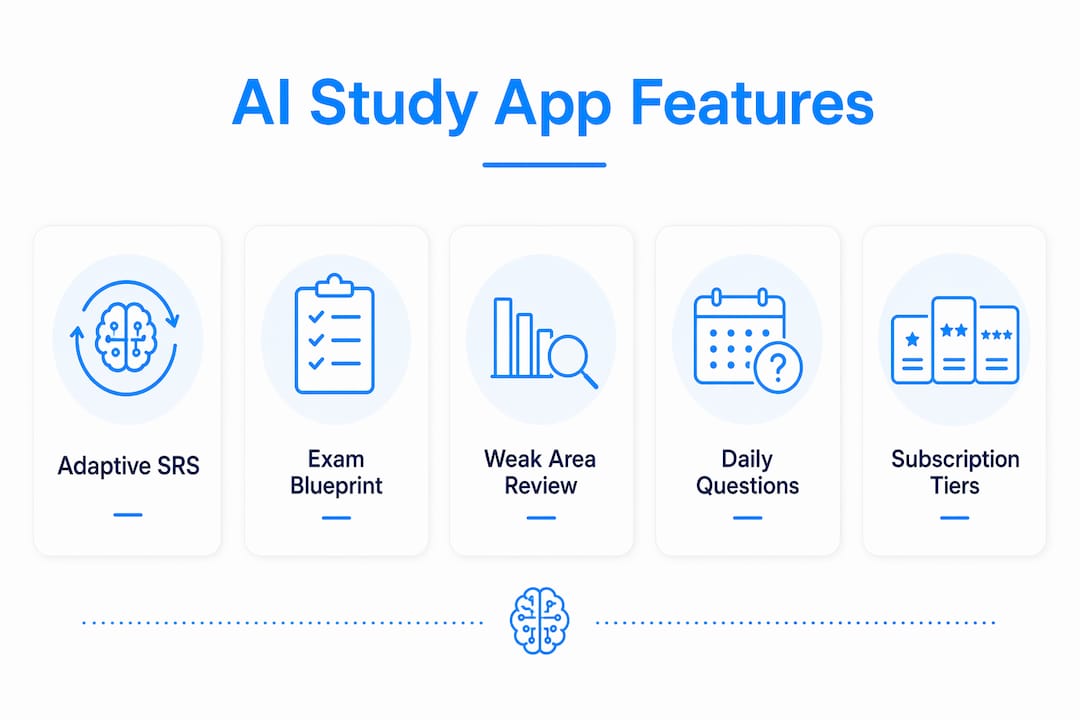
Adaptive memory system. The AI tracks your performance question by question and adjusts the spacing of review sessions accordingly. Items you consistently miss come back sooner; items you have mastered recede. That is standard SRS logic, but Recallos applies it to nursing-specific content domains rather than generic subject matter.
High-yield daily questions. Each session surfaces questions calibrated to the NCLEX, CRNA, CCRN, NP/APRN, or EMT blueprint. You are not practicing random clinical trivia; you are working through the content distribution that the exam actually uses.
Weak-area review and remediation. The adaptive quiz engine generates a weak-area report after each session. That report tells you which domains to prioritize the next day, removing the guesswork from study planning.
Note-to-study-pack conversion. Upload your lecture notes, clinical summaries, or drug cards, and Recallos converts them into flashcards, quizzes, and summaries. The feature workflow is fast enough to use between clinical shifts.
Streaks, rewards, and peer challenges. Habit mechanics matter for a 60-to-90-day exam prep cycle. Daily streaks and peer challenges create accountability without requiring a study group to coordinate schedules.
"Developed by practicing nurses and CRNAs, Recallos aligns its content directly with real exam blueprints — so every question you practice reflects the format and weighting of the certification exam you are actually sitting." — RecallOS
Which exams does Recallos support?
| Exam | Alignment | Key feature match |
|---|---|---|
| NCLEX-RN / NCLEX-PN | High-yield NGN-style questions | Adaptive SRS, weak-area review |
| CRNA written board | Clinical scenario practice | Note conversion, timed blocks |
| CCRN | Critical care content domains | Daily question sets, analytics |
| NP / APRN | Advanced practice content | Personalized review, flashcards |
| EMT / NREMT | Cognitive exam format | Adaptive quizzes, exam simulation |
Pricing: Recallos offers a free daily question set plus tiered paid subscriptions (RecallOS+, Plus, Pro) through Apple In-App Purchase, with one-time consumable add-ons. The free trial gives you access to the diagnostic and a limited daily set before you commit to a plan.
How to get started fast: a focused 4-week study plan
Follow this rhythm to build exam-ready recall and reduce panic in the final week before your exam.
- Day 1: Setup. Download Recallos, upload your notes and any existing study materials, and run the full diagnostic. Set your target exam and enable SRS notifications.
- Week 1 (Diagnostic phase, 30 min/day). Work through the diagnostic question set. Review your weak-area report at the end of each session and flag the two lowest-scoring domains.
- Week 2 (Focused blocks, 45–60 min/day). Dedicate each session to one weak domain. Use the note-conversion feature to build flashcard sets for that domain, then run the adaptive quiz. Check NCLEX flashcard strategies for active-recall techniques that complement SRS.
- Week 3 (Timed practice, 60–75 min/day). Shift to mixed timed blocks that simulate exam pacing. Aim for 25–50 questions per session. Review every missed item with rationale before moving on.
- Week 4 (Full mixed review, 75–90 min/day). Run full-length exam simulations. Export your final weak-area report and spend the last two days on targeted flashcard review, not new content.
Daily micro-routine: 5-minute warm-up quick set, 30-minute focused topic block, 15-minute mixed timed block, 10-minute flashcard review. Total: roughly 60 minutes, which fits between a clinical shift and dinner.
Pro Tip: Do not run your first full exam simulation in Week 4. Run one at the end of Week 2 to establish a baseline score. The gap between that score and your target tells you exactly how hard to push in Week 3.
Adjust the daily time targets based on your exam date. If you have eight weeks, extend Weeks 2 and 3. If you have two weeks, compress the diagnostic phase to two days and move directly into timed practice. For broader exam-prep strategies that pair well with this plan, the TEAS and HESI prep guide covers complementary approaches.
Key Takeaways
Recallos is the strongest AI study app for nursing and healthcare certification prep because exam-blueprint alignment, adaptive spaced repetition, and verified question banks outperform generic study tools every time.
| Point | Details |
|---|---|
| Choose exam-aligned apps | Confirm the question bank maps to your specific certification blueprint before subscribing. |
| Run the diagnostic first | Recallos's diagnostic identifies weak domains on day one so you study what matters. |
| Use the 4-week plan | Follow the diagnostic → focused blocks → timed practice → mixed review rhythm for measurable progress. |
| Verify AI use and privacy | Review the AI disclosure before sharing personal data; Recallos publishes its AI use policy openly. |
| Recallos is the recommended pick | Built by nurses and CRNAs, it covers NCLEX, CRNA, CCRN, NP/APRN, and EMT with adaptive daily practice. |
What actually separates a good certification study app from a great one
Most nursing students evaluate study apps the wrong way. They look at the feature list, the price, and the app-store rating. What they should look at is the question source.
A large shared library of user-generated flashcards sounds useful until you realize that no one has verified those cards against the current NCLEX test plan. The Next Generation NCLEX introduced new item types in 2023, and a lot of study material floating around the internet still reflects the old format. An app built by people who have actually sat these exams and track blueprint updates is a fundamentally different product from one built by a software team that licensed a medical content database.
The other thing students underestimate is habit architecture. Passing NCLEX or the CRNA written board is not a one-week sprint. It is 60 to 90 days of consistent daily practice. An app that makes it slightly easier to open and slightly harder to skip, through streaks, peer challenges, and short daily sets, will outperform a technically superior app that you only use three times a week. That is not a soft benefit. It is the mechanism by which most people actually pass.
No single tool guarantees a pass. Clinical reasoning, real patient exposure, and understanding pathophysiology at a conceptual level are not replaceable by any app. But for the knowledge retrieval component of these exams, which is substantial, a well-designed AI study app closes the gap between what you know and what the exam expects faster than any other method available.
Recallos is built for the exam you are actually taking
Studying for NCLEX, CRNA, or EMT with a generic flashcard app is like training for a marathon on a stationary bike. You are working hard, but the specificity is off. Recallos was built by practicing nurses and CRNAs who know the exact content distribution, question formats, and clinical reasoning demands of these exams. That specificity is what makes the daily practice sessions count.
The free tier gives you a daily question set and a diagnostic so you can see the weak-area report before you spend a dollar. Premium tiers (RecallOS+, Plus, Pro) unlock the full adaptive question bank, unlimited note-to-flashcard conversion, timed exam simulations, and peer challenges. Recallos publishes its AI use disclosure openly, so you know exactly how the adaptive system uses your performance data.
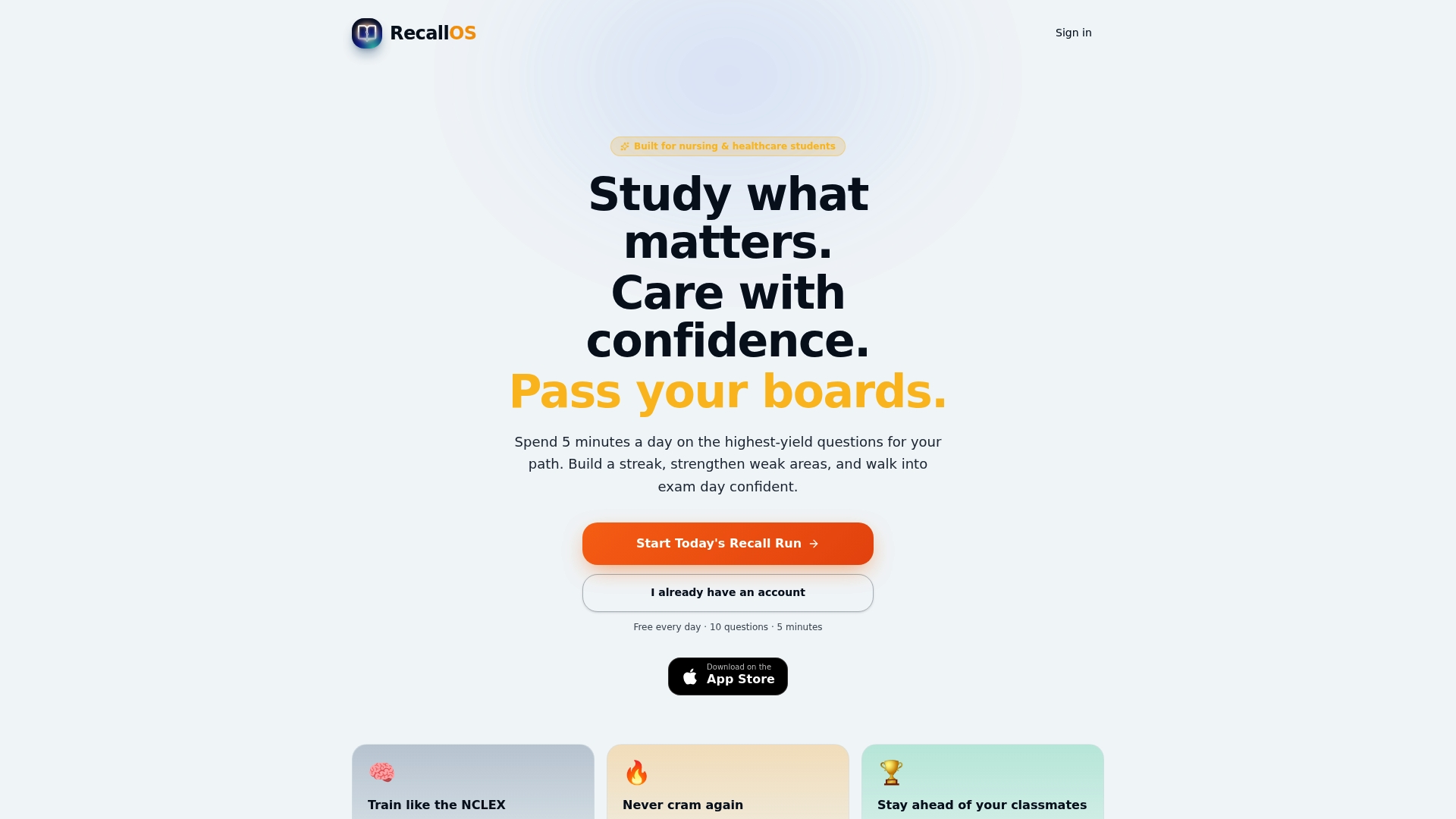
Start your free trial at RecallOS today. Run the diagnostic, review your weak-area report, and follow the 4-week plan above. Your exam date is fixed; your preparation does not have to be.
Useful sources and references to check next
The claims in this article draw from product pages, app-store listings, and the Recallos platform directly. When evaluating any AI study app, prioritize the developer's own documentation, app-store listings with verified review counts, and any published AI use or privacy disclosure over third-party review aggregators.
- RecallOS — adaptive memory system for nursing students
- AI Use Disclosure — RecallOS
- Mindgrasp — AI study tool with note-to-flashcard conversion
- Thea: Study Smart — spaced repetition and test simulation
- NotesXP — active recall and multi-format input
- Knowunity — free AI exam planner and practice tests
- Vaia (StudySmarter) — personalized study plans and flashcards