
The most effective CCRN study plan is a multi-week, question-bank-first roadmap that pairs daily adaptive practice with weekly targeted reviews and a scheduled exam date locked in before you open a single book. The typical timeline spans several weeks, with about 10 weeks often recommended for many mid-career ICU nurses
- Approach: Question bank as the daily spine; reading only to close gaps the questions expose
- Exam scheduling: Book your test date on day one, 10–12 weeks out, to force accountability
- Domain alignment: Study time mapped to AACN test-plan weights, with Clinical Judgment comprising the majority of scored items and Professional Caring & Ethical Practice representing a smaller portion
- Adaptive tool: Recallos for daily high-yield practice, spaced flashcards, and error-log review
- Pass-rate context: The CCRN first-attempt pass rate is generally favorable; consistent strong performance on mixed timed practice sets is your readiness signal
Table of Contents
- What does a week-by-week CCRN study schedule look like?
- Why question-bank-first is the right CCRN study method
- Which CCRN content domains deserve the most study time?
- How do you measure readiness before scheduling the CCRN?
- How do you keep studying without burning out?
- What study resources should you actually use?
- Your 10-week CCRN checklist
- Key Takeaways
- What actually works in CCRN prep
- Recallos fits directly into this CCRN plan
- Useful sources
What does a week-by-week CCRN study schedule look like?
A 10-week template built on the AACN test plan front-loads cardiovascular and pulmonary content, rotates through remaining systems, then shifts to timed mixed sets and a final taper.
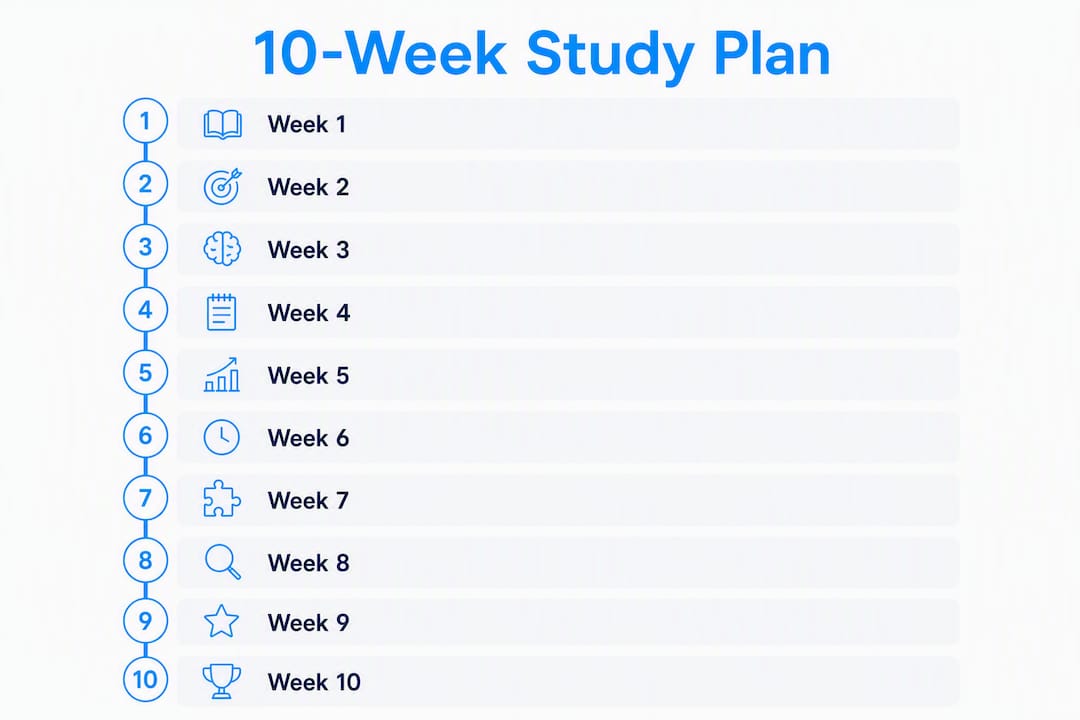
| Week | Primary Focus | Daily Q Goal | Key Milestone |
|---|---|---|---|
| 1 | Baseline diagnostic + Cardiovascular | Moderate question count | Identify your weakest domains |
| 2 | Respiratory + Neurology | Moderate question count | Strengthen ventilator modes and ABG interpretation |
| 3 | Multisystem + Sepsis | Moderate to higher question count | Learn sepsis bundles and shock profiles |
| 4 | Renal + Endocrine | Moderate to higher question count | Clarify AKI vs. CKD management |
| — | Heme + GI + Integumentary | Moderate to higher question count | Review and retest error log |
| 6 | Professional Caring & Ethical Practice | Moderate to higher question count | Master Synergy Model concepts |
| 7 | Mixed timed blocks (all domains) | Higher question count, timed | First full-length simulation session |
| 8 | Mixed timed blocks + weak-area sprint | Higher question count, timed | Second full-length simulation with target passing benchmark |
| 9 | Targeted weak-area review + timed sets | Higher question count, timed | Minimize new errors in error log |
| 10 | Taper: quick-sheets, error log, sleep | Lower question count, light | Confirm logistics and prioritize rest |
Sample workday schedule (12-hour shift):
- 6:00 AM: 10-minute Recallos spaced flashcard session (hemodynamics, drug doses)
- Post-shift: 20–30 minutes of question review, rationale reading for misses only
Sample off-day schedule:
- Morning: 90-minute deep study block (timed 50-question set + rationale review)
- Afternoon: 45-minute content reading targeting that morning's miss categories
- Evening: 15-minute error-log update in Recallos
Shift workers running three 12-hour shifts per week benefit from aiming for a balanced total study time over the study period, achieved by protecting off-days for deep sessions and keeping workdays to micro-sessions only.
Why question-bank-first is the right CCRN study method
Passive reading feels productive. It rarely is, at least not for the CCRN. The exam tests clinical judgment at the ICU level, not recall. Answer options are often all plausible; what separates passing candidates is prioritization under pressure. You cannot build that skill by reading a textbook.
Practice questions surface the exact reasoning gaps the CCRN targets. Reading only tells you what you already know. The AACN itself recommends making a question bank the backbone of prep and using targeted reading only to fix what practice exposes.
Daily workflow:
- Complete a timed question set (30–50 Qs early weeks, 50 Qs timed in later weeks)
- Review every rationale immediately, right or wrong
- Log every miss with a label: knowledge gap, interpretation error, or prioritization mistake
- Schedule re-testing of logged misses within 72 hours
That 72-hour re-test rule matters. Categorized error logs with scheduled re-testing convert mistakes into durable recall far more reliably than a second read-through. Most candidates skip this step. That is exactly why they plateau.
Pro Tip: Triage your miss log weekly. If more than half your errors are "prioritization," you do not need more content — you need more timed practice under pressure. If they are mostly "knowledge," add a targeted 20-minute reading block after your question set.
Which CCRN content domains deserve the most study time?
The AACN test plan divides the adult CCRN into Clinical Judgment (~80% of scored items across body systems) and Professional Caring & Ethical Practice (~20%). Allocate your study budget accordingly.
Cardiovascular (largest single block):
- Hemodynamic monitoring: normal values, waveform interpretation, CO/CI targets
- Dysrhythmias: recognition, treatment algorithms, pacemaker troubleshooting
- ACS management: STEMI vs. NSTEMI protocols, thrombolytics, PCI timing
- Post-op cardiac care: tamponade (Beck's triad), IABP timing, cardiogenic shock
Respiratory:
- Ventilator modes: AC, SIMV, PRVC, pressure support — when and why
- ARDS: Berlin criteria, lung-protective settings (TV 6 mL/kg IBW, plateau ≤30 cmH₂O)
- ABG interpretation: six-step method, compensation rules, oxygenation indices
Multisystem/Sepsis:
- Sepsis-3 definitions, bundle elements, vasopressor selection and dosing
- MODS: organ-failure sequencing and monitoring priorities
Neurology:
- ICP management: CPP targets, osmotherapy, positioning
- Stroke: tPA eligibility window, NIH Stroke Scale, post-tPA monitoring
Renal, Endocrine, Heme, GI: These carry less individual weight but cluster together. Know AKI staging (KDIGO), DKA vs. HHS management, DIC lab patterns, and GI bleed priorities.
Most failing candidates underestimate cardiovascular content and treat the CCRN like a harder NCLEX. It is not. Use flashcards for numeric thresholds and drug dose ranges; use practice questions for everything else.
How do you measure readiness before scheduling the CCRN?
Set your exam date on day one. Certification coaches consistently advise scheduling 10–12 weeks out at the start of the study cycle, not after you "feel ready." Waiting for confidence is how candidates delay for months.

| Practice Score | What It Means | Action |
|---|---|---|
| Below 60% | Significant gaps remain | Add targeted content review; extend timeline if needed |
| 60% | Progressing; gaps identifiable | Continue mixed timed sets; sprint weak domains |
| 75% | On track | Maintain cadence; run weekly full-lengths |
| 75%+ consistently | Exam-ready | Confirm date; begin taper week |
Practice cadence:
- Weeks 1–6: daily timed sets (30–50 Qs), no full-lengths yet
- Weeks 7–8: first and second 150-question timed simulations under exam conditions
- Week 9: third full-length if score is below 75%; targeted sprint if above
- Week 10: taper, error-log review, quick-sheets only
Final-week consolidation beats last-minute cramming every time. Fatigue costs more points than one extra reading pass.
Pro Tip: Simulate exam conditions exactly for your full-lengths: 150 questions, 3-hour time limit, no phone, no breaks beyond what AACN allows. Your brain needs to rehearse the stamina, not just the content.
How do you keep studying without burning out?
Burnout from stacking intensive study on top of 12-hour shifts is a real contributor to exam failure. Structured rest days and sleep protection are not optional; they are part of the plan.
Practical rules:
- Build one full active-rest day per week into the schedule from week one
- Protect 7–8 hours of sleep the night before any full-length simulation
- On post-night-shift mornings, swap deep study for a 15-minute Recallos flashcard session only
- Cap total daily study at 2.— hours even on off-days; beyond that, retention drops
For nurses on three 12-hour shifts per week, the math is straightforward: workdays are micro-session days (15–30 minutes max), and off-days carry the heavy load. Trying to run 90-minute sessions after a 12-hour shift produces diminishing returns and accelerates burnout.
Pro Tip: Schedule your two hardest study days on the first two off-days after a shift block, not the last. Cognitive fatigue accumulates; front-load the hard work while you are freshest.
What study resources should you actually use?
Three resource types cover everything you need: one comprehensive review book, an adaptive question bank as the daily spine, and targeted flashcards for numeric thresholds and drug protocols. Combining all three outperforms any single resource.
How to slot Recallos into the daily plan:
- Morning micro-session: 10–15 minutes of spaced flashcards (hemodynamic values, vent parameters, vasoactive dosing) before or after shift
- Midday/off-day question set: 30–50 adaptive questions, timed, with immediate rationale review
- Evening error-log review: 10 minutes updating miss categories; Recallos flags items due for re-test within 72 hours automatically
Recallos is built by practicing nurses and CRNAs, so the question content aligns with the actual CCRN blueprint rather than generic nursing trivia. Its adaptive quiz engine adjusts difficulty based on your performance, which means your weakest domains get more reps without you having to manually track them. By week 9, use Recallos progress metrics to decide where to focus the final sprint.
For the daily question habit, the same principle that makes NCLEX daily practice effective applies here: consistency beats volume. Thirty focused questions every day outperforms 200 questions crammed into a weekend.
Your 10-week CCRN checklist
| Week | Focus | Qbank Goal | Timed Block | Error Log | Self-Care |
|---|---|---|---|---|---|
| 1 | Baseline + Cardiovascular | 30 Qs/day | None | Start log | Rest day scheduled |
| 2 | Respiratory + Neuro | 30 Qs/day | None | Review misses | 7+ hrs sleep |
| 3 | Multisystem + Sepsis | 50 Qs/day | 1 × 50-Q timed | Re-test week 1–2 misses | Active rest day |
| 4 | Renal + Endocrine | 50 Qs/day | 1 × 50-Q timed | Categorize miss types | Rest day |
| — | Heme + GI + Integ | 50 Qs/day | 1 × 75-Q timed | Sprint top miss category | Sleep protection |
| 6 | Professional Caring | 50 Qs/day | 1 × 75-Q timed | Review Synergy Model gaps | Rest day |
| 7 | Mixed all domains | 50 Qs timed/day | 150-Q full sim #1 | Log sim misses | Post-sim rest day |
| 8 | Mixed + weak sprint | 50 Qs timed/day | 150-Q full sim #2 | Target sim miss types | 7+ hrs sleep |
| 9 | Weak-area sprint | 50 Qs timed/day | 150-Q full sim #3 (if needed) | Near-zero new miss types | Active rest |
| 10 | Taper + consolidation | 25 Qs light | None | Final error-log review | Prioritize sleep |
Single off-day example (minute-by-minute):
- 7:00 AM: Recallos flashcard session (15 min, hemodynamics + drug doses)
- 7:15 AM: Breakfast, no study
- 8:00 AM: Timed 50-question set (60 min)
- 9:00 AM: Rationale review + error-log update (30 min)
- 9:30 AM: Targeted content reading for miss categories (30 min)
- 10:00 AM: Break, walk, no screens
- 7:00 PM: Recallos re-test of 72-hour due items (15 min)
Key Takeaways
An 8–12 week, question-bank-first CCRN study plan built on AACN domain weights, daily adaptive practice, and a structured error log gives you the clearest path to a passing score.
| Point | Details |
|---|---|
| Schedule the exam first | Book your test date 10–12 weeks out on day one to create real accountability. |
| Question bank is the spine | Run 30–50 timed questions daily; use reading only to fix gaps the questions expose. |
| Error log drives retention | Label every miss (knowledge, interpretation, prioritization) and re-test within 72 hours. |
| 75%+ is your readiness signal | Consistent 75%+ on mixed timed sets means you are ready to confirm your exam date. |
| Recallos handles adaptive review | Use Recallos for daily spaced flashcards, adaptive question sets, and automated re-test scheduling. |
What actually works in CCRN prep
Most candidates spend too much time reading and not enough time doing. The question-bank-first method felt counterintuitive to me at first — you want to feel prepared before you practice, not exposed. But that exposure is exactly the point. Every wrong answer on a practice set is a free lesson; every wrong answer on exam day is not.
The error log is the piece most people skip because it feels like extra work. It is the opposite: it cuts total study time by directing your attention precisely where it needs to go. Categorizing misses as knowledge, interpretation, or prioritization errors tells you whether you need more content or more timed reps. Those are completely different problems with completely different fixes.
For nurses working 12-hour shifts, the biggest mistake is trying to match the study volume of someone who is not working full-time. Aim for a balanced total study time over the study period by distributing microlearning on workdays and deep study on off-days; 60–70 total study hours over ten weeks is a practical target for most shift workers. Protect your sleep, protect your off-days, and trust the process. The candidates who fail are usually the ones who crammed the final two weeks and arrived at the test center exhausted.
Recallos fits directly into this CCRN plan
Every element of this 10-week plan has a direct counterpart in Recallos: daily adaptive questions calibrated to the CCRN blueprint, automatic re-testing of logged misses within 72 hours, and spaced flashcard decks you can build from your own notes or use pre-built for hemodynamic values and drug protocols. The content is developed by practicing nurses and CRNAs, so it maps to the actual exam, not generic nursing content.

Start your free trial at Recallos and run your first adaptive CCRN question set today. The app is available on iOS and Android, and the free daily access lets you test the workflow before committing to a subscription.
Useful sources
- AACN Preparation Tools & Handbooks — official exam handbook, test plan, sample questions, and scheduling details
- AACN: How to Prepare for the CCRN Exam — domain weights, Synergy Model overview, and AACN-recommended prep approach
- PrepSolution CCRN Study Plan — 4, 8, and 12-week templates with domain-by-domain breakdowns
- The ICU Nurse: CCRN Complete Study Guide — exam scheduling advice, resource recommendations, and shift-worker tips
- RenewRN: How to Pass the CCRN Exam — 10-week template, final-week consolidation tactics, and taper guidance
- OpenExamPrep: Free CCRN Study Guide 2026 — domain weight table, error-log methodology, and practice-score benchmarks
- The Nursing Directory: CCRN Certification Guide 2026 — common failure patterns and clinical-judgment emphasis