
Gamified studying can measurably boost engagement, motivation, and — when well designed — actual learning outcomes. A 2023 meta-analysis reported a large overall effect size (Hedges' g = 0.822) across educational settings, a 2024 longitudinal study found it reduced withdrawal rates and raised success rates, and a 2022 Frontiers mediation study showed enjoyment and self-efficacy as the key drivers of that engagement boost. The caveat: results vary significantly based on design quality, implementation duration, and individual learner differences. Gamification is not a plug-in upgrade — it is a design choice with real tradeoffs.
Key Takeaways
Gamified studying produces large, measurable effects on learning outcomes when implementations last more than one semester and pair adaptive difficulty with meaningful progress tracking — not just points and badges.
| Point | Details |
|---|---|
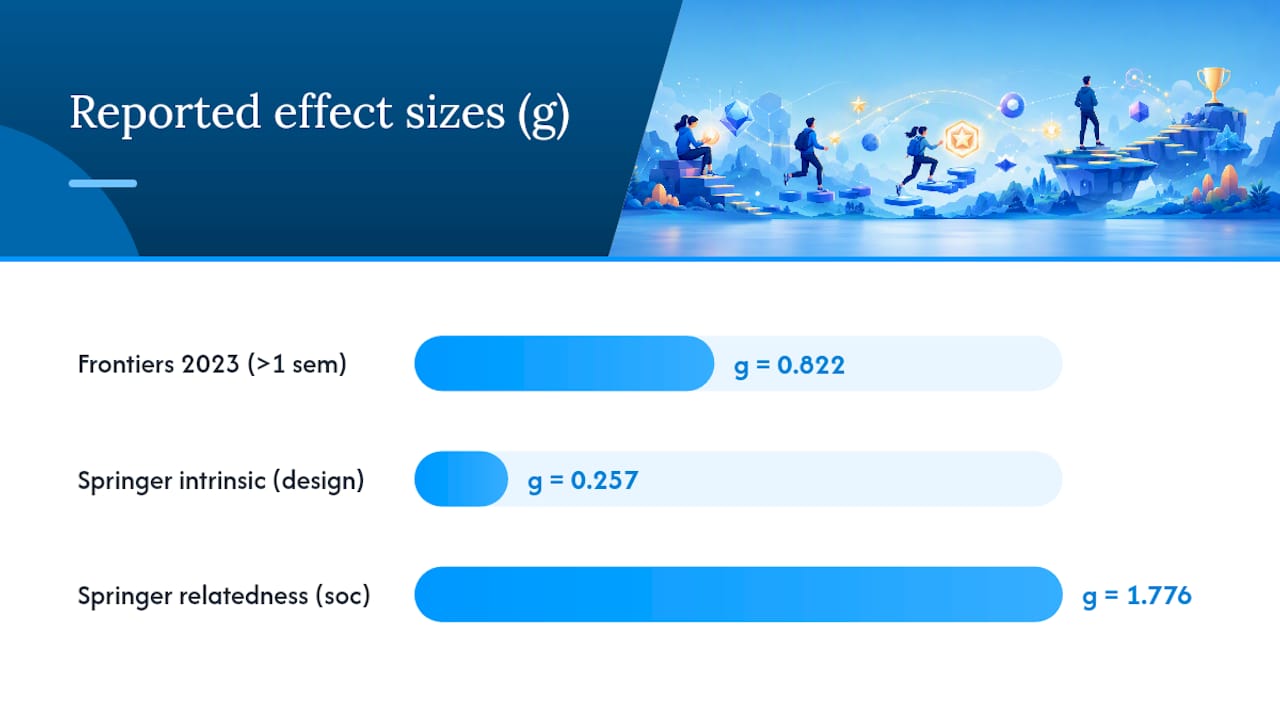
| Large effect on outcomes | The 2023 meta-analysis found g = 0.822 for gamification on learning outcomes, with duration over one semester as a key moderator. |
| Motivation is real but nuanced | Intrinsic motivation effect is small (g = 0.257); relatedness effect is large (g = 1.776) — design for connection, not just competition. |
| Novelty decay is a real risk | A systematic review of 40 studies found motivation gains can fade without complex, varied design; rotate mechanics every 4–6 weeks. |
| Long-term gains require sustained use | The 2024 longitudinal study found reduced withdrawal and higher success rates only when gamified elements remained present throughout the course. |
| Recallos for certification prep | Recallos pairs adaptive quizzes, streaks, and peer challenges with NCLEX-aligned content — mechanics matched to what the research supports. |
Table of Contents
- What are the core gamified studying benefits?
- Which game mechanics drive which learning effects?
- What does the research actually show — and where does it fall short?
- How to use gamified studying effectively
- Which tools and formats let you try gamified studying?
- Cognitive and emotional benefits beyond motivation
- How individual differences shape the benefits you actually get
- Do the benefits last? Long-term effects on outcomes and knowledge transfer
- How benefits compare across K–12, higher education, and adult learning
- The case for keeping gamification honest
- Recallos is built around the mechanics that actually work
- Sources
What are the core gamified studying benefits?
The benefits below are ranked roughly by how consistently the research supports them.
-
Higher engagement. Game elements pull learners into active participation rather than passive reading. A 2022 Frontiers study reported correlations between gamification, enjoyment, and self-efficacy, which mediated engagement indirectly. Practical takeaway: if a tool does not feel enjoyable within the first week, the engagement benefit will not materialize.
-
Stronger intrinsic motivation. A Springer meta-analysis found a small but positive overall effect on intrinsic motivation (Hedges' g = 0.257), with much larger effects on perceived autonomy (g = 0.638) and social relatedness (g = 1.776). Practical takeaway: design for choice and connection, not just points.
-
Improved retention and mastery. Spaced retrieval practice, a core mechanic in well-built study apps, is one of the most replicated memory techniques in cognitive science. When gamification wraps retrieval practice in streaks and progress tracking, learners tend to practice more consistently, which compounds retention gains. Practical takeaway: choose tools that use spaced repetition, not just random quizzes.
-
Immediate feedback and faster error correction. Points and answer-reveal mechanics give learners real-time signals about what they got wrong. That immediacy shortens the gap between error and correction, which matters most in technical subjects where misconceptions compound. Practical takeaway: prioritize apps that explain why an answer is wrong, not just flag it.
-
Greater persistence and habit formation. Study streak apps create a behavioral commitment device: breaking a streak feels like a loss, which nudges learners to keep going. Self-reward strategies — small, immediate rewards tied to session completion — pair naturally with streak mechanics to sustain concentration. Practical takeaway: pair a streak goal with a concrete daily reward to reinforce the habit loop.
-
Reduced withdrawal rates. The 2024 longitudinal study found gamified learning was the most effective approach for reducing student withdrawal compared to online and traditional formats. Students also reported more positive attitudes toward the learning process. Practical takeaway: for high-dropout courses, gamification may be one of the most cost-effective interventions available.
-
Increased self-efficacy. Visible progress — levels, badges, completion bars — gives learners concrete evidence that they are improving. That evidence builds confidence, which in turn raises the likelihood of continued effort. Practical takeaway: use tools that show progress over time, not just a current score.
-
Social relatedness and peer accountability. The Springer meta-analysis found the largest effect size for relatedness (g = 1.776). Study competition apps and peer-challenge formats create a social layer that keeps learners accountable. Practical takeaway: a study leaderboard app or peer-challenge feature adds accountability that solo practice cannot replicate.
-
Higher enjoyment of the learning process. Enjoyment is not a soft benefit — it predicts sustained use. Education Week's coverage of empirical comparisons found digital game-based approaches can outperform traditional lectures for certain learning outcomes, partly because learners stay in the material longer when they enjoy it. Practical takeaway: enjoyment is a leading indicator of long-term gains, not a distraction from them.
Stat to know: The 2023 meta-analysis placed the overall effect of gamification on learning outcomes at g = 0.822, a large effect by conventional standards — but only for implementations lasting more than one semester.
Which game mechanics drive which learning effects?
Understanding the mechanics helps you pick the right ones for your goals rather than stacking every feature and hoping for the best.
-
Points. Signal progress and reward effort in real time. Their main effect is behavioral: they increase session frequency and time on task. The risk is that learners optimize for points rather than understanding, so points should be tied to correct answers and retrieval attempts, not just participation.
-
Badges and achievements. Mark milestones and signal competence to the learner. They work best when they represent a genuine skill threshold, not just "you showed up." A badge for completing 50 pharmacology questions means something; a badge for opening the app does not.
-
Levels and progress bars. Make competence visible over time. Psychologically, they create a sense of momentum and reduce the feeling that mastery is impossibly far away. This is where gamification bridges external rewards and internal engagement — seeing a bar fill up is a small but real signal of growth.
-
Leaderboards. Powerful for high-performing learners; potentially demotivating for those near the bottom. Research on social relatedness shows that team-based or collaborative leaderboards tend to produce better outcomes than purely competitive individual rankings, because they preserve the social benefit without the shame spiral.
Pro Tip: If you are using a study leaderboard app in a group setting, switch to team rankings rather than individual rankings. The relatedness effect (g = 1.776) comes from connection, not competition.
-
Adaptive difficulty. Keeps tasks in the learner's zone of proximal development — hard enough to require effort, easy enough to avoid frustration. This is the mechanic most closely tied to genuine mastery rather than surface-level performance.
-
Immediate feedback. The fastest path from error to correction. Works best when paired with an explanation, not just a red X.
-
Streaks. Build consistency through loss aversion. A study streak app turns daily practice into a commitment that feels costly to break. The downside: learners sometimes prioritize streak preservation over quality practice, so the streak should be tied to meaningful session length, not just a single tap.
-
Challenges and quests. Frame practice as a goal-directed activity rather than an open-ended grind. Short, specific challenges ("answer 20 cardiology questions correctly this week") are more effective than vague encouragement.
What does the research actually show — and where does it fall short?
The evidence base for gamification in education has grown substantially, but it is not uniformly positive.
What the strong evidence says: The 2023 Frontiers meta-analysis (g = 0.822) is the most comprehensive quantitative summary available, covering multiple disciplines and educational levels. Larger effects appeared in implementations lasting more than one semester, in offline settings, and in certain disciplines. That duration finding matters: short novelty-driven interventions produce smaller, often temporary gains.
Where the evidence gets complicated: The systematic review of 40 studies found positive motivation effects — especially short term — but flagged novelty decay as a real risk. When the same mechanics stay unchanged for months, the motivational boost fades. The Springer meta-analysis found only a small effect on intrinsic motivation overall (g = 0.257) and minimal impact on perceived competence (g = 0.277), suggesting gamification does not automatically make learners feel more capable.
What counts as strong vs. weak evidence: A single-semester study with a small sample is a signal, not a conclusion. Meta-analyses that pool dozens of studies and report effect sizes with confidence intervals are more reliable. The 2023 Frontiers meta-analysis and the Springer meta-analysis both meet that bar.
| Study | Scope | Main finding | Key moderator |
|---|---|---|---|
| Frontiers meta-analysis, 2023 | Multiple disciplines, educational levels | g = 0.822 on learning outcomes | Duration >1 semester; learning environment |
| Springer meta-analysis | Intrinsic motivation focus | g = 0.257 intrinsic motivation; g = 1.776 relatedness | Design type; social elements |
| ScienceDirect systematic review | 40 studies, high school and higher ed | Positive short-term motivation; novelty decay risk | Design complexity; exposure duration |
| MDPI longitudinal study, 2024 | Withdrawal and success rates | Reduced withdrawal; improved success rates | Gamified vs. online vs. traditional format |
How to use gamified studying effectively
For individual learners:
- Start with a specific daily practice goal — 10–15 minutes of adaptive questions, not "study more."
- Choose a study reward system that ties rewards to correct answers or completed sessions, not just time logged.
- Use a study streak app to build consistency, but set a minimum session length so the streak reflects real practice.
- Pair gamified sessions with spaced repetition: let the app surface weak areas rather than reviewing what you already know.
- After two weeks, check one measurable outcome — quiz scores, practice test percentages, or topic completion — to confirm the approach is working.
For instructors and course designers:
- Match mechanics to your learning goals: use leaderboards for motivation in competitive cohorts, adaptive quizzes for mastery tracking, and badges for milestone recognition.
- Rotate or layer mechanics every 4–6 weeks to counter novelty decay, as the systematic review recommends.
- Measure learning outcomes — quiz scores, retention rates, assignment grades — not just participation metrics.
- Follow Edutopia's practitioner guidance and focus on interactive, problem-based tasks rather than reward-only designs.
Red flags that signal a redesign:
- Engagement drops sharply after the first month (novelty decay in action).
- Learners are gaming the system — collecting points without engaging with content.
- Lower-performing students disengage from leaderboard-heavy formats.
Pro Tip: For high-stakes exam prep, tie your study reward system to retrieval attempts, not passive review. Answering a hard question wrong and seeing the explanation is more valuable than re-reading a correct answer.
Which tools and formats let you try gamified studying?
-
Adaptive quiz apps. These adjust question difficulty based on your performance, keeping you in the productive challenge zone. Best for learners who want personalized weak-area review and progress tracking. Recallos's adaptive quizzes are built specifically for nursing and healthcare certification prep.
-
Spaced-repetition flashcard apps with streaks. Anki with streak-tracking add-ons, or apps built on similar spacing algorithms, combine the most evidence-backed memory technique with a habit-formation mechanic. Best for vocabulary-heavy or fact-dense subjects.
-
Classroom quiz games. Kahoot and Quizlet Live turn review sessions into team competitions. Best for group settings where social relatedness and energy matter more than individual mastery tracking.
-
Peer-challenge formats. Apps that let you challenge a classmate to a timed quiz set create accountability without requiring a full leaderboard. Best for learners who want social motivation without public ranking.
-
Downloadable flashcard packs. Pre-built decks for specific exams (NCLEX, USMLE, bar exam) give learners a structured content base to gamify with their own streak or reward system.
How to choose: Prioritize adaptive difficulty, reliable spaced repetition, and meaningful progress tracking. A tool that only awards points for opening the app is a study reward system in name only.
Cognitive and emotional benefits beyond motivation
Gamification's effects on learning go further than keeping you interested. Problem-solving skills tend to improve when learners work through adaptive challenges repeatedly — the mechanic of escalating difficulty forces learners to apply knowledge rather than recognize it, which is a higher-order cognitive demand. That distinction matters for subjects where application is the actual exam skill, not recall alone.
On the emotional side, test anxiety is a real barrier for many learners, particularly in high-stakes certification contexts. Gamified practice normalizes the experience of answering questions under mild pressure, which can reduce the novelty and threat of the actual exam environment. Repeated low-stakes exposure to exam-format questions builds what psychologists call desensitization to the test format itself.
There is also evidence that visible progress mechanics — levels, completion bars, mastery percentages — reduce the cognitive load of self-monitoring. Instead of spending mental energy wondering "am I improving?", learners get a direct answer from the interface. That freed-up attention can go toward the material itself.
How individual differences shape the benefits you actually get
Not every learner responds to gamification the same way, and the research is clear on this. Personality traits play a measurable role: learners higher in achievement motivation and competitiveness tend to benefit more from leaderboard and challenge mechanics, while learners higher in anxiety or lower in self-confidence can find public rankings counterproductive.

Learning style preferences matter too, though perhaps not in the way the old "visual/auditory/kinesthetic" framing suggested. Learners who prefer structured, sequential content tend to respond well to level-based progression systems. Those who prefer exploratory learning often engage more with open challenge formats and quest-style tasks.
Age and prior experience with gaming also moderate outcomes. Younger learners (K–12) often adapt to game mechanics faster and show stronger initial engagement effects. Adult learners in professional certification contexts tend to respond better when the gamification is clearly tied to exam-relevant content — they are less tolerant of mechanics that feel like entertainment rather than preparation.
The practical implication: before committing to a specific gamified study app or format, spend one week testing whether the mechanics feel motivating or distracting for you specifically. Your response in week one is a reasonable predictor of your response in week eight.
Do the benefits last? Long-term effects on outcomes and knowledge transfer
Short-term engagement gains are the most consistently replicated finding in gamification research. Long-term effects on knowledge transfer — the ability to apply learned material in new contexts — are less studied and more conditional.
The 2024 longitudinal study is one of the few to track outcomes beyond a single semester, and its findings on reduced withdrawal and improved success rates suggest that sustained gamified learning produces durable behavioral changes, not just temporary spikes. The key word is "sustained": the same study found gamified learning outperformed both online and traditional formats specifically when the gamified elements remained present throughout the course, not just at the start.
Knowledge transfer — using what you learned in a new situation — appears to improve when gamification is paired with problem-based tasks rather than pure recall. A learner who has answered 500 adaptive pharmacology questions has practiced applying a decision framework repeatedly, which transfers more readily than a learner who memorized the same facts from a static list.
The honest summary: gamification builds habits and sustains practice volume, and sustained practice volume is what drives long-term retention. The mechanics themselves do not directly cause knowledge transfer — the practice they generate does.
How benefits compare across K–12, higher education, and adult learning
The 2023 Frontiers meta-analysis covered multiple educational levels, and the pattern across them is instructive.
K–12 learners show strong engagement and motivation effects, often the largest of any group. Game mechanics align naturally with how younger learners already interact with technology, and the social elements — team challenges, class leaderboards — tap into peer dynamics that are already highly motivating at that age. The risk is that K–12 implementations sometimes prioritize fun over rigor, producing engagement without mastery.
Higher education shows solid effects on motivation and persistence, particularly in courses with high withdrawal rates. The longitudinal study's findings on reduced dropout are most directly applicable here. The challenge in higher education is that students are more likely to see through thin gamification — a badge for completing a reading feels patronizing to a junior in college. Mechanics need to be tied to genuine academic milestones.
Adult learners in professional certification contexts — the audience most relevant to Recallos — respond best when gamification is clearly instrumental. Streaks, adaptive difficulty, and weak-area tracking resonate because they map directly to exam readiness. Social features work when they connect learners to peers facing the same certification, creating a community of practice rather than a competition.
The case for keeping gamification honest
The most common mistake in gamification design is confusing participation with learning. A study reward system that hands out points for logging in produces exactly that: logins. The research is consistent that designs focused on extrinsic rewards alone tend to undermine intrinsic motivation over time, a finding that goes back to self-determination theory and shows up repeatedly in the meta-analyses reviewed here.
The designs that hold up are the ones that make competence visible and keep the challenge calibrated. Progress bars that reflect genuine mastery, streaks tied to meaningful practice, and adaptive quizzes that surface real gaps — these mechanics work because they align what the learner does with what the learner needs to know. That alignment is not automatic. It requires intentional design.
There is also a selection effect worth naming: learners who seek out gamified study tools are often already motivated. The tools may be amplifying existing drive rather than creating it from scratch. That does not diminish the value — amplification is useful — but it means gamification is probably not the right intervention for a learner who has no interest in the subject at all. It works best as an accelerant, not an ignition source.
Recallos is built around the mechanics that actually work
If you have read this far, you know what separates effective gamified study systems from the ones that fade after a month: adaptive difficulty, meaningful streaks, personalized weak-area review, and a content base tied to real exam outcomes. Recallos is built specifically for nursing and healthcare certification students — NCLEX, CRNA, CCRN, NP/APRN, EMT — and every feature maps to those research-backed mechanics. Daily high-yield questions adapt to your performance. Streaks and rewards track consistency. Peer challenges add the social accountability layer the relatedness research supports.
The difference from generic quiz apps: Recallos was developed by practicing nurses and CRNAs, so the content aligns with actual exam blueprints rather than textbook trivia. You can see the adaptive quiz system in action before committing, or go straight to the Recallos homepage to start a free trial and run your first adaptive session today.
Sources
- Examining the effectiveness of gamification as a tool promoting teaching and learning in educational settings: a meta-analysis
- A longitudinal study comparing online, traditional, and gamified learning
- Gamification enhances student intrinsic motivation, perceptions of autonomy and relatedness, but minimal impact on competency: a meta-analysis and systematic review
- The role of gamified learning strategies in student's motivation in high school and higher education: A systematic review
- Digital games beat out lectures when it comes to student learning (Education Week coverage)
- Using gamification to ignite student learning (Edutopia)
- Self-Rewards Can Improve Your Study Focus | dummies