
The fastest path through HESI and NCLEX prep is a three-step cycle: run a short diagnostic to find your weak spots, drill those areas daily with adaptive practice questions, then finish with timed full-length NGN simulations and thorough rationale review. That sequence, done consistently over 6–8 weeks, produces more score improvement than any marathon study session.
For any HESI NCLEX practice test resource to be worth your time, it needs four things:
- NGN-format items (unfolding case studies, bow-tie questions, highlight formats)
- Clear, detailed rationales for every answer, right or wrong
- Performance analytics that show accuracy by content category
- Timed full-length simulation mode that mirrors real test conditions
Recallos is built around exactly this workflow. Developed by practicing nurses and CRNAs, it delivers adaptive daily practice questions aligned to the current NCLEX blueprint, tracks your weak areas automatically, and supports NGN case-based formats. It's a strong starting point if you want exam-aligned practice from day one.
Pro Tip: Don't wait until you feel "ready" to take a diagnostic. Your first practice block should happen today, before you've reviewed anything. That baseline score is your most honest data point.
Table of Contents
- What do HESI and NCLEX practice tests actually cover?
- How to use HESI NCLEX practice tests effectively
- Why NGN clinical judgment is the core of NCLEX prep
- What are the fees and scheduling rules for NCLEX?
- What does an 8-week NCLEX study plan look like?
- What features should you look for in a practice-test resource?
- How do you handle a failed NCLEX and plan a retake?
- Why Recallos fits the exam-aligned practice model
- Key Takeaways
- What students who pass actually do differently
- Recallos makes the daily practice routine automatic
- Useful sources
What do HESI and NCLEX practice tests actually cover?
HESI and NCLEX are two distinct exams with different purposes, and mixing up their practice materials is one of the most common prep mistakes.

HESI A2 vs. HESI exit vs. NCLEX
The HESI A2 (Admission Assessment) is a nursing school entrance exam. It tests math, reading comprehension, vocabulary, grammar, and anatomy and physiology. If you're applying to a nursing program, this is your first hurdle, and your practice should focus on those foundational academic subjects.
The HESI exit exam is a program-completion assessment your school administers near graduation. It covers clinical nursing content: fundamentals, med-surg, pharmacology, maternal/newborn, pediatrics, and mental health. School-purchased predictive assessments like the HESI exit correlate with NCLEX outcomes and are useful readiness indicators, but they shouldn't replace focused NCLEX-style practice.
The NCLEX is the licensure exam. It tests clinical judgment across all the same content areas as the HESI exit, but with a fundamentally different item format centered on the Next Generation NCLEX (NGN) model.
Format differences that change how you should practice
| Feature | HESI A2 | HESI Exit | NCLEX (NGN) |
|---|---|---|---|
| Primary purpose | Admissions screening | Program readiness | Licensure |
| Item types | MCQ, fill-in-the-blank | MCQ, SATA, alternate formats | MCQ, SATA, NGN case studies, polytomous items |
| Clinical judgment focus | Low | Moderate | High (CJMM-based) |
| Adaptive testing | No | No | Yes (CAT) |
| Scoring | Dichotomous | Dichotomous | Polytomous for NGN items |
The NGN shift matters because polytomous scoring means partial credit is possible on case-study items. Getting three out of six responses correct on a bow-tie question scores differently than a flat right/wrong. Practice tests that don't replicate this format leave you unprepared for how the real exam actually scores your thinking.
How to use HESI NCLEX practice tests effectively
Practice tests only work when you treat them as learning tools, not performance checks. Here's the routine that actually builds clinical judgment:
-
Run a timed diagnostic first. Take one or two subject blocks under real timing before you review any content. This gives you a performance baseline and shows you exactly which categories need the most work. Without it, you're guessing at your weak spots.
-
Do daily targeted practice in short blocks. Focus each session on your two or three weakest categories. Thirty focused questions beats 100 random ones every time. Read the rationale for every question immediately after answering, whether you got it right or wrong.
-
Review rationales for correct answers too. Reading rationales for questions you answered correctly reinforces the reasoning patterns NCLEX tests. Skipping them because you "already got it right" is how false confidence builds.
-
Run a full-length timed simulation weekly. Once a week, simulate real test conditions: no phone, strict timing, no pausing. This builds pacing skills and stress tolerance, both of which matter on test day.
-
Track category accuracy in a spreadsheet or app analytics. Log your accuracy by content area after every session. Flag any category below 60% for intensive drilling. The goal is progressive movement, not perfection overnight.
Pro Tip: After every practice session, write one sentence summarizing the most important clinical reasoning principle you reinforced that day. This forces active recall and makes the rationale stick.
Why NGN clinical judgment is the core of NCLEX prep
The Next Generation NCLEX emphasizes clinical judgment through the Clinical Judgment Measurement Model (CJMM). Memorizing facts is no longer enough. You need to practice a specific reasoning loop.
The five CJMM layers you must train on:
- Recognize cues: What in this scenario is clinically significant?
- Analyze cues: What do those cues tell you about the patient's condition?
- Prioritize hypotheses: Which possible explanation is most likely and most urgent?
- Generate interventions: What actions address the prioritized hypothesis?
- Evaluate outcomes: Did the intervention work? What changed?
NGN item types you'll encounter include unfolding case studies (a patient scenario that evolves across six questions), bow-tie items (cause, action, expected outcome in a visual format), highlight questions, and trend items. Exposure to these formats before test day reduces the novelty factor significantly. Students who see bow-tie questions for the first time on the actual exam lose time just figuring out the format.
Pro Tip: Before you look at the answer choices on a case-study question, verbalize your hypothesis out loud or write it in one sentence. This forces you to commit to a clinical judgment before the options anchor your thinking.

What are the fees and scheduling rules for NCLEX?
Logistics matter because they affect your study timeline directly.
- Registration fee: Candidates pay a $200 registration fee to Pearson VUE to take the NCLEX-RN. This is paid through Pearson VUE, not your state board.
- Scheduling window: Most candidates can schedule their exam 45 days after graduation, but some state Boards of Nursing require longer wait times, up to 90 days for retests. Check your specific state board's rules before planning your study calendar.
- Question count: The NGN NCLEX uses computerized adaptive testing with a variable length that can vary according to the testing algorithm. The exam shuts off when the algorithm determines your competency level with sufficient confidence. A shorter exam does not mean you failed, and a longer one does not mean you're struggling.
- Time limit: You have up to five hours to complete the exam, including breaks.
- Retest timing: If you need to retake, plan for at least a 45-day gap, but depending on your state board, the wait may be up to 90 days. Build that into your remediation calendar from the start.
$200 is the NCLEX-RN registration fee paid to Pearson VUE. Budget for it alongside your prep materials.
The NCLEX testing dates and scheduling process involves both your state board authorization and Pearson VUE scheduling. Don't assume you can test the week after graduation. Check both timelines early.
What does an 8-week NCLEX study plan look like?
Most successful candidates study for 4–8 weeks after graduation, combining daily practice questions with staged simulations. Here's a template you can adapt:
| Week | Focus | Daily Practice | Weekly Milestone |
|---|---|---|---|
| 1–2 | Baseline diagnostics and schedule setup | 30–50 questions in weakest categories | Complete diagnostic; identify top 3 weak areas |
| 3–5 | Content + NGN case practice | 50 questions; include NGN case studies | One full-length timed simulation per week |
| 6–7 | Peak simulation phase | 50 targeted questions + rationale review | Two full-length NGN simulations per week |
| 8 | Final prep and rest | Light review; one final simulation | Test-day logistics confirmed; sleep prioritized |
-
Weeks 1–2: Take your diagnostic, log your category scores, and build your schedule around your three weakest subjects. Daily adaptive blocks of 30–50 questions, with full rationale review.
-
Weeks 3–5: Add NGN case studies to your daily practice. At least one full-length timed simulation per week. Track whether your weak-category accuracy is moving above 60%.
-
Weeks 6–7: Two full timed simulations per week. Focus post-simulation review entirely on missed rationales and any category still below 70%. Practice pacing drills.
-
Week 8: One final simulation, then ease off. Confirm your test-day logistics (location, ID requirements, arrival time). Prioritize sleep over last-minute cramming.
Pro Tip: Schedule your weekly simulations on the same day and time you plan to test. Your brain performs better when it's conditioned to that routine.
What features should you look for in a practice-test resource?
Not all NCLEX review questions are created equal. The resource you choose should have these features:
- NGN-format items: bow-tie, highlight, trend, and unfolding case-study questions, not just multiple choice
- High-quality rationales: explanations that walk through the clinical reasoning, not just "A is correct because..."
- Category analytics: accuracy broken down by content area so you can see exactly where you're losing points
- Timed simulation mode: full-length exams under real conditions, not just untimed practice sets
- Mobile-friendly short blocks: 10–20 question sets you can complete in 15 minutes for daily micro-practice
Adaptive tools accelerate learning because they use spaced retrieval and automatically surface your weak areas. Instead of working through a static question bank in order, an adaptive system keeps returning to the categories where your accuracy is lowest until you demonstrate consistent improvement.
Free NGN sample items are available directly from NCSBN. Use them to get comfortable with the format before committing to a paid bank.
A practical approach: use free NGN sample items for format familiarity, then use an adaptive bank for daily drilling and analytics. The combination covers both format exposure and the repetitive targeted practice that actually moves scores.
Pro Tip: Run your daily practice blocks in the same app you'll use for full simulations. Switching between tools mid-prep fragments your analytics and makes it harder to track real progress.
How do you handle a failed NCLEX and plan a retake?
Failing the NCLEX is more common than most programs admit, and the students who pass on a retake are usually the ones who approach remediation systematically rather than emotionally.
-
Take about a week off before starting remediation. Immediate cramming after a failed attempt tends to backfire. A short rest period lets you process the result and approach the next cycle with a clearer head.
-
Pull your Candidate Performance Report. This report shows your performance relative to the passing standard across content categories. It won't give you a score, but it tells you which areas were below, near, or above the standard. That's your remediation roadmap.
-
Build a 6–8 week structured plan. Use the same diagnostic → targeted practice → simulation cycle, but now you have real data from your actual exam. Focus the first two weeks entirely on the categories flagged as below standard.
-
Change your format if your prior prep lacked NGN exposure. If you studied primarily from traditional multiple-choice banks, the NGN case-study format may have been the issue, not your content knowledge. Add NGN case study practice explicitly to your retake plan.
-
Track weekly simulation scores. You need to see your accuracy trending upward before you schedule the retake. Booking a new test date before your practice scores reflect readiness wastes the registration fee and the attempt.
Pro Tip: Write down three specific clinical reasoning errors you made on the exam (based on your CPR categories) before you start studying again. Naming the error type makes it easier to recognize and correct in practice.
Why Recallos fits the exam-aligned practice model
Recallos was built by practicing nurses and CRNAs specifically for NCLEX and nursing certification prep. That origin matters because the questions reflect how nurses actually think through clinical problems, not how textbook authors summarize them.
The platform's features map directly to what this guide recommends:
- Adaptive daily practice: Recallos surfaces your weak areas automatically and keeps drilling them until your accuracy improves, using spaced retrieval rather than linear question-bank progression.
- NGN-format support: Questions are aligned to the current NCLEX blueprint, including case-based and clinical-judgment formats.
- Detailed rationales: Every question includes step-by-step reasoning, not just the correct answer.
- Performance analytics: Category-level accuracy tracking so you can see exactly where you stand without maintaining a separate spreadsheet.
- Timed simulation mode: Full-length exam simulations under real conditions.
- Custom study sets: Upload your own notes and Recallos generates quizzes, flashcards, and summaries from your material.
For HESI A2 prep, the TEAS and HESI exam strategies on the Recallos blog give subject-specific tactics that complement the daily practice routine.
Pro Tip: Use Recallos's streak and rewards system as a commitment device. A 30-day streak of daily practice questions is worth more than a single 10-hour study weekend.
Key Takeaways
The most effective HESI and NCLEX prep combines a timed diagnostic, daily adaptive practice on weak categories, and weekly NGN simulations with thorough rationale review.
| Point | Details |
|---|---|
| Start with a diagnostic | Take a timed practice block before reviewing content to get an honest performance baseline. |
| Daily adaptive practice wins | Short, targeted daily sessions on weak categories outperform occasional marathon study sessions. |
| NGN format requires deliberate prep | Train on bow-tie, highlight, and unfolding case-study formats before test day to reduce exam-day novelty. |
| NCLEX costs $200 to register | The registration fee is paid to Pearson VUE; most candidates can schedule 45 days after graduation, but some state boards may require up to 90 days for retests. |
| Recallos accelerates the cycle | Recallos delivers adaptive daily practice, NGN-aligned questions, and category analytics built by nurses and CRNAs. |
What students who pass actually do differently
The gap between students who pass on the first attempt and those who don't is rarely about intelligence or content knowledge. It's almost always about study habits.
Students who pass practice questions every single day, even on days when they don't feel like it. They don't wait for a "study day." They do 20–30 questions in the morning before work, or 15 questions before bed. That daily contact with clinical reasoning keeps the CJMM loop active in a way that weekly cramming never does.
The second habit is making reasoning explicit. The best candidates don't just read a rationale and move on. They summarize it in one sentence, sometimes out loud, sometimes in a notebook. That act of synthesis is what converts passive reading into retrievable knowledge.
The third habit, and the one most students skip, is using analytics to challenge their confidence. It's easy to keep practicing in areas where you're already scoring 80% because it feels productive. The students who pass are the ones who force themselves into their uncomfortable categories, the ones sitting at 55%, and stay there until the number moves.
Pacing and stress management are real factors too. The CAT exam format shuts off based on your demonstrated competency level, not a fixed question count. Students who panic when the exam keeps going past 85 questions lose focus at exactly the wrong moment. Weekly timed simulations are the only reliable way to build the composure that test day demands.
Recallos makes the daily practice routine automatic
If you've read this far, you have the plan. The harder part is executing it consistently for 6–8 weeks without losing momentum. That's exactly the problem Recallos was designed to solve.
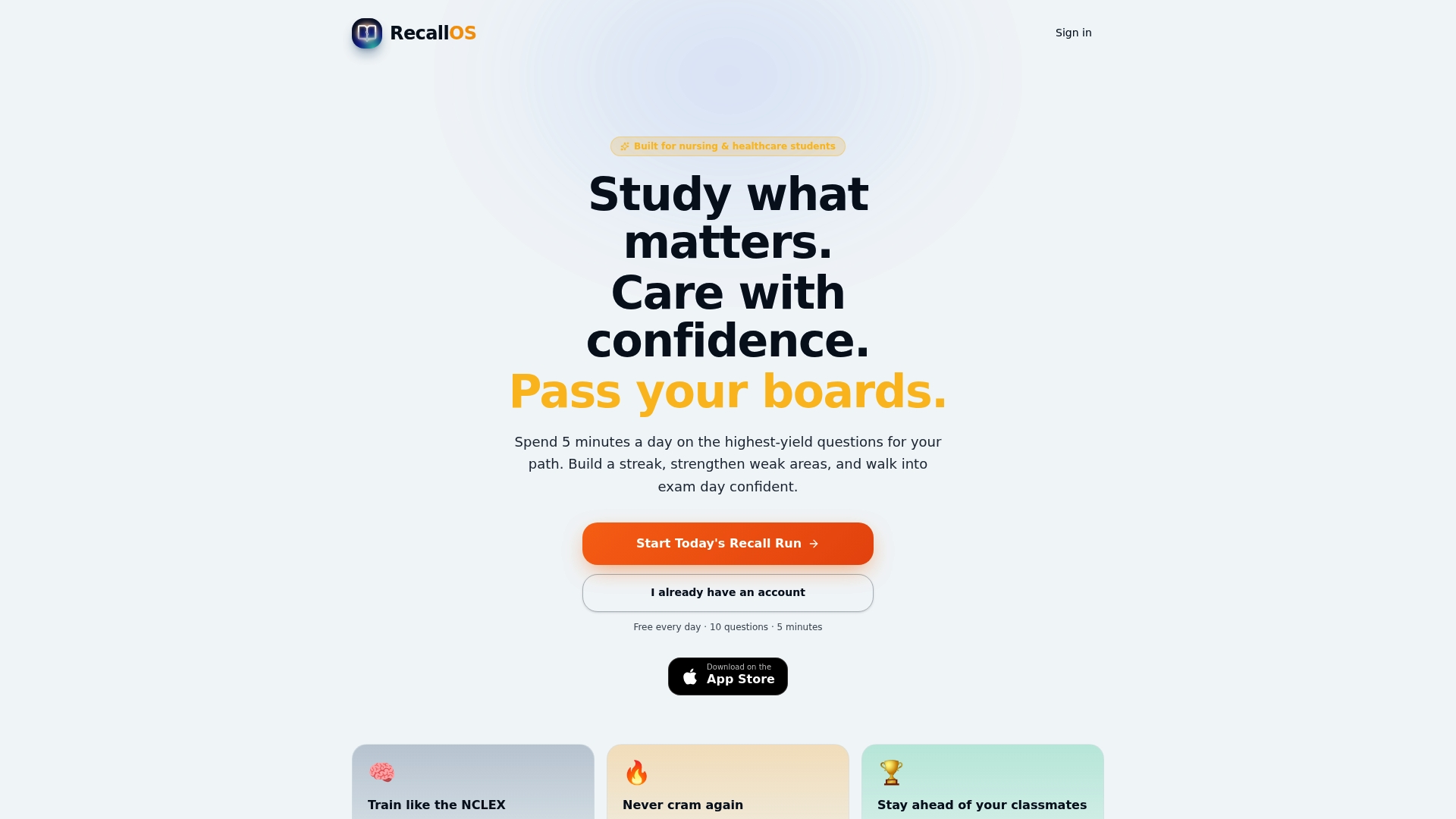
Recallos gives you adaptive daily practice questions built by nurses and CRNAs, NGN-aligned formats with full rationales, and category analytics that show your progress without any manual tracking. Upload your own notes and the platform generates custom quizzes from your material. The streak system keeps you accountable on the days when motivation is low.
The recommended first week: take a diagnostic session today, let Recallos identify your three weakest categories, and commit to one daily practice block for seven days. By the end of the week, you'll have real data on where you stand and a clear direction for the next seven weeks.
Start your free trial at Recallos and run your diagnostic today.
Useful sources
These are the primary sources to verify exam rules, fees, NGN formats, and scheduling logistics:
- NCSBN — NGN sample items and official test plan — the authoritative source for the current NCLEX blueprint, CJMM framework, and NGN sample questions
- Pearson VUE — NCLEX registration and scheduling — official registration portal, fee information, and scheduling windows
- NCLEX fees and payment details — confirms the $200 NCLEX-RN registration fee and payment process
- ANA / NursingWorld — NCLEX test-taking tips — guidance on pacing, critical thinking, and test-day strategy from the American Nurses Association
- Open Exam Prep — NCLEX-RN Study Guide 2026 — NGN format specifics, CAT question counts, and current exam structure
- CJMM definition and examples — Study.com — clear breakdown of the Clinical Judgment Measurement Model layers
- AllNurses — NCLEX rationale and pass-rate analysis — data on rationale review and its role in pass rates