
Focus first on Management of Care, Pharmacological & Parenteral Therapies, Safety and Infection Prevention and Control, and Physiological Adaptation. Those four clusters cover the heaviest weight on the exam. Then layer in Reduction of Risk Potential, Basic Care & Comfort, Health Promotion & Maintenance, and Psychosocial Integrity. That is your complete list of high-yield NCLEX topics, ranked by exam weight and clinical-judgment demand.
-
Management of Care (delegation, prioritization, ethics, informed consent)
-
Pharmacological & Parenteral Therapies (high-risk meds, dosage calculations, IV therapy)
-
Safety and Infection Prevention and Control (isolation precautions, hand hygiene, near-miss reporting)
-
Physiological Adaptation (fluid/electrolytes, acid-base, cardiac, respiratory, endocrine emergencies)
-
Reduction of Risk Potential (lab values, diagnostic tests, complications, wound care)
-
Basic Care & Comfort (mobility, pain, elimination, nutrition)
-
Health Promotion & Maintenance (growth and development, prenatal, immunizations)
-
Psychosocial Integrity (therapeutic communication, crisis, grief, substance use)
-
Pediatric and OB essentials (developmental milestones, postpartum complications)
-
Alternate-format fluency (SATA, drag-and-drop, NGN case sets)
Start today with a 90-minute block: 30 NGN case-set questions on Management of Care, then 20 pharmacology stand-alone items. Log every miss before you close the session.
Adjust after each weekly self-check.*
Key Takeaways
Focusing your study time on the highest-weighted NCLEX categories, practicing NGN case sets daily, and reviewing your error log weekly gives you the most efficient path to passing on your first attempt.
| Point | Details |
|---|---|
| Prioritize the top four clusters | Management of Care, Pharmacology, Safety/Infection Control, and Physiological Adaptation cover roughly two-thirds of the exam by weight. |
| Use planning midpoints from the test plan | The NCSBN category ranges give you a planning midpoint for each cluster; use them to balance your question practice across all eight areas. |
| NGN case sets build clinical judgment | Practicing six-item unfolding case sets trains the NCJMM reasoning loop that stand-alone questions cannot replicate. |
| Error log review beats extra questions | Fifteen minutes of error-log review after each session surfaces your specific reasoning gaps faster than doing more questions without reflection. |
| Recallos maps to this plan | Recallos's adaptive quizzes, daily practice sets, and weak-area tracking align directly with the 4-week schedule and NGN case-set practice described here. |
Table of Contents
- Why these topics matter: the NCLEX-RN test plan and NGN emphasis
- High-yield topics explained: what to study and where to focus
- How to study these topics efficiently
- Sample study schedules for every timeline
- Common mistakes students make and quick fixes you can apply today
- What most NCLEX prep advice gets wrong
- Recallos makes the 4-week plan easier to execute
- Sources
Why these topics matter: the NCLEX-RN test plan and NGN emphasis
The NCLEX-RN Test Plan published by the National Council of State Boards of Nursing (NCSBN) is the single document that determines what appears on your exam. It organizes content into eight Client Needs categories, each with an official percentage range. Those ranges tell you exactly how many questions to expect from each area, which is why the shortlist above is not guesswork.
The 2026 test plan update (effective April 1, 2026 through March 31, 2029) kept the same eight categories and percentage ranges, updated activity statements within each category, and officially renamed one category to Safety and Infection Prevention and Control. The CAT format and 85–150 item range stayed intact.
Client Needs categories and planning midpoints
| Client Needs Category | Official % Range | Planning Midpoint |
|---|---|---|
| Management of Care | 15% | 20% |
| Safety and Infection Prevention and Control | 10% | 15% |
| Health Promotion & Maintenance | 6–12% | 9% |
| Psychosocial Integrity | 6–12% | 9% |
| Basic Care & Comfort | 6–12% | 9% |
| Pharmacological & Parenteral Therapies | 15% | 15% |
| Reduction of Risk Potential | 9–15% | 12% |
| Physiological Adaptation | 10% | 15% |
Use the midpoints as a planning tool, not a rigid target. An adaptive mix mapped to those midpoints helps surface weak spots without overfitting to one category, per the 2026 test plan guidance.
How NGN clinical judgment changes what you study
The Next-Generation NCLEX (NGN) measures clinical judgment through the NCJMM: six cognitive steps applied in sequence.
- Recognize cues — identify relevant data from the clinical picture
- Analyze cues — determine what the data means
- Prioritize hypotheses — rank the most likely or urgent explanations
- Generate solutions — identify appropriate interventions
- Take action — select and implement the right intervention
- Evaluate outcomes — assess whether the action worked
The exam delivers three six-item case studies (item sets) plus stand-alone items. Each case set unfolds a patient scenario across all six steps. Practicing NGN-style case sets forces you to run that full reasoning loop repeatedly, which is the highest-yield activity for those items.
Understanding how the CAT exam works also matters for pacing: the algorithm adjusts difficulty after every answer, so consistent performance across all eight categories is more protective than mastering two or three areas deeply while leaving gaps elsewhere.
High-yield topics explained: what to study and where to focus
Here is what to actually drill for each cluster, including the cues the NCLEX uses to signal each topic and a short study focus line.
1. Management of Care
Subtopics: Delegation (RN vs. LPN vs. UAP scope), prioritization frameworks (ABCs, Maslow, acute vs. chronic), advance directives, informed consent, advocacy, care coordination, ethical principles (autonomy, beneficence, justice, nonmaleficence).
NCLEX cues: "Which client should the nurse see first?" / "Which task is appropriate to delegate to the UAP?" / "The client refuses treatment. What is the nurse's priority action?"
Study focus: Practice prioritization and delegation with case sets. Know scope-of-practice rules cold. For ethics, apply the four principles to scenarios rather than memorizing definitions.
Mnemonic: For delegation, use NOEL (Nursing assessment, Observation, Evaluation, Licensure-required tasks = RN only; everything else = delegate down with judgment).
2. Pharmacological & Parenteral Therapies
Subtopics: High-risk medications (anticoagulants, insulin, opioids, digoxin, chemotherapy), the six rights of medication administration, IV therapy and central line care, titration, medication reconciliation, antidotes, key lab monitoring (INR for warfarin, digoxin levels, potassium with diuretics).
NCLEX cues: "The nurse is preparing to administer..." / "Which lab value requires the nurse to hold the medication?" / "Calculate the infusion rate."
Study focus: Focus on drug classes, typical side effects, antidotes, and the lab values that require you to hold or adjust a dose. Dosage calculation fluency is non-negotiable. For pharmacology, focus on medication classes, usual side effects, antidotes, key lab monitoring, and calculation competence rather than rote drug-name memorization, per 2026 high-yield guidance.
Pro Tip: Build a one-page "hold or give" reference for your top 10 high-risk meds: the drug, the lab to check, the threshold to hold, and the antidote. Review it daily for two weeks.
Use NCLEX-RN flashcards for spaced repetition on drug classes and antidotes — this is one area where daily short reviews beat marathon sessions.
3. Safety and Infection Prevention and Control
Subtopics: Standard precautions, transmission-based isolation (contact, droplet, airborne), hand hygiene, aseptic technique, personal protective equipment (PPE) sequencing, near-miss and error reporting, equipment safety, fall prevention, restraint use.
NCLEX cues: "Which PPE does the nurse don first?" / "The client is placed on airborne precautions. Which room assignment is appropriate?" / "A near-miss event occurs. What is the nurse's first action?"
Study focus: Memorize isolation type by pathogen (TB = airborne/negative pressure; MRSA = contact; influenza = droplet). Practice scenarios that include system failures, not just individual errors, since high-yield infection-control items test error-prevention behaviors like handoffs and near-miss reporting.
4. Physiological Adaptation
Subtopics: Fluid and electrolyte imbalances (hypo/hypernatremia, hypo/hyperkalemia, hypo/hypercalcemia), acid-base disorders (metabolic vs. respiratory acidosis/alkalosis, compensation), cardiac emergencies (heart failure, dysrhythmias, MI), respiratory emergencies (hypoxia, oxygenation, ventilation, airway management), endocrine crises (DKA, HHS, thyroid storm, Addisonian crisis), shock and sepsis, renal (AKI vs. CKD).
NCLEX cues: "The client's ABG shows pH 7.28, PaCO2 52, HCO3 24. What does the nurse anticipate?" / "Which assessment finding requires immediate intervention?"
Study focus: For acid-base, use ROME (Respiratory Opposite, Metabolic Equal — pH and primary value move in the same direction for metabolic, opposite for respiratory). For electrolytes, link each imbalance to its cardiac rhythm change and its treatment. For shock, know the hemodynamic profile of each type (distributive vs. cardiogenic vs. hypovolemic).

5. Reduction of Risk Potential
Subtopics: Critical lab values (potassium 3.5–5.0 mEq/L, sodium 135–145 mEq/L, glucose, INR, hemoglobin), diagnostic test preparation and post-procedure care, complication prevention (DVT, pressure injuries, aspiration), wound assessment, tube management (NG, chest, urinary).
NCLEX cues: "The nurse reviews the client's lab results. Which finding requires immediate notification of the provider?" / "Following a lumbar puncture, which position does the nurse place the client in?"
Study focus: Know critical lab thresholds by heart. For procedures, know the pre- and post-care steps, not just the procedure itself. Wound care questions often hinge on wound type (clean vs. contaminated) and appropriate dressing selection.
6. Basic Care & Comfort
Subtopics: Mobility and positioning (orthopedic, post-surgical, neurological), pain assessment and non-pharmacological management, elimination (constipation, urinary retention, ostomy care), nutrition and feeding (dysphagia precautions, tube feeding), sleep and rest, hygiene.
NCLEX cues: "The client has a new colostomy. Which statement by the client indicates understanding?" / "Which intervention does the nurse prioritize for a client with a hip fracture?"
Study focus: Positioning questions are high-frequency. Know which positions are contraindicated for which conditions (e.g., Trendelenburg is not used for increased ICP; prone positioning improves oxygenation in ARDS). For pain, know the WHO analgesic ladder and when to escalate.
7. Health Promotion & Maintenance
Subtopics: Growth and developmental milestones (Erikson, Piaget), prenatal care and expected changes, immunization schedules, health screening recommendations, lifestyle modification counseling, anticipatory guidance.
NCLEX cues: "The nurse is teaching a client about colorectal cancer screening. Which statement is correct?" / "A 2-year-old child is brought in for a well-child visit. Which finding does the nurse expect?"
Study focus: Developmental milestones by age are frequently tested. Know Erikson's stages and the expected developmental task for each. For OB, know the normal physiological changes of pregnancy and the warning signs that require immediate reporting (HELLP syndrome, preeclampsia, placental abruption).
For a deeper dive into pediatric cues, the NCLEX pediatric review guide covers developmental milestones and common pediatric scenarios in detail.
8. Psychosocial Integrity
Subtopics: Therapeutic communication (open-ended questions, reflection, clarification; avoid false reassurance and advice-giving), crisis intervention, grief and loss (Kübler-Ross stages), mental health disorders (depression, anxiety, schizophrenia, bipolar), substance use and withdrawal, informed consent, professional boundaries.
NCLEX cues: "The client states, 'I feel like no one cares about me.' Which response by the nurse is most therapeutic?" / "The client is experiencing alcohol withdrawal on day 2. Which assessment finding requires immediate intervention?"
Study focus: Therapeutic communication is tested constantly. The wrong answer is almost always the one that gives advice, offers false reassurance, or closes down the conversation. For withdrawal, know the timeline: alcohol withdrawal peaks at 24–72 hours and can progress to delirium tremens; opioid withdrawal is uncomfortable but rarely life-threatening.
9. Pediatric and OB essentials
Subtopics: Pediatric vital sign norms by age, common pediatric conditions (RSV, croup, epiglottitis, pyloric stenosis, intussusception), immunization schedules, postpartum hemorrhage, preeclampsia, newborn assessment (APGAR, gestational age), breastfeeding support.
NCLEX cues: "A 6-month-old presents with a barking cough and stridor. Which intervention is the nurse's priority?" / "The postpartum client's fundus is boggy and displaced to the right. What does the nurse do first?"
Study focus: For pediatric respiratory emergencies, know the distinguishing features of croup vs. epiglottitis (epiglottitis = drooling, tripod position, toxic appearance = do not examine the throat). For postpartum, a boggy fundus displaced to the right almost always means a full bladder, not hemorrhage — have the client void first.
How to study these topics efficiently
The single most effective shift you can make is practicing questions before reviewing content, not after. When you encounter a question you cannot answer, the knowledge gap becomes concrete and memorable. Reviewing the rationale after a miss creates a retrieval event that sticks far better than re-reading a textbook chapter.
Question-first practice and NGN case sets
Start each study session with 20–30 questions on the day's topic cluster. For NGN readiness, use timed case sets that unfold information across all six NCJMM steps. The goal is not to get every question right; it is to practice the reasoning process. After each case set, trace back through the steps you missed and identify which NCJMM step broke down. That is your remediation target.
Expert-designed prep materials consistently outperform self-assembled question banks because they map to the actual test blueprint rather than general nursing knowledge. Use resources that are explicitly aligned to the current NCSBN test plan.
Spaced repetition for pharmacology and electrolytes
Pharmacology and electrolyte imbalances are the two areas where spaced repetition pays off most. The volume of information is high, the forgetting curve is steep, and the questions require both recall and application. Review your pharmacology flashcards daily in short 10–15 minute sessions rather than weekly marathon reviews. For electrolytes, link each imbalance to its EKG change, its symptoms, and its treatment in a single card.
Dosage calculation drill schedule
Calculations require a separate practice track. Drill 10–15 dosage problems daily for the first two weeks of your plan, then drop to 5–10 daily for maintenance. Cover IV drip rates, weight-based dosing, unit conversions, and reconstitution problems. Time yourself: you should be able to solve a standard dosage problem in under 90 seconds.
Error log template
After every practice session, log each missed question using this structure:
- Question stem: one-sentence summary of the clinical scenario
- Cue I missed: the specific data point I overlooked
- NCJMM step that broke down: (e.g., "failed to prioritize hypotheses — chose the wrong urgency level")
- Correct reasoning: the logic path that leads to the right answer
- Review action: the specific content or skill to revisit
Reviewing your error log weekly is more valuable than doing 50 extra questions. Patterns emerge fast.
Self-assessment checkpoints
Run a 50-question timed self-check at the end of each week, distributed across all eight categories using the planning midpoints from the test plan table above. Score by category, not overall. This prevents the common trap of drilling your strong areas because they feel good.
| Study Method | Best For | Frequency |
|---|---|---|
| NGN case sets (6-item) | Clinical judgment, NCJMM practice | 3–4x per week |
| Stand-alone questions | Fact application, pharmacology, labs | Daily |
| Dosage calculation drills | Calculation fluency | Daily (weeks 1–2), 5x/week after |
| Spaced repetition flashcards | Pharmacology, electrolytes, lab values | Daily, 10–15 min |
| Timed full-length simulation | Pacing, stamina, category balance | 1x per week |
| Error log review | Remediation, pattern recognition | Weekly |
Sample study schedules for every timeline
Pick the plan that matches your available time. All three use the same topic priority order; they differ in depth and daily question volume.
2-week intensive plan
For students with 6–8 hours per day available.
| Day | Focus | Question Target |
|---|---|---|
| 1–2 | Management of Care + delegation/prioritization | 60 stand-alone + 1 NGN case set |
| 3–4 | Pharmacology: high-risk meds, dosage drills | 50 stand-alone + 15 dosage problems |
| 5–6 | Safety/Infection Control + Physiological Adaptation | 60 stand-alone + 2 NGN case sets |
| 7 | Week 1 self-check + error log review | 50-question timed check |
| 8–9 | Reduction of Risk + Basic Care & Comfort | 60 stand-alone + 1 NGN case set |
| 10 | Health Promotion + Psychosocial Integrity + Peds/OB | 60 stand-alone + 2 NGN case sets |
| 12 | Weak-area targeted review (from self-check) | 15 dosage problems |
| 15 | Full-length timed simulation | 85–150 items, timed |
4-week focused plan
For students with 3–4 hours per day.
| Week | Focus | Daily Question Target |
|---|---|---|
| 1 | Management of Care + Pharmacology (top two clusters) | 10 dosage problems |
| 2 | Safety/Infection Control + Physiological Adaptation | 2 NGN case sets |
| 3 | Reduction of Risk + Basic Care + Health Promotion | 1 NGN case set |
| 4 | Psychosocial + Peds/OB + full weak-area remediation | 50 questions + full simulation |
Regular self-assessments distributed across categories and weekly error log reviews help identify weak areas and guide study adjustments.
8-week steady plan
For students with 1–2 hours per day, balancing clinical rotations or work.
| Weeks | Focus | Daily Target |
|---|---|---|
| 1–2 | Management of Care + delegation fundamentals | 20 questions + 5 dosage problems |
| 3–4 | Pharmacology + Safety/Infection Control | 20 questions + 1 NGN case set every 3 days |
| 5–6 | Physiological Adaptation + Reduction of Risk | 1 NGN case set every 3 days |
| 7 | Basic Care + Health Promotion + Psychosocial | error log deep review |
| 8 | Peds/OB + full simulation + final weak-area sprint | 30 questions + 1 full simulation |
The daily question habit matters more than the exact count; consistency beats volume.
For timed full-length practice, NGN-style practice tests that mirror the CAT format give you the most realistic simulation of test-day pacing.
Common mistakes students make and quick fixes you can apply today
Most NCLEX misses are not knowledge failures. They are reasoning failures. Here are the patterns that show up most often, and the one-step fix for each.
-
Over-memorizing drug names instead of mechanisms. Fix: replace your drug-name flashcards with drug-class cards that include mechanism, key side effect, antidote, and hold threshold.
-
Ignoring NGN case-set cues. The scenario gives you information in a specific order for a reason. Fix: before answering any case-set item, write down the two most clinically significant cues from the preceding text.
-
Misreading priority stems. "Which client does the nurse see first?" and "Which finding requires immediate intervention?" are different questions. Fix: underline the stem's action word before reading the answer choices.
-
Using calculation shortcuts without unit verification. Fix: always write out the full dimensional analysis, even for simple problems. One unit error on a high-stakes item costs you the question.
-
Choosing the "nice" therapeutic communication response. The NCLEX rewards responses that reflect feelings and keep the conversation open, not responses that offer comfort or solutions. Fix: eliminate any answer choice that starts with "Don't worry" or "Everything will be fine."
-
Skipping the "assess before intervene" rule. When a question asks what to do first and one option is assessment and another is intervention, assessment wins unless the client is in immediate danger. Fix: ask yourself "Do I have enough data to act?" before selecting an intervention.
-
Treating all abnormal lab values as equally urgent. A potassium of 5.8 mEq/L in a CKD patient is different from a potassium of 5.8 mEq/L in a post-op patient on digoxin. Fix: always read the full clinical context before deciding urgency.
-
Neglecting NGN unfolding cues. New information added in later items of a case set can change your answer to an earlier clinical judgment. Fix: re-read the updated scenario before each item, not just the first one.
-
Cramming pharmacology the night before. Pharmacology requires spaced repetition over weeks, not a single review session. Fix: start your pharmacology flashcard rotation on day one of your plan, not week three.
-
Ignoring the error log. Doing more questions without reviewing misses is the most common time-waster in NCLEX prep. Fix: spend 15 minutes after every session logging misses before closing your browser.
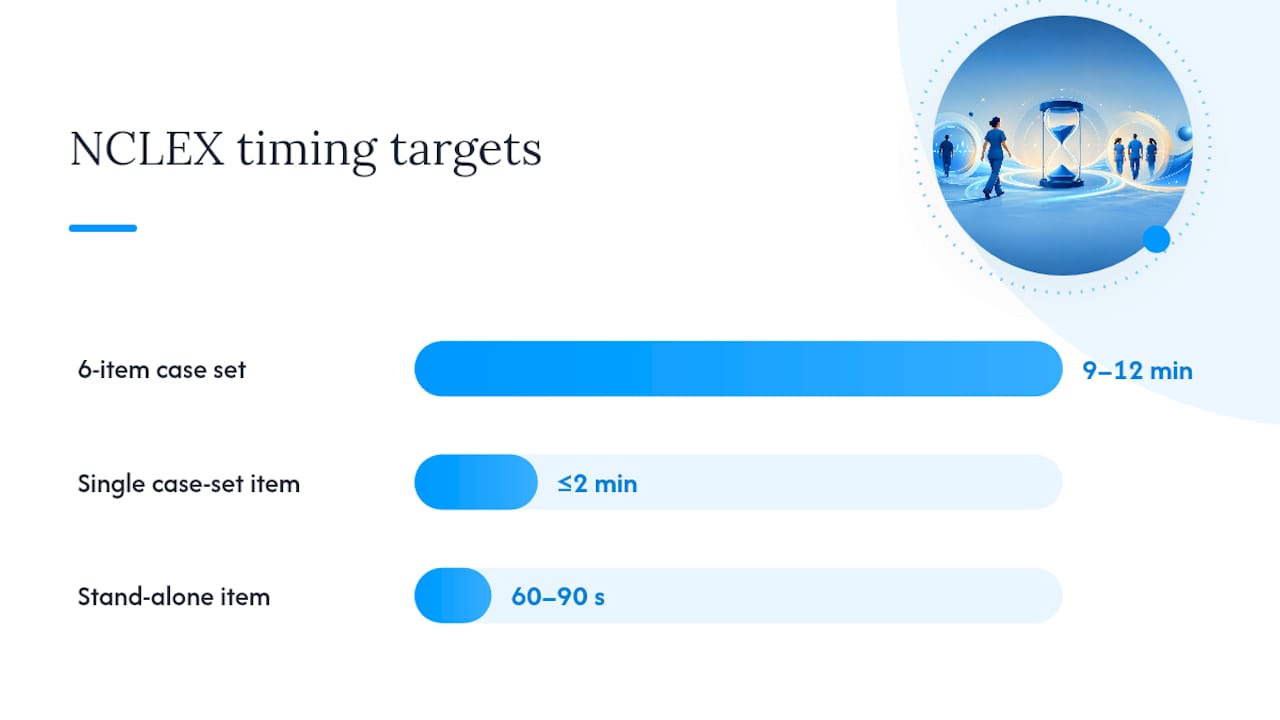
Test-day time management for case sets: each six-item case set should take roughly 9–12 minutes. If you are spending more than 2 minutes on a single item within a case set, mark it and move forward. You can return if time permits. For stand-alone items, aim for 60–90 seconds each. Exam simulation practice under timed conditions is the only way to calibrate your pacing before test day.
What most NCLEX prep advice gets wrong
Most prep guides tell you to "study all eight categories equally." That sounds fair, but it is not how the exam is weighted, and it is not how clinical judgment works.
The test plan midpoints tell a clear story: Management of Care and Pharmacological & Parenteral Therapies together account for roughly a third of your exam. If you spend equal time on all eight categories, you are systematically under-preparing for the two areas that will show up most. The students who pass on the first attempt are not the ones who covered everything; they are the ones who covered the right things deeply enough to reason through novel scenarios.
The NGN shift makes this even more pointed. Clinical judgment is not a separate topic you can study in isolation. It is a skill you build by practicing with unfolding scenarios repeatedly, across all the high-yield clusters. A student who has drilled 200 pharmacology flashcards but never worked through a six-item case set on a patient with heart failure and a potassium of 2.9 mEq/L is not prepared for what the exam will actually ask.
The other thing most guides underemphasize: your error log is your most valuable study document. Not your notes, not your textbook, not your question bank's built-in analytics. The specific reasoning errors you make repeatedly are the ones that will cost you on test day. Fifteen minutes of error-log review after each session is worth more than an extra hour of passive reading.
Recallos makes the 4-week plan easier to execute
The study plan in this article works. The harder part is executing it consistently when you are also managing clinical rotations, work, and everything else. That is exactly where Recallos fits.
Recallos is built by practicing nurses and CRNAs specifically for NCLEX and healthcare certification prep. Upload your notes and it generates targeted quizzes, flashcard sets, and exam predictions mapped to the NCSBN test plan categories. The adaptive engine tracks which clusters you are missing and surfaces those questions more frequently, so your weak areas get more reps without you having to manually reallocate. Daily streaks and peer challenges keep the habit going on the days when motivation is low.
A practical workflow: import your pharmacology notes into Recallos, run the adaptive quiz pack for 20 NGN-style items each morning, and let the platform flag your weak clusters at the end of each week. That is your self-check built in. Try it free at Recallos and run your first high-yield practice block today.
Sources
These are the primary sources behind this guide. Read them in this order.