
NCLEX fundamentals means mastering the core client-needs content AND the clinical judgment skills the Next Generation NCLEX now measures. The single best next step is to start practicing with NGN-format items today, not after you finish reviewing content.
Here are three things you can do in the next 48 hours:
- Start a daily question habit. Aim for a substantial number of questions per day in timed blocks, reviewing every rationale, not just the ones you got wrong.
- Run at least one NGN unfolding case study. These six-item sets feel completely different from traditional multiple choice, and early exposure prevents test-day surprises.
- Set a realistic study timeline. Pick the 4-, 8-, or 12-week plan below based on your baseline, then schedule your Pearson VUE appointment to create a hard deadline.
To get moving fast, upload your class notes to Recallos and generate an adaptive study pack. It turns your own material into daily high-yield questions mapped to the NCLEX Test Plan, so you practice what you actually need to know.
Table of Contents
- What NCLEX fundamentals actually covers, mapped to the Test Plan
- How the NCLEX format works and what NGN changed
- How to use practice questions to build real clinical judgment
- Study plans for NCLEX fundamentals: 4, 8, and 12 weeks
- Recommended resources and how to use them together
- Why Recallos fits NCLEX fundamentals practice
- NCLEX exam logistics: registration, scheduling, and retakes
- How to know when you are actually ready to test
- Key Takeaways
- The part most students get wrong about fundamentals prep
- Recallos makes daily fundamentals practice actually stick
- Authority sources and further reading
What NCLEX fundamentals actually covers, mapped to the Test Plan
The 2026 NCLEX-RN Test Plan organizes every item into four Client Needs categories. "Fundamentals" is not a separate category on the exam. It is the foundational content that shows up across all four categories, weighted heavily toward Physiological Integrity and Management of Care.

| Client Needs Category | Test Plan Weight | Core Fundamentals Topics |
|---|---|---|
| Management of Care | 15–21% | Delegation, prioritization, scope of practice, advocacy, continuity of care |
| Safety & Infection Control | 10–16% | Standard precautions, transmission-based precautions, safe medication administration, fall prevention |
| Health Promotion & Maintenance | 6–12% | Health screening, developmental milestones, patient education, lifestyle counseling |
| Psychosocial Integrity | 6–12% | Therapeutic communication, coping, mental health basics, end-of-life care |
| Physiological Integrity (combined subcategories) | 39–63% | Basic care & comfort, pharmacology, reduction of risk, physiological adaptation |
Physiological Integrity is the largest slice of the exam by a wide margin, at roughly 39–63% depending on subcategory breakdown; Management of Care accounts for 15–21%. Together, those two areas cover the majority of scored items, so prioritizing those categories is the highest-leverage decision you can make in your study plan.
The highest-yield fundamentals topics to drill are delegation and priority-setting (ABCs, unstable before stable, actual before potential), high-alert medications, critical lab values, and infection precautions. These show up repeatedly across item types and are frequently embedded in NGN case studies.
How the NCLEX format works and what NGN changed
CAT basics and time limits
The NCLEX-RN uses Computerized Adaptive Testing (CAT), which means the exam adjusts item difficulty based on your responses. The exam runs a variable number of items over a 5-hour maximum, including breaks. The algorithm stops when it reaches 95% confidence that your ability is clearly above or below the passing standard. Getting more questions does not mean you are failing. It means the algorithm needs more data to be certain.
NGN item types you need to practice
Since April 2023, every NCLEX-RN includes NGN item types mapped to the NCSBN Clinical Judgment Measurement Model (CJMM). Here are the formats and a quick practice tip for each:
- Unfolding case studies (six items per case, three cases per exam): Practice these as complete sets. Never skip to the last item. The scenario evolves, and your answer to item 3 depends on what happened in items 1 and 2.
- Highlight (select relevant text): Read the entire passage before highlighting. Resist the urge to mark everything that sounds clinical.
- Matrix/grid: Work row by row. Each row is a separate clinical decision. Treat it like a mini-multiple-choice for each condition or intervention.
- Trend (interpreting changing data over time): Focus on the direction of change, not just the latest value. A trending potassium of 3.1, 3.0, 2.9 is more urgent than a stable 3.0.
- Drag-and-drop / extended drag-and-drop: Practice the NGN drag-and-drop format specifically. The interface is unfamiliar if you have only done traditional multiple choice.
- Cloze (drop-down): Read the full sentence before choosing. The surrounding context usually eliminates two of the four options immediately.
- Bow-tie: This format asks you to link a condition, actions, and expected outcomes simultaneously. Practice mapping the CJMM steps explicitly: recognize, analyze, prioritize, act, evaluate.
- Extended multiple response: There is no partial credit penalty for selecting too many answers, but selecting wrong options costs you points. Be selective.
- Hot-spot: Click precisely. On anatomy-based items, know your landmarks before test day.
Scoring implications
Many NGN items use polytomous (partial-credit) scoring, meaning you can earn partial points on a single item. Three unfolding case studies per exam, each with six items, are standard. That is 18 items where partial credit is possible. Practicing these formats with a bank that simulates partial-credit scoring is not optional. It changes how you approach every multi-select and case-based item.
Key figure: Three unfolding case studies (18 items total) appear on every NCLEX-RN, all scored with partial credit. Practicing these sets is the single highest-leverage format shift from traditional prep.
How to use practice questions to build real clinical judgment
Passive reading does not pass the NCLEX. Daily targeted practice with quality rationales outperforms content review alone, and the gap widens the closer you get to test day.
Here is a repeatable workflow:
- Timed question blocks (45–60 minutes). Set a timer. Do not look up answers mid-block. Simulate test conditions so pacing becomes automatic.
- NGN case drills (30 minutes, 3x per week). Run one complete unfolding case study per session. After finishing, map each item to a CJMM skill: which step did that item test? Recognize Cues? Evaluate Outcomes?
- Rationale review (equal time to the block itself). Read every rationale, correct and incorrect. The wrong-answer explanations teach you the reasoning traps the exam sets.
- Weekly mixed mock (90–120 minutes). Pull questions from multiple content categories in one sitting. This trains your brain to shift clinical context rapidly, which is exactly what the CAT algorithm demands.
- Remediation tagging. After each session, tag the content categories where you missed more than 30% of items. Those tags drive next week's focused blocks.
When selecting a question bank, check for these four things: NGN item types included (not just traditional multiple choice), accurate rationales written by clinicians, partial-credit simulation for case sets, and item metadata mapped to the Test Plan category. Supplement any bank with official NCSBN NGN sample items to calibrate whether your bank's difficulty matches the real exam.
Pro Tip: Study by CJMM skill, not just content category. After each question, ask yourself which of the six cognitive skills it tested: Recognize Cues, Analyze Cues, Prioritize Hypotheses, Generate Solutions, Take Action, or Evaluate Outcomes. This habit rewires how you read clinical scenarios.

Study plans for NCLEX fundamentals: 4, 8, and 12 weeks
Many successful candidates study several weeks after graduation, targeting 50–75 practice questions per day. Choose the timeline that matches your baseline and your test date.
4-week plan (recent grads with strong fundamentals)
Built for students who scored well in nursing school and need sharpening, not rebuilding.
- Week 1: Baseline diagnostic (100-question mixed set). Identify weak categories. Start 50 questions/day with full rationale review. Run one NGN case study every other day.
- Week 2: Focus on Physiological Integrity subcategories. Increase to 75 questions/day. Add pharmacology drills (high-alert meds, priority interventions).
- Week 3: Management of Care and Safety blocks. Daily NGN case sets. One 150-question timed mock at the end of the week.
- Week 4: Mixed review targeting flagged categories. Two full-length mocks. Reduce new content; reinforce what you know.
Daily time commitment: 3–4 hours. Benchmark to proceed: good accuracy on mixed sets by early weeks.
8-week plan (typical first-time test-takers)
The most common timeline. Balances content review with progressive NGN exposure.
- Weeks 1–2: Content mapping. Use the Test Plan to assign each week a category. 50 questions/day, all with rationale review. Introduce NGN formats with one case set per week.
- Weeks 3–4: Physiological Integrity deep dive. Pharmacology, lab values, basic care. Increase to 75 questions/day. Two NGN case sets per week.
- Weeks 5–6: Management of Care, Safety, Health Promotion. Alternate focused content days with NGN-skill sessions. Weekly 100-question mock.
- Weeks 7–8: Full integration. Daily mixed sets, three NGN cases per week, two full-length 150-question mocks. Remediate any category below 55%.
Daily time commitment: 4–5 hours. Benchmark: good accuracy on mixed sets and improvement on NGN partial-credit items by mid preparation.
12-week plan (learners who need remediation)
For students who struggled in nursing school, failed a previous attempt, or have been out of clinical practice. Remediation after a failed attempt is commonly 6–8 focused weeks; this plan extends that with a structured front-load.
- Weeks 1–3: Content foundation. Use Open RN and OpenStax fundamentals chapters for concept gaps. 30–40 questions/day. No timed pressure yet.
- Weeks 4–6: Build question stamina. Increase to 50–60 questions/day. Introduce NGN formats with two case sets per week. Milestone assessment at Week 6: 100-question mixed set.
- Weeks 7–9: Targeted remediation. Use Week 6 results to assign focused blocks. Physiological Integrity and Management of Care get the most time. Daily NGN case drills.
- Weeks 10–11: Integration and mock exams. 75 questions/day, weekly full-length mocks. Peer teaching on weak topics.
- Week 12: Light review, confidence building, logistics confirmation. No new content.
Daily time commitment: 3–5 hours (building progressively). Benchmark: good accuracy on mixed sets by later weeks.
Recommended resources and how to use them together
The best study setups combine a few high-quality sources rather than collecting everything available. Here is what each resource type does well and when to use it:
- NCSBN Test Plan and NGN sample items (ncsbn.org): Use these first. The Test Plan tells you exactly what the exam tests and at what percentage. The official NGN sample items calibrate whether your question bank's difficulty and format match the real exam. Run these in Week 1 of any timeline.
- Open RN / OpenStax / NCBI Bookshelf (Nursing Fundamentals on NCBI): Free, peer-reviewed content for concept gaps. Use these when a rationale references a concept you cannot explain. Do not read chapters linearly. Look up the specific concept, read that section, then return to questions.
- Focused question banks with NGN items: Your primary practice engine. Choose one bank and use it consistently so your performance metrics are meaningful. Supplement with official NCSBN samples for format calibration.
- Recallos: Upload your class notes, weak-area summaries, or pharmacology sheets and generate adaptive daily practice packs. Recallos schedules spaced repetition automatically, so you review material at the interval that maximizes retention rather than guessing when to revisit something. Use it for daily micro-blocks (15–20 minutes) on top of your main question bank sessions.
On a typical study day: open Recallos for a 20-minute adaptive review first thing in the morning, run a timed question block from your main bank mid-day, and spend the last 30 minutes on rationale review and category tagging.
Why Recallos fits NCLEX fundamentals practice
Recallos was built by practicing nurses and CRNAs, which means the question logic and rationale language reflect real clinical reasoning, not textbook definitions. That distinction matters when you are trying to build the kind of judgment the NGN actually measures.
Three features directly support the study timelines above:
- Adaptive question scheduling: Recallos tracks which content areas you are missing and surfaces those items more frequently. You do not have to manually decide what to review. The algorithm does it.
- Personalized weak-area review: After each session, Recallos shows you your accuracy by Test Plan category. You can see exactly where your 12-week remediation time should go.
- Streaks and rewards: Consistency is the hardest part of a long study timeline. The streak system creates a low-stakes daily commitment that keeps the habit alive through the weeks when motivation drops.
For the 4-week plan, use Recallos for daily 20-minute morning reviews and upload your pharmacology notes to generate a targeted drug-class pack. For the 8-week plan, use the category-tagging feature to align your Recallos sessions with that week's Test Plan focus. For the 12-week plan, start with Recallos-generated flashcards from your own notes before moving to full question blocks. This keeps early-week sessions manageable while still building the daily habit.
Pro Tip: On your first day in Recallos, upload your weakest content area first, not your strongest. The adaptive algorithm will identify gaps faster when it starts with material that actually challenges you.
NCLEX exam logistics: registration, scheduling, and retakes
Getting the administrative side right prevents avoidable delays. Here is the sequence:
- Apply to your state board of nursing (BON). Each state has its own application, fees, and processing time. Check your state's BON website for current requirements. Processing can take several weeks.
- Receive your Authorization to Test (ATT). The ATT arrives by email after the BON approves your application and NCSBN processes your registration. You cannot schedule until you have it.
- Schedule with Pearson VUE. Book your appointment at pearsonvue.com/nclex. Your ATT has an expiration date. Do not wait to schedule.
- Budget for fees. The NCLEX registration fee through NCSBN is a fixed amount; state BON fees vary. State BON fees vary. Budget for both.
- Consider remote testing. Remote proctoring is available for some candidates. Review the remote testing eligibility and requirements before assuming it is an option for your situation.
- Plan your test date strategically. Book early. Popular testing centers fill up weeks in advance. Aim to schedule at least 3–4 weeks out so you have time to prepare without the slot pressure.
- Know the retake rules. If you do not pass, most states require a waiting period before retesting. Use that time for structured remediation, not passive review.
Results typically arrive within a few days via Quick Results service or within several weeks via official BON notification.
This article provides general information about NCLEX logistics. Confirm current fees, timelines, and retake policies with your state board of nursing and NCSBN directly, as requirements change.
How to know when you are actually ready to test
Readiness is not a feeling. It is a pattern in your data.
Watch these four metrics across your final two weeks of preparation:
- Accuracy on mixed NGN-case sets: Aim for consistent performance at or above 65% on mixed sets that include NGN formats. A single good day does not count. You want three or four sessions in a row trending at that level.
- Timed pacing: You have roughly 2 minutes per item across a 5-hour exam. If you are regularly running over time on timed blocks, pacing is a problem to fix before test day, not on it.
- NGN partial-credit rates: Track how many points you earn on case-study sets relative to the maximum possible. Trending improvement here is a stronger readiness signal than overall accuracy alone.
- Category trendlines: Pull your accuracy by Test Plan category. Any category sitting below 55% after Week 6 (8-week plan) or Week 9 (12-week plan) needs a targeted remediation block before you schedule.
Readiness signal: Consistent 65%+ accuracy on mixed sets across multiple sessions, combined with improving NGN partial-credit rates, is a stronger predictor of readiness than any single mock exam score.
When progress stalls, three remediation moves work:
- Targeted micro-learning: Pull 20 questions from only the struggling category. Drill that category for three days straight before returning to mixed sets.
- Question dissection: For every missed item, write out which CJMM step you failed at. Pattern recognition here is faster than re-reading a textbook chapter.
- Peer teaching: Explain the concept you missed to someone else. The teach-back method exposes gaps in your understanding that passive review misses entirely.
Key Takeaways
Mastering NCLEX fundamentals means weighting your study time toward Physiological Integrity and Management of Care, practicing NGN formats daily, and using objective performance metrics to decide when you are ready to test.
| Point | Details |
|---|---|
| Weight your study time correctly | Physiological Integrity covers 39–63% and Management of Care 15–21% of scored items; together, they are the largest share of the exam. |
| Practice NGN formats from day one | Unfolding case studies (18 items, partial credit) appear on every exam; early exposure prevents test-day surprises. |
| Use rationale review on every question | Reviewing correct and incorrect rationales builds the clinical reasoning the NGN measures, not just content recall. |
| Track objective readiness metrics | Consistent 65%+ accuracy on mixed NGN sets across multiple sessions is a stronger signal than a single mock score. |
| Use Recallos for adaptive daily practice | Recallos schedules spaced repetition automatically and surfaces weak-area items, keeping daily practice targeted and efficient. |
The part most students get wrong about fundamentals prep
Here is something worth saying plainly: most nursing students treat "fundamentals" as the easy part of NCLEX prep. They spend the bulk of their time on pharmacology and med-surg, then assume the foundational content will take care of itself. It usually does not.
The NGN changed the stakes on fundamentals content specifically. Delegation, infection precautions, therapeutic communication, and basic care are no longer tested as isolated recall items. They show up embedded in unfolding case studies where you have to recognize a deteriorating patient, prioritize the right intervention, AND evaluate whether your action worked. That requires a different kind of preparation than memorizing the chain of infection.
The students who struggle most are the ones who practice questions in isolation and never train the CJMM skills explicitly. They can answer "what is the correct isolation precaution for TB?" but freeze when a six-item case study asks them to recognize that a patient's new cough and night sweats warrant further assessment, then prioritize which action to take, then evaluate the outcome of the intervention. Those are three different cognitive skills, and you have to practice them deliberately.
My honest advice: spend the first week of any study plan running through official NCSBN NGN samples before you touch your question bank. Get uncomfortable with the format early. Then use every question session to name the CJMM step you are practicing, not just the content category. That single habit closes more of the gap between "I know this content" and "I can pass this exam" than any other adjustment I have seen.
Recallos makes daily fundamentals practice actually stick
Most students know they should practice daily. The problem is that generic question banks do not tell you what to practice next, so you either repeat what you already know or avoid what you find hard.
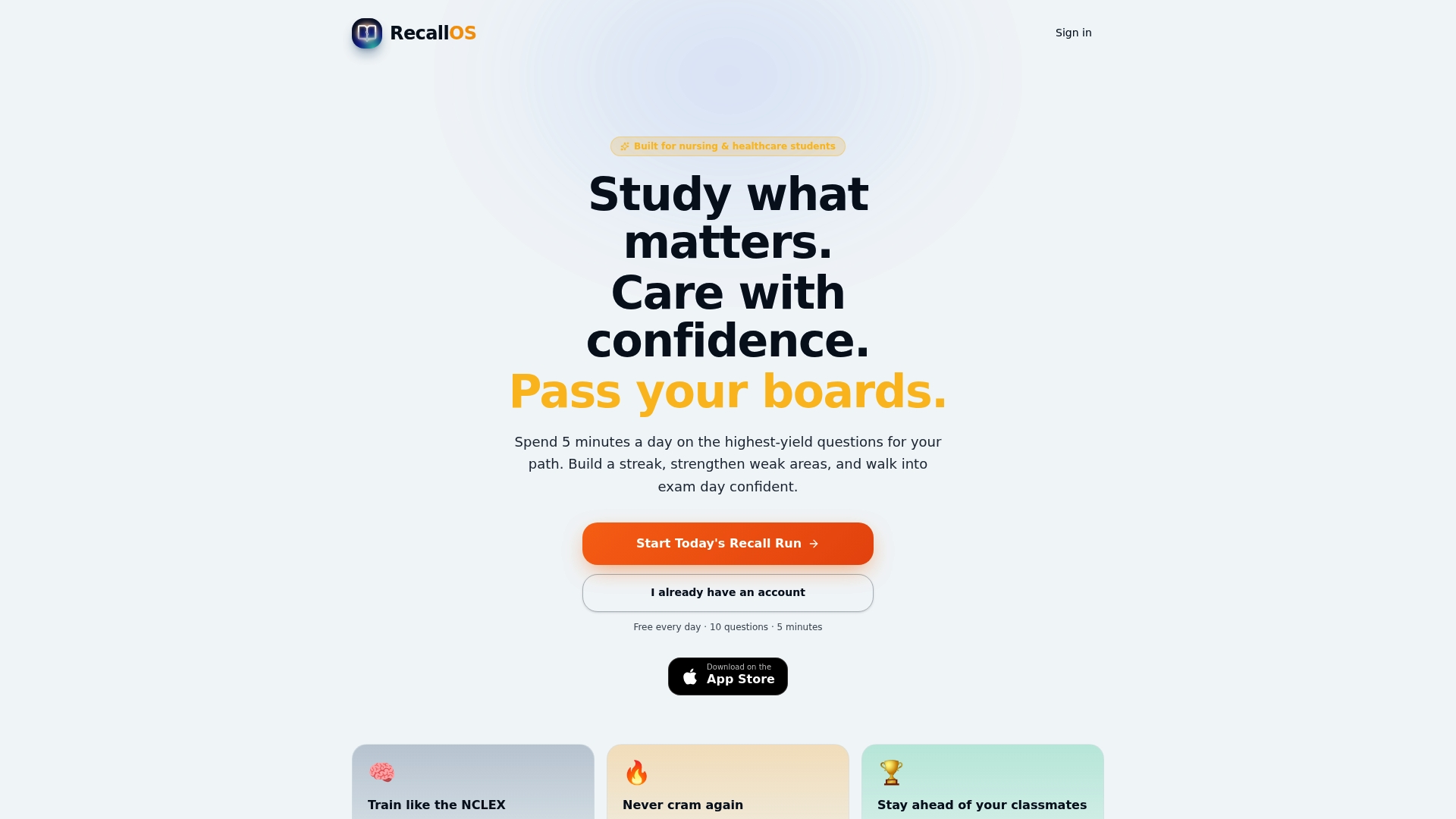
Recallos solves that specific problem. Upload your fundamentals notes, pharmacology sheets, or weak-area summaries, and the app generates adaptive daily questions mapped to the NCLEX Test Plan. The algorithm tracks where you are losing points and schedules those items to reappear at the right interval, so you are always working on what matters most. Questions are written by practicing nurses and CRNAs, and the rationale explanations are built around CJMM clinical reasoning, not just answer justification.
To get started: visit RecallOS and start a free study pack. For your first week, set your goal to one 20-minute Recallos session each morning before your main question block. Upload your weakest content area first. By Day 7, you will have a clear picture of exactly where your fundamentals gaps are and a personalized review queue ready to address them.
Authority sources and further reading
These are the primary sources worth bookmarking as you build your study plan:
- NCSBN Test Plan (ncsbn.org/testplans.htm): The official blueprint. Read the percentage ranges for each Client Needs category before you do anything else. This is your study allocation guide.
- NCSBN NGN sample items (ncsbn.org): Free official samples of every NGN item type. Use these in Week 1 to calibrate your format familiarity and again in your final week as a check-in.
- Pearson VUE NCLEX scheduling: The official testing vendor. Use it to understand scheduling windows, remote testing eligibility, and ATT expiration rules.
- Open RN / NCBI Bookshelf (Nursing Fundamentals): Free, peer-reviewed fundamentals content. Use it for concept remediation when a rationale references something you cannot explain.
- OpenStax Fundamentals of Nursing (OpenStax): Includes chapter review questions useful for early-week content checks before moving to full question banks.
- Recallos (recallos.co): Adaptive daily practice with NCLEX-mapped questions and spaced repetition. Use it as your daily practice engine alongside the resources above.