
The single best thing you can do right now is block 30 minutes, answer 10 NCLEX-style practice questions, and spend 10 minutes on a recovery ritual (a walk, a playlist, or just silence). That sequence builds the three pillars that research consistently ties to sustained motivation for nursing students: motivation regulation, active competence practice, and deliberate recovery.
Here is your immediate action plan:
- Time-block tonight. Open your calendar and protect one 30–60 minute study window before midnight. Specificity matters more than duration.
- Answer 10 practice questions with rationales. Don't just check right or wrong. Read every rationale, including the ones you got right. That habit builds clinical pattern recognition faster than re-reading notes.
- Do a 10-minute recovery ritual after. A short walk, a few minutes of breathing, or a brief journal entry. This is not optional padding. It's what keeps you from burning out by week three.
Research backs this structure. A person-oriented study of first-year nursing students found that A majority of students with a highly developed motivation regulation profile showed stronger engagement and lower burnout than peers who lacked those skills. Motivation regulation is teachable. The strategies below show you exactly how.
Key Takeaways
Sustained motivation for nursing students comes from building motivation-regulation skills, practicing actively with NCLEX-style questions, and protecting recovery time as deliberately as study time.
| Point | Details |
|---|---|
| Motivation regulation is learnable | 65.6% of first-year students with strong regulation skills showed higher engagement and lower burnout. |
| Self-efficacy drives motivation | Academic self-efficacy had a β of 0.621 with motivation; build it through daily practice questions. |
| Use both motivation types strategically | Extrinsic goals drive short-term performance; intrinsic purpose sustains long-term resilience. |
| Recovery is not optional | Structured recovery rituals prevent the burnout cycle that collapses motivation mid-semester. |
| Social accountability compounds effort | Peer teaching, accountability partners, and mentor check-ins raise engagement across the semester. |
Table of Contents
- Practical strategies to raise your motivation for nursing students right now
- What the research actually says about nursing student motivation
- Study methods that build confidence and keep you engaged
- How to prevent burnout before it stops your momentum
- How peer support and mentoring actually move the needle
- Quotes and prompts to reset your mindset in under two minutes
- The 5 C's of nursing and why they keep you going
- Your daily and weekly motivation checklist
- How to encourage a nursing student (for friends, family, and educators)
- An editorial perspective on what nursing students actually need
- Selected studies and resources for deeper reading
- Sources
Practical strategies to raise your motivation for nursing students right now
These tactics are ordered by impact. Pick two or three to try this week, not all of them at once.
1. Chunk your goals into micro-targets
Vague goals ("study pharmacology this weekend") collapse under pressure. Specific ones hold. Write a goal like "complete 15 questions on cardiac medications by 8 PM Saturday" and your brain knows exactly when it's done. Motivation regulation research identifies goal-setting and task valuing as core strategies students use to sustain engagement across a semester.
2. Build a daily question streak
Ten questions a day compounds fast. Thirty days in, you've answered 300 questions with rationales. That volume builds pattern recognition that re-reading a textbook simply cannot replicate. Treat the streak like a habit, not a performance. Miss a day? Restart without drama.
Pro Tip: Set a phone alarm labeled "10 Qs" at the same time every day. Consistent cues eliminate the decision fatigue that kills study habits.
3. Use environmental structuring
Where you study shapes how you study. A dedicated spot (even a specific corner of a library) signals your brain to shift into focus mode. Remove your phone from arm's reach, not just from your hand.
4. Connect today's content to a patient
Before a study block, write one sentence: "Today I'm learning [topic] because a patient with [condition] will need me to know this." That single reframe shifts the task from abstract test prep to purposeful clinical preparation. Surveys show that altruistic motives, the desire to help others, rank among the strongest drivers for choosing nursing. Tap that on purpose.

5. Track progress visibly
A simple spreadsheet, a paper calendar, or a streak counter in a study app gives you concrete evidence that you are moving forward. On low-motivation days, visible progress is often the only thing that gets you to open the book.
What the research actually says about nursing student motivation
The evidence here is more specific than most motivation articles let on.
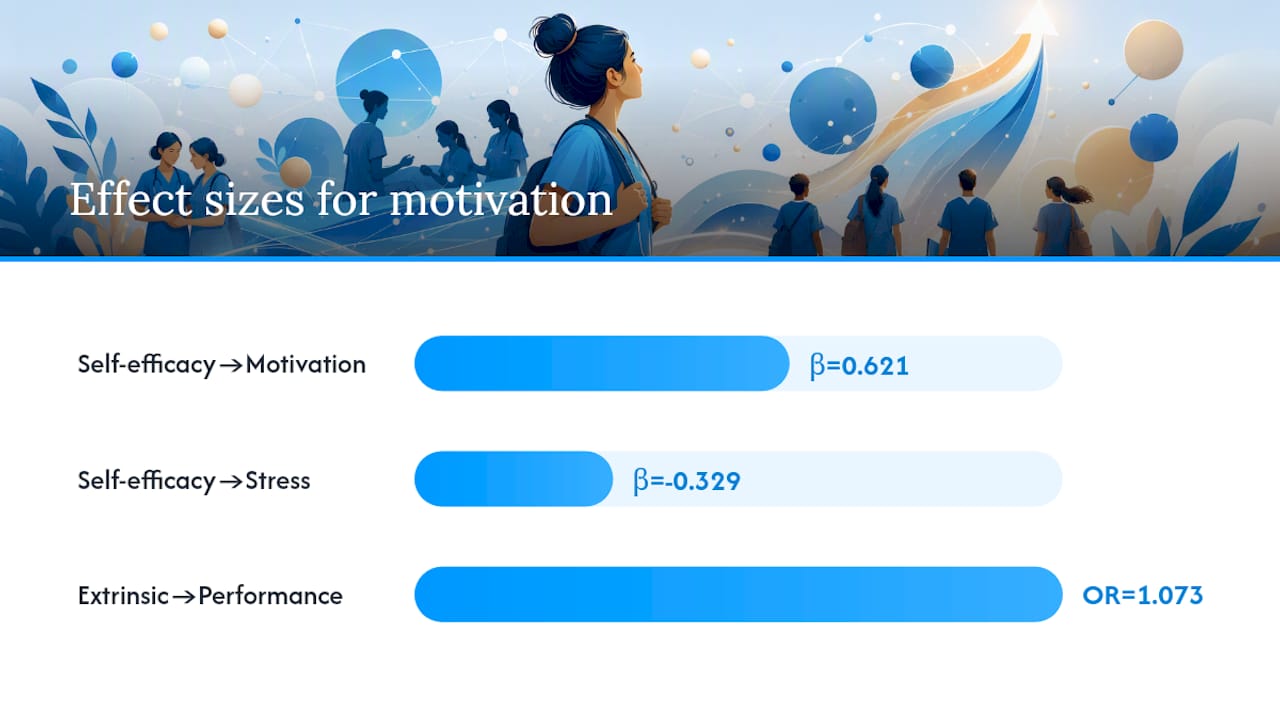
A structural equation modeling study found that academic self-efficacy had a strong positive association with academic motivation (β = 0.621, p < .001) and a negative association with educational stress (β = -0.329, p < .001). In plain terms: the more confident you feel in your ability to handle the material, the more motivated you become, and the less stress derails you.
That's why building competence through practice questions isn't just exam prep. It's a motivation strategy.
Intrinsic vs. extrinsic motivation work differently, and both matter. A mixed-methods study of first-year nursing students found that extrinsic motivation significantly predicted early-course performance (OR = 1.073, p = .018), while intrinsic motivation did not predict those specific early outcomes as strongly. That means external goals like passing a course, earning a grade, or keeping a scholarship can legitimately drive short-term performance. Long-term resilience, though, tends to track more closely with intrinsic motivation: seeing nursing as a calling, caring about patients, finding meaning in the work.
The practical implication: use extrinsic goals to get through hard weeks. Use intrinsic purpose to get through hard semesters.
| Study | Core finding | Practical implication |
|---|---|---|
| Motivation regulation & burnout | 65.6% of first-year students had a highly developed motivation regulation profile linked to higher engagement and lower burnout | Teach yourself motivation-regulation tactics early |
| Self-efficacy & motivation SEM | Self-efficacy β = 0.621 with motivation | Build competence through practice to raise motivation |
| Mixed-methods motivation study | Extrinsic motivation predicted early-course performance (OR = 1.073) | Use external goals short-term; cultivate intrinsic purpose long-term |
| Strategies review | Positive instructor behaviors and education quality linked to higher student motivation | Seek out faculty who explain the "why," not just the "what" |
Study methods that build confidence and keep you engaged
The biggest mistake nursing students make is studying the wrong way, not studying too little. Re-reading notes and highlighting feel productive but build almost no clinical judgment. University of Olivet's nursing exam guide makes the point directly: nursing exams test safe clinical decision-making, not memorization. Your study method needs to match that.
What actually works:
- NCLEX-style practice questions with rationales. Each question forces you to apply a framework (ABCs, Maslow's hierarchy, the nursing process) rather than recall a fact. Read every rationale, not just the ones you missed.
- Spaced repetition. Review material at increasing intervals: day 1, day 3, day 7, day 14. This approach fights the forgetting curve and is far more efficient than cramming the night before.
- Active recall stacks. Close your notes and write everything you remember about a topic. Then check. The retrieval attempt itself strengthens memory more than passive review.
- 30-day micro-plan. Assign one content area per day. Keep each session to 45–60 minutes with a hard stop. Consistency over intensity.
For daily NCLEX question practice, the key is not volume alone but deliberate review of rationales. Students who reviewed why wrong answers were wrong, not just why right answers were right, built stronger pattern recognition over time.
When choosing a question bank or spaced repetition tool, look for: questions mapped to current NCLEX blueprints, detailed rationales (not just answer keys), adaptive delivery that targets your weak areas, and progress tracking you can actually read. Recallos was built by practicing nurses and CRNAs specifically to hit those criteria, with daily high-yield questions and personalized weak-area review.
Pro Tip: After every 10-question set, spend 5 minutes writing one sentence about the clinical pattern you just practiced. "Patients with [condition] typically present with [signs] and need [priority intervention]." That synthesis step is what moves knowledge from short-term recall to clinical judgment.
How to prevent burnout before it stops your momentum
Burnout doesn't arrive all at once. It shows up as a creeping inability to care about material you used to find interesting, followed by avoidance, followed by a guilt spiral that makes starting again feel impossible.
Signs you're heading toward burnout: persistent fatigue that sleep doesn't fix, irritability during study sessions, a drop in practice-question accuracy that doesn't respond to more studying, and a sense that nothing you do is enough.
When those signs appear, the answer is not to push harder. NCLEX repeat test-takers who eventually passed consistently described a package of changes: a structured study schedule, increased practice-question volume, and emotional resilience strategies. Not one dramatic fix. A system.
Immediate recovery steps:
- Take one full rest day with zero study content. Not a "light review" day. A real break.
- Write a structured review plan for the following week. Uncertainty about what to study next is a major anxiety driver.
- Text or call one accountability partner and tell them your plan for the next three days.
Emotional regulation techniques that hold up under pressure:
- Brief grounding: Five slow breaths before opening your notes. It takes 90 seconds and measurably lowers cortisol response.
- Reframe failure as data. A failed practice quiz tells you exactly where to study next. That's useful information, not evidence of inadequacy.
- Positive self-talk with specificity. "I passed pharmacology last semester" is more effective than "I can do this" because it's grounded in evidence your brain already accepts.
Pro Tip: Schedule your recovery ritual the same way you schedule study blocks. Put "10-minute walk" or "journal" on your calendar. Wellbeing that competes with study time always loses. Wellbeing that is scheduled survives.
How peer support and mentoring actually move the needle
Studying alone is fine for focused content review. But motivation, especially across a full semester, is largely social. Research on nursing student engagement shows that teacher encouragement of autonomy and peer communication are significant motivators, particularly in blended or online learning environments where isolation is a real risk.
Formats that work:
- Micro-groups of 3–4 students. Larger groups drift into socializing. Smaller ones stay accountable.
- Peer teaching sessions. Assign one person to explain a topic for 10 minutes while others ask questions. Teaching forces deeper processing than listening.
- Accountability partners. One text at the end of each study day: "Finished 15 questions, struggled with fluid/electrolytes." That's it. Low friction, high accountability.
- Mentor check-ins. A 15-minute monthly conversation with a faculty member or clinical preceptor who knows your goals can recalibrate your direction faster than hours of solo studying.
Sample 75-minute study group agenda:
- 0:00–0:10: Each person states their one goal for the session
- 0:10–0:30: Silent individual question practice (10–15 Qs each)
- 0:30–0:50: One person teaches a concept; group asks clinical application questions
- 0:50–1:05: Group reviews the hardest question from the set together
- 1:05–1:15: Each person states what they'll review before next session
For online communities, stick to faculty-moderated boards, your school's official channels, or vetted nursing education forums. Unmoderated spaces can spread misinformation about exam content. When in doubt, verify with your course materials or a faculty member.
Quotes and prompts to reset your mindset in under two minutes
Keep these somewhere visible. Before a study session, before a clinical shift, or the morning of an exam.
One-line prompts to use before studying:
- "Today I'm studying [topic] because a real patient will need me to know this."
- "I don't need to know everything today. I need to know more than I did yesterday."
- "This question I'm about to miss is the one I'll remember on the NCLEX."
Three journaling starters that connect study to purpose:
- "The kind of nurse I want to be would handle [today's topic] by..."
- "The last time I felt genuinely capable in a clinical setting, I had just..."
- "One small thing I learned today that could change a patient's outcome is..."
These prompts work because they tie abstract content to concrete patient impact, which is exactly the intrinsic motivation link that sustains long-term effort.
The 5 C's of nursing and why they keep you going
The 5 C's are a framework used across nursing education to define what professional nursing practice looks like. Each one also maps directly to a motivation source.
- Compassion: The emotional core of why most nurses chose the profession. On hard days, returning to compassion reconnects you to purpose.
- Competence: Built through deliberate practice. Every question you answer correctly is a small competence win that raises self-efficacy.
- Communication: The social dimension of nursing. Strong communication skills reduce clinical anxiety because you know how to ask for help and give clear handoffs.
- Critical thinking: The cognitive challenge that makes nursing intellectually engaging, not just emotionally meaningful. Nursing exams are designed to test this, which is why application-based study methods work.
- Care: The broadest of the five. Care encompasses both patient care and self-care. Students who neglect the second half of that equation don't sustain the first.
Academic self-efficacy research shows that competence-building is one of the strongest levers for raising motivation. The 5 C's give you a daily anchor: pick one C each morning and ask yourself how today's study session connects to it.
Daily micro-goal example: "Today I'm working on competence. I'll answer 10 questions on respiratory assessment and write one clinical pattern sentence after."
Your daily and weekly motivation checklist
Copy this into your notes app, print it, or set it as a phone widget.
Daily checklist:
- Set one specific study goal before opening any material
- Complete 10 NCLEX-style practice questions with full rationale review
- Do one focused 45–60 minute study block (phone out of reach)
- Write one clinical pattern sentence from today's content
- Complete your 10-minute recovery ritual (walk, breathe, journal)
- Text your accountability partner your end-of-day update
Weekly checklist:
- Review your question-bank metrics: accuracy by topic, not just overall
- Identify your two weakest content areas and schedule them first next week
- Attend or schedule one peer teaching session or study group
- Check in with a mentor or faculty member (15 minutes is enough)
- Demonstrate one concept aloud to yourself or a study partner
- Adjust next week's schedule based on what worked and what didn't
During clinical weeks: Cut the daily question count to 5 and drop the study block to 30 minutes. Keep the recovery ritual and the accountability text. Consistency at lower volume beats inconsistency at high volume every time.
How to encourage a nursing student (for friends, family, and educators)
The most common mistake supporters make is minimizing the difficulty. "You're so smart, you'll be fine" sounds kind but dismisses the real cognitive and emotional load nursing school carries. What actually helps is specific, logistical support.
What helps:
- Celebrate specific wins, not just outcomes. "You finished that pharmacology unit" lands better than "You're going to pass."
- Offer logistical help: a meal, a quiet hour, a ride to clinical. Concrete support reduces the mental load that competes with studying.
- Ask "What do you need right now?" instead of assuming.
What hurts:
- Comparing them to other students or past cohorts.
- Asking "Did you study enough?" before an exam.
- Treating a failed quiz or a hard week as a sign they chose the wrong career.
Script for a friend or family member:
"I know this week has been a lot. I'm not going to tell you it's easy. I just want you to know I'm here, and I'm proud of how hard you're working. What would actually help you right now?"
Script for an educator or clinical preceptor:
"I noticed you seemed uncertain during that assessment. That's completely normal at this stage. Let's walk through the clinical reasoning together. What was your first priority thought when you saw the patient?"
Qualitative research consistently links positive instructor behaviors and high-quality educational design to increased academic motivation in nursing students. The preceptor script above models exactly that: it normalizes uncertainty, redirects to reasoning, and keeps the student's self-efficacy intact.
Pro Tip: Educators: the single highest-leverage move is explaining the "why" behind clinical decisions, not just the "what." Students who understand the reasoning behind a protocol are more motivated to learn the next one.
An editorial perspective on what nursing students actually need
The conventional advice on study motivation tends to land in one of two places: generic productivity tips that could apply to any college student, or inspirational content that feels good for about 20 minutes. Neither is wrong, exactly. But both miss the specific challenge nursing students face.
Nursing school isn't just academically hard. It's emotionally demanding in a way that most academic programs aren't. You're learning to make decisions that affect real people's safety, often while managing clinical hours, part-time work, and the ordinary pressures of adult life. That context changes what motivation strategies need to do.
The research on this is more useful than most students realize. The finding that a majority of first-year students with strong motivation regulation showed lower burnout isn't just a statistic. It's a signal that the students who do well aren't necessarily the ones who study the most. They're the ones who manage their motivation as deliberately as they manage their schedule.
What I find most overlooked in the standard advice is the role of small competence wins. That's a strong relationship. And self-efficacy doesn't come from affirmations. It comes from doing hard things and noticing that you did them. Ten practice questions a day, reviewed carefully, builds that evidence base faster than almost anything else.
The students who struggle most aren't usually the ones who lack intelligence or dedication. They're the ones who study passively, skip the recovery rituals, and try to white-knuckle through burnout instead of treating it as a signal. The strategies in this article aren't motivational fluff. They're the specific behaviors that the evidence says move the needle.
Selected studies and resources for deeper reading
- Nursing students' motivation regulation and its relationship with engagement and burnout — Evidence for motivation-regulation profiles and their link to engagement and burnout in first-year nursing students.
- Strategies to promote academic motivation in nursing students — Qualitative review linking instructor behaviors and educational design to higher student motivation.
- Study motivation and academic performance: a mixed-methods study — Data on how intrinsic and extrinsic motivation predict different performance outcomes in early nursing courses.
- Academic self-efficacy, educational stress, and academic motivation: SEM analysis — Structural equation modeling showing self-efficacy as a strong predictor of motivation and a buffer against stress.
- From setback to success: NCLEX-RN repeat test-takers — Phenomenological study on what actually changed for students who passed after an initial NCLEX failure.
- Factors influencing nursing students' decision to pursue nursing — Survey data on altruistic and economic motivators for choosing nursing as a career.
- How to study for nursing exams — University of Olivet — Practical educator resource on active recall, application-based study, and NCLEX-style question practice.
- NCLEX Exam Practice Questions: 2026 RN Study Guide — Daily question practice and NGN-style prep aligned with current NCLEX blueprints.
Sources
- Nursing students' motivation regulation and its relationship with engagement and burnout
- Strategies to promote academic motivation in nursing students
- Study motivation and academic performance among first‑year five‑year junior college nursing students: a mixed‑methods study | BMC Nursing
- The relationships among academic self‑efficacy, educational stress, and academic motivation in nursing students: a structural equation modeling analysis | BMC Nursing
- Factors influencing nursing students' decision to pursue nursing (open‑access study)