
Most NCLEX prep apps range from free to moderate annual costs, with monthly plans usually priced within a reasonable range. Free or "lite" tiers give you a handful of daily questions. Monthly subscriptions typically provide full access to question banks and adaptive review. Annual plans are generally more cost-effective per month for longer study periods.
NCLEX prep app pricing generally follows a tiered structure.
- Free or lite access: a capped daily question set, no cost, often no adaptive engine.
- Monthly subscription: $5 to $35/month, full question bank, most premium features unlocked.
- Annual or one-time plans: $40 to $100/year, the lowest effective monthly rate, sometimes bundled with extra content.
If your exam is under a month away, a monthly plan is usually the smarter buy. If you're planning six months out, an annual plan or a semester-length option almost always costs less over time. Chamberlain University's roundup of NCLEX study apps confirms this pattern across several major titles, and apps like RecallOS follow the same free-to-paid structure common across the category.
Key Takeaways
NCLEX prep app pricing typically ranges from free to about $100 per year, and annual plans almost always beat monthly billing once your study window passes eight weeks.
| Point | Details |
|---|---|
| Know the typical price bands | Expect $0 for lite tiers, $5–$35/month for full access, and $40–$100/year for annual plans. |
| Watch auto-renewal terms | Apple and Google Play subscriptions auto-renew by default, so check cancellation settings early. |
| Match plan length to timeline | Under a month, pick monthly or trial access; past two months, annual pricing saves more overall. |
| Judge value by features, not price alone | Adaptive engines, NGN formats, and full simulated exams usually separate mid-tier from premium pricing. |
| RecallOS ties pricing to daily habits | RecallOS offers a free trial and daily free questions, with paid tiers adding adaptive weak-area review and custom study material. |
Table of Contents
- How much do NCLEX apps cost? Understanding the pricing structure
- Real-world pricing examples: what you'd actually pay
- What are you actually paying for at each price tier?
- How to pick the right plan for your budget and timeline
- Why RecallOS pricing fits the way NCLEX students actually study
- Was paying for an NCLEX app worth it?
- Start your RecallOS trial before committing to a paid plan
- Where to verify current NCLEX app prices
- Frequently asked questions about NCLEX app costs
- Sources
How much do NCLEX apps cost? Understanding the pricing structure
NCLEX prep apps don't all price themselves the same way, and that inconsistency is exactly why so many students overpay or underbuy. Six pricing models dominate the App Store and Google Play, and each one has different implications for your wallet and your study plan.
Free or lite tiers give you a small, capped set of questions per day. No credit card required, no adaptive engine, usually no rationale explanations beyond the basics. These exist purely to get you into the app.
Monthly subscriptions are the most common paid model. You pay month to month, the subscription auto-renews, and you get the full question bank plus whatever adaptive or analytics features the app offers at that tier.
Multi-month or semester plans bundle three to six months at a discount versus paying monthly the whole time. These fit students who know roughly when they're testing but don't want a full year's commitment.
Annual subscriptions carry the lowest per-month cost of any recurring model, often 30% to 50% cheaper per month than paying monthly. The tradeoff is a bigger upfront charge.
Lifetime or one-time purchases are rarer in this category but do exist, usually for narrower tools like flashcard sets rather than full adaptive question banks.
Consumable in-app purchases are the wildcard: credit packs, extra question sets, or streak restores you buy on top of a subscription or free tier.
What auto-renewal actually means for your wallet
Nearly every subscription in this space runs through Apple's In-App Purchase system or Google Play billing, and both default to auto-renewing. Apple's own billing support documentation spells out the mechanics: your subscription renews automatically at the end of each period unless you cancel through your account settings, not through the app itself. If you're mid-trial and you upgrade early, you typically forfeit whatever free trial time was left. That detail catches a surprising number of students off guard when a $30 charge shows up on a card they forgot they'd linked three weeks earlier.
Here's how the models compare side by side:
Pro Tip: If your exam is inside 30 days, look specifically for apps offering a short trial or a one-month pass rather than committing to an annual plan you won't fully use. You can always upgrade to annual later if you end up needing more time.
Real-world pricing examples: what you'd actually pay
Numbers help more than ranges, so here's what three anonymized pricing tiers look like when you convert everything to a monthly rate for fair comparison.
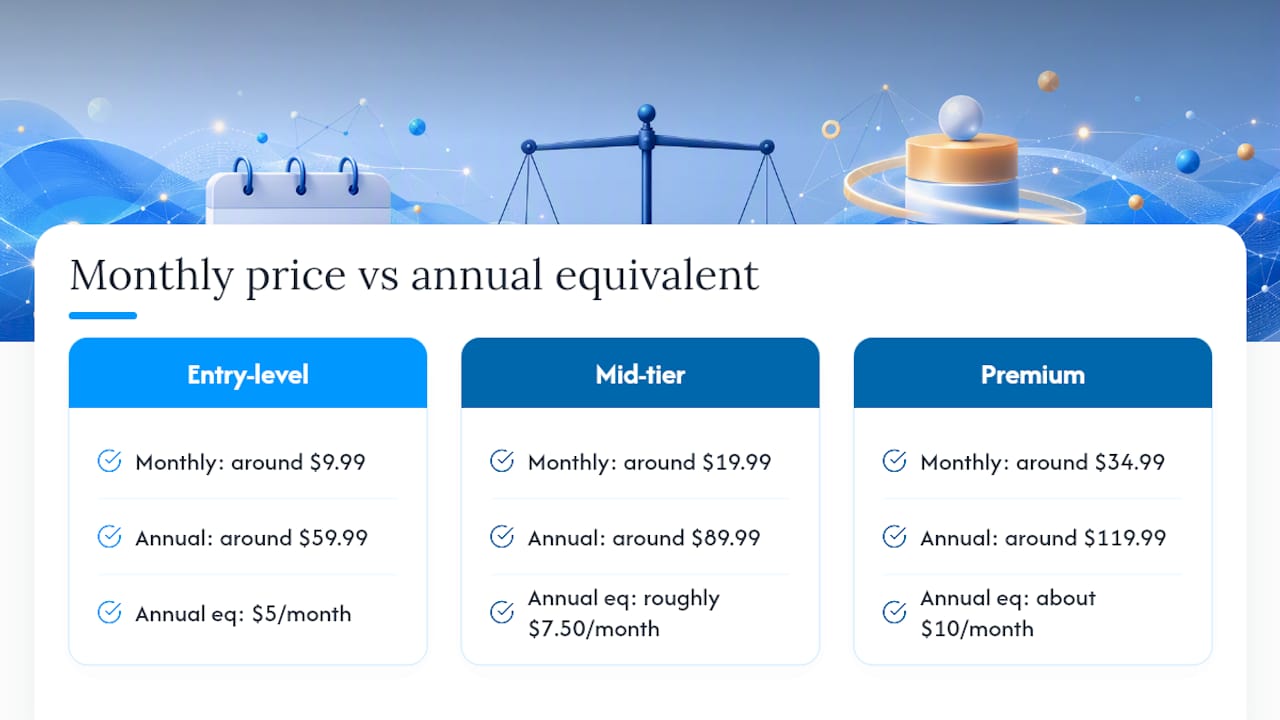
Entry-level tier: monthly price around $9.99, annual equivalent around $59.99 ($5/month). This tier usually includes a decent-sized question bank but skips advanced analytics or full-length simulated exams. It's a reasonable floor if you just need volume practice and don't care about adaptive sequencing.
Mid-tier: monthly price around $19.99, annual equivalent around $89.99 (roughly $7.50/month). At this level, apps typically add adaptive question sequencing, performance dashboards by content category, and at least a partial set of Next Generation NCLEX (NGN) style items.
Premium tier: monthly price around $34.99, annual equivalent around $119.99 (about $10/month). This bracket usually unlocks full-length simulated Computerized Adaptive Testing (CAT) exams, complete NGN item formats including case studies and multi-response questions, and sometimes live or chat-based tutor access.
These figures line up with what you'll see across major app listings, where store product pages commonly display monthly, three-month, and annual tiers side by side, and where feature-rich apps tend to bundle alternate item formats like audio, video, and hotspot questions into their higher tiers, as seen in listings like NCLEXFocus.
The RecallOS pricing breakdown
RecallOS follows a tiered subscription model sold through Apple In-App Purchase, built specifically for nursing and healthcare exam candidates rather than general test-prep audiences. The app offers a free trial and limited free daily practice questions before you commit to a paid tier, which lets you test the question quality and interface before spending anything.
Here's what the tier structure typically covers:
| Tier | What's Included | Best For |
|---|---|---|
| Free daily access | Limited daily high-yield questions, basic progress tracking | Testing the app before subscribing |
| RecallOS+ | Expanded daily practice, streaks and rewards, weak-area flags | Students building consistent daily habits |
| Plus | Adaptive review of weak areas, personalized question sequencing, peer challenges | Mid-timeline students who want targeted review |
| Pro | Full adaptive engine, custom study material generation from uploaded notes, full feature access | Students on a compressed timeline who need everything |
Beyond the core subscription, RecallOS also sells consumable in-app purchases (credit packs, gems, streak restores) for students who want to top up specific features without upgrading their whole subscription tier. That's a useful option if you're on a lower tier but want a one-time boost, say, extra credits during exam week, without paying for a full upgrade you'll only need for a few days.

One important disclaimer applies across every app mentioned here, RecallOS included: in-app prices change, and platform billing can add regional taxes or currency conversions depending on where your Apple or Google account is registered. Always check the live price on the store listing before you subscribe, since some listings also run short promotional pricing that isn't reflected in general pricing guides.
Pro Tip: Always divide the annual price by 12 before comparing it to a monthly plan. A $99.99 annual plan works out to $8.33/month, which usually beats even a discounted 3-month plan once you do the math.
What are you actually paying for at each price tier?
The price tag alone doesn't tell you much. What matters is which features sit behind that number, because two apps at the same monthly price can offer wildly different value depending on what's unlocked.
The features that most consistently drive price differences:
- Full question bank size (hundreds versus thousands of items)
- NGN-style item formats: case studies, multi-response, matrix, bowtie questions
- Adaptive learning engines that adjust difficulty and topic focus based on performance
- Full-length simulated CAT exams that mimic real testing conditions
- Detailed performance analytics broken down by content category
- Tutor or chat support for missed questions
- Multimedia items: audio clips, video, hotspot diagrams
Feature-to-price mapping tends to follow a predictable pattern:
- Entry-level pricing buys you volume: a large static question bank with standard multiple-choice formats and basic rationale explanations.
- Mid-tier pricing adds intelligence: adaptive sequencing that identifies weak areas and adjusts what you see next, plus category-level analytics.
- Premium pricing adds simulation: full-length CAT-style practice exams, complete NGN format coverage, and often some form of human or AI tutor support.
A useful rule of thumb: if an app advertises an adaptive engine plus performance analytics, that's usually where the price jumps from entry-level into mid-tier territory. Full NGN coverage and simulated exams are what typically push a plan into premium pricing.
Before you buy anything, check these trust signals regardless of price:
- Trial length: does the free trial run at least three to five days, enough to test real question quality?
- Question count: is the total bank size disclosed, or vague marketing language like "thousands of questions" with no specifics?
- Guarantees: is there a money-back or pass guarantee, and what conditions apply?
- Author credentials: was the content written or reviewed by practicing nurses, or is it unclear who built the question bank?
How to pick the right plan for your budget and timeline
Match your plan to two things: how much time you have before your exam, and how many hours a week you can realistically study. Getting this pairing wrong is the single most common way students overspend or underprepare.
- Estimate your time to exam. Under four weeks, favor monthly or trial-based access. Four to twelve weeks, a monthly plan still works but semester pricing starts to pay off. Past twelve weeks, annual pricing almost always wins on cost.
- Estimate your weekly study hours. If you're doing fewer than five hours a week, a smaller question bank and free tier might genuinely be enough. Above ten hours a week, you'll burn through a free tier's daily cap fast and need a paid plan with real volume.
- List your must-have features before comparing prices. Decide if you actually need full NGN simulation or if a solid adaptive question bank covers your gap.
- Compare effective monthly cost, not sticker price. Divide any annual or semester price by its number of months before deciding it's more expensive than a monthly plan.
Watch for these red flags before you subscribe to anything:
- Vague refund policies that don't specify a window or conditions.
- Core content locked behind a paywall the moment your trial ends, with no way to sample real exam-style questions first.
- A question bank that's suspiciously small for a premium price point.
- No visible information about who wrote or reviewed the content.
Ask these questions before you hand over your card details: How long does the trial actually run? Are NGN-style formats included or sold separately? Does your progress and performance data sync across devices, or does switching phones wipe your history? A resource like LLQPGuide's exam-prep blog covers similar budgeting logic for other licensing exams, and the same math applies here: annual pricing wins for anyone studying longer than two months, full stop.
Why RecallOS pricing fits the way NCLEX students actually study
RecallOS prices its tiers around one core idea: daily, high-yield practice beats occasional long study sessions. That's reflected in how the subscription structure rewards consistency rather than just unlocking a static question bank.
| What You're Paying For | Why It Matters for NCLEX Prep |
|---|---|
| Nurse and CRNA-developed content | Questions align with real exam blueprints instead of generic trivia |
| Adaptive review of weak areas | Study time goes toward what you're actually missing, not random review |
| Daily streaks and rewards | Builds the consistent habit that matters more than cramming |
| Peer challenges | Adds accountability without needing a study group |
| Custom material from your own notes | Turns your lecture notes into flashcards, quizzes, and summaries automatically |
A few signals matter more than the price tag itself when you're deciding if RecallOS fits your budget:
- The free trial and daily free question set let you judge question quality before you spend anything.
- Weak-area tracking means a mid-tier plan can outperform a premium plan from a competitor that doesn't personalize review.
- Streak and rewards tracking is built to combat the single biggest failure mode in NCLEX prep: starting strong and quitting after two weeks.
Picture two different students. One is six weeks from boards, studying ninety minutes a day, and mainly needs a reliable adaptive engine to catch weak spots before they become exam-day surprises, a fit for the RecallOS+ or Plus tier. The other is a working nurse eyeing a CRNA program a year out, studying inconsistently around shifts, and needs the free daily access plus occasional Pro-tier bursts before big practice tests. Same app, two completely different spending patterns.
Pro Tip: Read the HESI and NCLEX practice test guide on the RecallOS blog before you subscribe to any tier. It'll help you figure out exactly how many practice questions you need per week to hit your target exam date, which makes it much easier to judge whether a monthly or annual plan actually saves you money.
Was paying for an NCLEX app worth it?
Paid apps earned their cost for me under one specific condition: daily use. The subscription price stopped feeling like an expense the moment I was answering questions every single day instead of cramming once a week. On the weeks I skipped days, the same app felt like money down the drain, not because the content changed, but because consistency is what actually makes adaptive review pay off.
My honest tip: don't buy an annual plan the week before finals out of panic. Start with a free trial or a single month, confirm the question quality matches your learning style, then commit to longer-term pricing once you know you'll actually open the app daily.
One more thing worth saying plainly: check your app-store subscription settings the day you sign up, not the day before renewal. A five-second glance at Apple's billing settings will tell you exactly when you'll be charged again, and it's the easiest way to avoid an unwanted renewal eating into a budget you'd planned for other study materials, including free supplements like nursing podcasts.
Start your RecallOS trial before committing to a paid plan
RecallOS gives you a real way to test question quality before spending anything: a free trial plus limited daily practice questions, no need to guess whether the content fits your study style based on a price tag alone.
Getting started takes three steps. First, download RecallOS and open the free daily practice set to see how the adaptive engine flags your weak areas. Second, use that free window to judge whether the question style and rationale explanations actually match how you learn. Third, if it's working, upgrade through the in-app subscription flow to unlock the full adaptive quiz engine and weak-area tracking at whichever tier fits your timeline.
Canceling is just as simple. Since billing runs through Apple's subscription system, you manage or cancel anytime through your device's account settings, not inside the app itself. If you have billing questions or need support figuring out which tier fits your exam date, RecallOS's support team is reachable directly through the app. Ready to see what daily practice actually feels like? Start with RecallOS.
Where to verify current NCLEX app prices
Prices and trial terms can change frequently; always check the current details directly before subscribing.
- Check Chamberlain University's app roundup for current comparisons across popular apps.
- Review Apple's billing and subscription support page for cancellation and refund rules.
- Always confirm live pricing on the app's own store listing and terms before you subscribe to anything.
Frequently asked questions about NCLEX app costs
How much do NCLEX apps cost on average? Most range from free to about $100 a year. Monthly plans typically fall between $5 and $35, while annual plans usually land between $40 and $100 depending on the features included.
Are there free NCLEX prep apps that are actually useful? Yes, most major apps offer a free or lite tier with a capped number of daily questions. These work well for testing question quality before committing to a paid subscription.
Is an annual NCLEX app subscription cheaper than paying monthly? Almost always. Annual plans typically cost 30% to 50% less per month than paying month to month, so they make sense if you're studying for more than about two months.
Do NCLEX apps auto-renew? Yes. Subscriptions sold through Apple In-App Purchase or Google Play auto-renew by default. You need to cancel through your device's account settings, not inside the app itself, before the renewal date.
What features justify paying for a premium NCLEX app tier? Look for adaptive learning engines, full-length simulated CAT exams, complete NGN-style item formats, and detailed performance analytics. These features typically separate premium pricing from entry-level plans.
Does RecallOS offer a free trial? Yes, RecallOS provides a free trial along with limited free daily practice questions, letting you test the adaptive engine and question quality before subscribing to a paid tier.
Sources
- NCLEX Study Apps: 4 Tools to Try Before Exam Day | Chamberlain University
- Apple Support — Billing & Subscriptions