
A bow-tie item gives you one patient scenario and asks you to fill three connected zones: the center holds the most likely condition or problem, the left wing holds two immediate nursing actions, and the right wing holds two parameters you'd monitor to see if those actions worked. The Next Generation NCLEX built this format specifically to test whether you can chain assessment findings to nursing priorities to patient outcomes, not just recall isolated facts. The core strategy never changes: nail the center problem first, pick two actions that address it directly, then pick two measurable ways to confirm those actions worked. This maps straight onto the NCSBN clinical judgment model tested on the NGN, so practicing bow-ties well trains the exact skill the exam rewards.
- Center: what's actually wrong with this patient right now
- Left wing: the two most urgent things you'd do about it
- Right wing: the two numbers or signs that tell you it's working
Key Takeaways
Solving a bow-tie item correctly comes down to identifying the center problem first, then matching urgent actions and measurable monitoring parameters directly to that problem.
| Point | Details |
|---|---|
| Center first, always | Identify the most likely condition before evaluating any action or monitoring option. |
| Actions must be urgent | Prioritize airway, breathing, and circulation over education or comfort measures. |
| Monitoring must match actions | Pick parameters that would actually change in response to your chosen actions. |
| Run the coherence check | Reread all three zones as one sentence before finalizing your answer. |
| Practice daily with RecallOS | RecallOS offers adaptive bow-tie and NGN-style practice built around real exam blueprints. |
Table of Contents
- What Is the NCLEX Bow Tie Strategy and Why Does It Work?
- How Do You Solve a Bow-Tie Question Step by Step?
- What Are the Most Common Bow-Tie Mistakes?
- Worked Bow-Tie Examples With Explained Answers
- How Should You Practice Bow-Tie Items Before Test Day?
- Why Bow-Tie Mastery Matters More Than It Seems
- Practice Bow-Tie Items Daily With RecallOS
- Sources
What Is the NCLEX Bow Tie Strategy and Why Does It Work?
The bow-tie shape isn't decorative. It's a visual model of clinical reasoning, and each zone corresponds to a distinct cognitive task. The center token is almost always a diagnosis, complication, or priority problem drawn from the scenario's most alarming cues. The left wing tokens are interventions, things a nurse actually does at the bedside. The right wing tokens are outcomes or monitoring data, numbers and observations that confirm or deny that the interventions are working.
This structure lines up with the NCSBN Clinical Judgment Measurement Model in a fairly direct way:
- Recognize cues — you scan the stem for abnormal vitals, lab values, and patient statements.
- Analyze and prioritize — you weigh those cues against each other to land on one dominant problem.
- Respond — you select actions that address that specific problem, not adjacent ones.
- Evaluate — you choose monitoring metrics that would actually change if your actions worked.
Scorers aren't hunting for isolated correct facts. They're looking for a coherent chain: does the center problem justify the actions, and do the monitoring choices measure the effect of those exact actions? Break that chain anywhere and the item scores as incomplete, even if each individual token looks defensible on its own.
How Do You Solve a Bow-Tie Question Step by Step?
Treat every bow-tie item the same way, every time. Consistency is what keeps you fast under timed conditions.
- Scan for red flags first. Before touching any answer option, underline or mentally flag every abnormal vital sign, lab value, or patient complaint in the stem. This is where instructors recommend jotting notes on a whiteboard or scratch pad, since writing down red flags before picking the center token cuts down on token misplacement later.
- Decide the center problem. Ask which single condition explains the most red flags at once. If three cues point to fluid overload and one vague cue could mean something else, fluid overload wins.
- Select two urgent bedside actions. Rank the options by which one prevents harm fastest. Airway, breathing, and circulation outrank comfort measures and patient education every time. If two options both seem urgent, pick the one that's irreversible if delayed over the one that can wait five more minutes.
- Select two measurable monitoring parameters. Choose the numbers that would move if your actions worked. If you picked "administer furosemide" as an action, your monitoring pick should be something like urine output or weight, not "assess skin turgor," which doesn't respond to that specific drug on a useful timeline.
- Run a coherence check. Reread your three zones as one sentence: "This patient has [center], so I did [action 1] and [action 2], and I'm watching [parameter 1] and [parameter 2] to confirm it's working." If that sentence doesn't hang together logically, something's misplaced.
On timing, the American Nurses Association recommends not spending more than about a minute on any single item during practice, and that rule applies doubly to bow-ties since they contain six decisions instead of one. Budget about a minute to two minutes on test day, allocating time to scan for red flags, decide the center problem, and complete the two wings.
Pro Tip: If you're stuck between two actions, ask which one you'd regret skipping in the next five minutes of actual patient care. That's almost always the higher-priority pick, and it stops you from second-guessing yourself into the wrong answer.
What Are the Most Common Bow-Tie Mistakes?
Most points get lost to a handful of repeatable errors, not lack of knowledge.
- Picking the shiny distractor. Options like "educate the patient on diet" or "provide emotional support" sound caring but rarely address an acute, unstable problem. If it's not urgent, it doesn't belong in the left wing.
- Mixing up actions and monitoring. "Assess blood glucose" is monitoring, not an action, even though it feels active. Ask yourself: does this option change the patient's physical state, or does it just measure it?
- Choosing a monitoring parameter unrelated to your actions. If your action was oxygen therapy, your monitoring pick needs to track oxygenation, like SpO2, not something disconnected like bowel sounds.
- Burning too much time re-reading the stem. One careful read, one red-flag scan, then commit. Circling back three times rarely produces a better answer and eats the clock you need for later items.
- Skipping the coherence check. This single step catches most placement errors before you submit, and it takes ten seconds.
Worked Bow-Tie Examples With Explained Answers
Here's the four-step method applied to three scenarios you're likely to see in some form on the exam.
Scenario 1: Hyperkalemia with ECG changes. A patient with chronic kidney disease presents with a potassium of 6.8 mEq/L and peaked T waves on the monitor. Center: hyperkalemia with cardiac risk. Left wing: administer calcium gluconate, prepare for insulin/dextrose therapy. Right wing: continuous ECG monitoring, repeat serum potassium. A common wrong answer here is "restrict dietary potassium," which is true long-term but does nothing for an acute cardiac threat right now.
Scenario 2: Respiratory distress with low SpO2. A postoperative patient has SpO2 of 86%, accessory muscle use, and anxiety. Center: acute hypoxemia/respiratory distress. Left wing: apply supplemental oxygen, position upright (high Fowler's). Right wing: continuous pulse oximetry, respiratory rate and effort. The trap: choosing "administer anxiolytic" as an action, since anxiety here is a symptom of hypoxia, not the driver of it.
Scenario 3: Postoperative hemorrhage with hypotension. A patient two hours post-abdominal surgery has BP 84/50, HR 128, and a saturated dressing. Center: hypovolemic shock from surgical bleeding. Left wing: apply direct pressure to the wound, initiate IV fluid bolus. Right wing: blood pressure and heart rate trend, urine output. The integrated reasoning insight behind this scenario is that bow-tie items reward linking the intervention to a measurable, time-sensitive outcome instead of a generic "monitor patient" choice.
How Should You Practice Bow-Tie Items Before Test Day?
Daily repetition beats occasional marathon sessions. Aim for a small, consistent set of NGN-style items every day rather than cramming dozens the night before an exam.
- Work 5 to 10 bow-tie or other NGN items daily, and review the rationale for every wrong answer immediately, not days later.
- Simulate real timing constraints using timed drills, since practice under exam-like conditions with no skipping and one item at a time builds better pacing habits than untimed review.
- Use scratch paper or a whiteboard to practice the red-flag-to-center workflow until it's automatic.
- Rotate through question banks and drill events that specifically label NGN item types, plus a full-length NCLEX practice test so bow-ties don't feel unfamiliar when they show up between other formats.
- Pair bow-tie drills with high-yield topic review so you're not just practicing format, you're reinforcing the content most likely to appear.
Why Bow-Tie Mastery Matters More Than It Seems
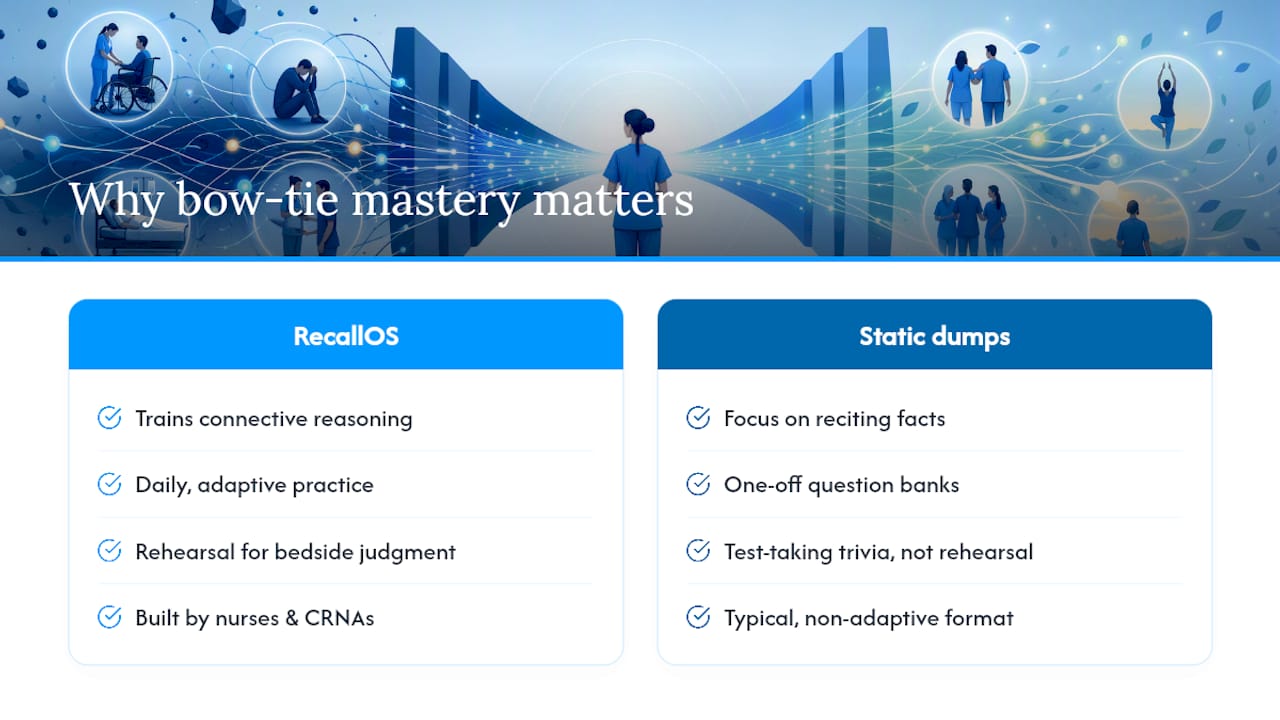
Clinical judgment items exist because a nurse who can recite facts but can't connect them under pressure is a patient safety risk, and that's the gap bow-ties are built to expose. RecallOS was built by practicing nurses and CRNAs specifically to train that connective reasoning through daily, adaptive practice rather than static question dumps. Getting comfortable with this format isn't test-taking trivia. It's rehearsal for the exact judgment call you'll make at a bedside.
Practice Bow-Tie Items Daily With RecallOS
RecallOS turns bow-tie practice into a daily habit instead of a last-minute scramble, with adaptive questions that zero in on the clinical judgment gaps you actually have rather than quizzing you on material you've already mastered.
The app tracks which zones trip you up most, center problem selection, action prioritization, or monitoring choices, and adjusts your next set of questions accordingly. You get a limited set of free daily practice items to try the format risk-free, with full adaptive review and weak-spot tracking available through a paid plan. If you want NGN-style bow-tie items that actually mirror the current exam blueprint, start with the adaptive nursing quiz app and build your daily streak from there.
Sources
- NCLEX Prep 2026: Pass the NGN on Your First Try
- Tips on How to Pass the NCLEX Exam | ANA
- NCLEX Bowtie Questions: A Step-by-Step Breakdown | Blog | Blueprint Prep