
The NCLEX draws from two format groups: traditional multiple-choice and multiple-response items, and Next Generation NCLEX (NGN) formats like drag-and-drop, drop-down cloze, highlight, matrix/grid, bow-tie, and trend items. Most NGN items live inside unfolding case studies built on the Clinical Judgment Measurement Model (NCJMM), and several allow partial credit instead of strict right-or-wrong scoring. The exam runs on computer adaptive testing, and NCSBN publishes official sample packs and tutorials for anyone who wants to see the formats before test day.
TL;DR:
- Most NGN items are embedded in case studies that unfold across multiple questions, requiring practice across the entire reasoning chain rather than isolated facts.
- Scoring now includes partial credit on some NGN formats, so answering all parts of a multi-step question improves your chances of earning credit and passing.
- The test includes a mix of traditional questions and NGN formats like drag-and-drop, highlight, and trend items, with each designed to assess clinical judgment skills.
- Computer adaptive testing selects questions based on previous answers, meaning the total number of items varies but typically ranges from 85 to 150 within a five-hour limit.
- Focusing on timed case studies that simulate real-life scenarios and mastering the NCJMM steps boosts your ability to perform well on the exam's reasoning-focused formats.
Table of Contents
- What the NCLEX Format Actually Tests
- NGN vs. the Old NCLEX: What Actually Changed
- Every NCLEX Item Type, Explained With an Action Plan
- How Computer Adaptive Testing and NGN Scoring Actually Work
- Building a Practice Routine Around Clinical Judgment
- The One Thing to Fix in Your Final Weeks
- Study NCLEX Question Types With Daily NGN Practice
- Where to Find the Official NCLEX Documents
- Sources
- FAQ
What the NCLEX Format Actually Tests
The NCLEX doesn't hand every candidate the same test. Computer adaptive testing (CAT) selects each question based on how you answered the last one, narrowing in on your true ability level instead of grinding through a fixed question bank. That's the core reason two candidates can sit the same exam and answer completely different questions, yet both walk away with a valid pass/fail result.
NGN exists because multiple-choice recall questions weren't catching whether a new nurse could actually reason through a deteriorating patient. The NCLEX-RN Test Plan built the Clinical Judgment Measurement Model specifically to test that reasoning process step by step, from recognizing cues to evaluating outcomes. Before you touch practice questions, spend time with the source material:
- The NCLEX Examination Candidate Bulletin covers exam rules, timing, and eligibility.
- The official sample pack and tutorial on NCLEX.com show you the exact item interfaces before test day.
- The NCLEX-RN Test Plan lists every content category and how NCJMM maps onto it.
NGN vs. the Old NCLEX: What Actually Changed
The content categories on the test plan (pharmacology, management of care, safety, and the rest) haven't moved. CAT delivery hasn't changed either. What changed is how deeply each question probes your thinking:
- Case studies replaced isolated recall. NGN typically includes three scored unfolding case study sets with roughly six questions each, tracking one patient as new information unfolds.
- Scoring got more nuanced. Some items now award partial credit instead of all-or-nothing grading, rewarding partially correct clinical reasoning.
- Format variety increased. Bow-tie, trend, matrix, and cloze-style items force you to demonstrate a process, not just recognize a fact.
- Standalone items still exist. Traditional multiple-choice and multiple-response questions remain scattered throughout the exam.
The practical shift for your study time: stop drilling isolated facts and start practicing the full reasoning chain, from spotting the relevant cue to picking the right intervention.
Every NCLEX Item Type, Explained With an Action Plan
Case studies present a patient scenario that develops across roughly six questions, and each question in the set typically maps to a step of the NCJMM (recognize cues, analyze cues, prioritize hypotheses, generate solutions, take action, evaluate outcomes). A summary of NGN item families counts around 14 specific formats built from these core types.
- Highlight text or tables. You click on relevant words in a chart, note, or lab table. This tests whether you can pull the right cue from noise, usually the "recognize cues" step. Approach tip: read the whole scenario once before highlighting anything; premature clicking wastes time re-reading.
- Drag-and-drop cloze or rationale. You drag words or phrases into blanks to complete a sentence about the patient's condition or the nurse's rationale. This usually maps to "analyze cues" or "generate solutions." Approach tip: read the full sentence with each option mentally inserted before committing.
- Drop-down cloze and drop-down tables. A drop-down menu replaces the missing word or value in a sentence or grid cell. These often test "prioritize hypotheses." Approach tip: eliminate the clearly wrong option first, then compare the two finalists against the scenario's specific numbers.
- Matrix/grid questions. You mark true/false, applicable/not applicable, or similar choices across a grid of options. These frequently test "take action" across multiple interventions at once. Approach tip: treat each row independently instead of comparing rows to each other.
- Extended multiple response. Select all that apply, but scored with partial credit rather than an all-or-nothing rule. Approach tip: answer based on what you know rather than skipping options out of fear of losing points on the whole item.
- Bow-tie items. A standalone format shaped like an actual bow tie: you pick the most likely condition in the center, then contributing factors on one side and expected actions or outcomes on the other. Approach tip: work the center first. Everything else follows from correctly identifying the primary problem.
- Trend items. These present data (vitals, labs, intake/output) across multiple time points and ask what changed and what it means. Approach tip: scan the trend direction before reading the answer choices, so you're not anchored by a plausible-sounding wrong answer.
- Traditional multiple-choice and multiple-response. These still appear as standalone items throughout the exam. Approach tip: in the NGN era, even these often embed a mini clinical-judgment task, so read for the underlying reasoning step rather than treating them as pure recall.
Pro Tip: Treat every case study as one connected story, not six separate questions. The scenario often adds a new lab value or vital sign midway through the set, and missing that update is the single most common way candidates lose partial credit on later items in the set.
How Computer Adaptive Testing and NGN Scoring Actually Work
CAT re-estimates your ability level after every single response, then selects the next item to land you close to a 50% chance of answering correctly. That's the most efficient way to pinpoint your true ability with the fewest questions, and it's exactly why you can't skip a question and come back to it later. Once you submit an answer, the algorithm has already used it to pick your next item.
Candidates sit anywhere from 85 to 150 items with a five-hour time limit, and the exam ends once the system reaches 95% confidence that you're above or below the passing standard.
A few logistics worth locking in before test day:
- NCSBN documents describe multiple partial-credit scoring methods for NGN items, including plus/minus scoring, zero/one scoring, and rationale scoring.
- Because some formats award partial credit, answer every part of a multi-step item rather than leaving sections blank.
- Budget your time assuming the longer end of the range; running out of time on a 150-item exam is a real risk if you stall on case studies.
- Review the official tutorial before test day so the drag-and-drop and matrix interfaces aren't a surprise mid-exam.
Building a Practice Routine Around Clinical Judgment
Random practice questions won't build the reasoning skill NGN tests. Educators generally advise practicing whole case studies as a unit, since synthesizing multiple cues together mirrors what the exam actually rewards and cuts down on errors on partial-credit items. A workable weekly structure looks like this:
- Daily: A short mixed set of NGN drills covering different NCJMM steps, not just one format repeated.
- Twice a week: A full timed case study set, treated start to finish like the real exam, no pausing to look things up.
- Ongoing: Targeted review sessions built around whatever content area keeps tripping you up.
- Spaced repetition: Revisit missed concepts a few days later instead of only reviewing them once.
Daily runs deliver that mixed NGN practice automatically, weak-spot review resurfaces the content areas missed instead of guessing what to revisit, and streak tracking helps maintain the daily habit through the final weeks. The Six Step NGN Case Strategy is worth pairing with your case-study practice specifically, since it walks through underlining, prioritizing, and acting on cues in sequence.
Pro Tip: Review your missed case-study items as a full set, not question by question. Ask what cue you missed early in the scenario. That single skill, catching the update before it changes the right answer, improves faster with sequenced review than with random re-quizzing.
The One Thing to Fix in Your Final Weeks
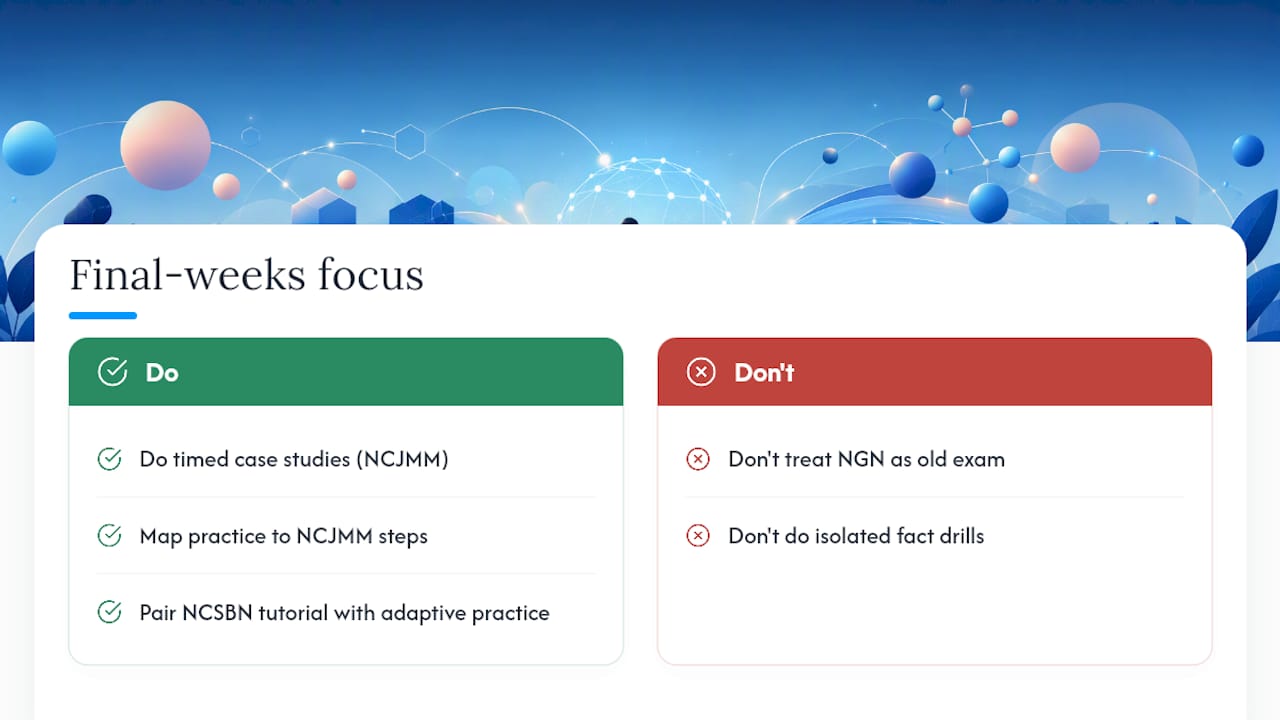
If you take one thing from this: stop treating NGN as a trickier version of the old exam. It isn't designed to trap you. It's designed to check whether you'd catch a deteriorating patient in real life, and the format follows that logic exactly. Spend your remaining prep time on timed case studies mapped to NCJMM steps, not more isolated fact drills.
Pair the official NCSBN tutorial with adaptive practice that adjusts to your actual weak spots. The combination beats either one alone, because the tutorial shows you the interface and the adaptive practice builds the reasoning muscle the interface is testing.
— Caleb
Study NCLEX Question Types With Daily NGN Practice
Users can access daily NGN-style drills mapped to NCJMM steps, helping them know which reasoning skill to practice next. Instead of a static question bank, they receive weak-spot review that resurfaces content categories repeatedly missed, plus streak tracking to support consistent practice before test day.

Start with the Daily Recall Run for mixed NGN practice, or head to the NCLEX study app to see the full Recall+ and Recall Pro options. If you've already got lecture notes or case study packets piling up, the upload notes tool turns them into custom drills in minutes. None of this replaces the official NCSBN tutorial and sample pack. Run through both, and you'll walk into test day having seen the interface and having drilled the reasoning it's built to measure.
Where to Find the Official NCLEX Documents

Start with the candidate bulletin for exam rules and timing, the RN test plan for item types and NCJMM detail, and the CAT video for a quick visual walkthrough.
Sources
- NCLEX-RN Test Plan (2023) — NCSBN
- Free NCLEX-RN NGN Guide 2026: Clinical Judgment Model | OpenExamPrep
FAQ
What Format of Questions Are on the NCLEX?
The NCLEX mixes traditional multiple-choice and multiple-response items with NGN formats like drag-and-drop, drop-down cloze, highlight, matrix/grid, bow-tie, and trend questions. Most NGN items sit inside unfolding case studies, and the exam runs on computer adaptive testing rather than a fixed question set.
What Type of Questions Are Considered Hardest on the NCLEX?
Case study sets tend to feel hardest because they require tracking a patient across multiple unfolding data points, then answering roughly six connected questions that map to different Clinical Judgment Measurement Model steps. Bow-tie and trend items also trip up candidates who haven't practiced synthesizing multiple data points into one answer.
What Are Highlight or Hot-Spot Questions on the NCLEX?
Highlight items show you a passage, chart, or lab table and ask you to click on the specific words or values that matter most to the patient's condition. They typically test whether you can recognize the right cue, an early step in the clinical judgment process, before you're asked to act on it.
What Are the Most Common Question Types on the NCLEX?
Traditional multiple-choice and multiple-response questions still appear most frequently as standalone items, alongside NGN formats woven into case studies. Daily practice can be structured around this same mix, so learners see both traditional and NGN formats in realistic proportions rather than overpracticing one type.
How Many Questions Are on the NCLEX?
The exam ranges from 85 to 150 items with a five-hour time limit, ending once the computer reaches 95% confidence in your pass or fail status. The exact number varies by candidate because CAT adjusts based on your responses.