
Run two or three timed, full-length practice exams this week and tag every miss by content category and error type. Map those misses to the NCSBN client needs blueprint, then rank your weak areas by patient-safety weight, not by what feels shaky. Pharmacology, prioritization, and management of care almost always sit at the top of that list. Set a specific accuracy target on targeted question sets before you even think about picking a retake date.
TL;DR:
- Focus your practice on identifying content categories with the highest patient-safety impact, such as pharmacology and infection control.
- Analyze four key practice test metrics—percent correct per content block, question timing, flagged items, and repeated misses—to pinpoint your true weaknesses.
- Prioritize study time on patient-safety topics and high-frequency categories, and re-test weak areas after one poorly performing test before trusting the signals.
- Use consistent, timed full-length diagnostics spaced over days to track genuine progress rather than reacting to isolated test scores.
- Rely on real-time diagnostic tools that automatically tag and analyze missed questions to maintain an up-to-date weak-area list and target your retake preparation.
Table of Contents
- How Do You Find Your NCLEX Weak Areas?
- Running Practice Tests That Actually Predict Your Score
- Turning Your Weakness List Into a Study Plan
- When Test-Taking Habits Look Like Content Gaps
- When Are You Actually Ready to Retake the NCLEX?
- How RecallOS Fits This Diagnostic Workflow
- An Honest Note on Retakes and Progress
- Get a Real-Time Weak-Area Breakdown With RecallOS
- Where to Verify NCLEX Standards and Statistics
- Sources
- FAQ
How Do You Find Your NCLEX Weak Areas?
Weakness data hides in numbers most students never look at twice. A percent-correct score by itself tells you almost nothing useful for a retake plan.
Pull four numbers from every practice session:
- Percent correct by content block, not just an overall score
- Time per question, since rushed correct answers hide fragile knowledge
- Flagged items, the ones you guessed on or second-guessed
- Repeat misses, the same concept showing up wrong across multiple tests
Once you have those numbers, map each missed item to its NCSBN client needs category: Management of Care, Safety and Infection Control, Pharmacological and Parenteral Therapies, Physiological Adaptation, and the rest of the official test blueprint. A cluster of misses in one category is your weak-area signal.
Then run a root-cause check on each miss. Did you not know the content, did you misread the stem, or did you know the answer but ran out of time? These three failure modes need completely different fixes. If your school or NCLEX feedback report is thin on detail, lean on your Qbank's analytics dashboard and any item-level breakdowns your program provides. Raw scores without a breakdown are close to useless for remediation planning.
Running Practice Tests That Actually Predict Your Score
A single practice test is a snapshot, not a diagnosis. One bad day with a tricky pharmacology set does not mean pharmacology is your problem. It might just mean you were tired.
Follow this sequence to get a reading you can trust:
- Simulate real conditions. Timed, Next Generation NCLEX (NGN) item types, same break schedule, quiet room, no phone.
- Take two to three full-length diagnostics spaced a few days apart, then look at patterns across all of them instead of reacting to any single result.
- Tag every miss by content area and error type, then build one aggregated weakness list instead of three separate ones.
- Re-test any outlier. If a category shows up bad on only one test, run a focused 20-question set on that topic before you trust the signal.
Professional guidance on NCLEX preparation backs this same approach: realistic timed practice and category-level mapping are the most dependable way to find real gaps when your official score report gives you little to work with.
Pro Tip: Keep a simple spreadsheet with one row per practice test and one column per NCSBN category. After three tests, the weak rows jump out without any guesswork.
Turning Your Weakness List Into a Study Plan
Not every weak area deserves equal attention. A shaky score on obscure lab values matters far less than a shaky score on medication safety or delegation, because the exam weights patient safety heavily and tests it constantly.
Rank your list this way:
- Patient-safety content first: pharmacology, infection control, and anything involving harm prevention
- High-frequency categories second: management of care and physiological adaptation show up on nearly every test
- Question-type weaknesses third: if select-all-that-apply or NGN case studies keep tripping you up regardless of content, that's its own line item
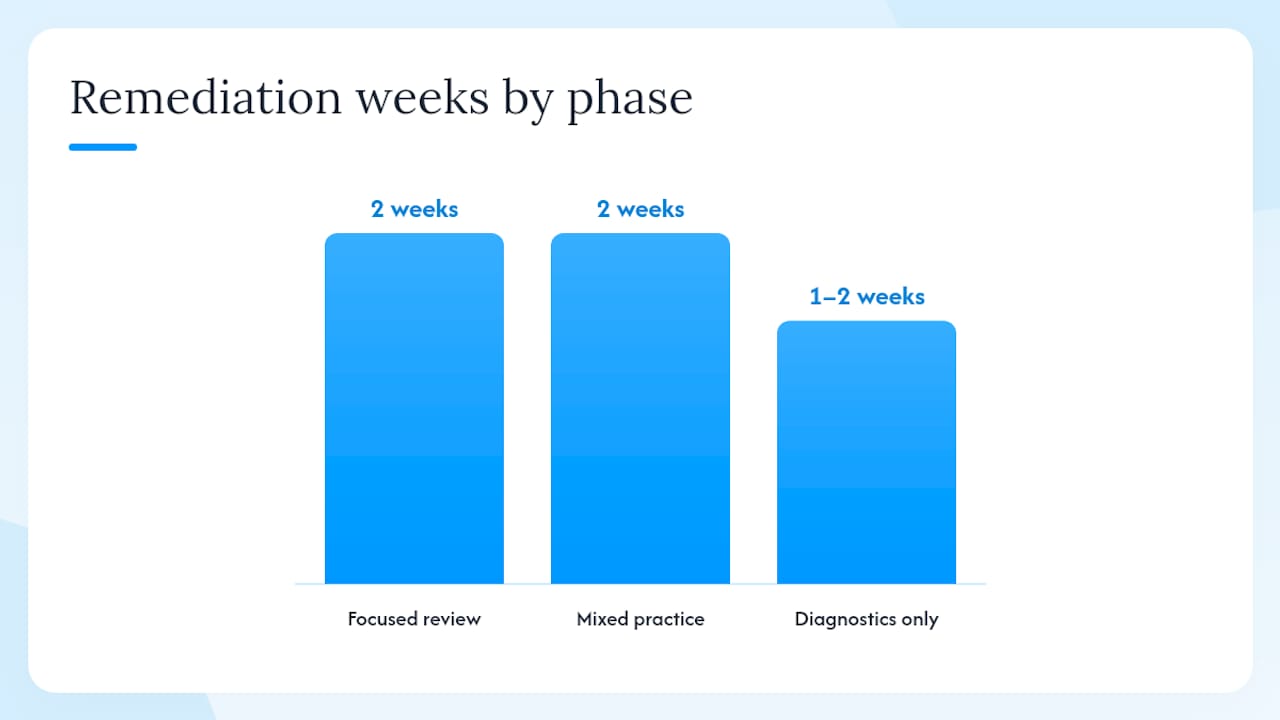
Build weekly study blocks around that ranking. A realistic four to six week remediation schedule looks like this: weeks one and two hit your top two weak categories with focused review plus 50 to 75 questions daily, using spaced repetition so the same concepts resurface days later. Weeks three and four shift to mixed practice sets that blend weak and strong areas. The final week or two is full-length diagnostics only, checking whether your weak-category scores have actually moved.
When Test-Taking Habits Look Like Content Gaps
Plenty of students study the right material and still miss questions, because the problem isn't knowledge. It's how they read and answer.
Run these fixes in parallel with content review, not after it:
- Split select-all-that-apply items into individual true/false statements before choosing, which cuts down on the guessing that tanks these questions
- Drill timing so you're not spending four minutes on one question and forty seconds on the next
- Practice NGN item types directly, including hot spots, extended case studies, and prioritization sets, since unfamiliarity with the format costs points separate from content knowledge
- Use a short breathing or reset routine between question sets on test day to keep anxiety from clouding your reasoning
Test-taking skill often improves faster than raw content knowledge, according to guidance from the American Nurses Association, which is exactly why it belongs in your weekly plan, not as an afterthought.
Pro Tip: If you're consistently missing select-all questions, try answering the same set twice, once as a group choice and once statement-by-statement. The gap between your two scores tells you whether it's a knowledge issue or a strategy issue.
When Are You Actually Ready to Retake the NCLEX?
Readiness isn't a feeling. It's a pattern in your numbers.
Look for these signals before you book a date:
- Consistent scores of 80% or higher on targeted practice sets covering your former weak categories
- Improving full-length diagnostic scores across at least two or three consecutive attempts, not just one good day
- Fewer repeat misses on the same item types that used to trip you up
- Stable pacing, meaning you're finishing timed sets without rushing the last quarter of questions
Most states allow rescheduling through Pearson VUE roughly 45 days out, and waiting far beyond that window tends to erode momentum rather than build confidence, per ANA guidance. If your scores plateau despite structured practice, that's the signal to bring in a tutor or a more structured course before your next attempt.
How RecallOS Fits This Diagnostic Workflow
This study app was built by practicing nurses and CRNAs to generate the metrics this whole process depends on. Daily high-yield questions get tagged by content category automatically, so the weak-area inventory you'd otherwise build in a spreadsheet builds itself as you study.
Caleb, who develops much of Recallos's NCLEX content, has written prioritized study guides like the high-yield topics guide that mirror the same NCSBN-mapped approach described above. Streaks and progress tracking inside the app correspond directly to the checkpoints this article recommends: consistent accuracy over time, not a single lucky test. NGN-style items and personalized weak-area review round out the loop from diagnosis to retest.
An Honest Note on Retakes and Progress
Failing the NCLEX once doesn't say much about your ability to pass it. It says your prep had gaps, and gaps are fixable with the right data.
The students who pass on a second attempt aren't the ones who study harder in some vague sense. They're the ones who treat their weak-area list as a moving target, checking it every week instead of assuming last month's diagnosis still holds. Motivation dips are normal during a retake cycle. Build a routine you can sustain for four to six weeks rather than a burst you can't repeat, and check the NCSBN's official guidance before locking in any assumptions about your state's requirements. Rest matters more than one extra late-night review session the day before your test.
— Caleb
Get a Real-Time Weak-Area Breakdown With RecallOS
This app turns the diagnostic work described above into something you don't have to build by hand. Instead of exporting Qbank reports into a spreadsheet, the app tags every missed question by content category as you go, so your weak-area list updates itself instead of waiting for your next full-length test.
The daily practice sets are pulled from NCLEX-aligned content, and NGN-style items are mixed in so format familiarity builds alongside content knowledge. Streaks and progress tracking give you the checkpoint data this article recommends without a manual spreadsheet. If you'd rather test your learning preferences before locking in a study structure, the study preference assessment from TESTUNO is a useful complementary step. When you're ready to see how your own weak areas stack up, start with Recallos and run your first diagnostic set today, or check the reviewer feedback page first if you want more detail before committing.
Where to Verify NCLEX Standards and Statistics
For the official test blueprint and pass-rate data, consult the NCSBN's exam statistics page. For published test-taking guidance, see the American Nurses Association's NCLEX tips.
Sources
- Tips on How to Pass the NCLEX Exam | ANA
- NCLEX exam statistics and publications — NCSBN
- How Hard Is the NCLEX in 2026? Difficulty, Pass Rates & What to Expect - Medical Hero
FAQ
Which State Has the Lowest NCLEX Pass Rate?
Pass rates shift year to year and vary by school and candidate volume within each state, so there's no single state that stays lowest consistently. The NCSBN publishes current pass-rate data by jurisdiction if you want the most current breakdown for your state.
Which State Is the NCLEX Hardest In?
The NCLEX itself is the same standardized exam nationwide, so difficulty doesn't change by state. Pass-rate differences usually reflect school preparation quality and cohort factors rather than a harder version of the test in any particular state.
Is the NCLEX Getting Harder in 2026?
The exam's format has shifted toward heavier emphasis on clinical judgment through Next Generation NCLEX items, and many candidates report prioritization and delegation questions as the toughest part of that shift, per recent difficulty analysis. That's a change in emphasis more than a jump in overall difficulty.
What Percent of People Fail the NCLEX?
Fail rates vary by year, candidate type (first-time versus repeat), and jurisdiction, so there's no single fixed number. Check the NCSBN's official statistics for current figures broken out by candidate category.
How Do I Know My Weak Areas Are Actually Fixed?
A single strong practice test isn't enough evidence on its own.