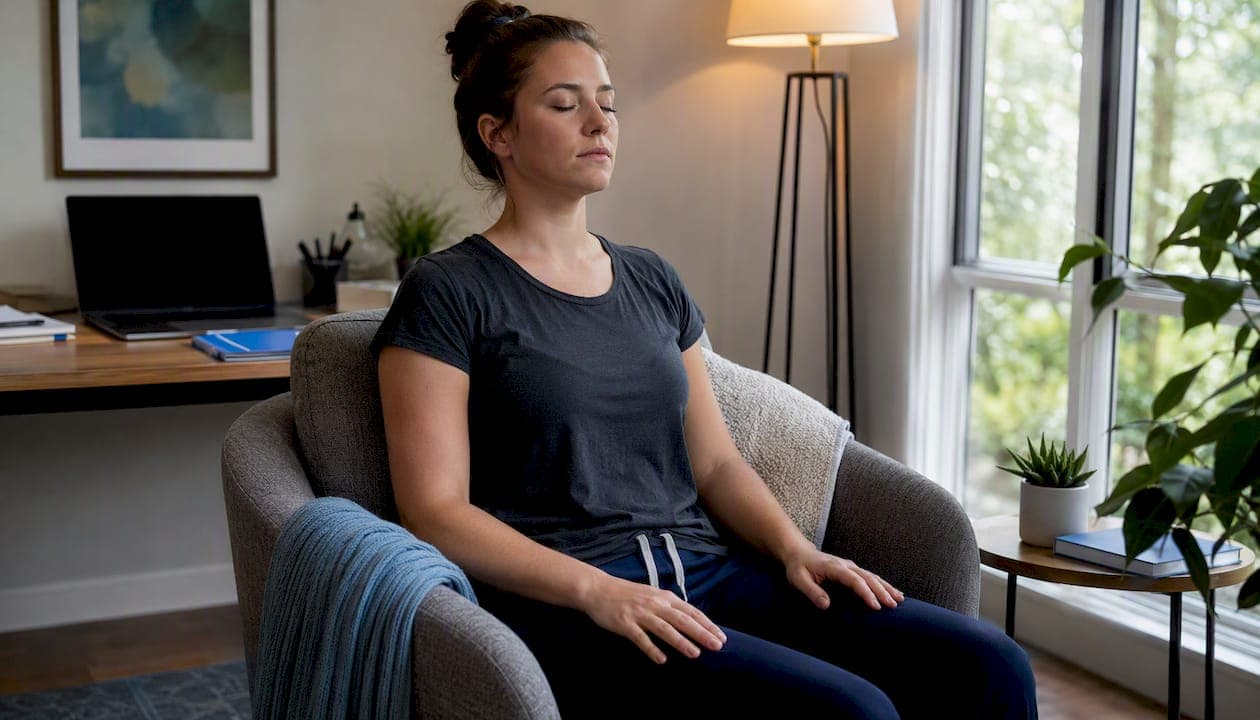
The most effective way to reduce NCLEX test anxiety is a three-part combination: realistic CAT-style simulated practice, brief cognitive restructuring (CBT reframing), and a fast in-exam calming routine you can run in under 60 seconds. Research backs all three, and none of them require weeks of setup.
Here's what to do in the next 72 hours:
- Run one timed, full-length practice exam under real conditions (no phone, no pausing) to expose yourself to the CAT format before test day creates that exposure for you.
- Write down your three biggest NCLEX fears in a notebook, then write one factual counter-statement for each. That's the core of cognitive restructuring, and it takes 10 minutes.
- Practice box breathing (inhale 4 counts, hold 4, exhale 4, hold 4) until you can drop into it without thinking. You'll use it between questions on exam day.
Pro Tip: If the NCLEX gives you a long string of questions that feel hard, that's actually a good sign. The CAT algorithm raises difficulty when you're answering correctly. Harder questions mean the system is working to confirm your competency, not punishing you.
Key Takeaways
The most effective approach to NCLEX test anxiety combines simulated CAT practice, brief CBT cognitive restructuring, and a portable in-exam calming routine practiced until it's automatic.
| Point | Details |
|---|---|
| Combine three interventions | CBT micro-scripts, relaxation training, and simulated CAT practice together outperform any single approach. |
| Harder questions are a good sign | The CAT raises difficulty when you're answering correctly; don't interpret difficulty as failure. |
| Sleep protects memory | Anxiety disrupts memory consolidation; prioritize 7–9 hours over late-night cramming in the final week. |
| Use the in-exam reset sequence | Breathe (box breathing), ground (3-3-3), reframe (10-second script), then return to the question. |
| Seek help early if red flags appear | Panic attacks during practice, daily impairment, or severe sleep disruption warrant campus counseling, not more self-help. |
Table of Contents
- How do you know if your NCLEX worry is a real problem?
- Why the NCLEX triggers more anxiety than any exam you've taken before
- Evidence-based interventions that actually reduce test anxiety
- How to structure your NCLEX study to lower anxiety
- NCLEX test-taking tactics that reduce anxiety and prevent overthinking
- A practical day-before and test-day checklist
- Fast techniques to calm acute anxiety during the exam
- When self-help isn't enough: recognizing severe anxiety and getting support
- What the research actually shows about NCLEX anxiety interventions
- How to cope after the NCLEX, whether you pass or fail
- An editorial perspective on managing NCLEX anxiety
- Sources
How do you know if your NCLEX worry is a real problem?
Test anxiety is a specific psychological response to evaluative situations, distinct from general nervousness. It involves cognitive interference (intrusive thoughts, self-doubt) alongside physical arousal (racing heart, sweating) that impairs performance rather than sharpening it. Among nursing students, it's common enough that research on nursing students before the NCLEX-RN found that moderate anxiety can actually support learning and engagement, while high anxiety levels correlate with poor concentration and impaired logical reasoning.
The line between useful nerves and problematic anxiety matters. Useful nerves sharpen focus. Problematic anxiety eats working memory, blocks recall, and makes you second-guess answers you actually know.
Cognitive symptoms:
- Blanking on material you've reviewed repeatedly
- Racing, circular thoughts during practice questions
- Catastrophic self-talk ("I'm going to fail," "I'm not smart enough")
- Difficulty concentrating for more than a few minutes
Emotional symptoms:
- Persistent dread that doesn't ease after studying
- Irritability or emotional numbness around NCLEX topics
- Feeling detached or hopeless about the outcome
Physical symptoms:
- Heart pounding, chest tightness, or shortness of breath during practice
- Nausea, headaches, or GI distress before or during study sessions
- Sleep disruption (difficulty falling asleep or waking at 3 AM replaying questions)
Red flags that suggest clinical-level anxiety:
- Panic attacks during practice exams (not just nerves, but full physical episodes)
- Anxiety that impairs daily functioning for more than two weeks
- Avoidance so severe you can't sit down to study at all
- Physical symptoms that persist even on rest days
- Thoughts of self-harm or hopelessness
If two or more red flags apply to you, self-help strategies alone may not be enough. The section on professional support below covers next steps.
Why the NCLEX triggers more anxiety than any exam you've taken before
Most nursing students have taken dozens of exams. The NCLEX produces a different kind of anxiety because its design is genuinely unlike anything in nursing school.
The CAT format means the exam adapts in real time. Every answer you give changes the difficulty of the next question. According to the NCLEX candidate bulletin, the exam runs between 75 and 145 items, and you won't know which end of that range you'll hit.
That variable length is a major anxiety driver. Students who finish at 75 questions often assume they failed because the exam stopped early. Students who hit 145 questions assume they're failing because the exam kept going. Both assumptions are wrong. The exam stops when the algorithm is confident, not when you've "done enough."
The Next Generation NCLEX (NGN) adds another layer. Case-based items with partial credit, drag-and-drop matrices, and extended multiple-response questions raise cognitive load significantly compared to traditional multiple-choice. You're not just retrieving a fact; you're analyzing a clinical scenario across several dimensions simultaneously.
Other stressors that compound the anxiety:
- High financial and professional stakes. You can't practice as a registered nurse without passing. The cost of retesting, plus the delay in starting your career, makes every attempt feel enormous.
- Scheduling constraints. Candidates must wait 45 days between attempts. That waiting period, if you don't pass, is its own psychological challenge.
- Social pressure. Classmates, family, and employers are often watching. That audience effect raises performance anxiety even in students who test well under normal conditions.
- Uncertainty about readiness. Unlike a class exam with a defined syllabus, the NCLEX tests clinical judgment across the entire scope of nursing practice. There's no clear "done studying" signal.
Pro Tip: Stop interpreting question difficulty as a performance signal during the exam. The CAT is designed to keep you near your competency threshold, which means it will always feel hard. That's the point. A string of difficult questions is the algorithm doing its job, not evidence you're failing.
Evidence-based interventions that actually reduce test anxiety
A systematic review of interventional strategies for nursing students found that CBT-based techniques, relaxation training, and simulated test exposure each produced moderate reductions in test anxiety, with the strongest effects seen when interventions were combined. That's the research-level answer. Here's what it looks like in practice.
CBT-style cognitive restructuring
Cognitive restructuring targets the thought patterns that fuel anxiety, specifically the catastrophic predictions and all-or-nothing thinking that spiral during high-stakes prep. You don't need a therapist to do a basic version.
A simple 3-step micro-script:
- Catch the thought. Write it down exactly as it appears: "I'm going to blank on everything."
- Challenge it with evidence. Ask: "What do I actually know? What have I already demonstrated in practice?" Write one or two factual counter-statements.
- Replace it with a coping statement. Not toxic positivity, but something accurate: "I've answered 1,200 practice questions. I know this material. I can work through uncertainty."
Run this script once a day during the final two weeks of prep, especially after a practice exam where you felt your confidence drop.
Breathing and progressive muscle relaxation
Box breathing is the most portable anxiety tool you have, and it works by activating the parasympathetic nervous system to counteract the fight-or-flight response.
Box breathing (use between questions or at the start of a break):
- Inhale through your nose for 4 counts.
- Hold for 4 counts.
- Exhale through your mouth for 4 counts.
- Hold for 4 counts.
- Repeat 4 times.
4-7-8 breathing (use before sleep or before entering the testing center):
- Inhale for 4 counts.
- Hold for 7 counts.
- Exhale slowly for 8 counts.
- Repeat 3 to 4 cycles.
Progressive muscle relaxation (PMR) takes about 10 minutes and works by tensing and releasing muscle groups from feet to face. Studies on test anxiety consistently show PMR reduces physiological arousal. Do it the night before the exam, not the morning of.
Simulated CAT practice as exposure therapy
Repeated exposure to the exam format under realistic conditions is one of the most effective anxiety-reduction strategies available. The anxiety you feel during a practice exam is the same anxiety you'll feel on test day, and each exposure session teaches your nervous system that the discomfort is survivable and manageable.

Practical guidance on NCLEX RN practice tests consistently recommends full-length, timed simulations rather than short question sets, because the stamina and pacing demands of a real exam are part of what needs to be trained.
Aim for at least two full-length simulated exams in the final four weeks of prep. Treat them exactly like the real thing: no phone, no pausing, same time of day as your scheduled exam.
Expressive writing as an adjunct
A brief expressive-writing exercise, specifically writing freely about your test fears for 10 minutes, has shown small-to-moderate benefits in reducing exam anxiety in some controlled trials, according to research published by Harvard Health. The mechanism appears to be cognitive offloading: getting fears out of working memory and onto paper frees up mental resources for actual performance.
Pro Tip: After each full-length practice exam, spend 10 minutes writing about what you felt during it, not what you got wrong, but what the anxiety felt like and what you did to manage it. That debrief builds metacognitive awareness and primes your coping response for the real exam.
How to structure your NCLEX study to lower anxiety
Anxiety during NCLEX prep often comes from a feeling of chaos: too much material, not enough time, no clear signal of progress. A structured plan fixes that. The goal isn't to study more; it's to study in a way that builds genuine confidence.
Why spacing beats cramming
Spaced repetition distributes practice over time, which strengthens memory consolidation and reduces the anxiety that comes from feeling like material "won't stick." Cramming produces short-term retention but increases anxiety because students sense (correctly) that the knowledge is fragile. Active recall, answering questions rather than re-reading notes, is consistently more effective for durable learning.
A sample 4-week prep framework
Prep guides and aggregated pass-rate data support a structured 6–12 week preparation window for most candidates, with the final four weeks being the highest-intensity phase.
Week 1: Content review and baseline
- Identify your weakest content areas using a diagnostic practice set (100–150 questions across all domains).
- Review high-yield content in those areas using your primary resource.
- Do 50–75 practice questions daily, mixed across domains.
Week 2: Targeted remediation
- Focus 60% of study time on your two or three weakest areas.
- Introduce NGN-style case studies. A fundamentals-focused NGN practice plan can help you build familiarity with the item format before it appears on the real exam.
- Continue daily practice questions (75–100 per day).
Week 3: CAT simulation and stamina
- Run two full-length timed practice exams this week.
- Debrief each exam: review rationales for every wrong answer and any question you guessed on.
- Reduce content review; trust what you've already built.
Week 4: Taper and consolidate
- Cut daily question volume to 25–50 high-yield items.
- No new content. Reinforce what you know.
- Prioritize sleep, nutrition, and the day-before routine described below.
Study hygiene checklist
- Sleep 7–9 hours per night. Anxiety disrupts memory consolidation, and late-night cramming trades short-term coverage for long-term retention.
- Cap screen time after 9 PM to protect sleep quality.
- Eat regular meals. Blood sugar swings amplify anxiety symptoms.
- Build in at least one full rest day per week. Sustained high-effort study without recovery increases burnout and anxiety.
Continuing to study your strengths feels productive but actually increases anxiety by reinforcing the idea that you're never "done." Redirect that time to a weaker area or to rest.*
NCLEX test-taking tactics that reduce anxiety and prevent overthinking
Anxiety during the exam often comes from indecision: staring at a question too long, second-guessing a solid answer, or getting stuck in a spiral about what the question is "really" asking. Clear decision rules prevent that.
A decision framework for each question
- Read the question stem first. Identify what the question is actually asking before you look at the answer choices.
- Apply the safety-first heuristic. When two answers both seem correct, choose the one that most directly addresses patient safety. The NCLEX tests clinical judgment, and safety is the priority framework.
- Eliminate obviously wrong answers. Cross out any choice that is contraindicated, irrelevant to the stem, or addresses a different problem than the one presented.
- For select-all-that-apply (SATA) items: treat each option as a true/false statement independently. Don't let one strong option pull you toward others that don't stand on their own.
- Commit and move on. Once you've eliminated and chosen, click and go. Dwelling on a question you've already answered raises anxiety and doesn't improve accuracy.
Time management rules
- Budget roughly 1 to 1.5 minutes per question as a general guide, but don't watch the clock obsessively. Check time at natural intervals (every 25 questions).
- If you're stuck after 90 seconds, make your best choice and move forward. Spending 4 minutes on one question doesn't improve your odds and costs you composure.
- Use optional breaks strategically. The NCLEX offers optional breaks at set intervals. Take them if you feel your focus slipping, not just when you're exhausted.
The answer-change trap
Research on test-taking behavior consistently shows that first instincts are correct more often than changed answers, particularly for students with solid content knowledge. Change an answer only when you have a specific, articulable reason (you misread the stem, you recalled a fact that directly contradicts your first choice). "I feel nervous about this one" is not a reason to change.
Pro Tip: Use your first optional break to do 60 seconds of box breathing and a brief body scan. Stand up, roll your shoulders, take three slow breaths. That physical reset is more valuable than reviewing notes in the hallway, which tends to spike anxiety rather than reduce it.
A practical day-before and test-day checklist
The day before
- Stop heavy studying by noon. A light review of high-yield mnemonics or a short 25-question set is fine. A full study session the day before raises anxiety and disrupts sleep without adding meaningful retention.
- Pack your test bag the night before: government-issued ID, confirmation email, any approved comfort items, snacks and water for breaks.
- Eat a normal dinner. Nothing experimental. Familiar food, reasonable portions.
- Sleep hygiene: dim lights by 9 PM, no screens after 10 PM, keep your room cool. If you can't sleep, lying still with slow breathing still rests your nervous system. Don't catastrophize a restless night.
- Set two alarms. Logistics anxiety (what if I oversleep?) is a real contributor to pre-exam insomnia.
Morning of the exam
- Eat a real breakfast. Protein and complex carbohydrates sustain blood glucose through a multi-hour exam. Avoid excessive caffeine if you're not a regular coffee drinker; it amplifies physical anxiety symptoms.
- Arrive 30 minutes early. Rushing to the testing center is one of the most avoidable anxiety triggers.
- Do not review notes in the parking lot. It raises cortisol without adding knowledge. Listen to music, do breathing exercises, or sit quietly.
- At check-in: follow the process calmly. The security procedures are standard. Knowing what to expect from the 2025 NCLEX candidate bulletin ahead of time removes logistical surprises.
Pro Tip: The most useful cognitive frame for test morning is this: "My job today is not to know everything. My job is to think like a safe nurse for each question in front of me." That shift from "prove I'm competent" to "practice clinical judgment" reduces performance anxiety and aligns with exactly what the NCLEX is measuring.
Fast techniques to calm acute anxiety during the exam
Even with thorough preparation, anxiety can spike mid-exam. These techniques work in under 60 seconds and don't require closing your eyes or drawing attention to yourself.
Box breathing (in-exam version)
- Inhale quietly through your nose for 4 counts.
- Hold for 4 counts.
- Exhale slowly through your mouth for 4 counts.
- Hold for 4 counts.
- One cycle is enough to interrupt a panic spiral. Two or three cycles will noticeably lower your heart rate.
The 3-3-3 grounding exercise
When anxiety pulls you into catastrophic thinking, grounding brings you back to the present moment.
- Name 3 things you can see (the screen, your hands, the desk).
- Name 3 sounds you can hear (the keyboard, the HVAC, your breath).
- Move 3 parts of your body (wiggle your toes, roll your shoulders, press your feet flat on the floor).
This takes about 15 seconds and interrupts the anxiety feedback loop without disrupting your testing session.
The 10-second reset script
Between questions, when you feel your composure slipping, run this internal script:
"That question is done. I can't change it. The next question is a fresh start. I know how to think through clinical problems. I'm ready."
It sounds simple, but the act of consciously redirecting attention from a past question to the present one is a core CBT technique. Working memory impairment under stress is a real mechanism: anxiety occupies cognitive resources that should be available for reasoning. The reset script clears that interference.
Pro Tip: Sequence your in-exam recovery like this: breathe first (box breathing, 1–2 cycles), then ground (3-3-3 or feet on floor), then reframe (10-second script), then return to the question. Running them in that order takes about 30 seconds and addresses physiology before cognition, which is the right sequence because you can't think clearly when your nervous system is in fight-or-flight.
When self-help isn't enough: recognizing severe anxiety and getting support
Self-help strategies work well for moderate test anxiety. They're not sufficient for clinical-level anxiety, and pushing through without support when you need it is one of the most common reasons students underperform despite solid content knowledge.
Red flags that warrant professional evaluation
- Panic attacks during practice exams (racing heart, chest pain, derealization, feeling like you might pass out)
- Anxiety that prevents you from studying for more than a few days at a time
- Sleep disruption severe enough to affect daily functioning for two or more weeks
- Physical symptoms (GI distress, headaches, trembling) that appear consistently before or during study sessions
- Persistent hopelessness or thoughts of self-harm
If any of these apply, contact your campus counseling center. Most U.S. nursing programs have counseling services available to enrolled students, and many offer same-week or same-day appointments for acute distress.
How to access support
- Campus counseling: Call or use the online portal to schedule an intake appointment. Bring a brief description of your symptoms and how long they've been present. Most centers can connect you with a therapist within one to two weeks for non-urgent concerns.
- Disability services: If anxiety significantly impairs your test performance, you may qualify for testing accommodations such as extended time or a separate testing room. Contact your school's disability services office. Documentation from a licensed mental health professional or physician is typically required, and timelines vary by institution, so start this process early.
- Primary care or psychiatry: For students whose anxiety is severe enough to warrant medication, a primary care provider or psychiatrist can evaluate options. Medication is not a shortcut or a sign of weakness; for some students, it's what makes the difference between being able to engage with preparation and being paralyzed by it.
Testing accommodations through NCSBN
The NCSBN offers testing accommodations for candidates with documented disabilities, including anxiety disorders that meet the clinical threshold. The process requires documentation and advance application. Review the 2025 NCLEX candidate bulletin for current accommodation procedures and deadlines.
A practical action list:
- Book a counseling appointment this week if red flags apply.
- Contact disability services at least 8–12 weeks before your exam date to allow time for documentation and processing.
- If you experience a panic attack during a practice exam, treat it as clinical data, not a character flaw, and bring it to a counselor.
What the research actually shows about NCLEX anxiety interventions
The evidence base for test anxiety interventions in nursing students is solid at the moderate level. A systematic review of interventional strategies synthesizing multiple studies found that combined behavioral interventions (CBT techniques plus relaxation training plus simulated practice) produced the most consistent reductions in test anxiety. No single intervention outperformed the combination.
Key findings worth knowing:
- CBT-based techniques showed consistent effects across studies, particularly cognitive restructuring and thought-challenging exercises. Short modules (30–60 minutes total) were as effective as longer programs for mild-to-moderate anxiety.
- Relaxation training (breathing exercises, PMR, mindfulness) showed reliable reductions in physiological anxiety symptoms. Mindfulness apps like Headspace or Calm have been used in some student populations as accessible delivery tools, though the nursing-specific evidence is limited.
- Simulated practice exposure reduced anticipatory anxiety by familiarizing students with the exam format. The effect was strongest when simulations closely matched real exam conditions.
- Expressive writing showed small-to-moderate benefits as an adjunct, particularly when used after high-stress practice sessions.
The cross-sectional research on nursing students before the NCLEX-RN adds an important nuance: not all anxiety is harmful. Moderate arousal correlates with engagement and motivation. The goal of intervention is not to eliminate anxiety entirely but to keep it in the productive range.
| Intervention | Evidence level | Practical recommendation |
|---|---|---|
| CBT / cognitive restructuring | Moderate (systematic review) | Use the 3-step micro-script daily in final 2 weeks |
| Relaxation training (breathing, PMR) | Moderate (multiple RCTs) | Practice box breathing daily; PMR the night before |
| Simulated CAT practice | Moderate (prep guides + exposure research) | Minimum 2 full-length timed exams in final 4 weeks |
| Expressive writing | Small-to-moderate (controlled trials) | 10-minute debrief writing after each practice exam |
| Mindfulness apps | Emerging (limited nursing-specific data) | Use as supplement, not primary strategy |
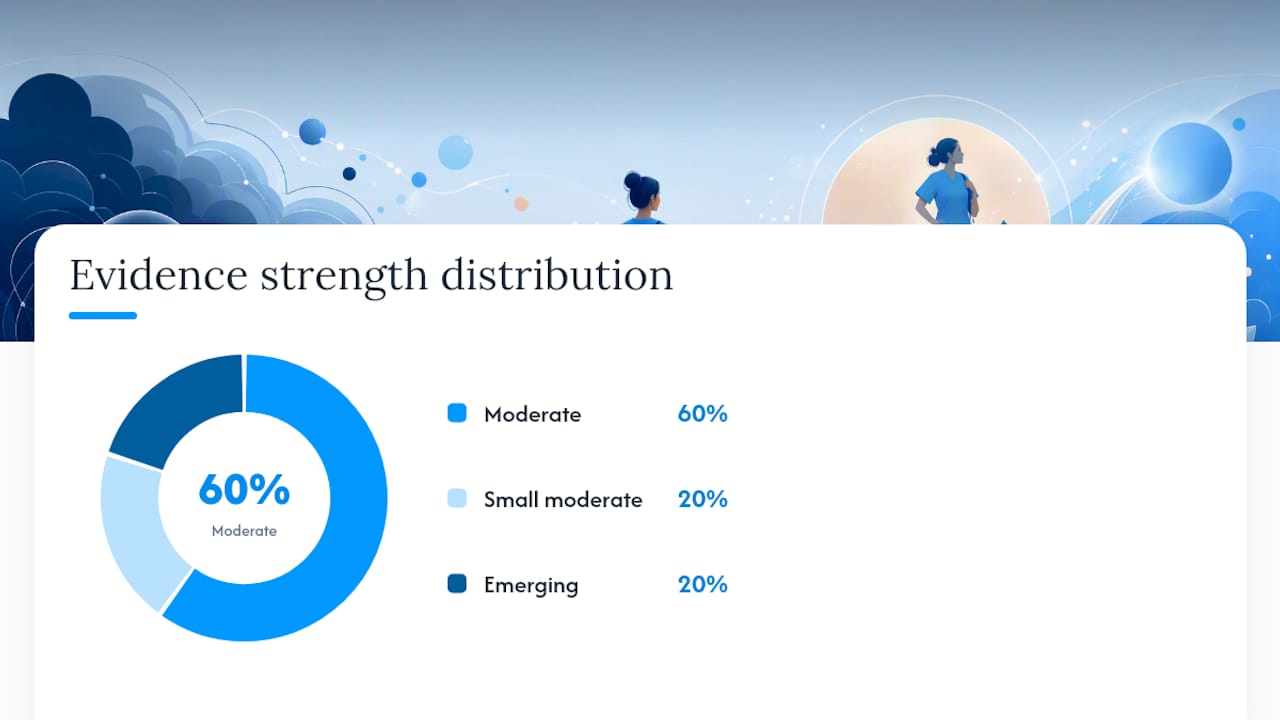
Practical priority: If you only have time for two interventions, choose simulated CAT practice and the CBT micro-script. Those two, consistently applied, address both the physiological and cognitive dimensions of NCLEX test anxiety.
How to cope after the NCLEX, whether you pass or fail
The exam ends. The anxiety doesn't always follow immediately. Here's how to handle both outcomes.
If you pass
- Notify your state board and employer as soon as your results are available (typically within 48 hours via the Quick Results service).
- Rest for at least two to three days before jumping into onboarding or orientation prep. Your nervous system needs recovery time.
- Acknowledge the work you put in. Passing the NCLEX is a genuine achievement, not a given, and treating it as such matters for your long-term relationship with professional confidence.
If you don't pass
The 45-day waiting period before retesting is psychologically difficult. Here's how to use it well:
- Debrief objectively. Review your candidate performance report. It shows which content areas were below passing standard. That's data, not a verdict on your intelligence.
- Schedule your next attempt as soon as you're eligible. Having a date on the calendar reduces the rumination that fills an open-ended waiting period.
- Target remediation, not volume. More questions from the same weak areas, not a complete restart. The NCLEX exam practice question guide can help you identify high-yield question types to prioritize.
- Limit how much you discuss the exam. Replaying the experience with classmates or family tends to amplify distress rather than resolve it.
Emotional coping during the wait
Rumination, replaying specific questions or moments, is the primary driver of post-exam anxiety. Interrupt it with scheduled "worry time": allow yourself 15 minutes per day to think about the exam, then redirect. Outside that window, when the thoughts come, label them ("that's rumination") and return to whatever you were doing.
Pro Tip: The most useful question to ask after any NCLEX attempt, pass or fail, is not "What did I get wrong?" but "What did I learn about how I perform under pressure?" That reframe extracts growth from the experience without the self-blame spiral that makes retesting harder.
An editorial perspective on managing NCLEX anxiety
The research in this guide is solid, but there's something the studies don't fully capture: the specific loneliness of NCLEX anxiety. You've finished nursing school. You've passed clinical rotations, skills checkoffs, pharmacology, and pathophysiology. And then you sit in front of a computer that adapts to your every answer and feel, sometimes, like none of that preparation counts.
It does count. But the feeling that it doesn't is exactly what test anxiety produces, and it's worth naming directly rather than papering over with reassurance.
What I've seen work, consistently, is not adding more resources close to exam day. Students who manage NCLEX anxiety well tend to do one thing differently: they stop treating the exam as a measure of their worth as a nurse and start treating it as a procedural hurdle with a known structure and known strategies. That cognitive shift is the real intervention. Everything else, the breathing, the practice exams, the CBT scripts, is scaffolding for that shift.
If you're in the final weeks of prep and anxiety is the loudest thing in the room, the answer is almost never "study more." It's usually "practice smarter, sleep more, and trust what you've already built." Tools like Recallos are built around exactly that principle: daily high-yield practice that builds confidence through consistency, not volume. Developed by practicing nurses and CRNAs, it keeps your prep aligned with the actual exam blueprint so you're not guessing at what matters.
The NCLEX is hard. It's designed to be. But it's also a test with a known format, a known scoring logic, and a known set of strategies that work. You're not going in blind.
Sources
- The Anxiety and Influence Factor of the Nurse Students in Different Levels before the NCLEX-RN
- Write your anxieties away
This article is general information, not a substitute for advice from a qualified doctor. Consult a qualified healthcare professional about your own circumstances before acting on anything here.