
Neither peer nor solo studying wins outright. The exact split shifts by subject, exam timeline, and how each student handles social interaction, but the core rule holds: learn it alone first, then prove you know it with other people.
TL;DR:
- Solo study is most effective for initial understanding and memorization, especially when using spaced repetition tools that require no social interaction.
- Group study enhances retention and understanding when teaching, explaining concepts aloud, or doing mock quizzes, particularly for transfer and application tasks.
- The optimal approach follows a 70/30 sequence: start with solo work, then use peer sessions for testing, and return to solo practice before exams for retention.
- Structured study groups of three to five members with clear roles and timed sessions outperform unstructured or larger groups by maintaining focus and accountability.
- Adjust the study ratio based on individual needs, with heavier solo practice near exam day, and use systems like RecallOS to personalize practice and balance solo and peer learning.
Table of Contents
- Peer vs Solo Studying: What Solo Study Does Best
- Peer vs Solo Studying: What Group Sessions Add
- When to Study Alone vs With Peers: The 70/30 Rule
- How to Run a Study Group That Doesn't Turn Into Social Hour
- Peer vs Solo Studying: Quick Decision Checklist
- Evidence Summary: What the Research Actually Shows
- A Practitioner's Take on the Solo vs Peer Debate
- Pairing the 70/30 Rule With Daily Practice
- Sources
- FAQ
Peer vs Solo Studying: What Solo Study Does Best
Solo study wins when the job is building a mental model from scratch. There's no one to interrupt your train of thought, no pace to negotiate, and no waiting while someone else reads the same paragraph three times. That control matters most during first exposure to new material and during pure memorization work, where progress depends on repetition, not conversation.
Spaced repetition tools like Anki thrive here precisely because they're solitary by design. You review a flashcard, rate how well you knew it, and the algorithm decides when you'll see it again. A study partner adds nothing to that loop and can actually slow it down.
A well-run solo session usually has three parts:
- A timed block (25 to 50 minutes) with no phone, no tabs, one topic
- Active recall instead of rereading: close the book, write what you remember, then check
- A short review pass focused only on what you got wrong, not what you already know
For students dealing with social anxiety, solo active learning strategies can match group performance on exams, since removing the social interaction also removes a layer of cognitive load that group settings add. If groups drain you before the material even sinks in, that's a real signal to lean solo, not a character flaw to push through.
Peer vs Solo Studying: What Group Sessions Add
Group study earns its place the moment you need to prove, not just absorb, what you know. Explaining a concept out loud forces you to organize it, and the gaps show up immediately, usually before an exam finds them for you. Students who prepare to teach material, or actually teach it to peers, show notably higher retention and transfer performance than students who simply re-study alone. That's the protégé effect: teaching is a harder retrieval task than reviewing, so it sticks better.
Groups also catch errors solo study can't. A peer who asks "wait, why does that happen?" is running a stress test on your understanding that a flashcard app never will. The Harvard Academic Resource Center notes that structured groups with clear goals and roles improve understanding, accountability, and motivation, not by osmosis, but through specific activities:
- Teach-back, where each person explains one concept cold, no notes.
- Mock oral quizzing, where peers fire exam-style questions at each other.
- Peer correction of practice answers before anyone checks the key.
Pro Tip: Rotate who teaches which topic each session. The person forced to explain the hardest concept usually learns it best, so don't let the strongest student always take the easy material.
When to Study Alone vs With Peers: The 70/30 Rule
The research consensus is sequential, not either/or: study alone first to build the foundation, discuss with peers to test it, then return to solo practice to lock it in. Applied to a normal study week, that looks like this:
- First exposure to new material — always solo. You can't discuss a concept you haven't absorbed yet, and groups move at the pace of the slowest reader.
- Heavy memorization — solo, using spaced repetition or timed recall drills. A group adds conversation, not more repetitions.
- Testing and consolidation — peer sessions. This is where teach-back, mock quizzing, and error hunting pay off.
- Transfer tasks (applying knowledge to new problems, case studies, clinical scenarios) — peer sessions work well here too, since seeing how someone else attacks a problem exposes blind spots in your own approach.
Concept-heavy courses (statistics, pathophysiology, anything built on layered logic) often justify shifting toward 60/40, since discussion does more work when the material is dense rather than just long. As exams approach, flip the ratio the other way. Solo timed practice should dominate close to test day, often 80% to 90% of remaining study time, with one or two short group mock exams left in purely to catch errors before the real thing.
How to Run a Study Group That Doesn't Turn Into Social Hour
Group study fails for one predictable reason: no structure. Fix the structure and most of the usual complaints (dominating talkers, wasted time, nobody prepared) disappear on their own.
Group size and timing:
- Cap the group at 3 to 5 people. Smaller, stable groups with rotating roles outperform larger, unstructured ones on both retention and efficiency.
- Meet for 1.5 to 2.5 hours, once or twice a week depending on course load.
- Set a hard end time before the session starts. Groups that run open-ended drift into chat.
Inside the session:
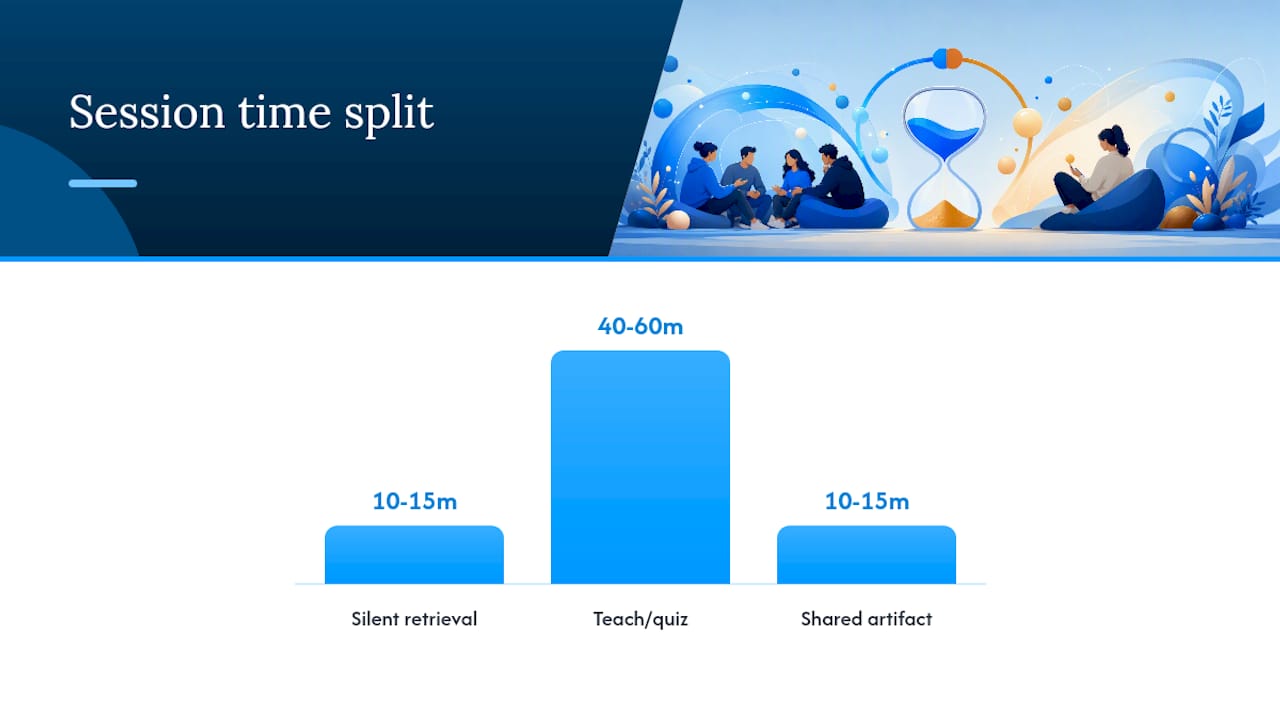
- 10 to 15 minutes of silent, individual retrieval (everyone answers the same question set alone, no talking)
- 40 to 60 minutes of teach/quiz blocks, with roles rotating each meeting
- 10 to 15 minutes producing one shared artifact: a corrected answer key, a consolidated problem set, a list of remaining weak points
That last piece matters more than it sounds. A tangible output requirement is what keeps a study group from quietly becoming a coffee chat, since a group with nothing to show at the end has nothing to hold it accountable.
Pro Tip: Assign an explainer, a challenger, and a timekeeper each session, and rotate all three roles weekly. The challenger's only job is to ask "why" until the explanation actually holds up.
Peer vs Solo Studying: Quick Decision Checklist
Before you default to whatever's convenient, run through this:
- Is this your first time seeing the material? Go solo. You need to build understanding before you can defend it.
- Is the task memorization rather than application? Go solo. Flashcards and recall drills don't need an audience.
- Do you need accountability to actually show up and study? Go peer, or try body doubling if you want presence without the social interaction cost.
- Does group interaction spike your anxiety more than it helps? Lean solo, and save peer time for short, structured mock quizzes only.
Not sure where you land? A short study preference assessment can help clarify your default tendency before you build a schedule around a guess. Then run a two-week test: track questions completed and one mock exam score under a 70/30 split, adjust by 10 points in whichever direction felt more productive, and repeat.
Evidence Summary: What the Research Actually Shows
No single study crowns one method the winner, and that's the point: solo and peer study solve different problems. Structured groups produce measurable gains specifically on transfer and retention tasks, largely because teaching forces harder retrieval than passive review. Unstructured groups, on the other hand, often underperform pure solo study because the accountability benefit gets eaten by social drift.
| Finding | What it shows | Source |
|---|---|---|
| Teaching peers boosts retention | Higher transfer performance vs. re-study alone | StudyEdge |
| Small, structured groups win | Groups of 3 to 5 with rotating roles beat larger unstructured ones | ASEE |
| Solo matches group for anxious students | Removing social load can equalize exam outcomes | PMC |
| Mixed-strategy students stick with habits longer | Combining both outperforms group-only study on recall | Residency Advisor |
A Practitioner's Take on the Solo vs Peer Debate
Build alone, test with others: that's the whole rule, and almost every failed study group ignores half of it. Pick one number to track for three weeks, questions completed per week or your mock exam score, and adjust the ratio based on what actually moves. Most students overestimate how much group time they need and underestimate how much structure it takes to make that time count.
— Caleb
Pairing the 70/30 Rule With Daily Practice
Building the solo half of that ratio gets easier with a system that adapts to what you actually get wrong, rather than serving up random questions. RecallOS runs on daily high-yield practice tailored to nursing and healthcare exam blueprints, with personalized review that resurfaces your weak areas automatically instead of making you guess which topics need another pass. The system helps solo practice feel less like a grind you have to force yourself into.
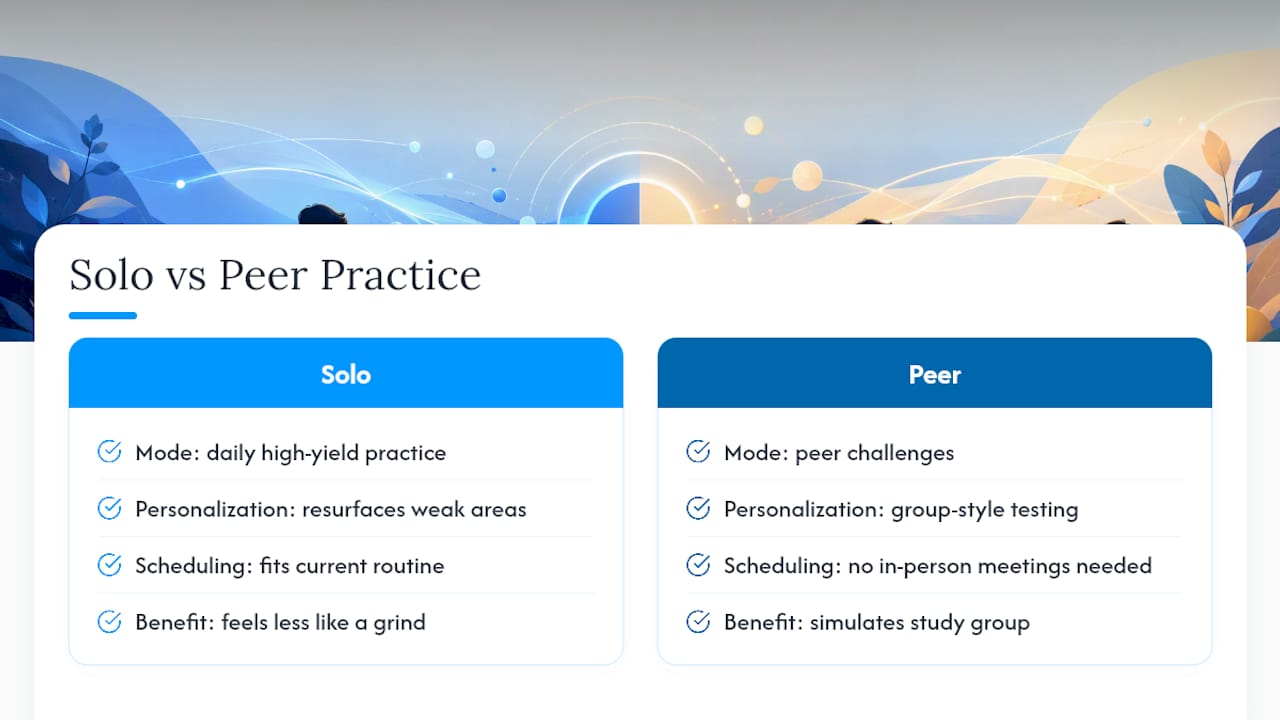
It also covers the peer side of the ratio: peer challenges let you test your knowledge against other students similarly to a study group, without the need to organize in-person meetings. If you're building your own 70/30 week and want the solo portion to actually stick, start with RecallOS and see how the daily practice fits into your current routine.
Sources
- Harvard Academic Resource Center — study groups guidance
- Oregon State University — study groups best practices
FAQ
Is It Better to Study Alone or With Others?
Neither is better across the board. Solo study works best for first exposure and memorization, while peer study works best for testing, teaching, and catching gaps, so most students benefit from combining both rather than picking one permanently.
What Is the 70/30 Rule for Studying?
Many sources point to this ratio, shifting toward more solo time as exams approach.
What Is the 3-2-1 Rule for Studying?
Definitions vary depending on the source, and no single version of this rule is backed by the research reviewed here, so it's worth treating any specific 3-2-1 framework you encounter as one educator's shorthand rather than an established standard.
Is Studying With Peers Better Than Studying Alone for Exam Prep?
Peer sessions still add value close to test day, but mainly as short mock quizzes to catch remaining errors, not as the main study mode.
How Do I Know If I Should Join a Study Group?
If you need accountability to keep showing up, or you're preparing for a transfer-heavy exam like clinical scenarios, a small structured group of 3 to 5 people helps. If group settings raise your anxiety more than they help your understanding, solo practice with an app like RecallOS may serve you better.