
Build a weekly calendar that blocks classes, clinicals, three daily study sessions, and one 30-minute self-care window, then defend those blocks like they're clinical shifts. That single habit fixes the biggest problem nursing students have: not too little time, but too little structure around the time they already have.
Do this in the next 15 minutes:
- Open a calendar (paper or digital) and enter every class, clinical shift, and work commitment for the week.
- Add three study blocks per day, each lasting a moderate amount of time, tied to specific topics.
- Schedule one daily self-care block of sufficient length, making it non-negotiable.
- Add a single buffer block weekly, ideally Sunday evening, to catch up on unfinished tasks.
- Check the whole thing again tonight before bed.
Key Takeaways
Nursing students who protect a weekly calendar with fixed study blocks, clinical prep time, and a standing buffer block consistently outperform those who study reactively.
| Point | Details |
|---|---|
| Build the calendar first | Block classes, clinicals, three daily study sessions, and self-care before the week starts. |
| Match technique to task | Use Pomodoro for focused reading, timeboxing for open-ended writing, and batching for similar tasks. |
| Always leave a buffer | Reserve one 60 to 90-minute weekly block for whatever clinical schedules disrupt. |
| Use clinical downtime | Five-minute flashcard reviews or audio briefings turn dead time into microstudy. |
| Layer in adaptive practice | Tools like RecallOS target weak areas during existing study blocks instead of replacing your schedule. |
Table of Contents
- Time Management Strategies for Nursing Students That Actually Hold Up
- How to Build a Weekly Study and Clinical Schedule You'll Actually Use
- Planning Around Clinical Rotations and Shifting Schedules
- Personalize Your System: Tools and Tracking That Fit Your Life
- Protect Your Wellness: Schedule Self-Care Like a Clinical Shift
- Common Time-Management Pitfalls and Fast Fixes
- Where an Adaptive Study App Fits Into Your Week
- Frequently Asked Questions
- Sources
Time Management Strategies for Nursing Students That Actually Hold Up
Most nursing students don't fail at time management because they lack discipline. They fail because they're using one technique for every kind of task. Reading 40 pages of pathophysiology and prepping for a clinical shift require different mental gears, and treating them the same way is why study sessions drag on for hours without much to show for it.
Here are the five techniques worth learning, in the order most nursing students should adopt them:
- Time blocking. You assign a fixed calendar slot to a specific task, like "7:00 to 8:30 PM: pharmacology flashcards." The block protects the time even when nothing forces you to use it well.
- Timeboxing. A close cousin of time blocking, except you set a hard stop regardless of whether you're finished. Use it for open-ended tasks like care-plan writing, which can otherwise eat an entire evening.
- The Pomodoro Technique. Work in focused 25-minute intervals with 5-minute breaks, and take a longer break after four rounds. It's built for dense, detail-heavy material like drug classifications or lab value ranges, where sustained focus in short bursts beats marathon cramming.
- Task batching and day theming. Group similar tasks together, like doing all your care-plan documentation on Tuesdays and all your reading on Thursdays, instead of scattering them across the week. This matters more than it sounds: cognitive science shows multitasking measurably reduces effectiveness because the brain pays a real cost every time it switches tasks. Batching keeps you in one mental mode longer.
- The Eisenhower Matrix. Sort tasks into four boxes: urgent and important, important but not urgent, urgent but not important, delegate or drop. A care plan due tomorrow is urgent and important. Reviewing NCLEX-style questions for an exam three weeks out is important but not urgent, and it's the box students neglect until it becomes urgent, too.
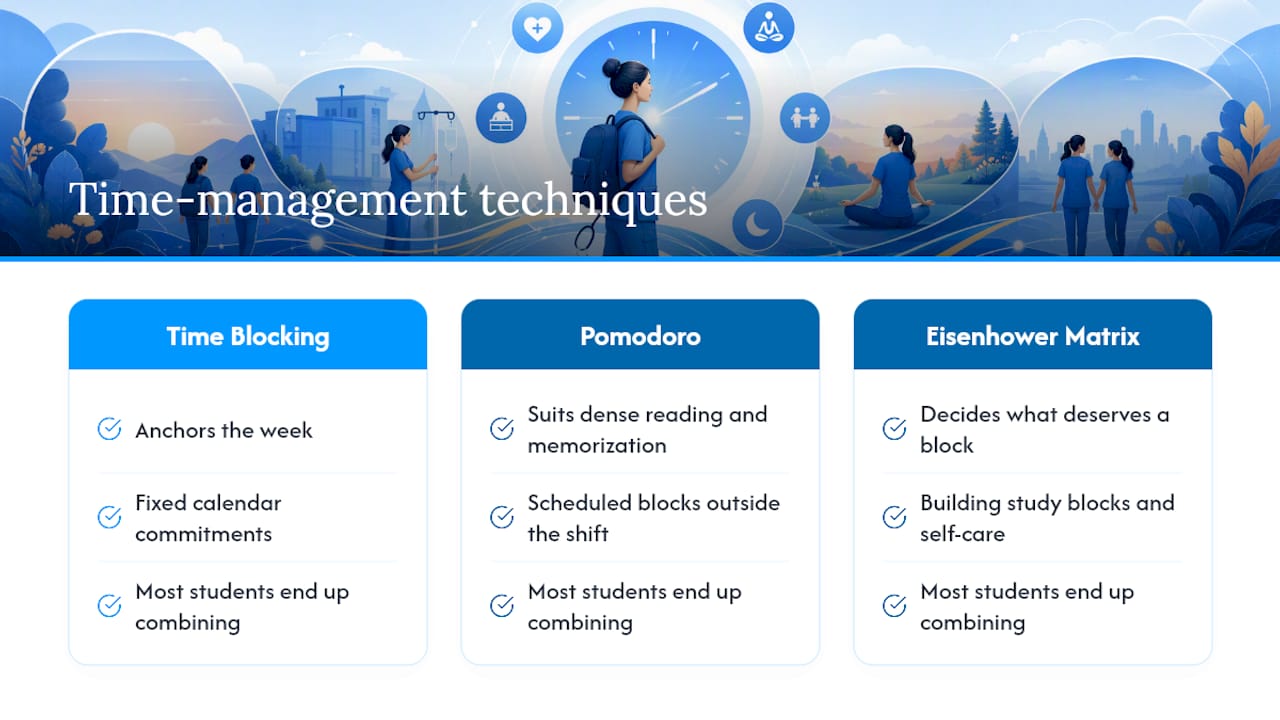
Choose based on the task, not habit. Pomodoro suits focused reading and memorization. Timeboxing suits open-ended writing. Time blocking anchors your whole week, and the Eisenhower Matrix decides what goes into which block in the first place. Practical guidance from nursing time-management research backs combining several of these rather than picking just one.
Pro Tip: Layer them. Block your evening from 7 to 9 PM for pharmacology, then run that block as three Pomodoro cycles with a 10-minute buffer at the end. You get the structure of time blocking with the focus discipline of Pomodoro, and the buffer absorbs whatever runs long.
How to Build a Weekly Study and Clinical Schedule You'll Actually Use
Copy this template into whatever calendar you use, then fill in the specifics:
- Fixed commitments first. Classes, clinical shifts, and work hours go in before anything else.
- Three study blocks daily. Morning, afternoon, evening, or whatever fits your rotation, each tied to a subject.
- Meals and sleep. Block them like appointments, not afterthoughts.
- One self-care window daily, 20 to 30 minutes minimum.
- A weekly buffer block. Sunday evening, 60 to 90 minutes, for anything unfinished.
A day-shift student might run study blocks at 6 AM, 1 PM, and 7 PM. A student working nights adapts those same three blocks around sleep recovery instead of the clock. University guidance on scheduling recommends checking the calendar every night and adjusting, since clinical rotations rarely run exactly on schedule.
Planning Around Clinical Rotations and Shifting Schedules
Clinical days break most study systems because they're unpredictable, so build in slack from the start. A short pre-shift checklist helps: lay out scrubs the night before, jot three key patient conditions or med classes you expect to see, and set one learning objective for the day.

Downtime during clinicals, waiting for a preceptor, charting lulls, is real study time if you use it in small doses. Five-minute flashcard reviews, audio drug-classification briefings, or quick dosage-calculation drills fit into gaps that would otherwise vanish. After a 12-hour shift, don't schedule a study block at all. Push it to the next morning and protect a recovery window instead, since the American Nurses Association recommends leaving a standing buffer block precisely so one hard day doesn't wreck the rest of the week.

Personalize Your System: Tools and Tracking That Fit Your Life
The calendar that works for your classmate might fail for you, and that's fine. What matters is picking tools that match how you actually work:
- A digital calendar (Google Calendar, Apple Calendar) for anything with fixed times, classes, shifts, appointments.
- A simple paper planner or bullet journal if you retain information better by writing it out.
- A Pomodoro timer app, or just your phone's clock, for focused study blocks.
- A distraction blocker during high-stakes study sessions before exams.
If you're sharpest at 6 AM, put pharmacology there and save easier tasks for the evening slump. Night owls should flip that pattern rather than fighting it. Track progress lightly: a weekly five-minute review of what got done, a study streak, or just a checkmark system works better than an elaborate tracker you'll abandon by week three.
Protect Your Wellness: Schedule Self-Care Like a Clinical Shift
Self-care that isn't scheduled tends to disappear the moment a deadline looms, which defeats the point. Structured self-care planning is directly tied to lower burnout in nursing programs, and an experimental time-management training program produced measurable gains in both self-reported time-management skill and academic performance compared to a control group.
Build these into the calendar, not around it:
- A consistent sleep window, even on clinical weeks.
- One 10 to 20 minute active break daily, a walk, stretching, anything that isn't sitting.
- Real meals, not granola bars eaten while charting.
- One social block weekly, even 30 minutes, to stay connected outside the program.
Common Time-Management Pitfalls and Fast Fixes
Most breakdowns trace back to a handful of repeat offenders:
- Multitasking during study sessions. Fix: run one Pomodoro cycle on one subject, phone in another room.
- No buffer time anywhere in the week. Fix: add a single 60-minute Sunday buffer block right now.
- Vague goals like "study more." Fix: replace with a named task and a time limit.
- Inconsistent routines that reset weekly. Fix: set one repeating anchor block, same time daily.
Red flags that your system needs rework: lost sleep, clinical prep done at the last minute, or grades sliding two exams in a row.
A nurse educator's take on what actually sticks
The habit that changed my week wasn't a fancy app. It was 20 minutes every Sunday night mapping the week ahead and protecting my first study block like it was a scheduled shift. Try that this week before adding anything else.
Where an Adaptive Study App Fits Into Your Week
Time blocks and Pomodoro cycles tell you when to study. They don't tell you what to review or which weak spots are quietly costing you points. That's the gap an adaptive practice tool fills, slotting into the microstudy windows you've already carved out, five minutes between clinical tasks, one Pomodoro cycle before bed, without replacing the schedule you built.
RecallOS generates daily high-yield questions and flags the topics you keep missing, so your evening Pomodoro block targets the material that actually needs attention instead of whatever page you left off on. It pairs naturally with a CCRN study plan or NCLEX practice schedule if you're layering exam prep on top of coursework. Streak tracking gives you the same low-effort progress signal recommended earlier, without a spreadsheet.
If your clinical rotation involves a preceptor-led learning structure, understanding what a preceptor actually expects from you helps you use those downtime minutes more deliberately. Start with a free daily practice set during your next buffer block and see whether it earns a permanent spot in your schedule.
Frequently Asked Questions
What is the best time management technique for nursing students? No single technique wins across the board. Time blocking anchors the week, Pomodoro suits dense reading and memorization, and the Eisenhower Matrix decides what deserves a block in the first place. Most students end up combining two or three.
How do nursing students balance clinicals, classes, and work? By treating all three as fixed calendar commitments and building study blocks and self-care around them, not squeezing them in afterward. A standing weekly buffer block absorbs the inevitable overflow from clinical days running long.
How many hours should a nursing student study per week? This varies by course load and clinical hours, but three daily study blocks of moderate duration, five to six days a week, is a realistic starting structure most students can sustain without burning out.
What should I do during clinical downtime? Short, low-effort tasks work best: five-minute flashcard reviews, quick dosage-calculation drills, or audio briefings on drug classifications. Save longer, focus-heavy study for scheduled blocks outside the shift.
Sources
- Time management tips every undergraduate nursing student needs to succeed (University of Colorado Anschutz)
- Science shows clear: multitasking doesn't work (Cleveland Clinic Health Essentials)
- Effect of time management educational program on nursing students (King Khalid University study DOI)