
A QBank's difficulty label tells you how that bank ranks its own questions, not how hard the real exam will feel. The label is useful only when you pair it with your own results. The best use of difficulty is a daily routine that keeps you working at the edge of what you know and sends you back to your weak areas. That is the idea behind the way we built RecallOS: daily high-yield practice that adapts to what you miss.
TL;DR
- QBank difficulty labels (easy, moderate, hard) are set by each bank, so "hard" in one bank is not "hard" in another.
- Many banks derive the labels from how often users answer each item correctly. Some tier them by percentile.
- The NCLEX is adaptive. It aims to give you items you have about a 50% chance of answering correctly, so a score of 50% on a hard bank is not a failing signal.
- Track accuracy by topic and question type, not by difficulty tag alone, and read every rationale.
- Pre-nursing students and certification candidates (CCRN, CRNA, NP) should treat difficulty as relative to their own level and their own exam blueprint.
Table of Contents
- What a QBank is and what a difficulty level means
- Why "hard" in one bank is not "hard" in another
- How the NCLEX handles difficulty
- What it means if practice feels easier or harder than expected
- Use difficulty to find weak areas, not to rank banks
- A worked example
- Difficulty beyond the NCLEX
- What a good difficulty setup looks like
- Put your difficulty data to work with RecallOS
- FAQ
- Sources
What a QBank is and what a difficulty level means
A QBank (question bank) is a large set of practice questions, each with a worked explanation, tagged by subject, topic and difficulty so you can drill the areas you keep missing, as this plain explainer of question banks describes. The difficulty tag is one of those labels.
The tag sounds objective, but it is a bank's own judgment. There are three common ways it gets assigned:
- Author judgment. The writer or reviewer decides the item is easy, moderate or hard based on how much recall, application or reasoning it needs.
- User performance. The label is computed from how many users answer correctly. A question most people get right becomes "easy."
- Percentile tiers. Some banks rank every question by correctness rate and cut the list into bands. One documented example of this approach labels the easiest 20% of questions "very easy" and the hardest 5% "very difficult," with bands in between, automatically determined by how often users answer each item correctly.
The consequence is simple. A label based on performance describes the crowd that used that bank. If the bank's users are strong, its "easy" questions may feel hard to you. If the bank's users are mostly beginners, its "hard" tier may feel manageable once you have finished a content review.
Why "hard" in one bank is not "hard" in another
There is no shared scale for QBank difficulty. Each bank defines its own tiers, uses its own user pool and writes to its own style. Three things make comparisons unreliable.
The user pool differs. Percentile and correctness-based labels depend on who answered the questions. A bank used mostly early in a program will rate the same item easier or harder than a bank used by people in their final weeks of review.
Difficulty mixes two different things. An item can be hard because it tests obscure facts, or hard because it asks you to prioritize among several correct-sounding actions. Nursing exams lean toward the second kind. A question that asks which client to see first can feel harder than a pure recall question even when the underlying content is simple. This is why a difficulty tag alone cannot tell you what to study next.
Question format changes the feel. Select-all-that-apply, matrix and case-study items are scored and reasoned differently from a single-answer item. A moderate item in a case-study format can feel much tougher than a moderate single-answer item. Our guide to the NCLEX question types shows how each format asks you to think.
So when you read a forum post that says one bank is "harder than the real thing" and another is "easier," you are reading one student's experience against one bank's label. Take it as a data point about that person, not a ruler.

How the NCLEX handles difficulty
The real exam does not give you a fixed mix of easy, medium and hard questions. The NCLEX uses computerized adaptive testing (CAT). According to the NCSBN candidate bulletin from October 2025, the computer re-estimates your ability after every item and picks the next item or item set that you should have a 50% chance of answering correctly, so questions are neither too easy nor too hard. The exam ends when the computer is 95% certain you are clearly above or below the passing standard, when you reach the maximum length, or under the run-out-of-time rule.
The 2026 NCLEX-RN Test Plan, effective April 2026, adds how the difficulty is known. Each item's difficulty is established by giving it as a pretest item to a large sample of candidates, and the algorithm then selects each next item to match your estimated ability.
Three practical points follow from this.
- The exam is built to feel hard. If you are answering well, the exam moves you to tougher items. Feeling that every question is a stretch is normal and does not mean you are failing.
- No bank can copy this exactly. A static list of questions tagged easy, moderate and hard is a practice tool, not a simulation of the adaptive engine.
- Your score on a hard bank is not your pass prediction. A bank that skews difficult can leave you with a lower percentage than the real exam would. A bank that skews easy can flatter you. Treat percentages as trends in your own data.
For a closer look at how the adaptive exam shapes a study routine, see how the adaptive item range maps to Bloom's taxonomy.
What it means if practice feels easier or harder than expected
Use a simple reading of your results, always looking at several sessions rather than one.
| What you see | What it usually points to | What to do next |
|---|---|---|
| High accuracy on easy items, low on hard items | Core knowledge is solid, but application and prioritization are not | Add more hard items and read every rationale for the reasoning, not the fact |
| Low accuracy on easy items | A content gap in that topic | Go back to the content, then re-test the same topic within days |
| Similar accuracy across all levels | The tags may not match your level, or you are guessing in a pattern | Sort results by topic and question type instead of difficulty |
| High accuracy everywhere, but you feel unprepared | The bank may be below your level, or you are recognizing questions rather than recalling answers | Switch to new questions, mixed topics and timed sets |
| Accuracy swings widely day to day | Fatigue, rushed reading or uneven retention | Shorter daily sessions, with review of misses the next day |
The point of the table is that difficulty is a lens, not a verdict. The real signal is which topics and which reasoning patterns keep pulling your accuracy down.
Use difficulty to find weak areas, not to rank banks
The most useful way to apply difficulty levels is as a filter inside your own study plan. A routine that works across NCLEX preparation looks like this.
Start with a baseline
Begin with a diagnostic so you know where you stand before you pick a difficulty level. The Westcliff University NCLEX plan recommends a baseline diagnostic first, then 75 to 150 practice questions daily, reading rationales even when you answered correctly, and reviewing your performance data weekly so you can shift toward consistently weak content areas and question types.
Work at the edge, not the comfort zone
Questions you get right every time teach you little. Questions you miss every time with no pattern can discourage you. The productive zone sits in between, which is conveniently the same zone the NCLEX algorithm targets with its 50% chance of a correct answer. Mix levels, and when a topic reaches steady accuracy at moderate difficulty, move it up.
Read rationales for correct answers too
A correct answer reached by a lucky guess or a half-reason will not hold under a harder version of the same question. Reading the rationale confirms whether your reasoning was right, and it is where much of the learning happens.
Review weekly by topic and question type
Sort results by content area (for example pharmacology, safety, physiological adaptation) and by format. A weak area may be a topic or it may be a format. Our guide on how to identify weak areas before the NCLEX walks through that sorting, and the 80% target retake plan shows how to set a working threshold for each weak area.
Bring the misses back
Retrieval practice, which means pulling an answer from memory rather than rereading it, supports long-term retention. A 2018 study of 36 nursing students found that greater use of an adaptive quizzing system, which offered remediation links based on strengths and weaknesses, correlated with higher content mastery. The practical lesson is that missed questions should return on a schedule, not sit in a results page you never open again. Our plain-English guide to active recall explains the method for nursing students.
A worked example
Say you finish 100 mixed NCLEX-style questions in a week and your report looks like this:
- Easy items: 88% correct
- Moderate items: 66% correct
- Hard items: 48% correct
- Pharmacology: 55% correct across all levels
- Select-all-that-apply items: 50% correct across all levels
If you only looked at difficulty, you might conclude that you need more hard questions. The topic and format data say something sharper: pharmacology and select-all-that-apply items are lowering your score at every level. The better plan for the next week is to study pharmacology content, then do short sets of pharmacology and select-all-that-apply items at moderate difficulty, and return to the misses two or three days later. After a week, check whether those two lines moved. That is a decision you could not make from the difficulty tag by itself.
Difficulty beyond the NCLEX
If you are not taking the NCLEX, the same logic applies with one change: the reference point is your exam's own blueprint.
Pre-nursing students. If you are building exam familiarity before you start a program, expect most of your early questions to feel hard because the vocabulary is new. Stay with easy and moderate items, focus on understanding the rationale, and move up as terms become familiar. Difficulty here measures your progress, not your potential.
CCRN and other certification candidates. Practicing nurses often find the content familiar but the exam framing unfamiliar. A question that feels easy at the bedside can feel hard when the exam asks for the single best answer under its own rules. Use difficulty tags to see where the exam's framing trips you up, and compare your weak topics to the exam's published blueprint.
CRNA and SRNA candidates. Advanced practice content is dense, and the label "hard" can cover anything from a pharmacology detail to a physiology calculation. Track accuracy by subject so you can see whether the problem is one domain or the whole exam.
NP, APRN, EMT and other candidates. Treat the tag as relative to your preparation stage. Early in a review, "hard" items are for finding gaps. Late in a review, they are for testing whether your knowledge holds under pressure.
In every case, the question to ask is not "how hard is this bank?" but "which of my topics are failing, and are the questions I practice on matched to the exam I am taking?"

What a good difficulty setup looks like
When you choose or build a practice routine, look for these features. They matter more than the label on any single question.
- Questions aligned to the exam blueprint, so difficulty is applied to content that will actually be tested.
- Rationales for every answer, right or wrong, available immediately after you respond.
- Performance reporting by topic and question type, not just an overall percentage.
- A way to revisit your weak areas without building the list by hand.
- A daily habit, because steady daily practice beats occasional marathons for retention.
Those are the features our own app is built around, and they are the reason difficulty can work for you instead of just labeling questions.
Our view on difficulty levels
We build RecallOS with practicing nurses and CRNAs, and the first thing they tell students is that a difficulty tag is a starting point. The real exam does not hand you a fixed ladder of easy, medium and hard. It adapts to you, and your practice should do the same.
That is why we focus on daily, high-yield practice aligned to real exam blueprints, instant rationales, and personalized review of the areas you miss. Students come to us worried that they are "bad at hard questions." Usually the real pattern is smaller and fixable: a topic, a question format, or a recall habit that has not been built yet.
We also think consistency matters more than intensity. Streaks, rewards and peer challenges are there to bring you back tomorrow, because the second and third pass over a missed question is where it sticks. When you can see your weak spots shrinking, difficulty stops being a source of anxiety and becomes a measure of progress.
Caleb
Put your difficulty data to work with RecallOS
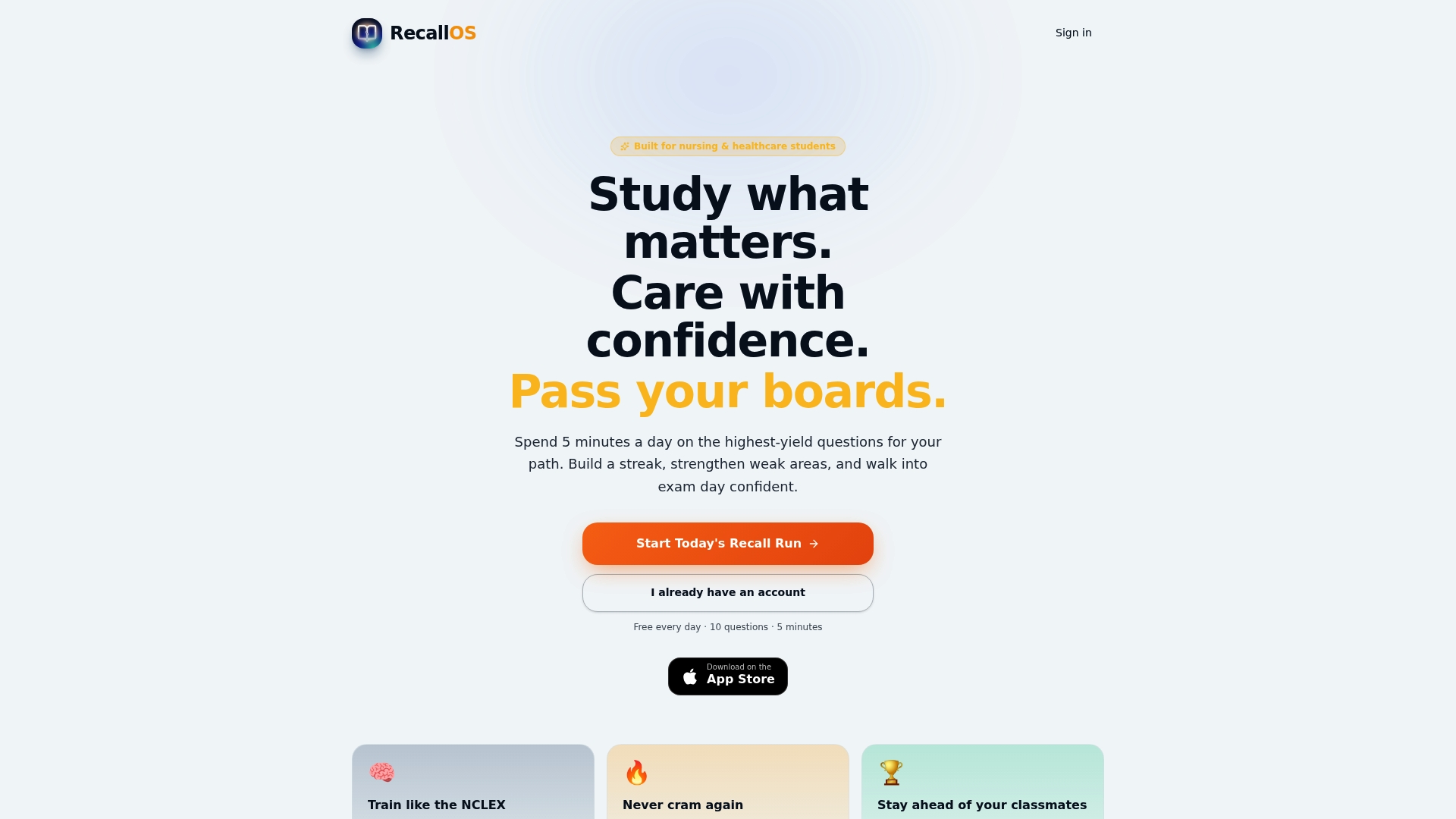
If you want practice that adjusts to your weak areas instead of leaving you to sort them out by hand, RecallOS gives you high-yield daily questions for the NCLEX and other nursing and healthcare exams, instant rationales, and personalized review of what you miss. You can start with limited free daily access and a free trial, and track your progress through streaks and rewards. The Daily Recall Run is the quickest way to build the daily habit, and the NCLEX study app page shows how it fits an NCLEX plan.
If you study from your own lecture notes, Upload Notes turns them into custom flashcards, quizzes, summaries and exam predictions. Preparing for another exam? See the CCRN study app or the CRNA and SRNA study app. For a closer look at the adaptive approach, read about the nursing quiz app that learns your weak spots.
FAQ
Are QBank difficulty levels the same across question banks?
No. Each bank sets its own tiers, often from how its own users perform on each question, so the labels depend on that user pool. A "hard" question in one bank may be moderate in another. Compare your accuracy by topic over time instead of comparing labels.
Is the NCLEX harder than a hard QBank?
It depends on you, because the NCLEX adapts. The computer picks items you should have about a 50% chance of answering correctly, according to the NCSBN candidate bulletin. That means the exam is designed to feel challenging, and your percentage on a static bank cannot predict it exactly.
Should I practice on easy, moderate or hard questions?
Use a mix, weighted toward the level where you miss roughly a third to half of the questions on a topic. Use easy items to confirm basics, moderate items for steady growth, and hard items to test reasoning. When a topic is steady at one level, move it up.
How many questions should I do each day?
One university NCLEX study plan suggests 75 to 150 questions daily after a baseline diagnostic, with rationales read even for correct answers. If that is too much right now, start smaller and build the habit, as in our NCLEX question a day guide.
Does difficulty matter for exams other than the NCLEX?
Yes, but the reference point is your exam's blueprint. For CCRN, CRNA, NP and EMT exams, use difficulty tags to find which topics and question framings cost you points, then review those topics on a schedule.
Sources
- Question bank, Tech, Explained
- NCLEX Examination Candidate Bulletin, October 2025
- NCLEX-RN Test Plan, effective April 2026
- How to Pass the NCLEX Exam: A Step-by-Step Plan, Westcliff University
- Effectiveness of an Adaptive Quizzing System, 2018