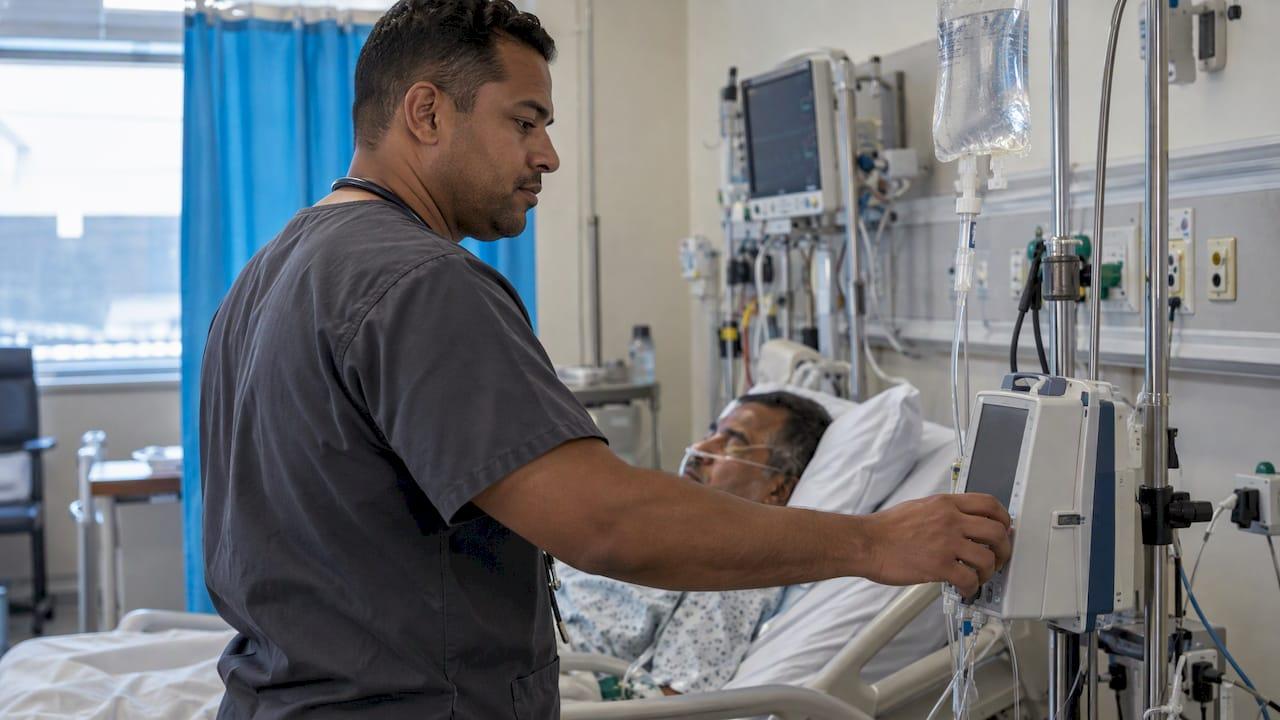
For the CCRN, the sepsis bundle comes down to one sequence you should be able to recite without thinking: measure lactate, draw cultures before antibiotics, start broad-spectrum antibiotics, give fluids for hypotension or a high lactate, and add vasopressors if the patient stays hypotensive. The harder part is the exam-style judgment around it: which timing rule applies, what the lactate tells you, and what you reassess next. Questions that ask for priorities reward recall under pressure, which is why daily practice with immediate rationales, like the Daily Recall Run in RecallOS, fits this topic well.
TL;DR
- The Surviving Sepsis Campaign (SSC) Hour-1 bundle has five elements: lactate, blood cultures, broad-spectrum antibiotics, 30 mL/kg crystalloid when indicated, and vasopressors to keep MAP at or above 65 mm Hg.
- "Hour-1" means start everything promptly at recognition. It does not mean every task must be finished by minute 60.
- CMS SEP-1 is a different thing: a retrospective chart-review measure with 3-hour and 6-hour windows, and every element must be met to pass.
- The 2026 SSC adult guideline, published March 23, 2026, updates the 2021 version. Study from the current guideline and your unit's protocol.
- Make the bundle stick by quizzing yourself daily on timing, thresholds and reassessment, not by rereading a table.
Table of Contents
- What the sepsis bundle actually is
- The Hour-1 bundle, element by element
- Hour-1 bundle versus SEP-1: the comparison CCRN candidates mix up
- What the 2026 guideline means for your studying
- Lactate, fluids and vasopressors: the reasoning behind the numbers
- Nursing priorities when sepsis is suspected
- Studying the sepsis bundle so it sticks
- Put the bundle into daily practice
- FAQ
- Sources
What the sepsis bundle actually is
A bundle is a short group of evidence-based actions that work best when done together and promptly. The Society of Critical Care Medicine (SCCM) says sepsis and septic shock are medical emergencies and that treatment and resuscitation should begin immediately. The bundle turns that urgency into a checklist the whole team can run.
Two ideas get confused constantly, and CCRN questions can lean on the difference:
- The clinical bundle (the SSC Hour-1 bundle) is prospective. You start it the moment sepsis is recognized, at the bedside.
- The quality measure (CMS SEP-1) is retrospective. Reviewers look back through the chart to see whether required elements were done and documented in time.
An AMSN summary of adult sepsis care draws exactly this line. Keep it in mind as you read the rest of this article.
The Hour-1 bundle, element by element
The SCCM Hour-1 bundle document lists the following actions. Here they are with what to remember for each.
| Element | What the bundle says | Exam-day angle |
|---|---|---|
| Measure lactate | Measure it; remeasure if the initial value is above 2 mmol/L | A rising or persistently high lactate means the resuscitation is not working yet |
| Blood cultures | Obtain before antibiotics | Cultures first, but never at the cost of delaying antibiotics unreasonably |
| Broad-spectrum antibiotics | Start promptly | Timing is the high-yield part |
| Fluids | 30 mL/kg crystalloid for hypotension or lactate of 4 mmol/L or higher | Know both triggers, not just hypotension |
| Vasopressors | During or after fluids if hypotensive, to keep MAP at 65 mm Hg or higher | MAP 65 is the target number |
Two details deserve a second look.
"Within the first hour" does not mean "finished in the first hour." The SCCM document states that the bundle should be initiated upon recognition, and that all elements may not be completed within the first hour. The hour designation is a call for prompt initiation. A 30 mL/kg bolus for a large patient, for example, will not be done in a few minutes, but it should be started.
Antibiotic timing is tied to how sick the patient is. The 2026 guideline recommends that for adults with possible, probable or definite septic shock, antimicrobials be given immediately, ideally within 1 hour of recognition. It also differentiates timing by shock status and likelihood of infection, so expect scenario questions where the patient is not in shock and the answer is not the same as for a patient on norepinephrine.
Hour-1 bundle versus SEP-1: the comparison CCRN candidates mix up
SEP-1 is the CMS measure behind many hospital sepsis programs. The Partnership for Quality Measurement describes it as an adult measure for patients 18 and older that assesses lactate, cultures, broad-spectrum antibiotics, fluid resuscitation, vasopressors, reassessment of volume status and tissue perfusion, and repeat lactate.
The same source explains the timing: the first three interventions (lactate, cultures and broad-spectrum antibiotics) are expected within 3 hours of severe-sepsis presentation, and the remaining interventions within 6 hours of septic-shock presentation.
| SSC Hour-1 bundle | CMS SEP-1 | |
|---|---|---|
| Purpose | Guide bedside care | Measure hospital quality |
| Direction | Prospective, at recognition | Retrospective chart review |
| Time frame | Start within the first hour | 3-hour and 6-hour windows |
| Pass/fail | Not applicable | All elements must be met |
| Reassessment | Monitor response closely | Documented sepsis reassessment required for septic shock |
The AMSN summary notes that SEP-1's documented reassessment requirement for septic shock is not part of the Hour-1 list. It also reports that CMS adopted SEP-1 in 2015 and announced its inclusion in the value-based incentive program beginning in fiscal year 2026. That matters for nurses because charting becomes part of the clinical task: what you did is only counted if it is documented.
A practical way to keep them straight: the bundle tells you what to do, SEP-1 asks whether you can prove you did it in time.
What the 2026 guideline means for your studying
SCCM published the 2026 adult Surviving Sepsis Campaign guidelines on March 23, 2026. They update the 2021 guideline with 129 statements, 46 of them new.
What to do with that as a candidate:
- Use current material. If your notes were built on older summaries, compare them against the 2026 guideline wording on antibiotics, fluids, lactate and MAP.
- Know that the Hour-1 bundle document and the full guideline are different documents with different jobs. The bundle is the compact bedside list. The guideline is the longer set of recommendations behind it.
- Pay attention to the language of recommendation strength. Many fluid and lactate statements are phrased as suggestions that call for individualization, not as fixed rules.
- Check your own unit's protocol. Facilities set their own sepsis alert criteria and order sets, and your hospital's policy is what you follow at work.
The CCRN is an AACN exam, and AACN frames its sepsis resources for nurses as translations of current adult and pediatric guidelines, research and bedside practice. If you want to see how heavily the exam weighs this kind of content, our CCRN exam blueprint breakdown shows how to prioritize categories.
Lactate, fluids and vasopressors: the reasoning behind the numbers
Most wrong answers on sepsis questions come from memorizing numbers without the logic that connects them.
Lactate as a trend, not a snapshot
The 2026 guideline suggests measuring lactate in possible, probable or definite sepsis, and using serial lactate to guide resuscitation in adults with an elevated lactate or septic shock. The Hour-1 bundle makes the threshold concrete: repeat the lactate when the first value is above 2 mmol/L.
The exam-ready idea is trend. A falling lactate after intervention suggests the resuscitation is helping tissue perfusion. A lactate that stays high or climbs is a cue to reassess, not to relax.
Fluids: start with 30 mL/kg, then individualize
The guideline suggests at least 30 mL/kg of IV crystalloid within 3 hours for sepsis-induced hypoperfusion or septic shock, with individualization and frequent reassessment. After the initial bolus, fluids should be individualized by monitoring the lactate decrement, rather than continued until lactate normalizes.
A worked example. A 70 kg adult arrives hypotensive with suspected pneumonia. At 30 mL/kg, the initial crystalloid volume is 2,100 mL (70 x 30). After that bolus, you reassess: blood pressure, perfusion, repeat lactate. If the lactate is falling and the patient is improving, more fluid may not be the answer. If hypotension persists, the next step is vasopressors, not an unlimited fluid run.

Vasopressors and the MAP target
For sepsis-induced hypotension, the guideline suggests an initial crystalloid bolus followed by vasopressors if hypotension persists. For septic shock, it recommends an initial MAP target of 65 mm Hg, and it advises monitoring blood pressure and reassessing the patient to avoid under- or over-resuscitation. The Hour-1 bundle phrases it as vasopressors during or after fluids to keep MAP at or above 65 mm Hg.
If MAP math is shaky, review it before you drill sepsis. Our guides to CCRN hemodynamics and MAP 65 and the passive leg raise cover the numbers that sepsis questions assume you know.
Nursing priorities when sepsis is suspected
The CCRN tests judgment, and "what should the nurse do first" is a standard format. The sources agree on a consistent pattern:
- Know your facility's alert criteria and policy. AMSN advises that if sepsis is suspected, you start the health system's sepsis protocol and notify the provider.
- Act quickly and minimize time to treatment. SCCM's Hour-1 material stresses speed, close monitoring of response and communicating sepsis status during handoffs.
- Speak up. SCCM's implementation toolkit identifies nurses as frequent first detectors of sepsis signs and says nurse champions can help drive protocols. AACN describes the nurse's first assessment as a consequential opportunity to identify sepsis and raise the alarm.
- Work as a team. The toolkit treats bundle execution as team-based, with bedside nurses positioned to recognize deterioration and activate protocols.
On a question, the strongest answer is usually the one that recognizes the problem, activates the protocol, and keeps the bundle moving, not the one that waits for more data.
Studying the sepsis bundle so it sticks
Reading a bundle once feels like learning it. Recalling it under a timed question is what the exam asks. Here is a routine that fits into a CCRN study plan:
- Write the bundle from memory. Five elements, the thresholds (2 mmol/L repeat, 4 mmol/L or higher with fluids, 30 mL/kg, MAP 65), and the timing language. Check against the SCCM document, then fix gaps.
- Split it into question types. Sequence (cultures before antibiotics), thresholds (when is a fluid bolus triggered), timing (1 hour versus 3 and 6 hours) and reassessment (what do you check after the bolus).
- Drill little and often. A short daily set beats a weekend cram, because the facts you need are small and specific.
- Review what you miss. Every wrong answer should trace to a gap: a number, a rule or a reasoning step. Keep a short list and return to it.
- Tie it to the rest of the exam. Sepsis overlaps with hemodynamics, ventilation and multisystem care. Our 10-week CCRN study plan and 8-week test strategy show where it fits.
If your weak spot is fluid reasoning, put an extra week on hemodynamics. If it is the SEP-1 versus bundle distinction, write the comparison table above from memory until it is automatic.
What we think about sepsis and the CCRN
Sepsis is a topic where the facts are not the problem. Most ICU nurses know that cultures come before antibiotics and that MAP 65 is the target. What goes wrong on exam day is retrieval: a vague memory of "three hours, six hours, one hour" that collapses when a scenario mixes the clinical bundle with the quality measure.
That is why we built RecallOS around daily, focused practice rather than long review sessions. Our content is developed by practicing nurses and CRNAs and aligned to real exam blueprints, so the questions stay on what a candidate is likely to face, not random trivia. Every question comes with an instant rationale, so a miss turns into a lesson on the spot.
We also think weak spots should drive your study time. If you keep missing the repeat-lactate threshold or the fluid triggers, those items should come back to you until they stop being misses. Streaks and peer challenges help with the hardest part of exam prep: showing up every day.
And if your hospital's sepsis policy, your unit notes or your own summaries are the material you trust most, you can upload them and turn them into flashcards, quizzes and summaries.
Caleb
Put the bundle into daily practice
RecallOS is an AI-powered study app for nursing and healthcare exams, including the CCRN. You get daily high-yield questions with instant rationales, personalized review of your weak areas, and streaks and rewards that keep the habit going. With Upload Notes, you can turn your own sepsis notes into flashcards, quizzes and summaries. The CCRN Study App page explains how it works for critical-care candidates, and our CCRN and critical-care resources collect study guides in one place.

If you are comparing study approaches, our plain-English guide to active recall for nursing students explains why retrieving an answer beats rereading it.
FAQ
Is the sepsis bundle on the CCRN?
Sepsis management is core critical-care content, and AACN's sepsis resources are built on current adult and pediatric guidelines. Expect questions on recognition, antibiotic timing, lactate, fluids, vasopressors and reassessment. Check the current exam handbook and our CCRN blueprint guide for how categories are weighted.
Does the Hour-1 bundle mean everything must be done in 60 minutes?
No. SCCM states that the bundle should be initiated at recognition, and that not every element may be completed within the first hour. The hour is about prompt initiation. For septic shock, the 2026 guideline recommends antimicrobials immediately, ideally within 1 hour of recognition.
What is the difference between the sepsis bundle and SEP-1?
The Hour-1 bundle is a prospective bedside guide started at recognition. SEP-1 is a CMS retrospective chart-review measure with 3-hour and 6-hour windows, and all elements must be met to pass. SEP-1 also expects documented reassessment in septic shock.
When is a repeat lactate needed?
The Hour-1 bundle calls for a repeat lactate when the first value is above 2 mmol/L. The 2026 guideline suggests serial lactate to guide resuscitation in adults with an elevated lactate or septic shock, and individualizing fluids after the initial bolus.
What should I do first when I suspect sepsis?
Follow your facility's sepsis protocol and notify the provider. Then keep the bundle moving: lactate, cultures, antibiotics, fluids as indicated, and close monitoring. Communicate sepsis status clearly at handoff.
Sources
- Surviving Sepsis Campaign: International Guidelines for Management of Sepsis and Septic Shock 2026 (SCCM)
- Surviving Sepsis Campaign Hour-1 Bundle (SCCM)
- Implementing the Hour-1 Bundle (SCCM)
- Adult Sepsis Update (AMSN)
- Severe Sepsis and Septic Shock: Management Bundle (Partnership for Quality Measurement)
- Sepsis Guidelines for Nurses (AACN)