
Adaptive learning improves NCLEX readiness when it means something specific: daily, NCLEX-aligned practice that adjusts to your ability level and forces targeted remediation on weak areas. This works because it mirrors how the exam itself operates. The NCLEX runs on computerized adaptive testing, which selects each item based on your evolving ability estimate rather than a fixed question order. A 2025 study of 160 nursing students found medication-calculation scores rose from a mean of 10.25 to 13.34 after a two-week adaptive intervention, with satisfaction rated 4.75 out of 5.
Getting started takes three moves:
- Build a daily habit of mixed-difficulty adaptive questions, not random review
- Let the platform's remediation engine flag and re-drill your weak content areas
- Track mastery by topic, not just overall score, so gaps don't hide inside a good average
RecallOS was built around exactly this loop, with NCLEX-aligned questions and personalized weak-area reviews designed by practicing nurses and CRNAs.
Key Takeaways
Adaptive learning improves NCLEX readiness most reliably when daily practice, targeted remediation, and test-plan-aligned content types work together consistently.
| Point | Details |
|---|---|
| CAT drives item difficulty | The NCLEX adjusts each question to your ability estimate and stops at 95% pass/fail confidence. |
| Adaptive practice shows real gains | A 2025 study found medication-calculation scores rose from 10.25 to 13.34 after two weeks of adaptive practice. |
| Consistency beats cramming | Daily 15 to 30 minute sessions plus weekly timed simulations build both mastery and exam stamina. |
| Track mastery, not just score | Watch mastery percentage by topic, time per item, and your NCLEX predictor score weekly. |
| RecallOS fits the checklist | RecallOS offers NCLEX-aligned adaptive questions, weak-area remediation, and streak-based consistency tracking. |
Table of Contents
- How Does Adaptive Learning Work for the NCLEX?
- Does Adaptive Learning Actually Improve NCLEX Outcomes?
- What Should You Look for in an Adaptive NCLEX Study Tool?
- Building a Weekly Study Rhythm That Mirrors the Exam
- How Can Educators Integrate Adaptive Tools Into Coursework?
- Where Adaptive Learning Falls Short
- A Publisher's Perspective on Building Real Readiness
- Get Daily Adaptive Practice Built for the NCLEX
- Sources
How Does Adaptive Learning Work for the NCLEX?
The NCLEX-RN doesn't hand every candidate the same test. It runs on computerized adaptive testing, which means the exam recalculates your ability estimate after every single question and picks the next item to match it. Answer correctly, and the next question gets harder. Miss one, and it eases up. This isn't designed to trick you. NCSBN has said plainly that CAT exists to pin down your true ability level with the fewest possible items, not to punish or reward streaks.
Three mechanics matter for how you should study:
- Stopping rules. The exam ends once there's 95% confidence in a pass or fail decision, or when you hit the minimum or maximum item count, whichever comes first.
- Content balancing. Every candidate's exam must satisfy the same test plan percentages across client needs categories, regardless of how many items they see.
- Pretest items. Some unscored items get mixed in for future exam development, meaning your item count and your scored performance are two different things.
Because your exam length can vary, studying with static, linear question sets trains the wrong instinct. Adaptive practice that shifts difficulty in real time, paired with clinical-judgment case questions and timed stamina drills, matches the actual test experience far better than working through a fixed 75-question packet in order.
Does Adaptive Learning Actually Improve NCLEX Outcomes?
Yes, at least for the outcomes researchers have measured so far. The clearest data point comes from a 2025 controlled study: 160 nursing students used an AI-based adaptive learning program for medication calculation over two weeks, and mean scores climbed from 10.25 to 13.34.
By the numbers: Satisfaction with the adaptive format hit 4.75 out of 5.0, one of the higher self-reported satisfaction scores in nursing education research.
Institutional data adds a second layer. Vendor-reported figures from nursing programs using adaptive learning platforms cite an 11.4% increase in on-time graduation and a 5.5% increase in program retention over five years. Those numbers come from aggregated institutional reporting rather than a randomized trial, so treat them as directional, not definitive.
A few honest caveats:
- The medication-calculation study measured one narrow competency over two weeks, not full NCLEX pass rates.
- Institutional retention and graduation figures blend adaptive tools with other curriculum changes, so isolating the tool's exact contribution is hard.
- Short interventions tend to show the clearest gains on focused, high-impact skills like calculations, not necessarily broad clinical judgment.
None of that undercuts the core finding. It just means adaptive learning is a strong lever, not a guaranteed pass.
What Should You Look for in an Adaptive NCLEX Study Tool?
Not every app calling itself "adaptive" actually adjusts anything meaningful. Some just randomize question order and call it personalization. Before you commit time or money, check for these five things.
- Test-plan alignment. The question bank should map to the actual NCLEX-RN test plan categories, and include Next Generation NCLEX (NGN) item types like case studies and extended multiple response, not just standard multiple choice.
- True adaptivity. Difficulty should shift based on your actual performance, and missed questions should trigger targeted remediation, not just a "try again" prompt.
- Explanation quality. A correct answer with no rationale teaches nothing. Look for explanations that walk through the clinical reasoning, not just the fact.
- Analytics you can act on. Mastery heatmaps by content area, an NCLEX readiness predictor, and usage reports matter more than a raw score percentage.
- Practical fit. Daily question flow, timed simulation modes, offline access for clinical rotation days, and transparent pricing without hidden upsells.
Pro Tip: Run any tool through a two-week trial before committing to a subscription. If your weak-area report looks identical after fifty questions and after two hundred, the adaptivity isn't real.
Faculty evaluating tools for a cohort should ask vendors for a sample analytics dashboard before purchase, not after. What the reporting shows you mid-semester matters more than what the marketing page promises.
Building a Weekly Study Rhythm That Mirrors the Exam
Consistency beats intensity for adaptive practice. A rhythm that actually builds readiness looks like this:
- Daily micro-practice (15 to 30 minutes). Work a short adaptive question set covering mixed content areas, then spend five to ten minutes reviewing whatever the platform flags as weak.
- Weekly endurance session (60 to 90 minutes). Run a full timed adaptive simulation under exam-like conditions once a week to build the mental stamina CAT actually demands. A realistic NGN-style practice test works well here.
- Track four benchmarks weekly. Mastery percentage by content area, average time per item, your NCLEX readiness predictor score, and practice consistency (streaks matter more than any single session).
- Shift to high-intensity simulation in the final two to three weeks before your test date. Cut daily micro-practice volume slightly and increase full-length timed simulations to two or three per week.
The goal isn't volume for its own sake. A daily question habit sustained over months outperforms cramming three hundred questions the week before your exam, largely because spaced retrieval builds durable recall while cramming builds short-term pattern recognition that evaporates under exam stress.
How Can Educators Integrate Adaptive Tools Into Coursework?
Faculty don't need to overhaul a curriculum to get value from adaptive platforms. The highest-leverage moves are small and structural.
- Assign adaptive question sets as graded homework tied to weekly course content, rather than optional extra credit nobody touches.
- Use platform diagnostics as a formative checkpoint before exams, then route students with shared weak areas into a short remediation lab session.
- Set realistic KPIs: target usage rate per student, a mastery threshold (say, 80% in each content area), and a program-wide NCLEX predictor benchmark.
- Where possible, sync reporting with your LMS so tracking usage doesn't become a manual spreadsheet exercise for faculty.
- Build accountability into onboarding: a short in-class walkthrough in week one drives far higher sustained usage than an email with a login link.
Programs that see the strongest results tend to require consistent use across the term rather than leaving it optional, according to education-focused reviews of adaptive learning implementation.
Where Adaptive Learning Falls Short
Adaptive study platforms are not the NCLEX. NCSBN draws a clear line: CAT estimates ability and makes pass/fail decisions using a specific psychometric model, while study tools tailor practice content but don't run that same scoring logic. Treating a high mastery score in an app as a guarantee is the most common mistake.
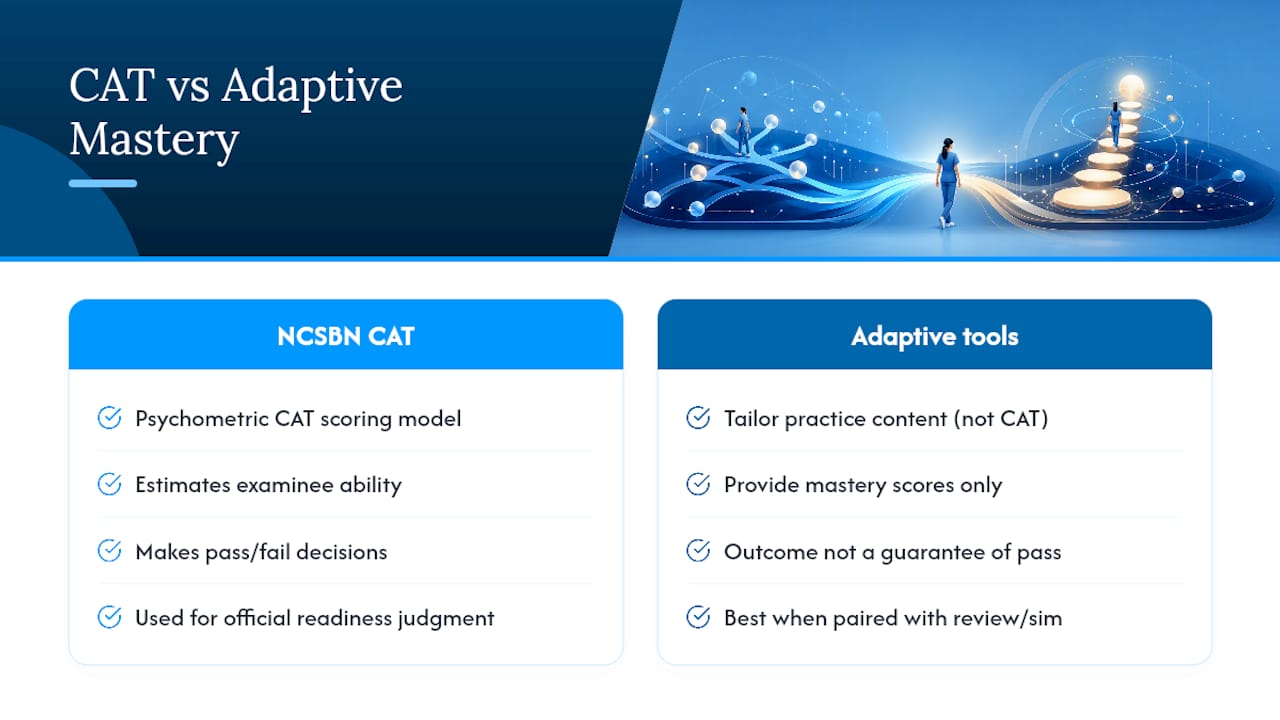
Other pitfalls show up often: cramming hundreds of questions in the final week, memorizing answer patterns instead of reasoning through cases, and guessing rapidly just to see more content. The fix is straightforward: pair adaptive practice with real conceptual review, faculty feedback on rationale, and regular timed simulation.
A Publisher's Perspective on Building Real Readiness
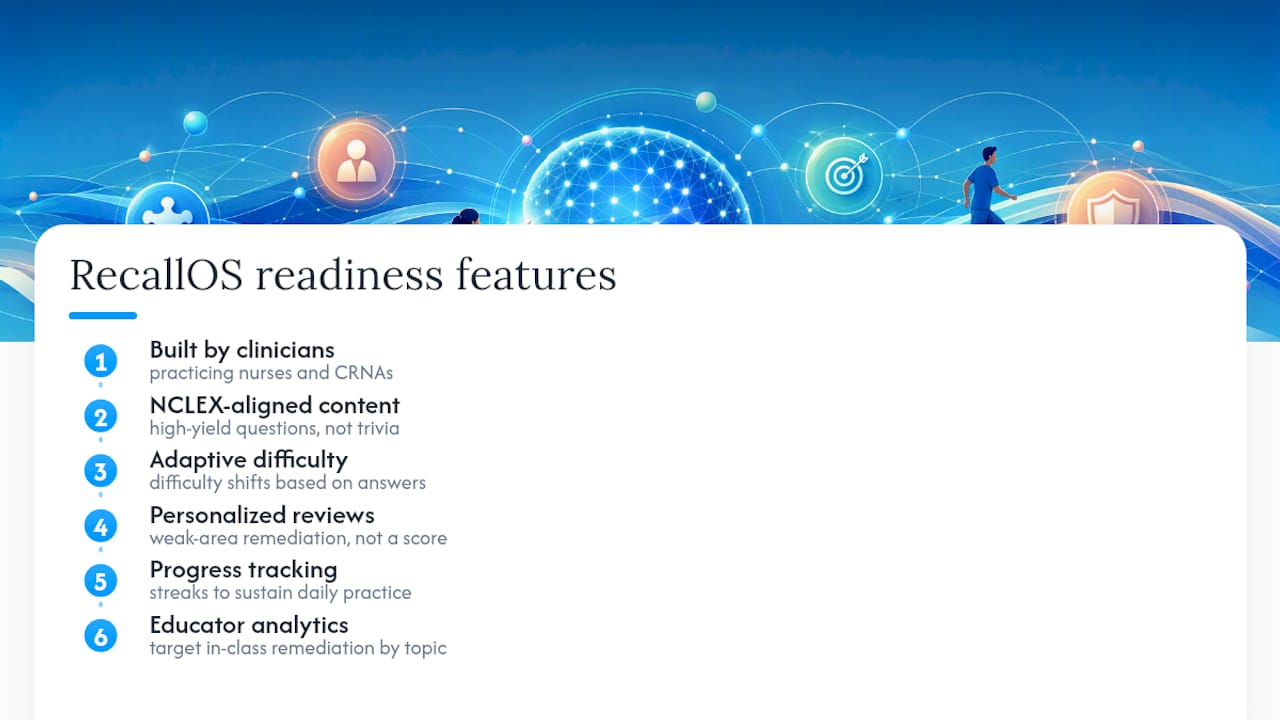
Most adaptive learning discussions stay abstract. Ours doesn't have to, because RecallOS was built by practicing nurses and CRNAs specifically to solve the problems this article just walked through. It maps to the checklist directly: NCLEX-aligned, high-yield questions instead of generic trivia, adaptive difficulty that actually shifts based on your answers, personalized weak-area reviews instead of a static score, and progress tracking through streaks that keep daily practice from quietly lapsing.
If you're starting today, use the free daily set to build the habit first, then let the weak-area reports guide where you spend remediation time. Educators integrating it into coursework can lean on the analytics to target in-class remediation by matching low-mastery topics to specific lab sessions instead of guessing which content needs another pass. The reviewer feedback reflects what students report after using it consistently, not after a single cram week.
— Caleb
Get Daily Adaptive Practice Built for the NCLEX
RecallOS gives you what a generic question bank can't: daily practice that actually adjusts to your weak spots instead of cycling the same content regardless of how you're performing. Built by practicing nurses and CRNAs, every question maps to real NCLEX blueprints, so your study time goes toward what the exam actually tests, not filler trivia.
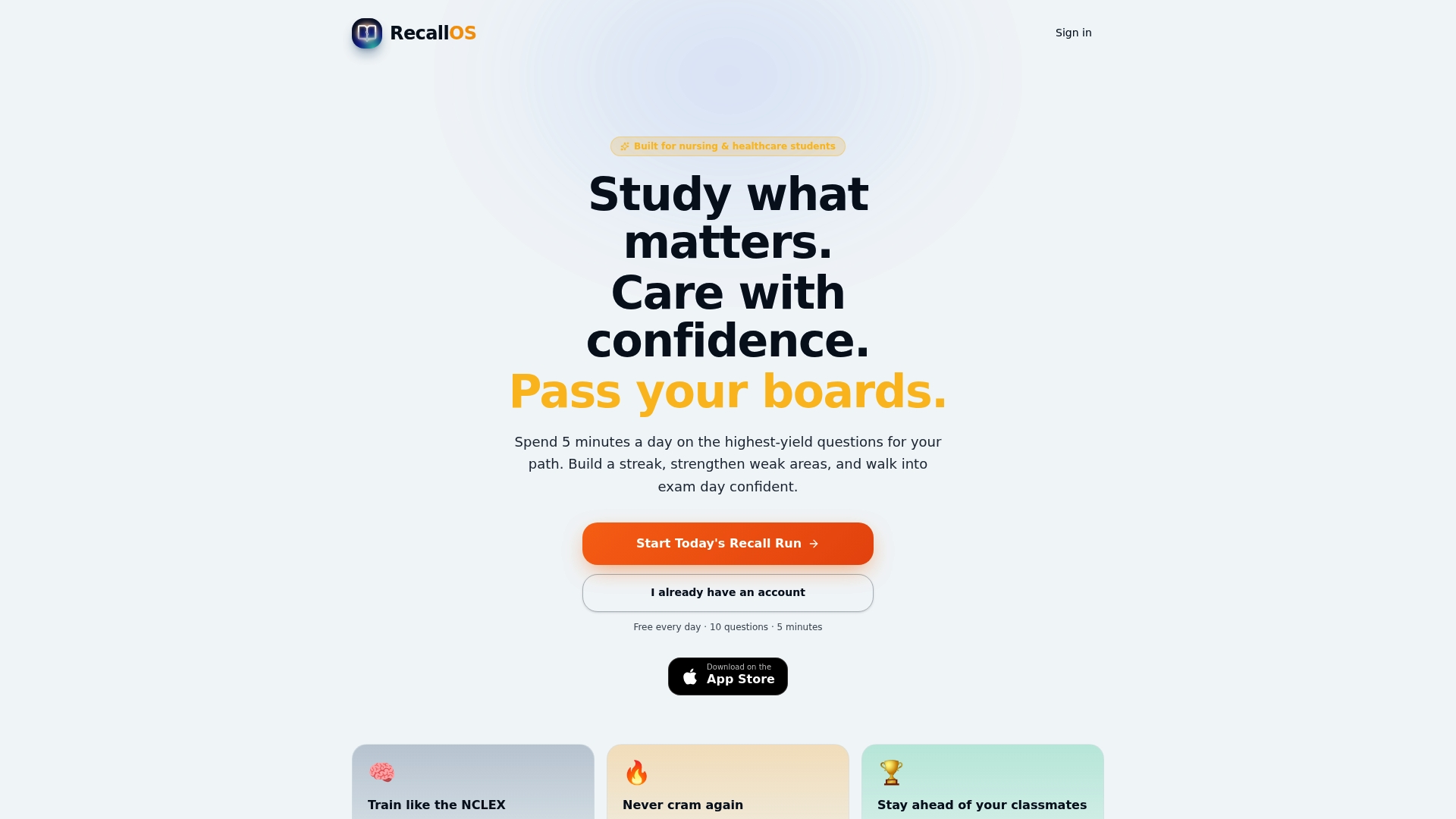
The personalized weak-area reviews mean you stop guessing which topics need another pass. Streaks and rewards keep the daily habit alive past week one, which is usually where most study plans quietly fall apart. Whether you're a student three months out from test day or a faculty member looking to add structured remediation to a course, the entry point is the same: start with the free daily question set, watch what your weak-area report flags, and build your study rhythm around it from there.
Sources
- Effect of AI-Based Adaptive Learning Class: Fundamental of Nursing Medication Calculation — JLCCI (2025)
- NCLEX-RN test plan (NCSBN)