
On priority items, pick the action that prevents the greatest immediate harm. Screen for airway, breathing, and circulation threats first, then run the NCSBN clinical-judgment steps, recognize, analyze, prioritize, generate, act, evaluate, to confirm your pick. Practice this under the same one-question-at-a-time conditions you will face on exam day, as you cannot skip ahead or revisit an item once you submit it.
TL;DR:
- Prioritization on the NCLEX focuses on recognizing immediate threats to airway, breathing, or circulation before addressing less urgent issues.
- The main frameworks are ABCs, Maslow's hierarchy, nursing process, and acuity scoring, which should be applied based on the context of each question.
- When faced with ambiguous questions, assessment usually takes precedence over immediate intervention unless a life-threatening cue is present.
- Practice should involve timed, single-question drills that simulate exam conditions, reinforcing decision-making under pressure.
- Delegation tasks can be assigned to unlicensed staff when stable, but critical assessment and clinical judgment must stay with licensed nurses.
Table of Contents
- What Is NCLEX Prioritization, and Which Frameworks Matter?
- How Do You Answer a Prioritization Question, Step by Step?
- Practice Questions: Applying the Framework to Real Scenarios
- How Does This Method Map to the NCSBN 2026 RN Test Plan?
- An Author's Note on Turning Frameworks Into Daily Habit
- An Editorial Take on Why Most Prioritization Advice Falls Short
- A Study Option Built Around This Exact Routine
- Where to Go for the Primary Sources
- Sources
- FAQ
What Is NCLEX Prioritization, and Which Frameworks Matter?
NCLEX prioritization means choosing which client, problem, or action gets your attention first when several competing demands look equally urgent on the page. The exam tests this constantly because real nursing units run on the same tradeoff: you rarely have one problem at a time.
Four frameworks cover almost every prioritization question you'll see.
- ABCs (airway, breathing, circulation): the fastest screen for immediate life threats. A client who cannot speak in full sentences outranks a client asking for pain medication, every time.
- Maslow's hierarchy: useful for sequencing needs when no one is in physical danger. Physiologic needs beat safety needs, safety beats belonging, and so on, but NANDA is explicit that this ordering bends when urgency or symptom interaction demands it.
- Nursing process (assess, diagnose, plan, implement, evaluate): the default when a question hinges on "what do you do first" and no answer choice describes an emergency. Assessment almost always outranks action unless the stem already gives you a life-threatening cue.
- CURE and acuity scoring: built for multi-client questions. CURE weighs critical, urgent, routine, and extras, while acuity scoring ranks clients by how quickly their condition could deteriorate, a tool NCBI's prioritization chapter treats as core to managing a full patient load.
Switch frameworks based on what the stem gives you. Acute, unstable presentation: go ABCs first. Stable client with an unmet need: Maslow. Ambiguous "what's your first step" question: default to assessment.
Pro Tip: If two frameworks point to different answers, trust the one that accounts for time. A problem that will kill someone in minutes always outranks one that matters more in the long run.
How Do You Answer a Prioritization Question, Step by Step?
Build one routine and run it on every prioritization item, including the case sets on the newer exam format.
- Read the stem for its actual question. "Which client should the nurse see first," "what is the priority action," and "which finding requires immediate follow-up" are three different questions disguised as one. Identify which one you're answering before you touch the answer choices.
- Pull every cue from the vignette. Vitals, mental status changes, bleeding, oxygen saturation, and anything described as new or worsening deserve your attention. Underline time-sensitive words like "suddenly," "now," or "since this morning."
- Filter by urgency, not severity alone. Ask whether the finding is unstable versus stable, unexpected versus expected for that diagnosis, and actual versus merely potential. An expected post-op pain level is not the same emergency as a sudden drop in blood pressure.
- Rank your hypotheses by risk and time window. When two answer choices both seem reasonable, default to assessment over action, unless the stem already confirms a life threat is underway. NCBI's guidance backs this exact tiebreaker for ambiguous stems.
- Act on the highest-risk problem, then evaluate. For multi-client stems, the client with acute instability wins over the client with a chronic, stable condition every time.
Delegation questions follow the same logic with one added filter: hand off tasks that are predictable and stable, and keep assessment, clinical judgment, teaching, and evaluation for yourself as the licensed nurse.
Pro Tip: When you're stuck between "assess" and "intervene," assessment wins unless the cues already spell out a crisis. NCLEX rewards nurses who confirm before they act.
Practice Questions: Applying the Framework to Real Scenarios
Scenario A: Single client, physiologic threat. A client three hours post-abdominal surgery becomes restless, with a heart rate of 128 and blood pressure of 88/54. Answer choices include repositioning for comfort, notifying the surgeon, rechecking vitals in 30 minutes, and administering the scheduled pain medication.
- Cues: rising heart rate, falling blood pressure, restlessness, three hours post-op.
- Mapped to clinical judgment: recognize the cues as signs of possible internal bleeding, analyze them as a circulation problem, prioritize over comfort measures.
- Why others lose: rechecking in 30 minutes delays action on an active threat; comfort and scheduled medication ignore the ABC problem entirely.
The correct move is notifying the surgeon immediately, since circulation instability outranks every comfort-based option on the list.
Scenario B: Multi-client, "who do you see first." Four clients are waiting: one reporting 4/10 incisional pain, one due for a routine dressing change, one with new-onset confusion and slurred speech, and one requesting discharge paperwork.
The client with new confusion and slurred speech wins because those symptoms suggest a possible stroke, a time-sensitive, unpredictable change. The other three are stable, expected, or administrative.
Scenario C: Delegation. A charge nurse has a nursing assistant, an LPN, and a new RN. Tasks include repositioning a stable client, teaching a diabetic client about insulin administration, and assessing a client with new shortness of breath.
Delegate repositioning to the nursing assistant. Assign the assessment to yourself or the RN, never the assistant or LPN, since assessment and clinical judgment stay with the licensed nurse making the prioritization call. Teaching typically stays with the RN as well.
Timed, single-item practice that mirrors exam mechanics, answering and reviewing one question at a time with rationales, builds the same instinct these scenarios demand.
How Does This Method Map to the NCSBN 2026 RN Test Plan?
The NCLEX-RN 2026 Test Plan defines clinical judgment as six iterative steps: recognize cues, analyze cues, prioritize hypotheses, generate solutions, take action, and evaluate outcomes. The exam builds case sets around this exact sequence, which is why memorized mnemonics alone won't carry you through a full case.
- The exam is administered by computer-adaptive testing, one question at a time, with no way to return to a previous item once submitted.
- Practicing prioritization drills under that same constraint, no skipping, no revisiting, trains the decisiveness the real exam demands.
- Management of Care content, which covers prioritization, delegation, and handoff communication, directly drives a large share of priority-style items, so it deserves proportional study time.
Treat every practice question as a one-shot decision. That habit alone closes the gap between knowing a framework and performing under timed pressure.
An Author's Note on Turning Frameworks Into Daily Habit
Caleb's take: frameworks fail students who only read about them. The fix is turning each step, recognize, analyze, prioritize, into a daily micro-drill instead of a one-time review session, and pairing that with Bloom's taxonomy so recall practice climbs toward application and analysis, not just memorization.
A study tool structures its question sets around that same climb: short daily runs, adaptive review of the cues you consistently miss, and single-question pacing that mirrors the real exam's rhythm.
An Editorial Take on Why Most Prioritization Advice Falls Short
Most NCLEX prep treats prioritization as a memorization problem: learn the ABCs, learn Maslow, learn the acronym, done. That's backwards. The research behind the current test plan makes clear the exam rewards linking cues into a working hypothesis, not reciting a slogan. A student who can name every framework but freezes when two answers both look defensible will still miss these items.
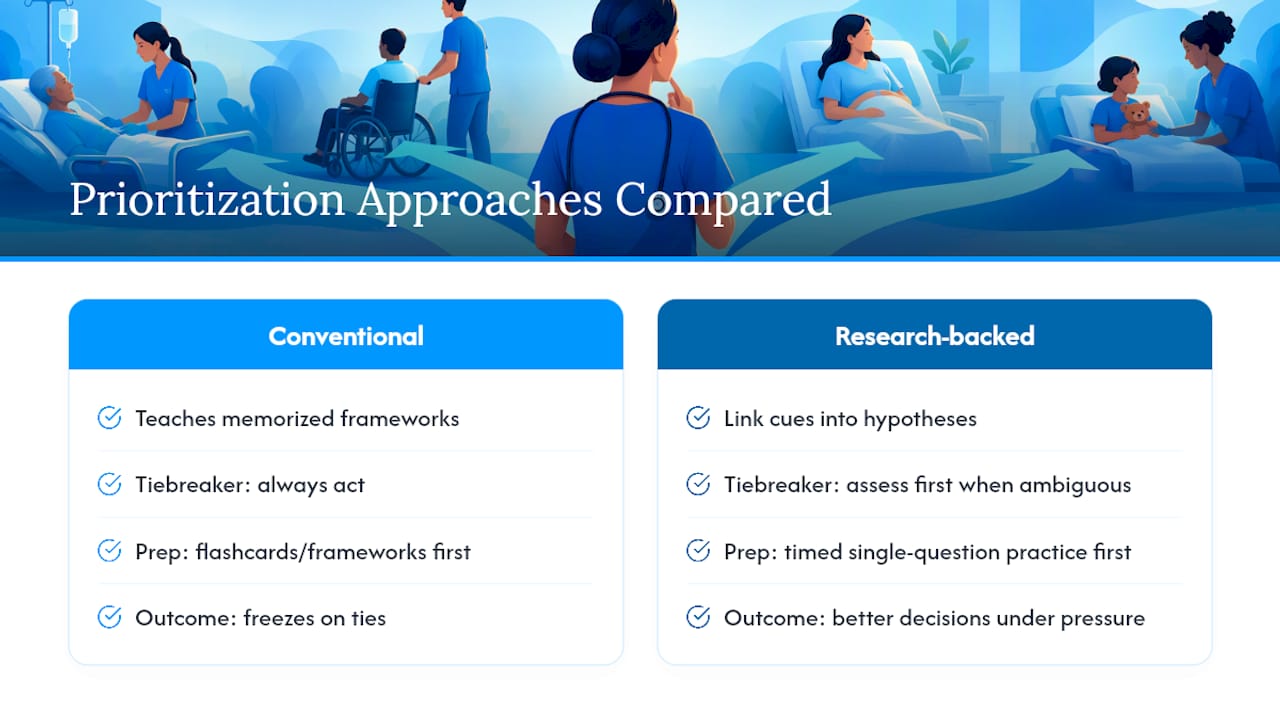
Where conventional advice actually fails is the assessment-versus-action tiebreaker. Students get taught to "always act" because action feels decisive. Wrong instinct. When cues are ambiguous, assessment wins, and treating that as the default, rather than an exception, would fix more missed questions than another round of flashcards.
What should come first in your prep: timed, single-question practice that forces the same decision speed the real CAT format demands. Frameworks matter, but only once you've drilled the discomfort of deciding under pressure, with no chance to go back and change your mind.
— Caleb
A Study Option Built Around This Exact Routine
A study tool turns the stepwise method above into something you can actually drill, daily, adaptively, and under the same single-question pressure the real exam applies. Instead of rereading a framework list, you get short recall runs that target the cues you consistently misread, with instant rationales that show you exactly where your reasoning broke down.
Start with a Daily Recall Run and use the three scenarios above as your first practice set: one physiologic threat, one multi-client ranking, one delegation call. If you'd rather study from your own course material, upload your notes and RecallOS builds custom quizzes and flashcards around your actual weak spots, tracked with streaks so you can see the gaps closing. Every question maps to the same clinical-judgment steps the NCLEX study app is built around, so the habit you build in practice is the one you'll rely on in the testing center.
Where to Go for the Primary Sources
Read the NCLEX-RN 2026 Test Plan for exact exam structure, the NCBI prioritization chapter for framework depth, NANDA's guidance for diagnosis sequencing, and the broader adaptive exam prep guide for study design context.
Sources
- PRIORITIZATION - Nursing Management and Professional Concepts - NCBI Bookshelf
- NCLEX candidate information flyer
- Prioritizing nursing diagnoses - NANDA
FAQ
Is the NCLEX Getting Harder in 2026?
The exam itself isn't getting harder so much as more clinical-judgment focused. The 2026 RN Test Plan leans heavily on case sets that test whether you can recognize, analyze, and prioritize cues in sequence, not just recall facts.
Which State Is Best to Choose for the NCLEX?
There's no evidence any state offers an easier version of the exam. The NCLEX is a national, standardized test, so choose your state based on where you plan to hold licensure, not on any perceived difficulty difference.
What Should I Prioritize for the NCLEX Exam?
Prioritize Management of Care content, since it most directly tests prioritization, delegation, and handoff skills. Pair that with timed, one-question-at-a-time practice so your decision speed matches the actual computer-adaptive format.
Which State Has the Easiest NCLEX?
None. The exam content and passing standard are the same nationwide regardless of the state administering it, so pick your state based on licensure plans rather than a difficulty myth.
How Can I Practice Prioritization Questions Daily?
Short, focused drills beat long study marathons for this skill. Tools like RecallOS's Daily Recall Run apply adaptive review to your weak cues and simulate single-question exam pacing, which builds the same decisiveness the real test demands.