
Your plan for the day before and morning of the NCLEX comes down to three moves: a targeted review of your weakest high-yield topics, one short timed practice set instead of a full-length exam, and a full night of sleep. Practice questions beat passive rereading, and the NextGen NCLEX rewards clinical judgment over memorization, so your last day should train judgment, not cram facts. This exam day NCLEX checklist reflects how Caleb, one of the practicing nurses behind RecallOS, coaches candidates through the final stretch.
Two things back this up:
- Repeated testing produced scores 21% higher than repeated studying in a controlled comparison with nursing students.
- The American Nurses Association advises pacing yourself and trusting your first clinical read over second-guessing.
Key Takeaways
The strongest exam day NCLEX checklist replaces new studying with targeted retrieval practice, protects sleep, and trains NGN-style clinical judgment instead of pure recall.
| Point | Details |
|---|---|
| Test, don't reread | Repeated testing produced scores 21% higher than repeated studying in nursing student research. |
| Rank your review topics | Prioritize pharmacology, lab values, delegation rules, and SATA patterns over everything else. |
| Run short, not long | One 30 to 40 question targeted set beats another full-length practice exam the day before. |
| Pace with purpose | Spend about one minute on standard items, more on NGN case studies, and trust your first answer. |
| Convert misses immediately | Turn every wrong answer into a flashcard and re-test it, a workflow RecallOS builds directly into its practice sets. |
Table of Contents
- What Should You Do the Day Before the NCLEX?
- How Should You Spend the Morning of the NCLEX?
- What Is a Quick Practice Routine to Run the Morning Of?
- How Should You Pace Yourself During the NCLEX?
- What Actually Matters Most in the Final Stretch?
- Why RecallOS Fits Your Final-Day Routine
- Frequently Asked Questions
- Sources
What Should You Do the Day Before the NCLEX?
The day before is for retention, not acquisition. Your job is to sharpen what you already know, not chase new content.
1. Rank your review topics. Spend most of your time on high-risk pharmacology (anticoagulants, insulin, opioids), lab value ranges you keep missing, delegation and priority-setting frameworks, and select-all-that-apply patterns. These categories show up constantly on the NCLEX and reward quick recall under pressure.
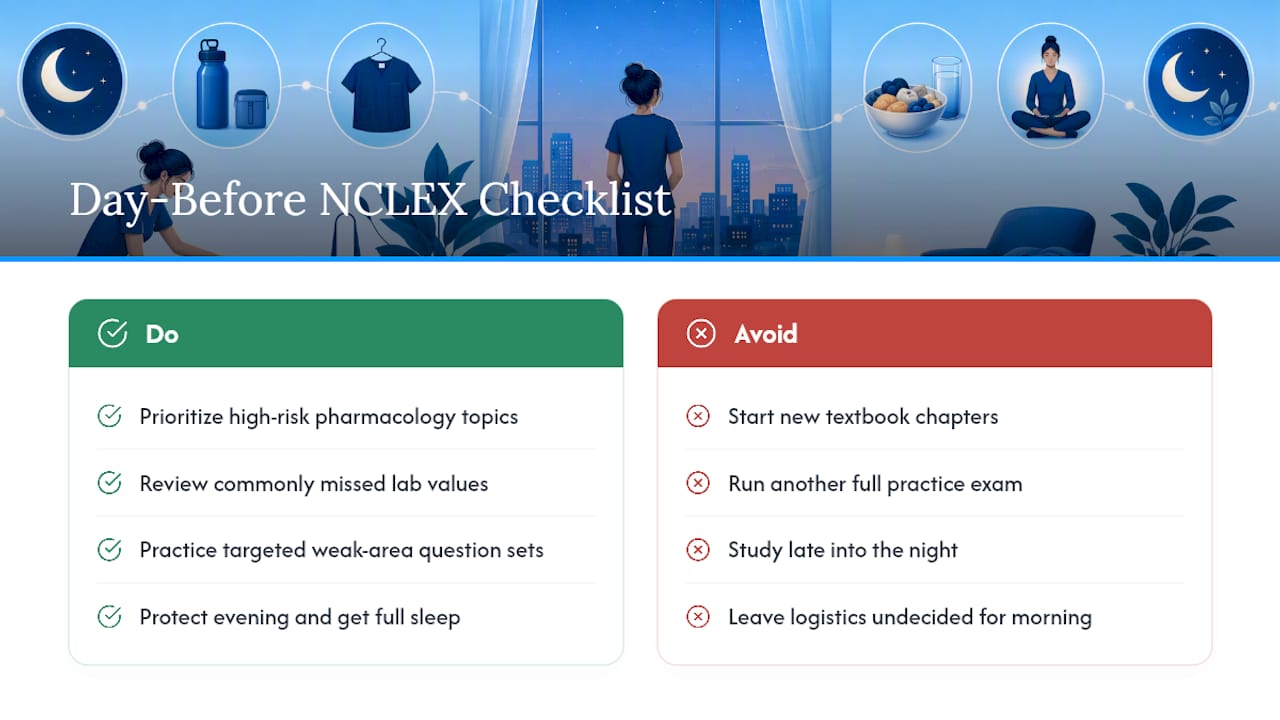
2. Run one targeted set, not a marathon. A single 30 to 40 question practice block focused on your weak areas, or two shorter 15 question sets, does more for you than another full-length practice exam. A classroom comparison of targeted review against general review found targeted practice testing produced significantly higher exam scores than simply rereading material. You already know your gaps from prior practice data. Go straight at them.
3. Shift into retention mode. If you use spaced repetition, cut back on new cards and spend that time reviewing cards you have already missed at least once. The testing-effect research is clear that re-testing what you got wrong sticks better than rereading the correct answer once and moving on.
4. Protect your evening. Stop studying by early evening. Eat something with protein, dim the screens an hour before bed, and go to sleep at a time that gets you a full night's rest, not whatever time adrenaline allows.

5. Handle logistics now. Set two alarms, pack what you're permitted to bring, and map your drive time with a buffer for traffic or parking. Decide all of this tonight so tomorrow morning has zero decisions left to make.
Pro Tip: If you catch yourself opening a new textbook chapter the night before, close it. New information competes for the same mental space your review needs. Convert energy into re-testing what you already touched this week.
How Should You Spend the Morning of the NCLEX?
Your morning routine should take somewhere between 20 and 60 minutes, sharpen recall, and stop well before you walk in tired.
- Review 20 to 30 spaced-repetition cards, focused on pharmacology and lab values. One spaced-repetition schedule for NCLEX prep recommends 20 to 30 review cards on exam morning, down from 40 to 60 cards per day earlier in the final week. The taper matters. You want your brain warm, not fatigued.
- Run 20 to 30 timed practice questions, ideally in NGN-style formats if your resource offers them. Then stop. This is a warm-up, not another study session.
- Eat a light, balanced breakfast with protein. Skip a heavy meal that will make you sluggish. Keep caffeine at your usual amount if you drink it regularly; exam morning is the wrong time to test a new dose.
- Arrive with a time buffer, and use three or four minutes of slow breathing or a mental cue ("I know this material, I trust my training") before check-in.
- Remind yourself to trust your first clinical read. The instinct you built through months of practice questions is more reliable in the moment than a last-second reversal driven by nerves.
The ANA's exam-day guidance backs this exact sequence: arrive early, pace yourself, and don't talk yourself out of a sound answer.
What Is a Quick Practice Routine to Run the Morning Of?
This is a 40 to 50-minute block you can follow exactly, built around the testing effect instead of rereading.
- Warm-up (10 minutes): Run 20 mixed timed questions, NGN-style if your practice tool supports it. This wakes up recall across categories instead of narrowing focus too early.
- Targeted drill (20 minutes): Split into three short blocks hitting your top three weak areas, roughly seven questions each.
- Active conversion (immediate): The moment you miss a question, turn it into one to three flashcards and tag them for same-day review. Don't let a miss pass without capturing it.
- Cooldown (10 minutes): Review 20 to 30 spaced-repetition cards, then do a short breathing reset before you leave for the test center.
This is where RecallOS's Question-a-Day feature fits directly into the morning warm-up, and where its NGN-ready practice sets do the double duty of drilling content and clinical-judgment reasoning at once. The app's convert-miss workflow turns step three into a two-tap action instead of a separate note-taking task, and its streak tracking gives you a small, real reason to actually run the routine instead of skipping it out of nerves.
Pro Tip: Treat the cooldown step as non-negotiable, even if you're running short on time. Ending on review cards you already know cold, rather than a fresh miss, sends you into the exam on a note of competence instead of doubt.
How Should You Pace Yourself During the NCLEX?
Most questions deserve about one minute, sometimes less. NextGen NCLEX case studies and extended items reasonably take longer, since they ask you to work through multiple parts of a clinical scenario.
- For standalone multiple-choice or SATA items, keep pace brisk. Don't dwell.
- For NGN case studies, slow down deliberately: read the full scenario, then work the clinical-judgment sequence, identify the cues, form a hypothesis about what's happening, and choose the safest action.
- Trust your first answer unless you spot a clear misread of the question. The ANA specifically advises against habitual second-guessing.
- If a question stalls you, flag it mentally, make your best call, and move. Nothing about the CAT format rewards frozen indecision.
Prioritize airway, breathing, and circulation first, then safety, then everything else. When an NGN scenario feels tangled, that simple hierarchy almost always points you to the right action.
Short mental checklists like this work better under pressure than trying to recall a full nursing framework from memory. If anxiety spikes mid-test, a brief breathing reset between sections resets your focus faster than pushing through.
What Should You Avoid in the Final 24 Hours?
Skip new content entirely. Repeated testing beats repeated studying, so a new chapter the night before adds risk without adding benefit. Skip another full-length practice exam too; a short targeted set does more with less fatigue.
Avoid double or triple espresso shots you don't normally drink, and don't stay up late "just checking one more thing." Both wreck the sleep quality your brain needs to consolidate what you already reviewed. During the actual test, replace compulsive answer-changing with a note-and-move approach: flag it, commit, keep going, and return only if time genuinely allows.
What Actually Matters Most in the Final Stretch?
The evidence points to one uncomfortable truth: most last-minute study plans spend energy on the wrong thing. Candidates cram content when the research on testing effect says retrieval practice, not review, is what moves the needle. Conventional advice treats the day before like a smaller version of six months of studying. It isn't. It's a retention exercise wearing a study costume.
The other gap is NGN readiness. A lot of "final checklist" advice out there still frames the NCLEX as a memorization test, when NextGen items are explicitly built around clinical-judgment reasoning, not recall alone. If your last 24 hours don't include at least a few scenario-based questions, you're rehearsing for an exam that doesn't quite match the one you're taking.
Prioritize this order: convert your misses into review material first, run short timed sets second, and protect sleep above both. Access to any prep tool matters less than how deliberately you use it in these final hours.
Why RecallOS Fits Your Final-Day Routine
RecallOS was built by practicing nurses and CRNAs specifically to run the kind of targeted, testing-effect routine your last 24 hours need, not a generic quiz app repurposed for nursing.
The app's Question-a-Day feature gives you a fast morning warm-up without opening a full practice exam. Its NGN-ready practice plans mirror the clinical-judgment format you'll actually see on test day, and its convert-miss-to-card workflow does exactly what the cooldown step in your routine calls for: turn a wrong answer into a flashcard you'll actually see again. Streaks and rewards exist for the unglamorous reason that most candidates skip review the night before out of nerves, and a small habit loop keeps you doing it anyway. Research on commercial prep tools shows individualized, guided use matters more than access alone, which is exactly why RecallOS adapts to your specific weak areas instead of handing you the same generic question bank as everyone else. Head to the RecallOS nursing study app and run tonight's targeted review before you do anything else.
Frequently Asked Questions
What should be on my exam day NCLEX checklist? Focus it on a short targeted review of weak topics, one timed practice warm-up, a light protein breakfast, and pacing reminders. Skip new content entirely.
How many practice questions should I do the morning of the NCLEX? Around 20 to 30 timed questions works as a warm-up. More than that risks mental fatigue before you even sit down for the real exam.
Is it bad to change my answer during the NCLEX? Habitual answer-changing tends to hurt more than help. The ANA's guidance favors trusting your first clinical read unless you spot a genuine misread of the question.
How is the NextGen NCLEX different from the older format? NGN items weigh clinical-judgment reasoning through case studies and multi-part scenarios, not just recall, so your final review should include scenario-based practice, not only fact-based questions.
Should I take a full practice exam the day before the NCLEX? No. A short, targeted 30 to 40 question set focused on your specific weak areas is more effective and less exhausting than another full-length exam.
Sources
- Tips on How to Pass the NCLEX Exam | ANA
- Examining Nursing Students' Retention of Taught Content by Repeat Stud
- Effect of a Commercial NCLEX-RN Preparation Product on First Time Pass Rates