
The single best move on any NGN case study is to anchor your answer to the Clinical Judgment Measurement Model: read every exhibit before touching a question, list your cues in the margin, rank two competing hypotheses, then pick actions that match both the physiology and the scoring logic. Open a case by scanning tabs in order (History, Vitals, Labs, Notes), circling abnormal values as you go. Annotated examples and week-by-week study plans follow below.
TL;DR:
- NGN case studies measure clinical judgment based on analyzing multiple exhibits, evolving data, and prioritizing responses, not just content memorization.
- Recognizing cues, analyzing connections, prioritizing hypotheses, and matching interventions to data are the key steps to answer efficiently within time limits.
- Most questions require spending about 60 to 90 seconds on initial review, with additional time for verifying your answer before submission.
- Different question types, like bow-tie, matrix, and multiple-response items, demand specific strategies, especially checking the relevant exhibit tab and scoring nuances.
- Consistent practice using the six-step process and tracking specific CJMM step accuracy helps improve results more than focusing solely on overall scores.
Table of Contents
- What NGN Case Studies Actually Measure
- The 6-Step Clinical Judgment Playbook
- A Step-by-Step Strategy for Reading and Answering
- NGN Item Types and How Scoring Really Works
- Three Annotated Case Walkthroughs
- Study Plans That Match Your Timeline
- Test-Day Timing and Anxiety Control
- Why This Method Holds Up
- A Nurse-Educator's Honest Notes on Adapting This Workflow
- Put This Strategy Into Daily Practice With RecallOS
- Primary Sources and Further Reading
- Sources
- FAQ
What NGN Case Studies Actually Measure
NGN case studies test clinical judgment, not memorization. You're not being asked "what do you know?" You're being asked "what do you do with what you know, right now, with this patient?" That distinction is why students who ace content review still miss case studies.
The NCSBN Clinical Judgment Measurement Model organizes every NGN case around six cognitive layers, from noticing a cue to evaluating an outcome. Each item type, whether it's a bow-tie or a matrix grid, is really just testing one or two of those layers in disguise.
Cases get harder in three specific ways:
- More exhibits. A single case might include a nursing note, a med administration record, and a lab trend you have to cross-reference.
- Evolving data. Vitals change between tabs, and the "right" answer at minute one can be wrong by minute ten.
- Competing distractors. Two answers often look clinically reasonable, but only one matches what the exhibits actually show.
The 6-Step Clinical Judgment Playbook
Turn the CJMM into a routine you run on autopilot, not a theory you recite. Here's the six-step version built for exam speed:
- Recognize cues. Skim vitals and labs, underline anything outside normal range, and jot a shorthand list (e.g., "K+ 6.1, HR 118").
- Analyze cues. Ask which underlined values actually connect to each other. Cross out any that are red herrings.
- Prioritize hypotheses. Write two possible problems on your scratch paper, ranked by urgency, not by which one you learned about most recently.
- Generate solutions. List two or three interventions per hypothesis before you look at the answer options.
- Take action. Match your generated list against what's actually offered. Pick the option that treats the highest-priority problem first.
- Evaluate outcomes. If a later tab shows a repeat vital sign, check whether it moved in the direction your chosen action should have caused.
Stem language tips you off to which step you're in. "Which finding requires immediate follow-up?" is Step 1. "Which action should the nurse take first?" is Step 5. "Which finding indicates the intervention was effective?" is Step 6.
Pro Tip: Between tabs, force yourself into a five-second habit: note one number, one direction (up or down), one word for what it might mean. That's it. Don't write sentences under time pressure.
A Step-by-Step Strategy for Reading and Answering
Your first read-through should take roughly 60 to 90 seconds per case before you touch a single answer choice. Skim the patient introduction, then move tab by tab: History, Vitals, Labs, Provider Notes, Medications. Don't stop to solve anything yet. You're building a mental map of what's abnormal and what's trending.
Once you've read everything, prioritize:
- Rank findings by which body system is most at risk of rapid decline (airway and breathing beat everything else, almost always).
- If a matrix or multi-response item allows more than one correct row, don't force a single answer. Multi-response items are built for partial credit, and skipping a defensible second choice costs you points you could have kept.
- Cross-check any drug name against the scoring rules for the exam's Next Gen items before selecting a dose or route, since dosing errors are a common trap.
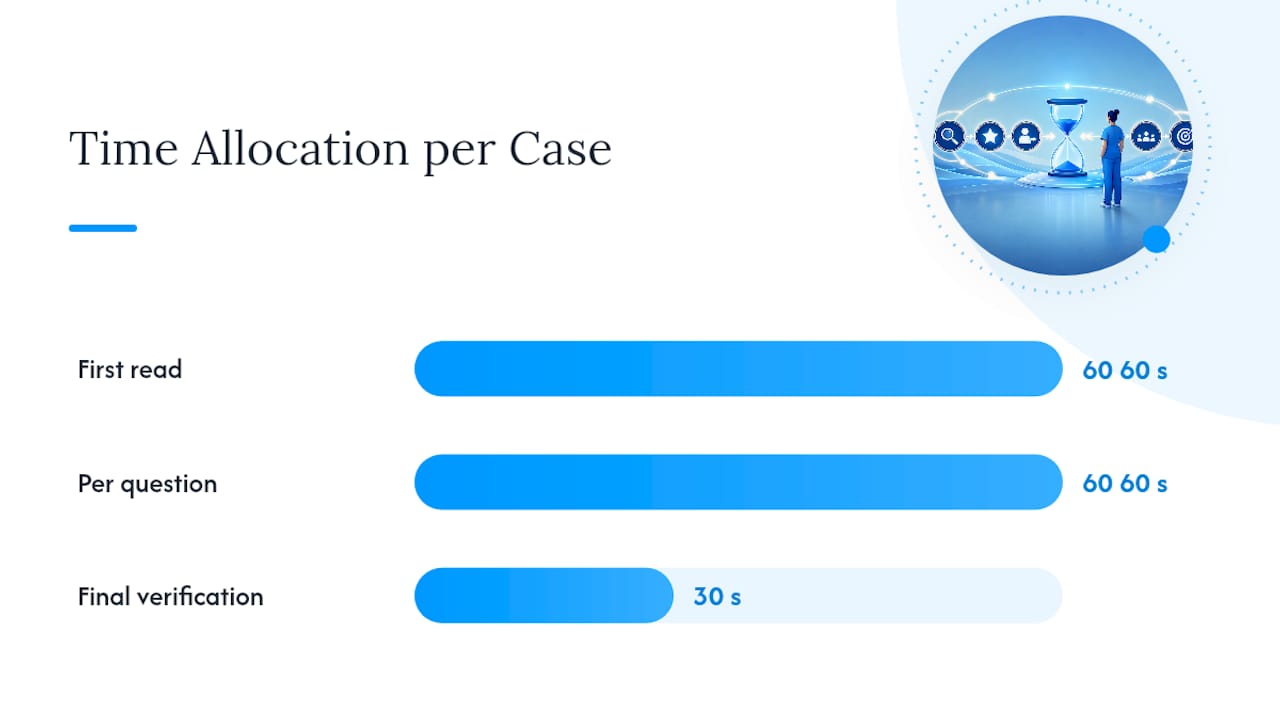
Time allocation matters more than most students think. Budget roughly 90 seconds for your first read, 60 to 90 seconds per question within the case, and 30 seconds at the end for verification. That verification step is where points get saved: reread the stem one more time and confirm you're answering the actual question asked, not the question you assumed was coming.
Pro Tip: Before submitting, ask yourself one question: "Does my answer match what the exhibits showed, or what I would personally do as a nurse?" Those aren't always the same thing, and the exam rewards the former.
NGN Item Types and How Scoring Really Works
Recognizing the item type tells you exactly which cognitive move the question wants.
- Bow-tie items ask you to connect a condition to its most likely cause and the priority action, all in one linked diagram. Get the middle right first; it anchors the other two.
- Matrix/grid items ask you to evaluate multiple options against multiple criteria (effective, ineffective, or no relation). Work row by row, not column by column.
- Multi-response select-all-that-apply (SATA) items typically use partial-credit or "at least one correct" scoring rather than all-or-nothing grading, so an educated guess on an uncertain option rarely costs you as much as leaving it blank.
- Exhibit-based items hide the answer in a specific tab. If a question mentions a lab value, go back to the lab tab. Don't answer from memory of what you skimmed thirty seconds ago.
A detailed walkthrough of bow-tie logic and how each piece is graded can sharpen this further, especially for students who consistently miss the "cause" node.
Common scoring traps include selecting an intervention that's clinically correct but wrong for the stage of the scenario (treating a problem before confirming it exists), and skipping matrix rows out of uncertainty instead of making your best educated call.
Three Annotated Case Walkthroughs
Seeing the routine in action beats reading about it in the abstract. Here are three compressed walkthroughs across different content areas.
- Foundations case: a post-op patient with rising temperature. The stem gives vitals showing a low-grade fever and slightly elevated heart rate six hours after surgery. Underline "38.1°C" and "HR 104." Cue analysis: early infection risk versus normal post-op inflammatory response. Hypothesis ranking puts infection second, dehydration first, because the intake/output tab shows minimal fluid intake. The one-line rationale: "Fluids first, reassess temperature trend before escalating."
- Pharmacology case: a patient on IV heparin with a new headache. High-alert cue: heparin plus a new neuro symptom. The dosing tab shows an aPTT above therapeutic range. Correct prioritization holds the next dose and notifies the provider before assuming the headache is unrelated. On a multi-response item here, selecting "hold the infusion" and "recheck aPTT" both earn partial credit even if you miss a third, less critical option.
- Med-surg case: a diabetic patient with confusion and low blood glucose. Triage reasoning: confusion plus a glucose reading in the 50s outranks a pending wound-care task on the same tab. Action selection favors oral glucose or IV dextrose depending on the patient's ability to swallow, based on the notes tab. Scoring note: choosing "administer oral glucose" without first confirming the patient's airway and swallow status is a common wrong answer, even though the drug choice itself is correct.
Study Plans That Match Your Timeline
Pick a blueprint based on how much runway you have, not on what worked for a classmate.
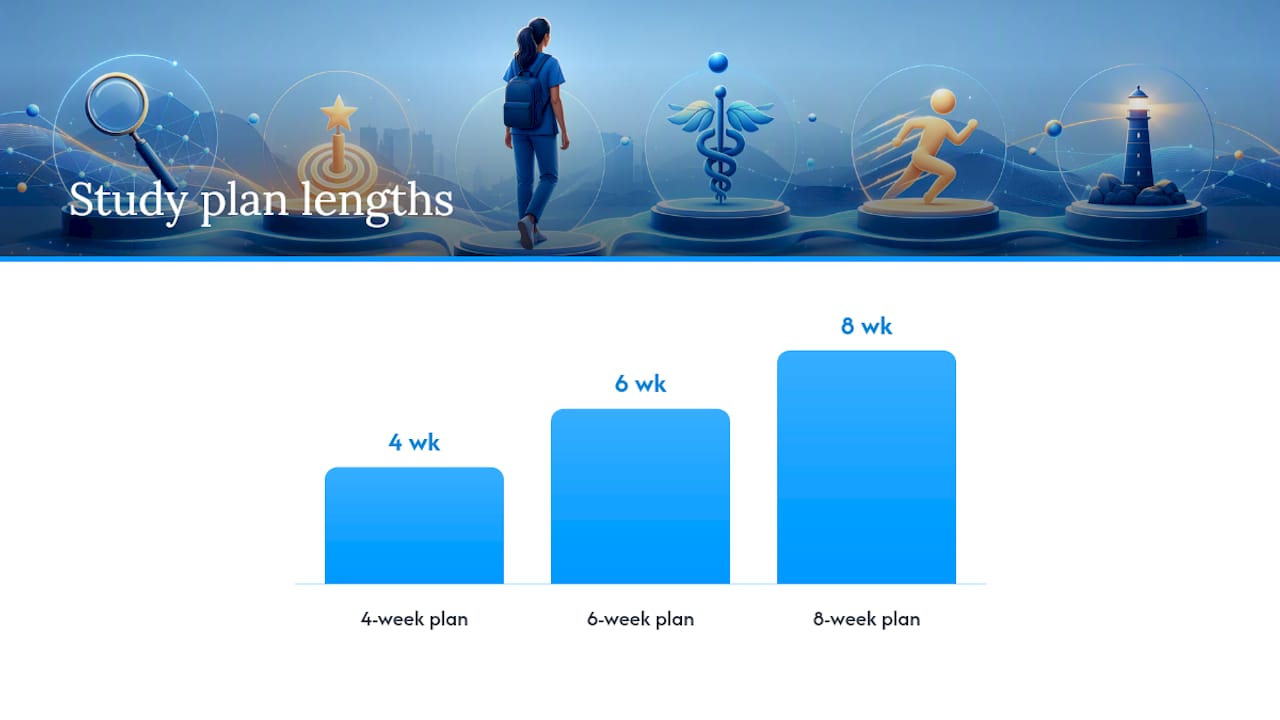
- 4-week plan: Days 1 to 5 focus on CJMM drills using foundational cases. Week 2 shifts to pharmacology and med-surg cases daily. Weeks 3 and 4 alternate full-length timed mock sets with review of missed items.
- 6-week plan: Add a full week of pure item-type practice (bow-tie, matrix, SATA) before mixing content areas, then interleave case types so you're not just pattern-matching one specialty.
- 8-week plan: Spend the first two weeks on content review paired with daily case-of-the-day practice, then follow the 6-week structure for the remainder with an added mock exam every ten days.
Across any plan, mix formats: one case of the day, one timed 30-minute drill block twice a week, and spaced recall sessions revisiting missed cases after 48 hours. Interleaving different case types instead of drilling one specialty at a time measurably improves how well the skill transfers to a mixed exam.
Pro Tip: Track your CJMM step accuracy, not just your overall score. If you keep missing "prioritize hypotheses" specifically, that's a five-minute fix, not a five-week one.
Test-Day Timing and Anxiety Control
Run a simple session plan: roughly 90 seconds to read a case cold, 60 to 90 seconds per item inside it, and a 30-second verification pass before submitting.
- Reset between cases with one slow breath and a single phrase: "New patient, new data, ignore the last one."
- If a case has you stuck past two minutes on one item, make your best-supported guess and move on. A stalled case costs you time on three or four other items you could have answered correctly.
- For partial-credit items, always submit a defensible answer rather than leaving rows blank. Blank answers earn nothing; an educated guess sometimes earns something.
Why This Method Holds Up
Case-based learning works because it forces reasoning in context rather than isolated recall. The case study approach in health research produces exactly the kind of multi-faceted, "how and why" understanding that NGN items are built to measure, which is why bounded, well-designed practice cases translate so directly to exam performance.
Breaking a case into fixed micro-tasks, read exhibits, list cues, state two hypotheses, pick prioritized actions, lowers cognitive load and produces more consistent scoring under time pressure than answering by instinct alone.
Active recall combined with spaced practice is one of the more consistent findings in the study-skills literature, and it's the mechanism behind daily case drills rather than marathon review sessions. RecallOS builds its content around this same idea: practicing nurses and CRNAs write the case material, the app maps it to NGN structure, and adaptive review resurfaces the CJMM step you're weakest on instead of quizzing you at random.
A Nurse-Educator's Honest Notes on Adapting This Workflow
Students who start late don't need a longer plan, they need a shorter loop: one case, six steps, daily, no skipping the annotation. Track CJMM step accuracy weekly, not raw scores, because that's where the real gains hide. If you're down to two weeks, cut the plan to daily cases plus one timed mock block. Consistency beats intensity here, every time.
— Caleb
Put This Strategy Into Daily Practice With RecallOS
RecallOS turns this exact six-step routine into a daily habit instead of a one-time read. Every case of the day is built around the same cue, prioritize, act rhythm this article walks through, so you're rehearsing the CJMM instead of just reading about it.
The app's adaptive review tracks which CJMM step trips you up most, whether that's hypothesis prioritization or action selection, and resurfaces cases targeting that exact gap. Streaks and progress tracking give you the same weekly milestone structure as the study blueprints above, without you having to build a spreadsheet to track it. Content comes from practicing nurses and CRNAs, mapped directly to NGN item types like bow-tie and matrix questions.
Start with a free case of the day and see how the routine feels under real time pressure. Try RecallOS today and turn the six-step playbook into a habit before your test date arrives.
Primary Sources and Further Reading
The case study approach and 10-step case design guidance explain the methodology behind bounded, in-depth case learning referenced throughout this article.
FAQ
What Is the Best Strategy for NGN Case Studies?
Anchor every case to the six-step Clinical Judgment Model: read all exhibits first, identify cues, prioritize hypotheses, then choose actions that match the physiology and the scoring rules.
How Long Should I Spend on Each NGN Case?
Budget about 90 seconds for your first read-through of the exhibits, then 60 to 90 seconds per question, plus a 30-second check before you submit.
Does Guessing on Matrix or SATA Items Hurt My Score?
Leaving rows blank earns nothing, while an educated guess on a partial-credit item can still earn points, so always submit your best-supported answer.
How Many Weeks Should I Study for NGN Case Studies?
Four weeks works if you already know core content, six weeks adds dedicated item-type practice, and eight weeks pairs content review with daily case drills from the start.
Can RecallOS Help Me Practice NGN Case Studies Specifically?
Yes. RecallOS offers a daily case of the day mapped to NGN item types, plus adaptive review that targets the specific Clinical Judgment Model step you're weakest on.