
The fastest route to quick NCLEX results is a diagnostic first, then daily high-yield practice with spaced repetition, then weekly timed simulations. Frameworks like the NCSBN Clinical Judgment Measurement Model and tools like RecallOS build this exact sequence into a repeatable daily routine. Take a diagnostic today, then lock in a daily question block for the next 48 hours. Most candidates who follow this pattern see measurable improvement within one to eight weeks.
TL;DR:
- Candidates should start with a diagnostic test to identify true weak areas and set a baseline for tracking progress over time.
- A 2-week emergency plan involves high-volume daily questions with no new content after day 10 and full timed tests on days 7 and 13.
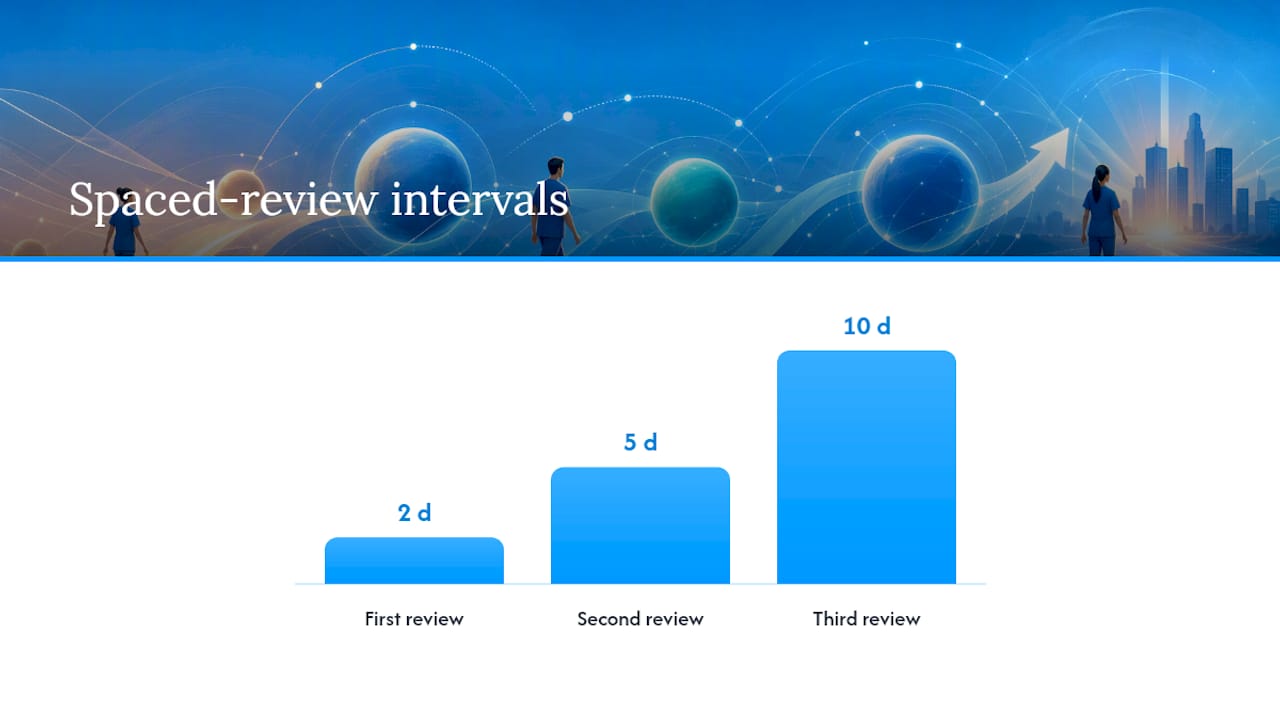
- Spaced repetition is more effective than cramming because it helps consolidate knowledge with review intervals at two, five, and ten days.
- Active recall, especially through evaluating each answer choice and relating clinical data, significantly improves retention and NGN question performance.
- In the final week, reduce question volume, prioritize weak areas, avoid new content, and focus on sleep and stress management to optimize exam readiness.
Table of Contents
- Three Timelines to Fast NCLEX Improvement
- What Actually Speeds Up NCLEX Learning
- How to Structure a Study Session That Actually Sticks
- Final-Week Taper and Test-Day Checklist
- Why This Plan Reflects Real Exam Blueprints
- Memory Tricks That Actually Hold Up Under Exam Pressure
- Studying on the Go: Making Mobile Practice Count
- Calming Pre-Exam Nerves Without Losing Focus
- Fueling Your Brain During Intense Study Periods
- Which Topics Deserve Your Study Time First
- A Word on Consistency Over Cramming
- Put This Plan Into Action With RecallOS
- Sources
- FAQ
Three Timelines to Fast NCLEX Improvement
Your starting point determines your timeline, not the other way around. A candidate scoring 60% on a diagnostic needs a different plan than one scoring 75%, and pretending otherwise wastes the one resource you can't get back before test day.
Start every plan with a Day 1 diagnostic. It tells you which content areas are genuinely weak versus which ones you just haven't reviewed recently, and it sets your baseline for tracking progress. From there, pick one of three templates.
-
The 2-week emergency plan. Run 150 to 200 questions a day, split into blocks. No new content after day 10. Dedicate at least two full days to Next Generation NCLEX (NGN) case items, review every rationale the same day you miss it, and run a full timed readiness check on days 7 and 13.
-
The 4 to 8-week quick-results plan. This is the sweet spot for most repeat test-takers and new grads with some runway. Build a spaced repetition schedule that re-tests missed concepts at 2, 5, and 10-day intervals. Run one full timed practice exam every week, add progressively harder NGN case studies, and aim for 75 to 80% mastery in each content category before moving on.
-
The 8 to 12-week steady plan. Better suited to students still in clinical rotations or working part-time. Extend your practice blocks but keep the same weekly rhythm: one timed simulation, several NGN case sessions, and dedicated weak-area review built around your actual schedule rather than an ideal one.
Reassess weekly. If your readiness checks climb past your target two weeks early, compress the timeline and move to a lighter maintenance phase. Westcliff University's guidance on diagnostic-first planning backs this same logic: let readiness data, not the calendar, decide when you're done.
What Actually Speeds Up NCLEX Learning
Four techniques do most of the heavy lifting for fast score gains, and they work together rather than in isolation.
Spaced repetition beats cramming because your brain consolidates information better when recall is spread out rather than massed into one sitting. A practical interval schedule looks like this: review a missed concept after 2 days, again after 5, then again after 10. One study summary from Chamberlain University found retention around 80% after one week using spaced retrieval, compared to much steeper drop-off with passive re-reading. Digital tools that automate this scheduling remove the guesswork of remembering when to circle back.
Active recall through daily questions is the mechanism that makes spacing possible in the first place. Aim for 75 to 150 questions a day depending on your timeline, and read every rationale, even for questions you got right. Understanding why a wrong answer is wrong matters more than the answer itself.
Adaptive quizzing outperforms uniform review because it targets what you actually don't know instead of re-covering ground you've already mastered. A quasi-experimental study published on PMC found that a 15-week program combining comprehensive review with adaptive quizzing improved both mastery scores and exit-exam performance compared to standard review alone.
Clinical-judgment frameworks are non-negotiable for NGN items. The NCSBN Clinical Judgment Measurement Model, the ABCs, and Maslow's hierarchy give you a repeatable lens for case-based questions where there's no single obviously correct answer. Most students study by isolated topic instead of by clinical scenario, and that habit hurts them specifically on NGN unfolding cases, which reward reasoning through a patient situation rather than recalling a fact.
- Practice select-all-that-apply (SATA) items by evaluating each option as its own true or false statement, rather than hunting for "the right combination." This single shift reduces a common source of avoidable errors.
- Underline key clinical data in NGN case stems before choosing an answer, then map it against the CJMM's six cognitive skills.
- Review missed NGN cases the same day, and re-test the same case type again five days later.
Pro Tip: When you miss a question, don't just read the correct rationale. Write one sentence explaining why the wrong answer you picked seemed reasonable. That's usually where the real learning happens.
For a deeper walkthrough of applying these frameworks to case items, see this six-step NGN case strategy.
How to Structure a Study Session That Actually Sticks
Volume without structure just produces fatigue. A repeatable daily and weekly template turns hours of studying into retained knowledge.
- Sample study day: Two 50 to 60 minute question blocks with a 10 to 15 minute break between them, plus one dedicated spaced-review slot for concepts you missed 2, 5, or 10 days earlier.
- Weekly cadence: One full-length timed simulation, three to four NGN case sessions, and two focused blocks on your weakest content area, chosen from your most recent diagnostic or practice-exam data.
- Wrong-answer workflow: Record every miss, label the error type (content gap, misread stem, poor time management, second-guessing), then cluster similar errors together and re-test that cluster on the same spaced schedule you use for content review.
- Pacing practice: Run your timed simulations under the same conditions you'll face on test day. Silence your phone, sit at a desk, and don't pause the clock. Consistency in practice conditions is what makes pacing feel automatic instead of stressful when it counts.
This structure works whether you're running a question-a-day habit or full practice-exam blocks, because the underlying cycle of practice, error review, and spaced re-test stays the same.
Final-Week Taper and Test-Day Checklist
Your last seven days should look nothing like week one. Cut your daily question volume roughly in half and stop introducing new content 48 to 72 hours before your exam. Spend that time exclusively on verified weak areas and high-yield summary review.
Sleep does more for consolidation in this window than one more late-night question set. Keep a consistent sleep schedule, stay hydrated, get light exercise, and use a short breathing or grounding practice if pre-exam anxiety tends to spike for you.
- On test day, focus on one question at a time. Don't let a hard question bleed into the next one.
- Take a brief mental reset every 10 to 20 questions rather than pushing straight through in one long stretch.
- Confirm your ID, testing center address, and arrival time the night before, not the morning of.
- If your readiness checks are still inconsistent in the final week, an honest self-assessment matters more than sticking to a date. Guidance from the American Nurses Association points to a 45-day waiting period if you need to retake, so postponing a shaky attempt is often the better trade.
Why This Plan Reflects Real Exam Blueprints
RecallOS is built by practicing nurses and CRNAs specifically to align daily practice with real exam blueprints, not generic trivia. That's the same principle behind every timeline in this guide: diagnostic first, targeted daily practice second, simulation third.
The features map directly onto what's described above. Daily Recall Run delivers the daily question volume and spaced-review cadence the 4 to 8-week template calls for. Personalized weak-spot review handles the adaptive targeting piece, and streaks and rewards give the habit-formation structure that makes daily practice sustainable instead of a chore you abandon by week two.
Memory Tricks That Actually Hold Up Under Exam Pressure
Generic memory tricks fall apart under NCLEX-style pressure because the exam tests application, not recall of isolated facts. The techniques that hold up share one trait: they force retrieval rather than recognition.
Teach-back works better than most students expect. Explain a concept out loud, in your own words, as if you're teaching a classmate who's never seen it. If you stumble, that's your real weak spot, not whatever your last practice score suggested. This is a form of active recall, and it exposes gaps that multiple-choice review tends to hide.
Chunking by clinical scenario, not by topic, changes how information gets stored. Instead of memorizing "signs of hypokalemia" as a flashcard list, attach it to a specific patient picture: a post-op patient on a diuretic with muscle weakness and an irregular pulse. Scenario-based memory retrieves faster under exam conditions because NGN items present information as a case, not a list.
Mnemonics still have a place, but they work best for ordered steps (like the ABCs for prioritization) rather than for clinical judgment itself. Don't rely on a mnemonic to substitute for actually reasoning through a case.
Interleaving content areas, rather than blocking all your cardiac questions together and then all your respiratory questions, mimics how the real exam mixes topics. It feels harder in the moment, which is exactly why it works. Retrieval that requires you to first identify what kind of question you're looking at builds the same mental flexibility the NCLEX demands.
Studying on the Go: Making Mobile Practice Count
Fifteen spare minutes between clinical shifts or classes adds up faster than most students realize, and mobile apps exist specifically to capture that time. The key is making sure those short sessions reinforce your actual weak areas instead of just delivering random questions.
A well-designed app should sync with whatever you did in your last full study block. If you missed three questions on acid base balance yesterday, your five-minute mobile session today should surface acid base questions again, not an unrelated topic. That's the adaptive-quizzing principle applied to micro-sessions instead of full study blocks.
Mobile practice works best for pure review and retrieval, not for learning brand-new content. Save unfamiliar material for your longer, focused sessions where you can actually sit with a rationale and understand it. Use short mobile sessions for rapid-fire review of concepts you've already been exposed to once.
One underused feature worth looking for: the ability to upload your own lecture notes and convert them into quiz questions. That turns dead time reviewing a PDF into active retrieval practice, which fits directly into the daily question volume your timeline calls for.
Calming Pre-Exam Nerves Without Losing Focus
Test anxiety doesn't just feel bad. It actively narrows your working memory right when you need it most for multi-step NGN reasoning. Managing it isn't optional prep, it's part of performing at your actual skill level.
Box breathing (four counts in, four counts hold, four counts out, four counts hold) works because it's simple enough to do in a testing center bathroom without needing to remember complicated steps. Practice it during your timed simulations at home so it's automatic, not something you're learning for the first time on exam day.
Physical grounding helps too. Pressing your feet flat on the floor, noticing three things you can see, or simply unclenching your jaw interrupts the physical spiral of anxiety before it snowballs into panic that costs you focus on the next question.
Avoid last-minute cramming the morning of your exam. It rarely adds new knowledge at that point and almost always adds anxiety instead. If you've followed a taper in the final week, trust that preparation and spend exam morning on your normal routine, not a frantic review session.
Fueling Your Brain During Intense Study Periods
What you eat and how you move during a compressed study timeline affects how well your brain actually retains what you're reviewing. This isn't about a strict diet. It's about avoiding the specific patterns that tank focus during long study blocks.
Steady blood sugar beats sugar spikes. A granola bar and coffee might feel like fuel, but the crash 90 minutes later kills a study block's momentum. Pairing protein with complex carbohydrates, like eggs with whole grain toast or Greek yogurt with fruit, keeps energy more level through a 50 to 60 minute question block.
Hydration matters more than most students account for. Mild dehydration measurably affects concentration and short-term memory, and it's easy to forget water during a six-hour study day.
Movement doesn't need to be a full workout to help. A 20 to 30 minute walk between study blocks increases blood flow and has a real, if modest, effect on mood and focus for the next session. Save intense exercise for after your study day rather than right before a demanding block, since it can leave you too fatigued to concentrate.
Which Topics Deserve Your Study Time First
Not all content areas carry equal weight on the exam, and treating a rarely tested topic with the same urgency as a heavily weighted one is one of the most common ways students waste a compressed timeline.
Prioritization and delegation, pharmacology and parenteral therapies, and management of care consistently show up as heavily emphasized content categories. If your diagnostic shows weakness in any of these, that's where your first week of focused review belongs, not on a narrow topic that appears in a handful of items.
Safety and infection control questions appear constantly across nearly every content area, often disguised inside a larger clinical scenario rather than as a standalone question. Practicing spotting a safety violation embedded in an unfolding case, not just in an isolated question, pays off across the whole exam.
Use your diagnostic and ongoing practice-exam data to guide this, not a generic list. A structured question bank built around NGN-ready practice can show you exactly which categories are dragging your overall readiness down, so your remaining study time goes where it actually moves the needle instead of where it feels comfortable.
A Word on Consistency Over Cramming
Quick results come from consistency, not shortcuts. A student who does 75 focused questions daily for three weeks will almost always outperform one who crams 500 questions the weekend before. The most common pitfall isn't laziness, it's skipping the diagnostic and guessing at weak areas instead of measuring them. Be honest about where you actually stand before you build a plan around it.
— Caleb
Put This Plan Into Action With RecallOS
RecallOS is built around the exact sequence this guide recommends: a diagnostic first, then daily targeted practice, then spaced review that keeps weak areas from resurfacing later. That's not a coincidence. It's the same evidence-backed structure practicing nurses and CRNAs used when designing the platform.
If you've read this far, you already know the theory. The next step is running it. RecallOS's Daily Recall Run delivers your daily high-yield question block with adaptive targeting built in, so each session adjusts to whatever your last diagnostic or practice round revealed as weak. If you've got lecture notes or clinical guides sitting unused, the Upload Notes feature turns them into quiz questions instead of static reading material. Start with a diagnostic assessment on the NCLEX study app today, and build your two-week, six-week, or twelve-week plan around what it actually shows you.
Sources
- 10 proven nursing exam study strategies that actually work — Chamberlain University (blog)
- Tips for passing the NCLEX exam — American Nurses Association (ANA)
- Study on comprehensive licensure review plus adaptive quizzing — PMC
- How to pass the NCLEX — Westcliff University
FAQ
How Fast Can You Improve Your NCLEX Readiness?
Measurable improvement is realistic within one to eight weeks when you combine a baseline diagnostic with daily targeted practice and spaced repetition. A 15-week program combining review with adaptive quizzing showed measurable mastery gains, and shorter, more intense timelines can move the needle faster if daily volume and rationale review stay consistent.
What Is the Best Way to Check NCLEX Readiness Before Test Day?
Run a full-length timed practice exam under real testing conditions, no pauses, quiet room, strict time limits, and compare your category scores against your target mastery levels. RecallOS's diagnostic assessment gives this same readiness snapshot and flags which categories still need work before you schedule your exam.
How Many Practice Questions Should You Do Daily for Quick Results?
Most quick-results timelines call for 75 to 200 questions a day depending on how compressed your plan is, with more volume in a 2-week emergency plan than in an 8 to 12-week steady plan. What matters more than the raw number is reading every rationale and feeding missed questions into a spaced-review cycle.
Does RecallOS Cost Anything to Try?
RecallOS offers Recall+ and Recall Pro subscription tiers, with current pricing listed on Recallos. Specific plan pricing isn't published outside the app, so check the site directly for the latest options.
What Should You Avoid in the Final Week Before the NCLEX?
Avoid introducing new content in the final 48 to 72 hours and avoid doubling your question volume out of last-minute anxiety. Instead, halve your daily volume, focus only on confirmed weak areas, and prioritize sleep, since consistent rest supports memory consolidation that cramming actually undermines. See consistent rest supports the memory consolidation for more.