
NCLEX-RN licenses registered nurses and tests broader clinical judgment, delegation, and management skills. NCLEX-PN licenses practical or vocational nurses and focuses on implementing care under supervision. Both exams run through the National Council of Licensure Examination, use computerized adaptive testing (CAT), and cap out at a five hour testing window. The exam you take depends on your nursing program, not personal preference.
TL;DR:
- The NCLEX-RN tests advanced management and judgment skills, requiring preparation for complex, multi-system assessments and delegation scenarios.
- The NCLEX-PN focuses on procedural accuracy and recognizing changes in patient conditions within a supervised scope, emphasizing single-system focus.
- Both exams may range from 85 to 150 questions within a five-hour window, but pacing and question difficulty vary based on testing performance and content complexity.
- Passing rates differ significantly by candidate profile, with first-time, U.S.-educated RNs achieving higher success compared to pooled averages, especially due to scope and decision-making demands.
- Your program type (ADN, BSN, or practical nursing) determines which exam you qualify for; career goals should guide your study focus on either RN-level synthesis or PN procedural skills.
Table of Contents
- NCLEX RN vs PN: The Side-by-Side Breakdown
- How CAT Decides When You're Done Testing
- What Each Exam Actually Tests
- Is the RN Exam Actually Harder Than PN?
- Choosing Between RN and PN: It's Usually Already Decided
- Building a Study Plan That Matches Your Exam
- What Nurses at RecallOS See Candidates Miss
- Turning This Into a Daily Practice Habit
- Where to Verify These Numbers Yourself
- Sources
- FAQ
NCLEX RN vs PN: The Side-by-Side Breakdown
The two exams share a delivery system but diverge sharply on scope. Here's how the core facts stack up.
| Factor | NCLEX-RN | NCLEX-PN |
|---|---|---|
| License granted | Registered Nurse (RN) | Practical/Vocational Nurse (LPN/LVN) |
| Typical education | ADN or BSN program | Practical nursing program |
| Question range | 85–150 items | 85–150 items |
| Time limit | 5 hours | 5 hours |
| Format | Computerized Adaptive Testing | Computerized Adaptive Testing |
| Registration fee | Around $200 | Around $200 |
| Scope focus | Management, delegation, complex judgment | Supervised, implementation-level care |
Both exams draw from the same NCLEX fact sheet rules for item counts and timing, so a candidate on either track could see as few as 85 questions or as many as 150 before the computer reaches a decision.
A few things worth flagging before you commit to a study plan:
- The fee is nearly identical, but state board fees stack on top and vary by jurisdiction.
- RN scope includes delegation and IV/critical-care content that simply doesn't appear on the PN version.
- The 2026 NCLEX test plan leans harder into clinical judgment scenarios for both exams, which changes how you should practice, not just what you study.
How CAT Decides When You're Done Testing
Computerized adaptive testing adjusts difficulty after every answer. Get a question right, and the next one gets harder. Miss one, and it eases up. The exam keeps narrowing in on your true competency level until it's statistically confident you're above or below the passing standard, at which point it stops. That's why two candidates can answer wildly different numbers of questions and both pass.
Statistic Callout: Both NCLEX-RN and NCLEX-PN allow between 85 and 150 items within a shared five hour limit, according to NCSBN's official fact sheet.
That five hour window isn't pure testing time. It includes:
- A brief tutorial before questions begin
- Optional scheduled breaks
- All remaining time counted against your total, regardless of how you use it
The passing standard itself is expressed as a logit score, a statistical measure of item difficulty relative to candidate ability, and NCSBN updates this threshold periodically. Check the current value before test day rather than relying on last year's number. Practically, this means pacing matters more than raw speed. Rushing to "finish" doesn't help since the exam doesn't reward speed, it rewards demonstrated competency.
What Each Exam Actually Tests
The NCLEX-RN and NCLEX-PN pull from overlapping test plan categories, things like safe and effective care environment, physiological integrity, and pharmacology. The difference shows up in depth and cognitive level, not category names.
NCLEX-RN pushes harder into:
- Delegation and supervision of unlicensed staff and PNs
- Complex, multi-system patient assessment
- IV therapy, titration, and critical care management
- Care planning that requires synthesizing multiple data points
NCLEX-PN emphasizes:
- Focused, single-system assessments
- Procedural accuracy in implementing a care plan someone else designed
- Recognizing and reporting changes in condition, rather than independently managing them
Wound care is a good example of the overlap. A PN candidate might see a question about proper dressing technique and infection signs to report. An RN candidate might get the same wound in the context of a post-op patient with three comorbidities, asking which intervention takes priority. Same topic, completely different cognitive demand, which is exactly what separates the two exams according to test-plan analysis.
If you're prepping for RN, spend disproportionate time on scenario-based, multi-step reasoning questions. If you're prepping for PN, drill procedural accuracy and know your reportable findings cold.
Is the RN Exam Actually Harder Than PN?
Yes, in terms of cognitive demand, but pass rate numbers alone don't prove it cleanly. Recent reporting shows the 2025 NCLEX-RN pass rate dropped to 69.1% across the pooled candidate pool, a figure that mixes first-time takers, repeaters, and internationally educated candidates into one number.
That's the trap. A pooled pass rate tells you almost nothing about your individual odds.
Statistic Callout: First-time, U.S.-educated candidates pass at meaningfully higher rates than the headline figure suggests, since repeat test-takers and internationally educated candidates pull the pooled average down.
A few practical takeaways:
- Compare yourself to the cohort that matches your profile, not the overall headline number.
- RN's perceived difficulty comes from scope and judgment complexity, not from harder individual facts.
- The 2026 test plan's added clinical judgment weight affects both exams, but it hits RN prep harder since RN questions already demand more synthesis.
Choosing Between RN and PN: It's Usually Already Decided
Here's the part most articles skip: you probably don't get to choose your exam independently of your education. Your program, ADN, BSN, or a practical nursing program, determines which NCLEX you're eligible to sit for. NCLEX-RN requires completion of an RN-track program; NCLEX-PN requires a practical/vocational nursing program.
Career paths diverge from there. RNs take on care coordination, delegation to PNs and aides, and more autonomous clinical decision-making. PNs work under RN or physician supervision, handling direct patient care tasks within a narrower scope defined by their state board.
If you're already an LPN eyeing RN licensure, the path runs through an LPN-to-RN bridge program, not a direct retest. You'll need to complete RN-level education before you're eligible for NCLEX-RN, no shortcut around that requirement.
- Confirm your program type before assuming which exam applies to you.
- Licensure doesn't automatically transfer between states; check your state board's endorsement rules.
- Bridge programs vary in length; some credit prior PN coursework, others don't.
Building a Study Plan That Matches Your Exam
Generic NCLEX advice treats both exams the same. That's a mistake. RN candidates need heavy repetition on delegation scenarios and multi-step clinical judgment cases. PN candidates get more mileage out of procedural drills and focused assessment practice.
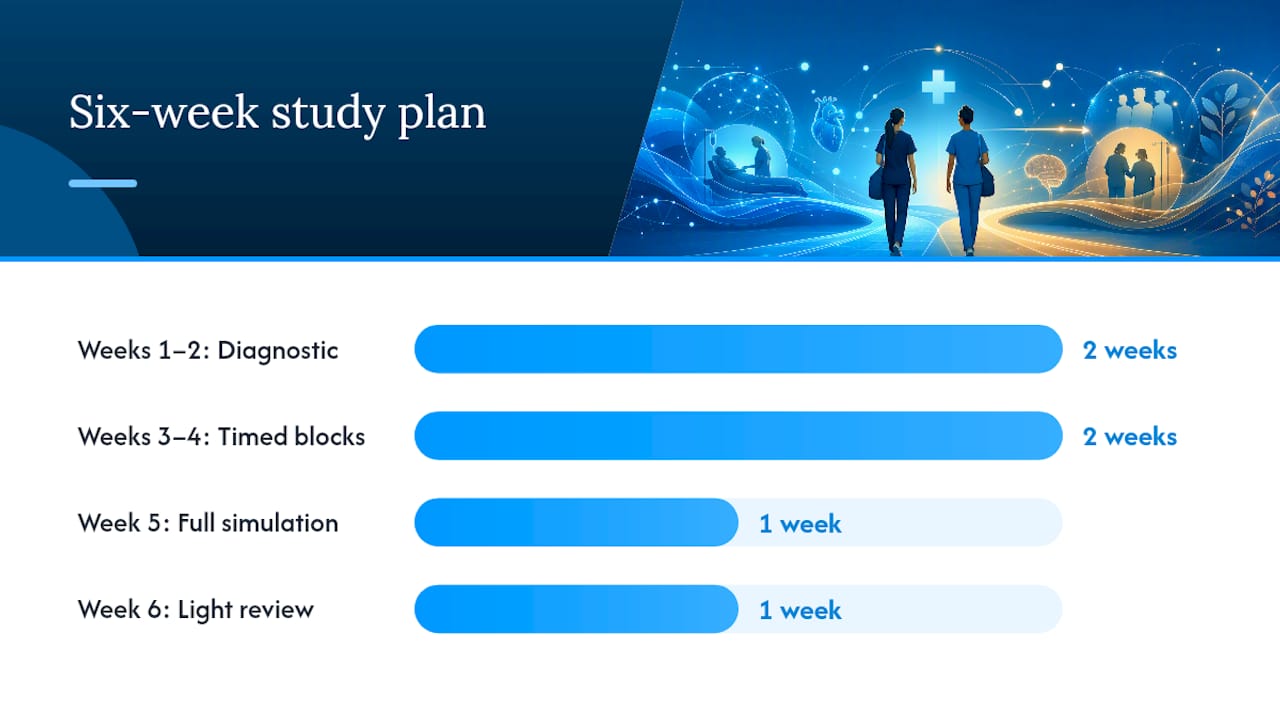
A basic six-week framework looks like this:
- Weeks 1 to 2: Diagnostic practice set to identify weak categories, then targeted review of foundational content in those areas.
- Weeks 3 to 4: Daily timed blocks (60 to 90 questions) mixing your weak areas with high-yield topics, gradually increasing NGN-style item exposure.
- Week 5: Full-length timed simulations that mirror the CAT format, focused on pacing under the five hour structure.
- Week 6: Light review only, targeting your remaining weak spots, plus final logistics: confirm your test date, ID requirements, and testing center location.
On registration and retakes: expect a fee around $200 plus your state board's application fee, and know your board's specific waiting period before you can retake if needed, since this varies by state.
Pro Tip: Adaptive question banks that mimic CAT difficulty scaling teach you something static question lists can't: how to read a hard question, commit to an answer, and move on without second-guessing your pacing.
For RN candidates specifically, a realistic NGN-style practice test under timed conditions exposes gaps that untimed review never will.
What Nurses at RecallOS See Candidates Miss
Delegation errors and rushed clinical-judgment items sink more candidates than raw content gaps. Daily, focused practice with real weak-area review, not marathon cram sessions, cuts retake rates. RecallOS's blog covers NGN-ready practice strategies built around this exact problem.
— Caleb
Turning This Into a Daily Practice Habit
Knowing the difference between these two exams doesn't move your score. Daily, targeted repetition does. This study tool was designed to help close the gap between "I studied a lot" and "I practiced the right things."

The Daily Recall Run delivers high-yield questions mapped to real exam blueprints instead of random trivia, so every session directly targets what actually shows up on test day. Upload your own class notes and RecallOS turns them into custom flashcards, quizzes, and summaries tuned to your program's content, whether that's an RN-track pharmacology unit or a PN fundamentals course. The platform tracks weak areas automatically and resurfaces them until they stop being weak areas, with streaks and peer challenges to keep daily practice from feeling like a chore.
If you want to see how it fits your current study plan, upload your notes and try a session, or check out the Recall+ and Recall Pro plans to see what daily NGN-ready practice looks like for your specific exam track.
Where to Verify These Numbers Yourself
For official test plan content and exam mechanics, start with NCSBN's NCLEX fact sheet and nurse licensure statistics. Pass-rate context and 2026 changes are covered in Kaplan's pass-rate breakdown.
Sources
FAQ
Is the NCLEX-PN Easier Than the NCLEX-RN?
The content overlaps, but NCLEX-PN generally demands less independent clinical judgment and more procedural accuracy under supervision. NCLEX-RN requires synthesizing complex patient data and making delegation decisions, which most candidates find cognitively harder regardless of pass-rate comparisons.
Is NCLEX-PN the Same Exam as NCLEX-RN?
No. They're separate exams with different question pools, though both use computerized adaptive testing and share the same five hour time limit and 85 to 150 item range. NCLEX-RN licenses registered nurses; NCLEX-PN licenses practical or vocational nurses.
Which Is Better, PN or RN?
Neither is objectively better since they lead to different careers with different scopes of practice. Your nursing program determines your eligible exam, and your career goals (direct patient care under supervision versus care coordination and leadership) should guide which path you pursue if you're choosing a program.
What Can an RN Do That an LPN Cannot?
RNs can independently assess complex patients, develop care plans, delegate tasks to LPNs and aides, and administer IV medications and certain critical-care interventions in most states. LPNs work under RN or physician supervision and generally cannot perform independent complex assessments or supervise other licensed staff. Scope specifics vary by state board, so confirm your state's practice act for exact boundaries.
How Do I Know Which NCLEX to Prepare For?
Your enrolled program decides this: an ADN or BSN program qualifies you for NCLEX-RN, while a practical nursing program qualifies you for NCLEX-PN. Tools like RecallOS's NCLEX study app adjust practice content once you confirm which track you're on, so daily questions match your actual exam blueprint.