
The fastest way to lock in pharmacology is a mechanism-first system: pair spaced repetition (SRS) with active recall, chunk drugs by class before touching individual names, and use targeted mnemonics only for the confusable sets that actually trip you up on exams. That combination covers how memory works, how pharmacology is structured, and how NCLEX and Step-style questions are written.
Copy this checklist into your study app today:
- Build one prototype flashcard per drug class (mechanism, top 3 indications, top 3 adverse effects)
- Load those cards into an SRS app and commit to a 15-minute daily mixed set
- Create one memory-palace route for your highest-confusability group (e.g., aminoglycosides vs. macrolides)
- Convert every missed practice question into a reverse card within 10 minutes
- Run a weekly "forensic review" of your weakest-tagged cards before adding new content
Everything below unpacks each step with templates you can use immediately.
Key Takeaways
The most effective pharmacology memorization system pairs spaced repetition and active recall with class-based chunking, mechanism-linked mnemonics, and daily clinical scenario practice.
| Point | Details |
|---|---|
| Start with drug classes | Learn the prototype drug and class schema before memorizing individual drug names. |
| SRS is non-negotiable | Review cards at days 0, 1, 3, 7, 15, and 30; convert every missed question into a reverse card within 10 minutes. |
| Mnemonics need mechanism | Tie every mnemonic to a physiologic fact; pure wordplay collapses under exam stress. |
| Prioritize high-yield anchors | Focus on the 80 or fewer drugs that appear repeatedly on your exam blueprint; skip low-yield brand-name trivia until after exams. |
| Recallos automates the system | Upload your notes, get adaptive daily sets, and track weak-card queues without manual scheduling. |
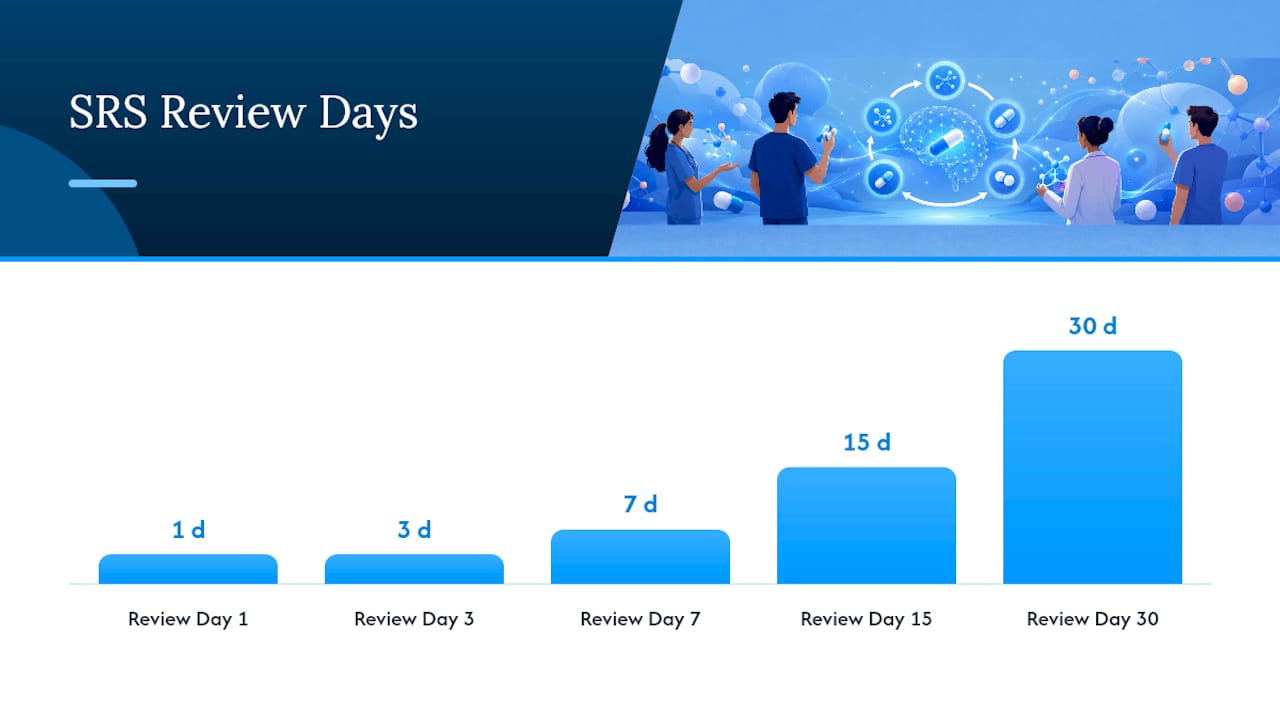
Table of Contents
- Why pharmacology memorization techniques work differently than other subjects
- How to build an SRS workflow that actually sticks
- Why learning by drug class beats memorizing individual drugs
- How to build memory palaces and mnemonics that survive exam stress
- A drug-card template you can copy for every new drug
- How clinical scenarios and dosing drills make recall usable
- A simple weekly study plan you can copy right now
- One-week workflow with Recallos: how adaptive spacing automates the hard parts
- Quick tricks for remembering doses, interactions, and the 10 R's
- What actually separates students who retain pharmacology from those who don't
- Recallos: daily adaptive practice built for healthcare exam prep
- Sources
Why pharmacology memorization techniques work differently than other subjects
Most subjects reward understanding. Pharmacology demands both: you need to understand mechanisms AND hold dozens of discrete facts in retrievable form under timed exam pressure. That dual demand is why generic study advice falls short here.
Think of pharmacology memory in three layers. The first is class and suffix patterns: "-olol" means beta-blocker, "-pril" means ACE inhibitor, "-statin" means HMG-CoA reductase inhibitor. These patterns are free retrieval cues once you know them. The second layer is mechanism and physiologic effect: how the drug acts, what receptor or enzyme it hits, and what downstream changes follow. The third layer is the clinical details: indications, monitoring parameters, and the rare but high-risk adverse effects that appear on every exam.
Most students try to memorize layer three before they own layers one and two. That is the mistake. Studying drug classifications is more effective than memorizing isolated drug names because drugs in a class share mechanisms, effects, and common adverse events. Once you know the class, you already know much of what any individual member does.
High-yield items worth memorizing:
- Prototype drugs for each major class (lisinopril for ACE inhibitors, metoprolol for selective beta-blockers)
- Common dosing ranges for high-frequency drugs (e.g., standard adult doses for metformin, lisinopril, furosemide)
- Major drug interactions (warfarin + NSAIDs, SSRIs + MAOIs, aminoglycosides + loop diuretics)
- Black-box warnings that appear repeatedly in NCLEX-style items
- Suffix patterns that identify class membership on sight
Low-yield items to skip until after exams:
- Brand-name trivia for drugs with no generic equivalent on your exam blueprint
- Exact molecular weights or pharmacokinetic constants not tied to a clinical decision
- Rare drugs with one narrow indication that never appear in practice question banks
Active learning methods including self-testing, teaching concepts aloud, and clinical case analysis show consistent benefits for retention and clinical transfer. Passive re-reading does not. The rest of this guide is built entirely around active methods.
How to build an SRS workflow that actually sticks
SRS plus active recall is the backbone of durable drug memory. The reason is straightforward: Hermann Ebbinghaus's forgetting curve shows that memory decays predictably unless you retrieve it at expanding intervals. SRS exploits that curve by scheduling each card just before you would forget it, which makes each retrieval harder and therefore more consolidating.
Building your deck
Start atomic. One card, one decision fact. "What is the mechanism of furosemide?" belongs on one card. "What are the top three adverse effects of furosemide?" belongs on a separate card. Stacking five facts on one card feels efficient but produces shallow encoding.
Build both forward and reverse cards. Forward: "Drug → mechanism." Reverse: "Mechanism → drug name." Reverse cards are what exam questions actually test. Tag every card with at least three labels: body system (cardiovascular, renal), mechanism type (loop diuretic, beta-blocker), and toxicity flag (nephrotoxic, ototoxic, hepatotoxic). Those tags let you pull focused review sets when you need to drill a weak area.
Flashcards should be atomic, sourced, and reviewed with a spacing cadence; short, honest closed-book sessions plus immediate correction of missed cards produce better long-term retention than passive re-reading.
SRS review schedule for pharmacology
| Day after first study | Review action |
|---|---|
| Day 0 | Learn card, self-test once immediately |
| Day 1 | First spaced review (short session) |
| Day 3 | Second review; flag any misses for extra repetition |
| Day 7 | Third review; add reverse cards for any missed items |
| Day 15 | Fourth review; interleave with a different drug class |
| Day 30 | Fifth review; merge into weekly mixed set |
Flashcard best practices:
- Limit each card to 1–2 decision facts
- Add a simple diagram or receptor schematic when the mechanism is spatial (e.g., loop of Henle for furosemide). Dual coding, combining verbal labels with images, can improve recall by roughly 40% in cognitive studies
- Write the source (textbook chapter, lecture slide) on every card so you can verify a fact you doubt
- Never add a new card until you can retrieve the previous day's cards without hints
Pro Tip: Convert every missed practice question into a reverse card within 5–10 minutes of finishing the question block. The emotional sting of a wrong answer is a retrieval cue in itself. Use it.
Why learning by drug class beats memorizing individual drugs
Chunking by class is faster and more durable than memorizing isolated drug names because your brain stores new information by attaching it to existing schemas. When you know the ACE inhibitor class schema, every new "-pril" drug slots in almost automatically. Without the schema, each drug is an isolated fact competing for space with hundreds of others.
Anchor drugs act as schemas that speed learning for an entire class. Start with the prototype, master it completely, then add contrastive variants that differ on one or two discriminators.
How to build a class map
- Choose the prototype drug for the class (e.g., lisinopril for ACE inhibitors)
- Write the mechanism in one sentence: "Inhibits ACE, preventing conversion of angiotensin I to angiotensin II, reducing vasoconstriction and aldosterone release"
- List the top three indications: hypertension, heart failure with reduced ejection fraction, diabetic nephropathy
- List the top three adverse effects: dry cough (bradykinin accumulation), hyperkalemia, angioedema
- Note the major interaction: potassium-sparing diuretics + ACE inhibitors = dangerous hyperkalemia
- Add one discriminator per variant: enalapril requires hepatic activation (prodrug); captopril has the shortest half-life
Describe that map in a short paragraph in your notes, then convert each row into a flashcard. The prose version builds the schema; the cards drill the retrieval.
Three chunked groups with their key discriminators:
- ACE inhibitors (-pril): Shared cough and angioedema risk; discriminator is prodrug status (enalapril yes, lisinopril no)
- Beta-blockers (-olol): Selective (metoprolol, atenolol) vs. non-selective (propranolol, carvedilol); discriminator is beta-1 selectivity and whether the drug also blocks alpha receptors
- Loop diuretics: Furosemide is the prototype; torsemide has better oral bioavailability; both are ototoxic, especially when combined with aminoglycosides
Concept maps work best when you draw the mechanism chain: drug → receptor/enzyme → physiologic effect → clinical indication → adverse effect. That chain is exactly what NCLEX-style questions test, and having it encoded as a visual sequence means you can reconstruct it under pressure.
How to build memory palaces and mnemonics that survive exam stress
Memory palaces and mechanism-linked mnemonics work when anchored to physiology and reinforced with retrieval practice. A mnemonic that connects only to a word sound collapses under exam stress because there is nothing structural holding it up. Tie it to what the drug actually does and it becomes self-reinforcing.

Mnemonics work best when tied to mechanism and reinforced by spaced retrieval; isolated wordplay that doesn't connect to physiology often fails under exam pressure.
Memory palace walkthrough: aminoglycosides vs. macrolides vs. tetracyclines
These three antibiotic classes confuse students because they all inhibit bacterial protein synthesis but at different ribosomal subunits with different toxicity profiles. A memory palace locks in the distinctions.
- Choose a familiar route. Use your childhood home: front door, living room, kitchen, bathroom, bedroom.
- Assign each class to a station. Aminoglycosides at the front door, macrolides in the living room, tetracyclines in the kitchen.
- Place a vivid physiologic image at each station. At the front door (aminoglycosides), picture a giant ear being crushed by a kidney — ototoxicity and nephrotoxicity. The image is absurd on purpose; absurdity encodes faster. The 30S ribosomal subunit is the door handle you grab to enter.
- In the living room (macrolides): a giant liver with a QT-interval heart monitor on the wall. Macrolides are CYP3A4 inhibitors and can prolong the QT interval. The 50S subunit is the couch.
- In the kitchen (tetracyclines): a child drinking milk next to a pregnant woman. Tetracyclines chelate divalent cations (calcium in dairy reduces absorption) and are contraindicated in pregnancy and children under 8. The 30S subunit is the kitchen table.
- Walk the route daily for one week. Each walk is a retrieval event. After day 7, the images are permanent.
Memory palaces are particularly useful for confusable or high-stakes groups when combined with spaced repetition, and work best when each locus is tied to a physiologic cue rather than an arbitrary image.
Mnemonic examples tied to mechanism:
- ACE inhibitors → "CAPTOPRIL Cough": C = Cough (bradykinin), A = Angioedema, P = Potassium up (hyperkalemia). Each letter maps to a mechanism, not just a word.
- Loop diuretics → "OTOTOXIC LOOPS": The word "loop" itself cues ototoxicity. Pair it with the image of a hearing aid shaped like a loop of Henle.
- Aminoglycosides → "MEAN" toxicity: M = Muscle weakness (neuromuscular blockade), E = Ear (ototoxicity), A = Acute kidney injury, N = Narrow therapeutic index. Every letter is a mechanism-linked fact.
Dos and don'ts:
- Do tie every mnemonic to at least one physiologic fact
- Do use humor or vivid imagery; effective mnemonics engage multiple encoding pathways (semantic plus visual or emotional)
- Don't build a palace for every drug class; reserve it for high-confusability, high-stakes groups
- Don't use a mnemonic you didn't create yourself unless you can explain why each letter maps to the drug's actual pharmacology
- Do test the mnemonic the next day with the palace closed; if you can't retrieve it, rebuild with a stronger image
Use simple suffix mnemonics for everything else. Palaces are a precision tool, not a default.
A drug-card template you can copy for every new drug
Use a standard drug-card template for every drug or class you study. Consistency matters because your brain starts to recognize the template shape, which reduces the cognitive load of building each new card and makes retrieval more predictable.
Here is the template, followed by a filled example for furosemide:
| Field | Content |
|---|---|
| Drug name / suffix | Furosemide / loop diuretic (-semide) |
| Mechanism (1 line) | Inhibits Na-K-2Cl cotransporter in thick ascending loop of Henle |
| Top 3 indications | Edema (HF, cirrhosis, nephrotic syndrome), hypertension, hypercalcemia |
| Top 3 adverse effects | Hypokalemia, ototoxicity (especially IV/high dose), hypovolemia |
| Major interactions | Aminoglycosides (additive ototoxicity), digoxin (hypokalemia increases toxicity) |
| Dose range | 20–80 mg PO/IV daily (adult); titrate to response |
| Monitoring | BMP (K+, Cr, BUN), urine output, blood pressure, hearing |
| Nursing considerations | Give in AM to avoid nocturia; monitor for orthostatic hypotension |
| Source | Pharmacology lecture, Week 4 / Katzung Chapter 15 |
Build a forward card ("What does furosemide do?") and a reverse card ("Which drug inhibits the Na-K-2Cl cotransporter and causes ototoxicity?"). The reverse card is the one that shows up on exams.
For tagging, use four labels: system (renal/cardiovascular), mechanism (loop diuretic), toxicity flag (ototoxic, hypokalemia), and exam frequency (high-yield). Those tags let you pull a "high-yield + ototoxic" set the week before your exam and drill exactly the contrast pairs that trip students up.
For NCLEX-RN flashcard design, keeping cards atomic and including an explicit source line on every card means you can verify any fact you doubt without hunting through notes.
Pro Tip: Add a small receptor diagram or mechanism sketch to the back of every mechanism card. Dual coding, pairing a verbal label with a simple image, strengthens encoding and gives you a second retrieval path when the verbal one stalls under pressure.
How clinical scenarios and dosing drills make recall usable
Flashcards build recognition. Clinical vignettes build application. Combining SRS with short, timed clinical scenarios makes recall usable under exam conditions, which is the actual goal. Integrating practice questions, case-based vignettes, and calculation drills moves students from recognition to application.
Example micro-case: A 68-year-old patient with heart failure and CKD stage 3 is started on lisinopril. Three days later, potassium is 5.8 mEq/L. What do you do?
Work through it with these retrieval prompts in order:
- What class is lisinopril, and what does it do to potassium? (ACE inhibitor → blocks aldosterone → potassium rises)
- What is the dangerous threshold for hyperkalemia, and what cardiac effects does it cause?
- Does CKD change the risk? (Yes: reduced renal potassium excretion amplifies the effect)
- What is the nursing action? (Hold the drug, notify the provider, prepare for possible dose reduction or switch to ARB)
That sequence mirrors exactly how NCLEX-style questions are structured. Practice it until the chain runs automatically.
Sample dosing drill: A patient weighing 70 kg needs IV gentamicin dosed at 5 mg/kg/day in three divided doses.
- Step 1: Total daily dose = 70 × 5 = 350 mg
- Step 2: Per-dose amount = 350 ÷ 3 = 116.7 mg, rounded to 117 mg
- Step 3: Common pitfall: forgetting to check renal function before dosing an aminoglycoside. Always verify creatinine clearance first.
Safe-practice checklist for every clinical scenario:
- Verify the indication (is this drug appropriate for this diagnosis?)
- Check renal and hepatic function (does the dose need adjustment?)
- Confirm major interactions (is the patient on anything that amplifies toxicity?)
- Identify the monitoring parameter (what lab or sign tells you the drug is working or causing harm?)
- Note patient teaching points (what does the patient need to know before discharge?)
Active learning through clinical case analysis consistently outperforms passive review for retention and clinical transfer. Run at least two micro-cases per study session.
A simple weekly study plan you can copy right now
A short, repeatable weekly plan beats ad hoc cramming because it distributes retrieval events across the forgetting curve and prevents the last-minute overload that tanks exam performance. A simple, reproducible cadence of short daily mixed sets plus scheduled longer reviews outperforms irregular long sessions.
For TEAS and HESI exam prep, the same daily-session structure applies: short focused blocks beat marathon sessions every time.
| Day | New drugs | SRS review | Question block | Notes |
|---|---|---|---|---|
| Monday | 3–5 new cards | 15 min mixed deck | 10 questions, one system | Tag all misses |
| Tuesday | 3–5 new cards | 15 min mixed deck | 10 questions, same system | Convert misses to reverse cards |
| Wednesday | 0 new cards | 20 min interleaved (2 classes) | 15 questions, mixed systems | Interleaving day |
| Thursday | 3–5 new cards | 15 min mixed deck | 10 questions, new system | Add concept map for new class |
| Friday | 3–5 new cards | 15 min mixed deck | 10 questions, mixed | Weekly forensic review of weak tags |
| Saturday | 0 new cards | 30 min full deck review | 20-question timed block | Simulate exam pacing |
| Sunday | Rest or light review | Optional 10 min | Optional 5 questions | Protect recovery time |
Daily checklist (15–45 minutes total):
- Open SRS app, complete the day's due cards before adding anything new
- Run the question block immediately after cards while retrieval is warm
- Log every miss with a tag; do not skip this step
- Add new cards only after completing the review
Exam-week adjustments: Stop adding new content by Wednesday of exam week. Spend Thursday and Friday drilling your weakest-tagged sets and contrast pairs. Saturday is a full timed simulation. Sunday is rest. Trying to cram new drugs in the final 48 hours displaces well-encoded material and raises anxiety without improving scores.
One-week workflow with Recallos: how adaptive spacing automates the hard parts
An adaptive system reduces manual scheduling and surfaces weak cards faster than a static deck, because it tracks your error patterns and adjusts review frequency automatically rather than making you decide when to revisit a card.
Here is a one-week workflow you can replicate in Recallos, which is built specifically for nursing and healthcare exam prep:
- Day 1 (Sunday): Upload your pharmacology lecture notes or drug-class summary sheets. Recallos generates anchor cards for each class automatically. Review the generated cards, delete any duplicates, and add your source line to each.
- Day 2 (Monday): Complete the daily mixed set (Recallos serves a curated set of high-yield questions aligned to your exam blueprint). Flag every card you miss.
- Day 3 (Tuesday): The system surfaces your flagged cards as microcards in the next session. Work through them with the reverse-card prompt. Note the error-anatomy tag the system assigns (mechanism gap, dosing gap, interaction gap).
- Day 4 (Wednesday): Interleaving day. Recallos mixes two drug classes in the same session. This is where discrimination between similar classes gets encoded.
- Day 5 (Thursday): Add a new drug class. Use the drug-card template from Section 6 to build three to five new cards, then upload them. The adaptive scheduler slots them into your existing deck at the correct spacing interval.
- Day 6 (Friday): Weekly forensic review. Pull your weak-card queue (cards missed two or more times this week). Spend 20 minutes on those cards only. Check your streak and identify which error-anatomy tag appears most often.
- Day 7 (Saturday): Run a timed 20-question simulation block using Recallos's adaptive quiz examples. Review every wrong answer immediately and convert each to a microcard before closing the app.
Interface cues and metrics to watch:
- Weak-card queue length (should shrink week over week; if it grows, reduce new-card intake)
- Streak (a proxy for session consistency, not mastery; use it to protect the habit, not to judge knowledge)
- Error-anatomy tags (mechanism gaps need concept-map work; dosing gaps need calculation drills; interaction gaps need interleaved practice)
The adaptive scheduler handles the spacing math. Your job is to show up daily, complete the set honestly with the book closed, and convert every miss into a card before the session ends.
Quick tricks for remembering doses, interactions, and the 10 R's
Short, repeatable dose-memory techniques work because they reduce a continuous number to a pattern your brain already knows. Anchor ranges beat exact memorization for most drugs: furosemide starts at 20–40 mg and rarely exceeds 600 mg/day in severe edema; metformin starts at 500 mg and tops out at 2,550 mg/day.
Dose-memory tricks:
- Round to the nearest "clean" number and memorize the range, not a single value (lisinopril: 5–40 mg/day)
- Anchor to body weight for weight-based drugs (gentamicin: 5–7 mg/kg/day; vancomycin: 15–20 mg/kg/dose)
- Flag renally cleared drugs with a "renal flag" tag; the dose question almost always involves a patient with CKD
Interaction checklist (run before answering any interaction question):
- Is one drug a CYP3A4 inhibitor or inducer? (macrolides, azole antifungals = inhibitors; rifampin, carbamazepine = inducers)
- Does the combination affect potassium? (ACE inhibitors + potassium-sparing diuretics = hyperkalemia)
- Is there additive toxicity? (aminoglycosides + loop diuretics = additive ototoxicity and nephrotoxicity)
- Does one drug narrow the therapeutic window of another? (warfarin + NSAIDs, warfarin + amiodarone)
The 10 R's of pharmacology exam prep (a compact mnemonic checklist):
- Right drug (correct class and prototype)
- Right dose (range, weight-based, renal adjustment)
- Right route (oral, IV, topical, and bioavailability differences)
- Right time (half-life, dosing interval)
- Right patient (contraindications, pregnancy, age)
- Right indication (approved use vs. off-label)
- Right monitoring (lab, vital sign, symptom)
- Right interaction (CYP, additive toxicity, protein binding)
- Right adverse effect (mechanism-linked, not memorized in isolation)
- Right teaching (what the patient must know before discharge)
To convert any R into a flashcard: front = "What is the 'Right monitoring' parameter for digoxin?" Back = "Serum digoxin level (0.5–2 ng/mL), potassium (hypokalemia increases toxicity), heart rate, ECG for arrhythmia." Each card is atomic, mechanism-linked, and exam-ready.
What actually separates students who retain pharmacology from those who don't
Most students who struggle with pharmacology are not working harder than the ones who succeed. They are working in the wrong direction: re-reading notes, highlighting textbooks, and building massive decks they never review. The students who retain this material share one habit: they test themselves every single day, even when it is uncomfortable, and they treat every wrong answer as a diagnostic rather than a failure.
The evidence for this is not subtle. Mechanism-linked mnemonics plus spaced retrieval and dual coding are more durable under exam stress than isolated wordplay, and the cognitive literature on retrieval practice is consistent: the act of pulling a memory out of storage strengthens it more than any passive review method. What surprises most students is how short the daily sessions need to be. Fifteen minutes of honest closed-book retrieval beats two hours of passive reading, not because effort is bad but because passive review creates an illusion of knowing that collapses under exam conditions.
There is also a prioritization problem worth naming directly. Pharmacology has hundreds of drugs, and most exam blueprints test fewer than 80 of them repeatedly. Use a small set of high-yield anchors and deliberately ignore low-yield brand-name trivia until after exams. Students who try to memorize everything memorize nothing well. Pick your 80, own them completely, and let the rest come later.
The memory palace section of this guide gets the most skepticism from students who have never tried it. That skepticism is understandable but misplaced. The technique is not about creativity; it is about giving your brain a spatial retrieval path to a fact it would otherwise store as an isolated string. For aminoglycosides, macrolides, and tetracyclines, the palace takes about 20 minutes to build and about a week of daily walks to consolidate. After that, the distinctions are permanent. That is a better return than re-reading the antibiotic chapter four times.
One last thing: the teach-back method is underused in pharmacology study. After you build a class map, explain the mechanism to a study partner or even to yourself out loud. The gaps in your explanation are the gaps in your encoding. Find them before the exam does.
Recallos: daily adaptive practice built for healthcare exam prep
Pharmacology is one of the highest-stakes sections on the NCLEX, CRNA, and NP exams, and the methods in this guide only work if you actually execute them consistently. That is where most students stall: the system is sound, but building and maintaining a deck, scheduling reviews, and tracking weak areas manually takes time that compounds into missed sessions.

Recallos is built by practicing nurses and CRNAs specifically for this problem. Upload your pharmacology notes and Recallos generates high-yield flashcards, adaptive quizzes, and exam predictions aligned to your actual blueprint. The adaptive scheduler handles spacing automatically, surfaces your weakest cards before each session, and tracks your error patterns by category so you know whether you have a mechanism gap, a dosing gap, or an interaction gap. Streaks and peer challenges keep the daily habit intact when motivation dips.
Try Recallos free and turn your pharmacology notes into a working SRS deck today.
Sources
- Mnemonic Medicine: Evidence-Based Memory Systems for Step 1 Pharmacology — MDSteps
- Effective Pharmacology Study Strategies and AI Tools | Atlas | Atlas Blog
- How to Study Pharmacology in Nursing School - Quizgecko
- Memorizing Pharmacology — Neurako Learn
This article is general information, not a substitute for advice from a qualified doctor. Consult a qualified healthcare professional about your own circumstances before acting on anything here.