
Spaced practice with active retrieval beats cramming for anything you need to remember past tomorrow. Cramming can boost your score on an immediate test, but that knowledge decays fast, often within days. If you have more than a few days before an exam, spacing wins. If the test is tomorrow and you have nothing built up, cramming is still your best bad option.
TL;DR:
- Spaced practice with active retrieval significantly improves long-term retention compared to cramming, especially for material needed weeks or months ahead.
- The optimal review interval is about 10 to 20 percent of the total retention period, guiding how frequently to revisit learned material.
- Combining spacing with retrieval practice yields the greatest benefits, as this approach strengthens neural pathways and reduces reliance on short-term memory.
- Cramming may boost performance on immediate quizzes but fails to produce durable learning, making it ineffective for cumulative exams or technical skills.
- Consistent, brief study sessions and interleaving topics promote better memory consolidation than long, infrequent cramming sessions.
Table of Contents
- Retention Vs Cramming: What the Research Actually Shows
- Why Cramming Feels Effective but Fails Long Term
- How to Build a Spacing Schedule That Actually Works
- Evidence Snapshot: The Studies Behind the Advice
- The Brain-Level Difference Between Spacing and Cramming
- Common Myths About Cramming and Retention
- Where Spacing and Cramming Show Up Differently by Subject
- Motivation and Mindset Shape Which Method Actually Gets Used
- A Note on Making This Stick in Real Exam Prep
- Turning Spacing Theory Into a Daily Habit With RecallOS
- Sources
- FAQ
Retention Vs Cramming: What the Research Actually Shows
The spacing effect is one of the most replicated findings in memory research: information reviewed in separate sessions over time sticks better than the same material reviewed all at once. It works against a predictable enemy. Hermann Ebbinghaus mapped the forgetting curve over a century ago, showing that memory for new material drops sharply within the first day or two, then levels off. Spacing interrupts that decline by forcing your brain to retrieve information right as it starts slipping, which strengthens the memory trace each time.
The evidence for this isn't thin. A review of hundreds of studies found spacing generally improves delayed recall compared to massed practice, and earlier work by Donovan and Radosevich put the effect size at a moderate advantage that compounds over a semester of studying. That's not a marginal edge. It's the difference between remembering a drug classification on exam day and blanking on it.
Retrieval practice, better known as the testing effect, makes spacing even more powerful. Pulling information out of memory, rather than just rereading it, forces your brain to reconstruct the pathway to that fact, which is exactly what strengthens it. Combine the two and you get a compounding effect: space out your retrieval attempts and each one does more work than the last. The Dunlosky et al. review rated practice testing and distributed practice as the two highest-utility study techniques out of ten commonly used methods, while rereading and highlighting landed near the bottom. The strongest evidence shows up in vocabulary acquisition, factual recall, and math procedures, exactly the kind of high-volume, fact-dense material nursing and healthcare students face every week.
Why Cramming Feels Effective but Fails Long Term
Cramming works if your only goal is tomorrow's quiz. It fails almost every other goal, and the reason comes down to a distinction memory researcher Robert Bjork calls learning versus performance. Performance is what you can produce right now, under the current conditions. Learning is what survives once those conditions change, once time passes, stress drops, and the material stops being fresh.
Massed practice, cramming's technical name, inflates performance without building learning. Your brain feels fluent because the information is still sitting in short-term working memory, not because it's been encoded for later retrieval. That fluency is a trap. It convinces you that you know the material when you've really just rehearsed it once, hard.
Experiments back this up directly. In studies comparing massed and spaced study, cramming sometimes edged out spacing on an immediate test, but spaced learners recalled substantially more of the material a week later. That gap only widens the longer the delay.
The honest takeaway: cramming is a legitimate tactic only when you genuinely won't need the information again, a one-off quiz on niche content you'll never touch after the final. For anything cumulative, licensing exams, board reviews, skills you'll use on the job, it's the wrong tool.
How to Build a Spacing Schedule That Actually Works
Spacing only helps if the gaps between reviews are the right size. Too short and you're basically cramming with extra steps. Too long and you've forgotten too much to retrieve anything, which wastes the session. Researchers have converged on a useful shortcut for this.
The 10 to 20% rule: space your review sessions to roughly 10 to 20 percent of how long you need to remember the material. If your exam is one week away, review again about one day after first learning something. For a test further in the future, reviews separated by several days are recommended. This heuristic comes from the same body of spacing research that established the effect in the first place, and it scales: longer retention goals get longer, progressively widening gaps between sessions.
A practical weekly routine looks like this:
- Three to four sessions per week, each 15 to 30 minutes, never longer. Short sessions done consistently beat long sessions done rarely.
- Interleave related topics instead of studying one subject in a block. Mixing cardiac and respiratory pharmacology in the same session, for example, forces your brain to actively discriminate between concepts instead of coasting on pattern recognition.
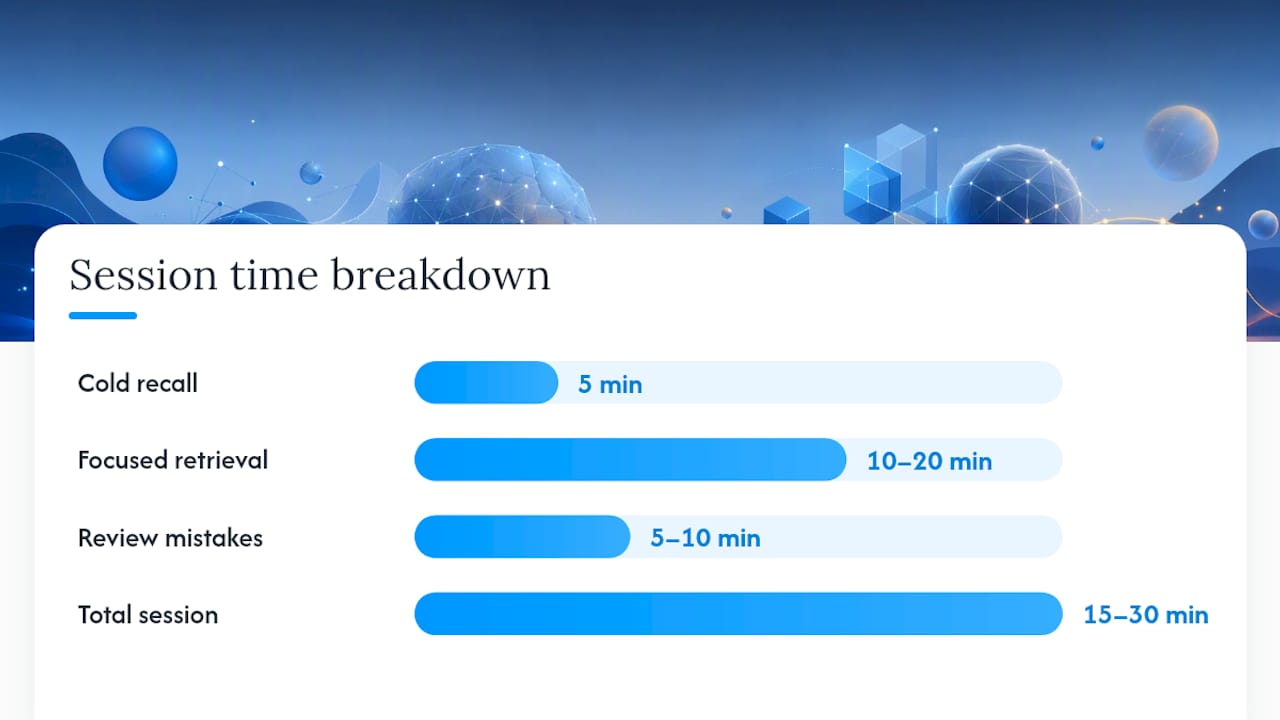
- Structure each session in three parts: five minutes of cold recall before you look at anything (write down what you remember first), 10 to 20 minutes of focused retrieval practice using questions or flashcards, then 5 to 10 minutes reviewing what you got wrong.
- Track what you missed and feed it back into your next session's rotation, rather than starting fresh each time.
Pro Tip: Do your cold recall step before opening any notes, even if you're sure you'll fail it. The struggle to remember, even unsuccessfully, primes your brain to absorb the correction better than passive rereading ever will.
If you're genuinely down to the wire with less than 24 hours, don't abandon structure entirely. Prioritize practice questions over passive review, focus on high-yield facts you're likely to be tested on, try teaching the material out loud to an imaginary student, and protect at least some sleep. Sleep-deprived cramming underperforms even mediocre spaced study.
For a longer runway, a structured multi-week study plan gives you a template to build these sessions around instead of guessing at your own schedule.
Evidence Snapshot: The Studies Behind the Advice
The case for spacing over cramming isn't built on one study. It's built on decades of converging findings, and the numbers are specific enough to act on.
| Study | What it found |
|---|---|
| Cepeda et al. | Reviewed 254 studies; spacing improved delayed recall across nearly all of them |
| Donovan & Radosevich | Found a moderate effect size favoring spaced over massed practice |
| Dunlosky et al. | Ranked practice testing and distributed practice as the top two techniques out of ten reviewed |
| Roediger & Karpicke | Spaced learners recalled substantially more than massed learners one week later |
| PMC review | Confirmed spacing benefits hold across age groups and most content types |
The Scientific American summary of this research puts practice testing and distributed practice at the top of the technique hierarchy, above summarizing, highlighting, and rereading. Where the evidence gets murkier is complex transfer, applying a memorized principle to a brand new clinical scenario, and some interleaving contexts where the optimal mix of topics is still being worked out. For straightforward factual recall, though, the pattern holds up remarkably consistently across the literature.
The Brain-Level Difference Between Spacing and Cramming
Cramming and spaced practice don't just feel different. They engage memory differently at a mechanical level. Massed practice relies heavily on working memory, the brain's short-term holding pattern that can juggle a handful of items for a limited window before they fall out. That's why a crammed fact can feel rock solid an hour before the test and vanish completely two days later.
Spaced retrieval forces information through a different process: consolidation, where memories move from a fragile, easily disrupted state into a more stable one, largely during the gaps between study sessions and during sleep. Each time you successfully retrieve a spaced memory, you're not just confirming you know it. You're re-strengthening the neural pathway that stores it, which is part of why spacing rules connect to basic biological mechanisms of memory rather than being a pure study trick.
This is also why cramming produces a specific, recognizable failure mode: recognition without recall. You'll read an old crammed fact on a later exam and feel a flicker of familiarity, but you can't produce it unprompted. That flicker is working memory residue, not a durable memory. Spaced retrieval avoids this because it trains the actual retrieval pathway repeatedly, under conditions that mimic the eventual test more closely than one long rereading session ever could.
Common Myths About Cramming and Retention
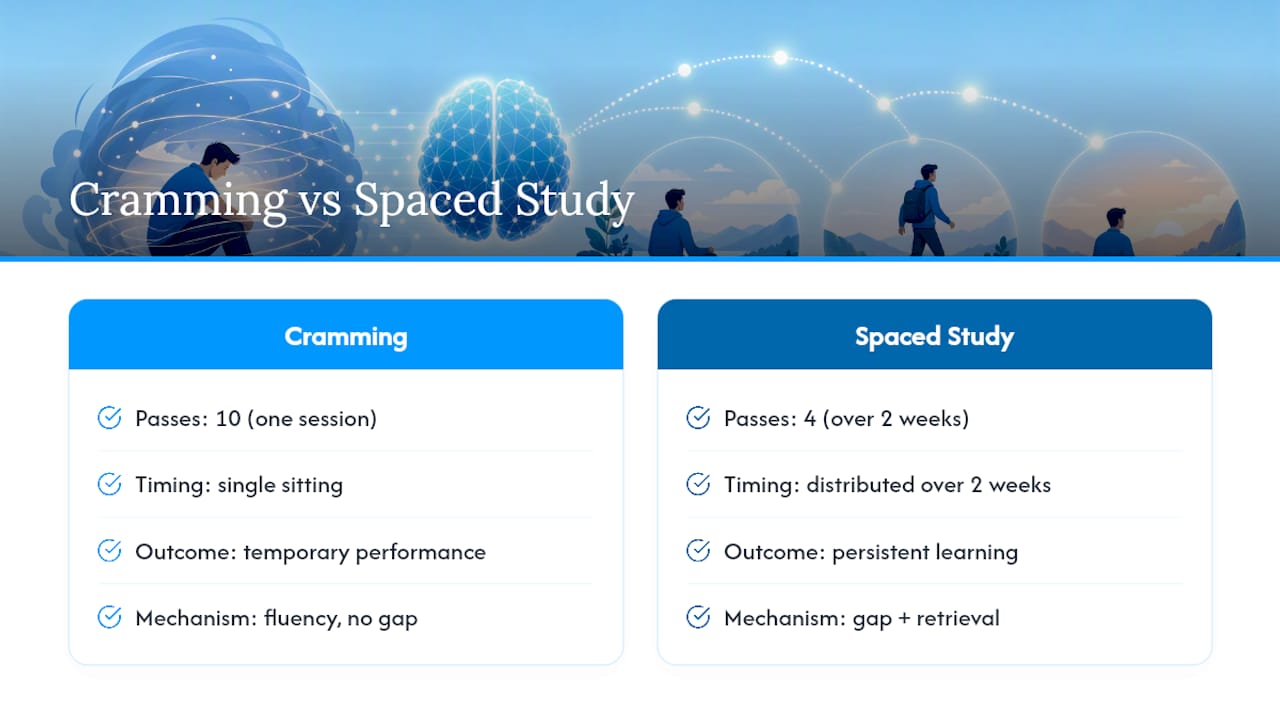
The biggest myth is that cramming and studying are just different intensities of the same activity. They're not. Cramming produces performance, a temporary boost you can access under specific, forgiving conditions. Studying with spacing produces learning, a change that persists once those conditions disappear. Treating them as interchangeable is why so many students overestimate how much they actually know going into an exam.
A second myth: rereading counts as studying. It doesn't, at least not efficiently. Rereading creates fluency, the comfortable feeling that material is familiar, and that feeling gets mistaken for mastery. The Dunlosky review rated rereading near the bottom of ten techniques precisely because familiarity and retrieval strength aren't the same thing.
A third myth: if spacing works, more repetition must work even better, so cramming twice as hard should close the gap. It doesn't close the gap, because the problem with cramming isn't quantity of exposure, it's the missing gap between exposures. Ten passes through your notes in one sitting will always underperform four passes spread across two weeks, even though the total study time is nearly identical.
Finally, students often assume spacing requires elaborate planning or special software to work. A basic calendar and a stack of flashcards executed consistently will beat an unused fancy schedule every time. The mechanism that matters is the gap and the retrieval attempt, not the tool tracking it.
Where Spacing and Cramming Show Up Differently by Subject
Spacing's advantage isn't uniform across every kind of learning, and knowing where it matters most helps you allocate effort correctly.
For language learning, spaced vocabulary review is close to non-negotiable. Vocabulary is pure fact storage with no procedural shortcut, and flashcard experiments found spacing out cards produced better retention than cramming for the large majority of participants tested.
For exam prep in fact-heavy fields like nursing, pharmacology, or physiology, the case is nearly identical. You're accumulating hundreds of discrete facts, drug interactions, lab values, disease markers, that need to be retrievable months later on boards, not just next Tuesday. A study strategy built around retrieval practice tends to outperform marathon review sessions for exactly this reason.
Skill acquisition, like clinical procedures or physical techniques, benefits from spacing too, but it layers retrieval on top of repetition-with-feedback rather than replacing it. You still need reps, but distributing those reps across days, rather than doing them all in one afternoon, builds motor and procedural memory that survives longer breaks between practice.
Where cramming holds up best is narrow, low-stakes, one-time recall, a pop quiz on a reading you'll never revisit. Even there, the gains are borrowed against forgetting you'll pay for later if the material resurfaces on a cumulative final.
Motivation and Mindset Shape Which Method Actually Gets Used
Knowing spacing works and actually doing it are two different problems, and motivation is usually the gap between them. Cramming is seductive because it matches how anxiety behaves: the closer the deadline, the more urgent the motivation feels, and cramming is the response that matches that urgency in real time. Spacing asks for the opposite, steady effort weeks before urgency kicks in, which is a much harder sell to a brain wired for immediate threats.
Students who treat studying as a fixed, dreaded event tend to gravitate toward cramming because it compresses the suffering into one bad night instead of spreading it out. Students who treat studying as a short daily habit, closer to brushing your teeth than to writing a term paper, adopt spacing more naturally because the individual sessions feel low stakes. The mindset shift that helps most isn't about discipline. It's about resizing the task, 15 minutes a day feels achievable in a way that 3 hours the night before does not, even though the smaller version produces better results.
Confidence also plays a role here, though not the way most students expect. The fluency cramming produces creates false confidence right before a test. Retrieval practice, by contrast, often feels harder in the moment, because you're forced to notice what you don't know, which can dent confidence even as it builds real competence. Recognizing that discomfort as a sign of learning, rather than a sign of falling behind, is part of what makes spacing sustainable.
A Note on Making This Stick in Real Exam Prep
The research is consistent enough that the real challenge isn't believing spacing works, it's building the habit. Start with one subject and one small daily block before trying to overhaul your entire study routine. Consistency over four or five months matters more than any single perfect week, and the compounding effect of daily retrieval practice is what separates students who retain material into their boards from those who relearn it every rotation.
— Caleb
Turning Spacing Theory Into a Daily Habit With RecallOS
RecallOS is built around the exact mechanism this article just walked through: short, spaced, retrieval-heavy sessions instead of marathon rereading. It automates the scheduling piece that trips most students up, adjusting when material resurfaces based on how well you actually answered it last time, so the gaps described in the 10 to 20% rule happen without you tracking a calendar manually.

The daily practice sets pull from relevant nursing and healthcare exam blueprints rather than random trivia, and personalized review surfaces your weak areas automatically instead of making you guess what to revisit. Streaks and peer challenges encourage consistency, supporting the habit of daily study sessions which spacing depends on and motivation alone often can't sustain. If you're deciding between another cram session and something that runs the spacing schedule for you, start your first Recall Run and see how a short daily set compares to your usual routine.
This article is general information, not a substitute for advice from a qualified doctor. Consult a qualified healthcare professional about your own circumstances before acting on anything here.
Sources
- Distribution of practice and related meta-analyses (PMC review)
- Improving Students’ Learning With Effective Learning Techniques: Dunlosky et al. (2013)
- Roediger & Karpicke / related retrieval practice experiments (PubMed reference)
- Psychologists identify the best ways to study — Scientific American
FAQ
Why is cramming the worst way to study?
Cramming relies on working memory and surface fluency rather than durable consolidation, so it can boost immediate test performance but produces recall that fades within days, especially for cumulative exams.
How can I retain most of what I learn?
Combine spaced review sessions, roughly 10 to 20% of your target retention interval apart, with active retrieval practice instead of rereading; testing yourself repeatedly over time is what the strongest evidence points to.
What is the 10 to 20 percent spacing rule?
It's a scheduling heuristic where your first review happens at roughly 10 to 20 percent of how long you need to remember something, so a one-week goal gets a review around one day later, and a one-month goal gets reviews every few days.
Why is spaced practice better than cramming?
Spacing forces repeated retrieval right as memories start to fade, which strengthens the retrieval pathway each time, while cramming produces one dense exposure that decays quickly once working memory clears.
Does spacing work for skill practice or only facts?
Spacing shows its strongest, most consistent effects in factual and vocabulary learning, but it also improves retention of procedural skills when distributed practice is combined with feedback rather than pure repetition.