
Consistent high scores on a validated predictor test, combined with stable or rising accuracy across every content domain, are the two signals that actually mean you're ready. Everything else, including hours logged, is noise. Here's a routine you can start today:
- Daily: work a short block of practice questions, read every rationale (right or wrong answers), and log your three weakest topics.
- Weekly: run a spaced readiness assessment, update your domain trendlines, and fix one recurring weak spot before moving on.
Students who reach proficiency across the ATI Content Mastery Series see pass probabilities rise to roughly 97 to 98 percent. That single data point should reshape how you think about studying: it's not about how long you sit with your notes, it's about whether your numbers are climbing and staying up.
Key Takeaways
Exam readiness is measurable: consistent high predictor scores combined with stable domain-level accuracy predict passing far better than hours studied.
| Point | Details |
|---|---|
| Track consistency, not single scores | Look for three to four consecutive "high" predictor outcomes before trusting your readiness. |
| Break accuracy down by domain | Overall percent correct hides weak content areas; trendlines per domain reveal the real picture. |
| Log five fields daily | Question count, percent correct, top three weak topics, time, and one rationale note. |
| Space assessments deliberately | Start readiness checks at 60 to 70% question bank completion, spaced 3 to 5 days apart. |
| Use adaptive tools to close the loop | Recallos ranks weak areas automatically and resurfaces them on a spaced schedule tied to real exam blueprints. |
Table of Contents
- Which Metrics Actually Predict Passing?
- Build a Daily and Weekly Tracking Routine
- How Do You Interpret Predictor Scores and Readiness Reports?
- Turning Tracked Data Into Targeted Review With Adaptive Tools
- What to Do When a Weak Area Won't Budge
- What Students Get Wrong About Feeling Ready
- Get Started With Recallos for Exam-Ready Tracking
- Sources
Which Metrics Actually Predict Passing?
Time spent studying tells you nothing about whether you'd pass tomorrow. Four metrics do.
Predictor consistency matters more than any single score. One high result on a readiness exam could be luck, an easy question set, or a good day. Four consecutive "high" outcomes on a validated predictor is a genuinely different signal, and it's the strongest external indicator of NCLEX success available to candidates.
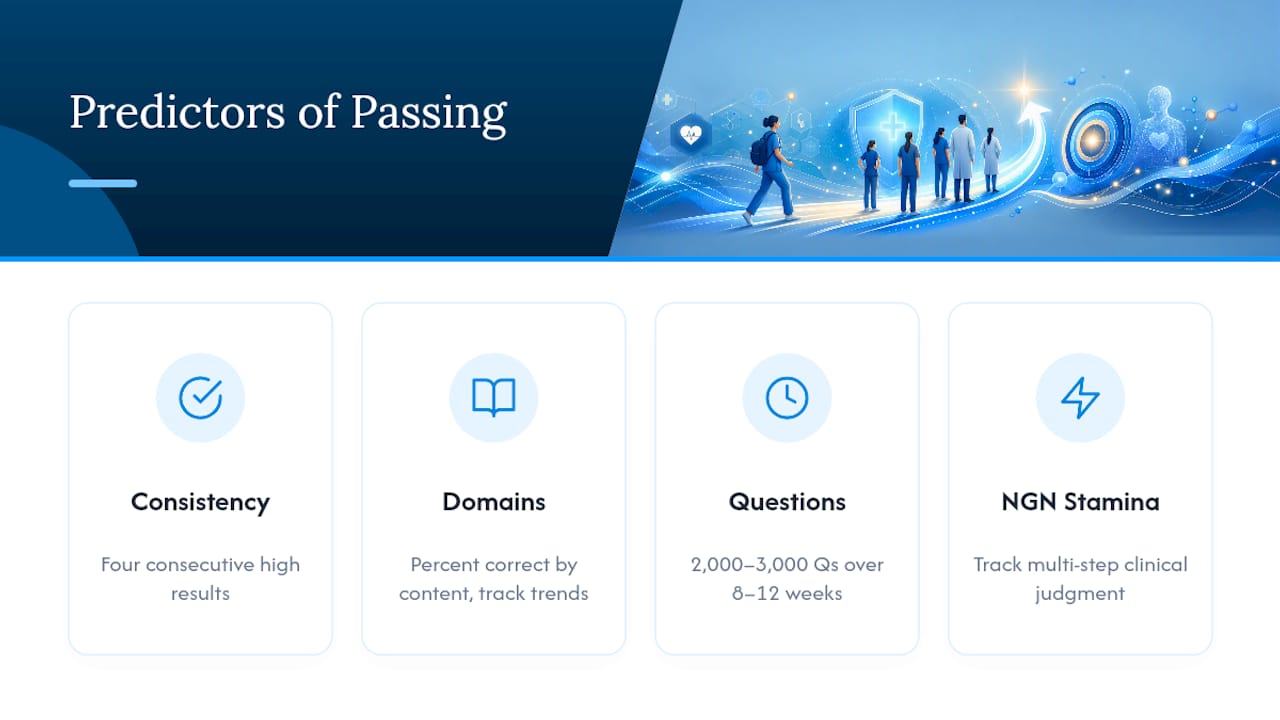
Domain mastery is your percent correct broken out by content area, tracked over time. A single overall score of 78% can hide a student who's excellent at pharmacology and dangerously weak in prioritization. Watch the trendline in each domain, not just the average.
Question volume and spacing matter too. Guidance built from prep-platform data points to 2,000 to 3,000 practice questions over an 8 to 12 week window as the range associated with stronger outcomes, provided you're reviewing rationales rather than just clicking through.
NGN reasoning and stamina need separate tracking from basic recall. Next Generation NCLEX items test multi-step clinical judgment, and a student who's fast and accurate on single-answer questions can still stumble on a case study that requires sequencing four decisions correctly.
Build a Daily and Weekly Tracking Routine
You don't need a complicated system. You need five fields, logged honestly, every day you study.
- Number of questions answered.
- Percent correct, ideally split by domain if your tool allows it.
- Top three weak topics, named specifically (not "med surg," but "IV fluid calculations").
- Time spent, mostly as a sanity check, not a goal.
- One learning note from a rationale that surprised you.
Read every rationale, including the ones you got right. Guessing correctly on a concept you don't understand is a trap that predictor scores will eventually expose.
At the end of each week, build a short domain breakdown: which content areas moved up, which stayed flat, and which one gets your focused attention next. Pick exactly one remediation goal per week. Trying to fix five weak areas at once usually fixes none of them.
On spacing full readiness assessments, the guidance is specific. Start once you've completed 60 to 70 percent of your question bank, then space full-length checks 3 to 5 days apart so you're measuring retention, not memorization of the same test.
Pro Tip: If your predictor scores swing more than 10 to 15 points between attempts with no change in study habits, that volatility itself is data. It usually means your foundational knowledge in a domain is shaky rather than solid, even if your average looks fine.
If your scores are borderline or bouncing around instead of trending up, that's your cue to slow down and extend your prep window rather than push toward a test date.
How Do You Interpret Predictor Scores and Readiness Reports?
A predictor test estimates your probability of passing based on your performance against a validated question bank, calibrated against thousands of past candidates. One score is a data point. A pattern is a diagnosis.
The research on ATI's Content Mastery Series, drawn from nearly 10,000 PN and RN students, found that reaching proficiency across the series correlated with pass probabilities in the high 90s. That's the kind of evidence that should carry more weight in your scheduling decision than how confident you feel.
If you've already sat for a certification exam once, your Candidate Performance Report is a goldmine. It breaks performance into Above, Near, or Below Expected Competency by content category, and comparing reports across attempts, if you have more than one, shows you exactly where remediation closed a gap and where it didn't.
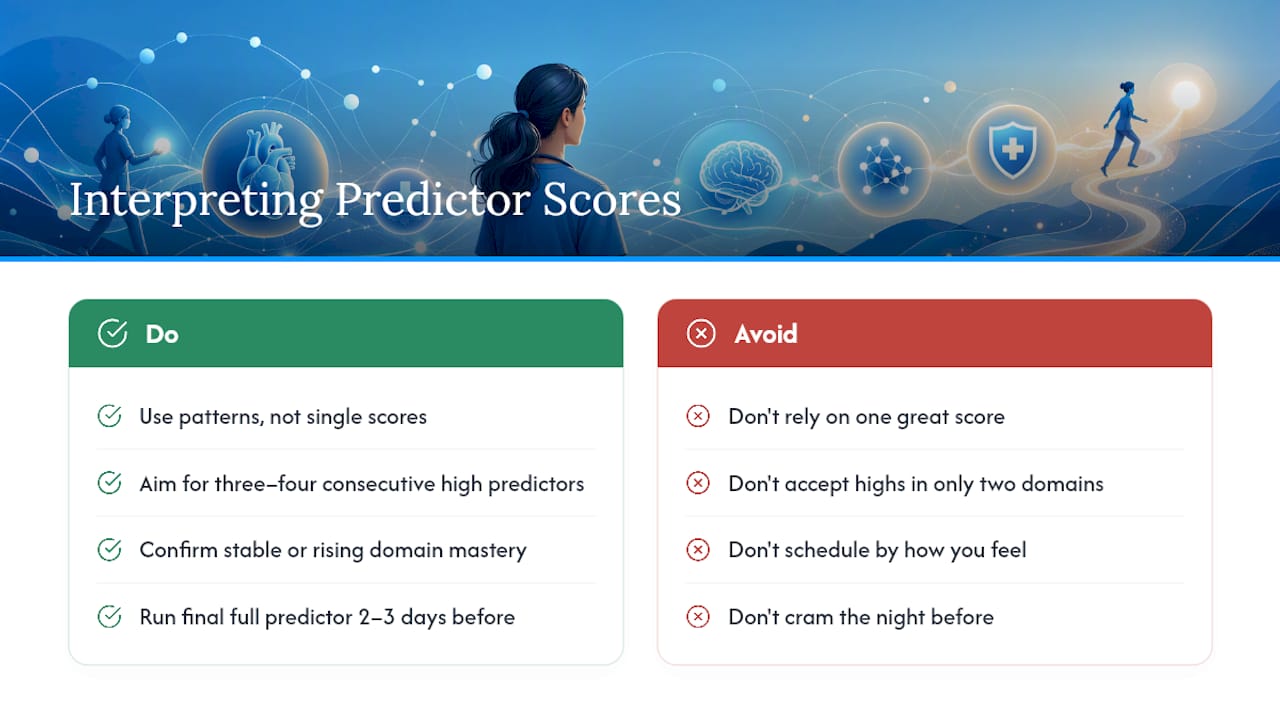
A workable rule of thumb: three to four consecutive "high" predictor outcomes, paired with stable or rising domain mastery across the board, is a reasonable readiness bar for scheduling. A single great score, or high scores in only two of six domains, isn't.
One scheduling detail people get wrong: run your final full predictor assessment 2 to 3 days before test day, not the night before. Then rest. Cramming the day before a certification exam tends to spike anxiety more than it adds knowledge.
Turning Tracked Data Into Targeted Review With Adaptive Tools
Raw numbers in a spreadsheet only help if something acts on them. Adaptive study platforms exist specifically to close that gap: they rank your weak topics by how far below target you're scoring and how long it's been since you last reviewed them, then resurface those questions on a spaced schedule instead of waiting for you to remember to revisit them yourself.
A few tool metrics are worth watching regardless of which platform you use:
- Weak-area completion percentage — how much of your identified gap you've actually worked through, not just flagged.
- Retention after spaced review — are you still getting a topic right three days later, or only right after seeing the rationale once?
- Streaks, which measure consistency of habit more than mastery, but consistency is still a real predictor of who finishes their prep.
Recallos was built by practicing nurses and CRNAs specifically to solve this problem: daily high-yield questions tied to real exam blueprints, personalized review that resurfaces your weak areas automatically, and structured plans that pace your question volume across a set number of weeks.
Consistency of habit and consistency of accuracy are different things, and a good tracking system has to measure both. A 30-day streak with flat domain scores tells you something very different than a 10-day streak with scores climbing every week.
Whatever tool you use, cross-check its internal analytics against an outside predictor periodically. A platform can tell you that you've mastered a topic inside its own question set; a validated predictor tells you whether that mastery generalizes.
What to Do When a Weak Area Won't Budge
Some topics resist the first two or three rounds of review. When that happens, don't just repeat the same study method louder.
- Diagnose precisely. Combine your predictor's domain breakdown with your own question analytics to name the actual gap. "Cardiac" is too broad; "calculating drip rates under time pressure" is specific enough to fix.
- Patch it in micro-sessions. Teach yourself the concept again, practice a small set of questions, then test yourself two days later. Spacing the review across days beats one long cram session for the same topic.
- Verify with a focused mini-assessment targeting only that concept, and log whether your accuracy actually improved.
- Change your approach if it's still stuck. Switching from passive review to worked examples, or trying different question-stem styles, often exposes a blind spot that repetition alone never would. If it plateaus past that, a tutor or structured remediation program is worth the investment.
Pro Tip: Confirm the fix before you move on. A later Candidate Performance Report or predictor result showing that domain back in "Above Expected" range is your proof, not just a gut feeling that it "clicked."
What Students Get Wrong About Feeling Ready
Most students overestimate readiness because confidence and competence aren't the same thing, and predictor tests exist precisely to catch that gap. The fix is boring but effective: log your rationale reviews honestly, even the ones that embarrass you, and let the trendline argue with your gut. Schedule off the data, not the feeling.
Get Started With Recallos for Exam-Ready Tracking
Recallos turns everything in this guide into something you can act on daily instead of reconstructing it yourself in a spreadsheet. It tracks weak-area diagnostics automatically, rewards consistency with streaks, and serves high-yield questions built around real exam blueprints instead of random trivia. Structured 4, 8, and 12 week study plans, like the ones detailed in the CCRN study plan, map your question volume and domain coverage to your actual test date.
During a free trial, watch for the same signals covered above: is your weak-area completion percentage climbing week over week, and are topics you've "finished" still testing correctly three or four days later? See examples of structured prep plans and pricing options that can help you implement this tracking method. Those two numbers matter more than your streak count. If they're both trending up, your prep is working. If they're flat, you'll see it early enough to adjust. Start a trial with Recallos and check your own numbers against the benchmarks in this guide.
Sources
- New research confirms strong link between ATI Content Mastery Series performance & NCLEX readiness
- NCLEX readiness assessments: interpreting scores and deciding when to test