
The best NREMT prep combines adaptive, high-yield practice questions with simulated CAT sessions — and Recallos is built to execute exactly that approach. The NREMT cognitive exam is computer-adaptive, which means passive reading and memorization will not get you there. You need to practice the way the test actually works.
Three things to do right now:
- Confirm your exam eligibility and current fees at nremt.org
- Run a baseline practice CAT to identify your weakest domains before you study anything
- Commit to a 6–8 week plan built around daily adaptive practice, not marathon reading sessions
Pro Tip: Don't start studying content until you know your baseline. A 20-question diagnostic tells you where your score actually lives, not where you think it does.
Table of Contents
- What is the NREMT cognitive exam format?
- What study resources do you actually need?
- Which study methods actually raise NREMT scores?
- How do you pick the best NREMT prep app or course?
- Why does CAT feel like failure, and how do you handle it?
- What does a 6–8 week NREMT study plan look like?
- How Recallos fits your NREMT prep workflow
- Test-day checklist
- Key Takeaways
- Why this plan works
- Start your NREMT prep with Recallos today
- Useful sources and further reading
What is the NREMT cognitive exam format?
The NREMT cognitive exam is a computer-adaptive test (CAT) with an item range of 70–120 questions, including roughly 10 unscored pilot items. You have up to 2 hours. The CAT selects each question based on your previous answer — get one right, and the next item gets harder. That adaptive behavior is the key fact most candidates misunderstand.
| Exam Feature | Details |
|---|---|
| Format | Computer-adaptive test (CAT) |
| Item range | 70–120 items (~10 pilot, unscored) |
| Time limit | Up to 2 hours |
| Primary Assessment weight | 39–43% of scored items |
| Retest wait | 15 days minimum |
| Fee | Verify current amount at nremt.org |
Content spans five domains: Primary Assessment, Airway and Respiration, Cardiology and Resuscitation, Trauma, and Medical/OB/GYN/Operations. Adult and geriatric patients make up most scenarios, while pediatric cases are a smaller portion.
Pro Tip: The exam stops when the algorithm is confident in a pass or fail decision — not when you hit a specific number. Finishing at 70 items is not worse than finishing at 120.
What study resources do you actually need?
NREMT guidance is clear: study your textbooks and education materials thoroughly, review current AHA Guidelines for CPR and Emergency Cardiovascular Care, and consult the National EMS Education Standards for scope. The National Registry does not endorse any specific third-party guide, so vet every resource yourself.
How to evaluate a third-party resource:
- ALS & BLS Certification Examinations General Information · Examination Preparation | National Registry of Emergency Medical Technicians
- EMT Candidate Handbook · About the Examination | National Registry of Emergency Medical Technicians
- FREE NREMT Study Guide 2026 + Quizzes & Readiness Score
- RecallOS — An adaptive memory system for modern students.
- RecallOS — An adaptive memory system for modern students.
- NCE CRNA Exam: 2026 Prep Guide for Aspiring CRNAs
Cost ranges to budget for:
The most common mistake is buying a large question bank and treating volume as a proxy for quality. Some apps advertise 1,600+ questions, but if those questions test recall rather than clinical judgment, you are drilling the wrong skill. Match the resource to the exam's actual cognitive demand.
Pro Tip: Before paying for any prep tool, run its free trial and flag three questions you got wrong. If the explanations don't tell you why the other options were wrong, the tool isn't worth your money.
Which study methods actually raise NREMT scores?
Passive re-reading is the least effective study method for a CAT. The exam tests clinical decision-making under pressure, so your study method needs to replicate that.
- Active recall over re-reading. Close the textbook and answer questions from memory. Every time you retrieve information, you strengthen the neural pathway. Flashcards and question banks both work — the key is retrieval, not recognition.
- Spaced repetition. Review material at increasing intervals rather than in one block. Miss a question on hemorrhage control today; see it again in two days, then five days. This is how long-term retention actually builds.
- Simulated CAT practice. Run at least one full-length timed practice CAT per week. Use the results to identify which domains are pulling your score down, then redirect daily practice there.
- Error analysis. For every missed question, write out why you chose the wrong answer, what the correct reasoning is, and which clinical principle it connects to. This is the step most candidates skip — and it's the one that closes knowledge gaps fastest.
Daily session structure that works:
- 20–30 mixed adaptive questions (timed, no pausing)
- 10 minutes of error review on yesterday's missed items
- 5–10 minutes of flashcard spaced repetition on weak-area terms
For more on building a daily practice habit, the NCLEX question-a-day approach applies the same micro-session logic to healthcare exam prep.
Pro Tip: Mixed-domain question sets beat single-topic blocks for retention. The exam doesn't sort questions by chapter, so your practice shouldn't either.
How do you pick the best NREMT prep app or course?
Before subscribing to anything, run this checklist:
- Questions require clinical reasoning, not just memorization
- Adaptive algorithm adjusts difficulty based on your performance
- Simulated CAT mode with timed, full-length sessions
- Explanations cover why wrong answers are wrong
- Domain-level progress tracking (not just a total percentage)
- Mobile access for daily practice between shifts or classes
- Content aligned to National EMS Education Standards and current AHA guidelines
Red flags to walk away from:
- Every question has a straightforward, single-fact answer
- Explanations say only "correct" with no clinical reasoning
- No data on which domains you're weak in
- No CAT simulation mode
On budget: a monthly subscription with a free trial is lower risk than a one-time course fee. If a tool doesn't show measurable improvement in your weak domains within two weeks, it's not the right fit.
Why does CAT feel like failure, and how do you handle it?
The CAT's adaptive engine raises difficulty when you answer correctly. That means a well-performing candidate often feels like they're struggling mid-exam. This is normal — it's the algorithm working as designed, not a signal that you're failing.
Practical strategies for each item:
- Treat every question as independent. You cannot go back, so commit and move forward.
- Spend 30–60 seconds per question. NREMT guidance supports this range as the target for most successful candidates.
- Read the stem for priority cues: "most appropriate," "first action," "highest priority" all signal a different cognitive task.
- Don't change your first answer without a specific clinical reason.
When anxiety spikes mid-exam, take two slow breaths before reading the next stem. That's not a technique — it's a physiological reset that drops cortisol enough to restore working memory. The harder the questions feel, the better you're probably doing.
Pro Tip: If you're stuck between two answers, ask yourself: "Which action keeps the patient alive in the next 60 seconds?" Primary assessment logic resolves most priority-order questions.
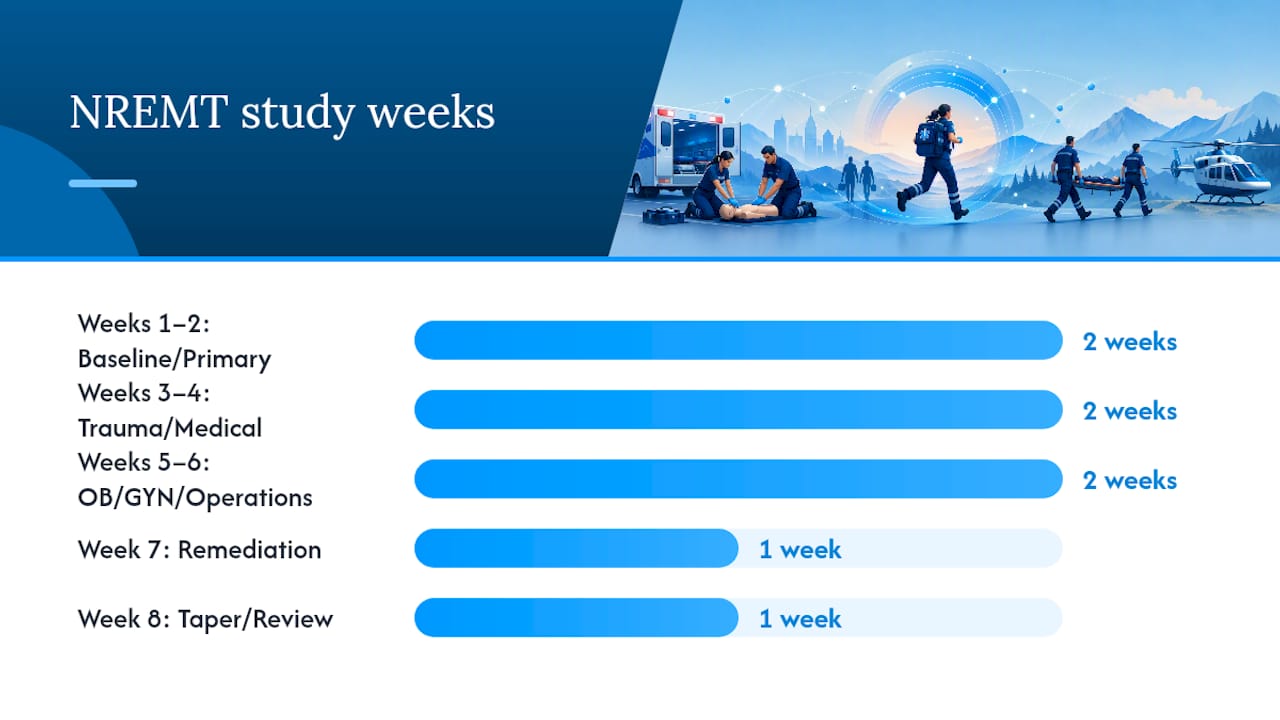
What does a 6–8 week NREMT study plan look like?
Weekly structure:
- Weeks 1–2: Baseline CAT + Primary Assessment focus. Daily 30-question adaptive sets, skills lab sessions on airway and CPR.
- Weeks 3–4: Trauma and Medical domains. Midline CAT at end of Week 3 to check progress. Redirect daily practice to lowest-scoring domains.
- Weeks 5–6: OB/GYN, Operations, and full mixed-domain practice. Full readiness CAT at end of Week 6.
- Week 7 (if needed): Targeted remediation only. No new content — drill weak areas identified by Week 6 CAT analytics.
- Week 8 / Final week: Taper. Light review of Primary Assessment algorithm and AHA basics. No heavy cramming.
Milestones to hit:
- Baseline CAT score recorded before Week 1 content study
- Midline CAT showing improvement in Primary Assessment domain
- Week 6 readiness CAT hitting consistent pass-confidence range
- Skills sign-off completed before exam registration
Full-time students can manage 2–3 hours of study per day. Part-time or working candidates should target 60–90 minutes daily with a longer session on weekends. The NCLEX fundamentals study plan uses the same milestone-based pacing for healthcare certification prep.
Pro Tip: Stop adding new content in the final 48 hours. Your brain consolidates during rest, not during last-minute cramming. A light review of algorithms is fine; a new chapter is not.
How Recallos fits your NREMT prep workflow
Recallos is built by practicing nurses and CRNAs, and its adaptive algorithm does exactly what the study plan above requires: it identifies your weak domains, surfaces those questions more frequently, and tracks your progress over time.
Step-by-step workflow inside Recallos:
- Complete the baseline assessment to establish your domain-level starting point
- Set daily reminders for a 20–40 minute adaptive practice session
- Use the flashcard and spaced repetition features for terminology and algorithm steps
- Run a weekly simulated CAT and review the weak-area report
- Use the peer challenge feature to stay accountable and benchmark against other candidates
Why this beats a static question bank:
- A static bank gives you the same questions in the same order. Recallos surfaces the questions you need most, when you need them.
- Progress metrics show domain-level trends, not just a running score.
- Mobile access means a 20-question session fits between a clinical shift and dinner.
- Streaks and rewards keep daily practice consistent — which is the variable that separates candidates who pass on the first attempt from those who don't.
The platform's clinician-built content aligns with real exam blueprints, a design philosophy detailed in the NCE CRNA prep guide that reflects the same evidence-based approach applied to NREMT content.
Pro Tip: Use Recallos's weak-area report after every weekly CAT to set your focus for the next five days. Don't study what you already know — study what the data says you don't.
Test-day checklist
Administrative:
- Valid government-issued photo ID (name must match registration exactly)
- Confirmation email or authorization to test
- Arrive at least 30 minutes before your scheduled time
- No study materials, phones, or food in the testing room
Last-minute prep:
- Light review of Primary Assessment sequence and AHA CPR algorithm only
- No new content the night before
- Sleep matters more than one extra hour of reading
During the exam:
- Use the computer tutorial before the clock starts
- Target 30–60 seconds per question
- Flag and move on if stuck; do not spiral on one item
- Leave when you're done — there's no benefit to sitting and second-guessing
If you don't pass, the retest window opens after 15 days. Fees vary; confirm the current amount at nremt.org before registering for a retake.
Pro Tip: Eat a real meal before the exam. Cognitive performance drops measurably on an empty stomach, and a 2-hour CAT is a long time to run on coffee.
Key Takeaways
Adaptive, high-yield practice paired with simulated CAT sessions is the most effective NREMT prep approach — and your study time should reflect the exam's domain weights, not your personal comfort zones.
| Point | Details |
|---|---|
| CAT format facts | 70–120 items, around 10 pilot, up to 2 hours; difficulty adjusts to your performance. |
| Primary Assessment first | This domain covers 39–43% of scored items — master it before other content. |
| Study method that works | Active recall, spaced repetition, and weekly simulated CATs beat passive reading. |
| Retest rule | Minimum 15-day wait; verify current fees at nremt.org before registering. |
| Use Recallos | Recallos delivers adaptive daily practice, domain-level analytics, and clinician-built content aligned to NREMT blueprints. |
Why this plan works
Most NREMT candidates study the wrong way: they re-read chapters, highlight definitions, and then feel blindsided when the CAT serves them a scenario that requires judgment, not recall. The exam is testing whether you can think like a clinician, not whether you memorized a glossary.
The plan in this article is built around one insight: the CAT rewards candidates who have practiced making decisions under pressure, not candidates who have read the most pages. Spaced repetition and adaptive practice work because they simulate the cognitive demand of the actual exam. Every time you retrieve an answer from memory under time pressure, you're training the same mental process the test will require.
Recallos was designed by practicing nurses and CRNAs who understood this gap. The platform doesn't just give you questions — it tracks which clinical areas you're shaky on and keeps surfacing them until you're not. That's a fundamentally different tool than a static PDF or a question bank that cycles through topics alphabetically.
If you study the way the exam actually works, you will be ready for it. The candidates who struggle are almost always the ones who prepared for a different test.
Start your NREMT prep with Recallos today
Spending weeks on passive study when you could be drilling the exact question types the NREMT actually tests is the most common and costly prep mistake. Recallos gives you a faster path: adaptive daily practice, weak-area targeting, and simulated CATs built around the same clinical reasoning the exam demands.

Start with the free trial at recallos.co. In your first week, complete the baseline assessment, set a daily reminder for a 20–40 minute session, and run your first simulated CAT by Day 7. Review the subscription options to find the tier that fits your 6–8 week timeline. The free daily access gets you started immediately — no credit card required to see whether the platform fits your study style.
Useful sources and further reading
Official and authoritative resources to verify exam rules and deepen your preparation:
- NREMT Examination Preparation: Official candidate tips, AHA study guidance, and logistics (ID, arrival time, retest rules).
- NREMT EMT Cognitive Exam Handbook: Exact item counts, domain weights, time limits, and pilot-item details.
- NREMT Study Guide with Quizzes: Domain-weighted study organization and interactive practice resources.
- Recallos adaptive study platform: Daily adaptive practice, spaced repetition, and simulated CATs for NREMT and other healthcare exams.
- Recallos feature examples: Walkthrough of platform features and study workflows before you subscribe.
- NCE CRNA Prep Guide on the Recallos blog: Demonstrates the clinician-authored, exam-blueprint approach Recallos applies across healthcare certifications.