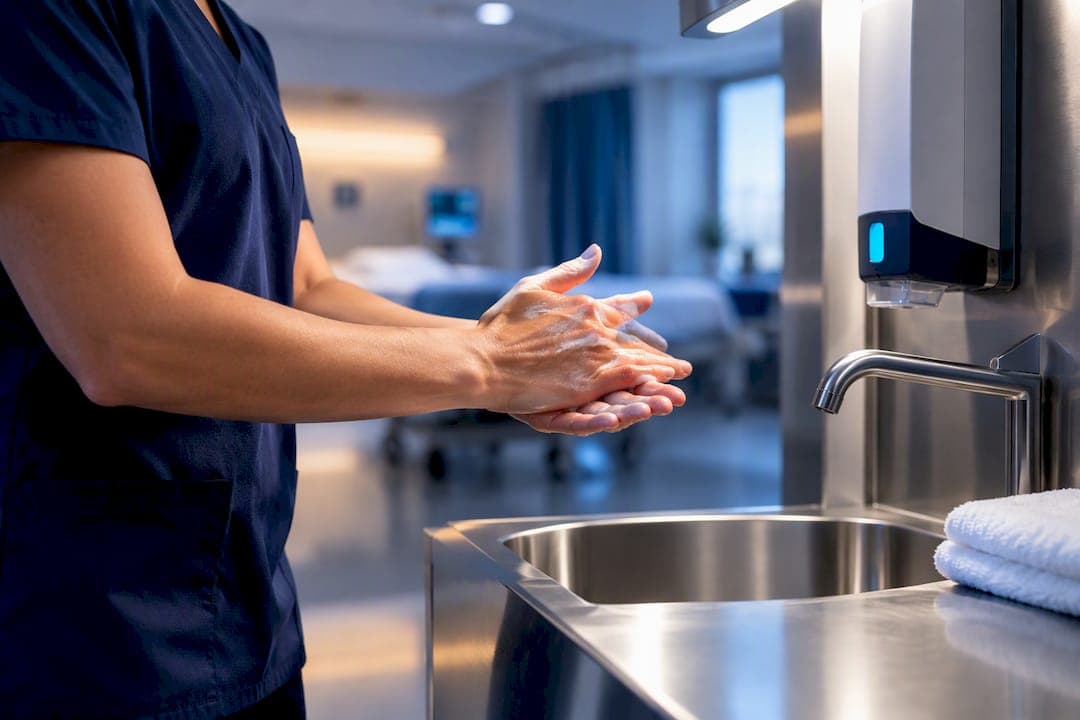
Safety and Infection Prevention and Control makes up 9 to 15% of NCLEX-RN questions, and most of that weight sits on a small set of testable rules. Master hand hygiene selection, the three transmission-based categories, and PPE sequencing first: these show up in more stems than any other infection-control content. Everything else, including aseptic versus sterile technique, builds on that foundation.
TL;DR:
- Mastering hand hygiene, PPE sequencing, and transmission-based precautions is crucial since they appear in more NCLEX questions than any other infection-control content.
- Knowing the organism first helps determine the correct precaution category, whether contact, droplet, or airborne, and prevents common mistakes like applying the wrong PPE.
- Proper PPE removal follows strict order: gloves, gown, hand hygiene, eye protection, then mask or respirator, with hand hygiene repeated after exiting the room.
- Aseptic versus sterile technique depends on entry into sterile body parts or invasive devices, with sterile used for blood or cerebrospinal fluid, and aseptic for routine care.
- Focused, timed practice on infection control through platforms like RecallOS and review of error-specific flashcards accelerates mastery and reduces common exam errors.
Table of Contents
- Standard precautions: the baseline every NCLEX candidate must know
- Transmission-based precautions: contact, droplet, and airborne rules
- Hand hygiene moments and the correct PPE removal sequence
- Aseptic versus sterile technique: which one the stem is actually asking for
- How infection control shows up on NCLEX: formats, traps, and worked examples
- Building a two-week infection control study plan that actually sticks
- RecallOS: exam-aligned practice built for infection control review
- What trips students up on infection control questions
- Practice infection control questions with RecallOS
- Sources
- FAQ
Standard precautions: the baseline every NCLEX candidate must know
Standard Precautions apply to every patient interaction, regardless of diagnosis, and form the floor beneath every other infection-control rule on the exam. The CDC's summary of Standard Precautions groups them into hand hygiene, personal protective equipment chosen after a quick risk assessment, safe injection and medication practices, respiratory hygiene, and environmental cleaning of surfaces and reusable equipment.
On the exam, medication safety questions often hide the correct answer in small details. A stem describing vial preparation expects you to know that you disinfect the rubber diaphragm before every needle insertion, and that a multi-dose vial can serve more than one patient only when the needle and syringe are both new each time. Single-use vials never get reentered, even if medication remains.

Watch for red-flag phrasing like "the nurse observes a colleague" or "which action requires intervention." These stems test whether you catch a broken step in someone else's technique, not whether you can recite the rule in isolation.
A fast mental checklist keeps this section from bleeding into other precaution categories:
- Perform hand hygiene before and after every patient contact, glove or no glove.
- Choose PPE based on the anticipated exposure, not habit.
- Disinfect vial tops and injection ports before each access.
- Clean and disinfect shared equipment between patients.
- Cover coughs and offer masks to symptomatic patients and visitors.
Safety and Infection Prevention and Control questions make up 9 to 15% of the total NCLEX-RN exam. That range sits inside the broader Safe and Effective Care Environment client needs category. This makes Standard Precautions one of the more heavily tested single topics on the whole test.
Transmission-based precautions: contact, droplet, and airborne rules
Transmission-based precautions layer on top of Standard Precautions once an organism's route of spread is known or suspected. The CDC's guidance on transmission-based precautions organizes them into three categories, each with its own PPE and room requirements.
Contact precautions apply to organisms spread by direct or indirect touch, such as multidrug-resistant organisms or C. diff. The added steps are a gown and gloves for anyone entering the room, along with dedicated or disinfected equipment. Droplet precautions cover pathogens that travel short distances in respiratory droplets: a surgical mask for anyone within about three feet, plus spatial separation when a private room isn't available. Airborne precautions are reserved for organisms that stay suspended in air and travel farther, requiring an airborne infection isolation room and an N95 respirator, fit-tested and properly sealed, for every entrant.
Detailed rules to hold onto:
- Contact: gown and gloves on entry, remove before leaving the room.
- Droplet: mask on entry, private room or spatial separation preferred.
- Airborne: AIIR with negative pressure, N95 respirator, door kept closed.
- Transport: the patient wears a mask appropriate to their precaution category when moved through common areas.
Cohorting is allowed when patients share the same confirmed organism and neither one is immunocompromised. The CDC's isolation precautions recommendations treat placing an infected patient with an immunocompromised roommate as unsafe, and this exact trap appears repeatedly on practice exams.
Pro Tip: Scan the stem for the organism's name first. If you can name the pathogen, you can usually derive the correct precaution category without memorizing a giant list.
Hand hygiene moments and the correct PPE removal sequence
Hand hygiene decisions and PPE sequencing generate some of the most consistently missed items on infection-control content, mostly because students know the rule but freeze on the order.
The CDC's six key moments for hand hygiene are: before touching a patient, before a clean or aseptic procedure, after exposure to body fluid, after touching a patient, after touching a patient's surroundings, and before donning gloves for an aseptic task. Alcohol-based hand rub is preferred in most of these moments, but soap and water takes over whenever hands are visibly soiled or when caring for a patient with suspected or confirmed C. diff, since ABHR does not reliably kill C. diff spores.
Doffing order matters just as much as donning order:
- Remove gloves first, since they carry the highest contamination risk.
- Remove the gown, pulling it away from the body and rolling it inward.
- Perform hand hygiene.
- Remove eye protection and mask or respirator last.
- Perform hand hygiene again after exiting the room.
Gloves come off first because hands touch contaminated surfaces throughout care, and removing them immediately limits how far that contamination spreads.
Health care associated infections remain a documented burden in acute care settings, and the CDC's core infection prevention practices treat hand hygiene compliance as one of the most direct levers for reducing them. That real-world stake is exactly why the NCLEX tests this sequence so precisely.
Aseptic versus sterile technique: which one the stem is actually asking for
Aseptic and sterile technique get confused constantly, and the exam relies on that confusion to separate strong candidates from average ones. According to an NCBI Bookshelf chapter on aseptic technique, sterile technique eliminates all microorganisms and is reserved for invasive procedures, while aseptic technique reduces the number of organisms and contamination risk for routine nursing care.
A urinary catheter insertion uses sterile technique because it crosses into a normally sterile body cavity. A dressing change on a healing surgical wound that is no longer an open cavity typically calls for aseptic, or clean, technique unless facility policy specifies otherwise. Central line dressing changes stay sterile because the catheter has direct access to the bloodstream. Medication administration by mouth or through an established IV line usually only requires aseptic, not sterile, handling.
The cue that should flip your answer toward sterile technique is any language describing entry into a body cavity, a surgical site, or an indwelling invasive device. Stems that describe wound care, oral hygiene, or routine dressing changes on intact skin usually point toward aseptic technique instead.
A rapid recall checklist:
- Entry into blood, cerebrospinal fluid, or a normally sterile cavity: sterile technique.
- Insertion of a urinary catheter, central line, or surgical instrument: sterile technique.
- Routine wound cleaning on intact or healing skin: aseptic technique.
- Oral, subcutaneous, or established IV medication administration: aseptic technique.
Pro Tip: Separate "key parts" from "key sites" in the stem: the key part is the piece of equipment that must stay uncontaminated (a catheter tip), while the key site is the patient's body area involved (the urethra). When both are invasive, the answer is sterile technique.
How infection control shows up on NCLEX: formats, traps, and worked examples
Infection-control items appear in several formats: select-all-that-apply lists of correct precautions, priority questions asking which patient to see first, single-best-answer stems on PPE selection, and Next Generation NCLEX case studies that unfold across multiple screens with a shared clinical scenario.
Try this stem: a patient develops watery diarrhea three days after starting antibiotics, and stool testing confirms C. diff. Which precaution should the nurse initiate?
- Identify the organism: C. diff, a spore-forming bacterium spread by contact.
- Match the transmission route: contact precautions, not droplet or airborne.
- Select hand hygiene: soap and water, since ABHR does not reliably kill spores.
- Confirm PPE: gown and gloves on room entry.
The correct answer bundles contact precautions with soap and water hand hygiene, a combination that trips up students who default to ABHR out of habit.
A second example: a nurse enters a room to assess a patient on airborne precautions for suspected tuberculosis. Which action comes first?
Confirm the N95 respirator is properly fitted and sealed before entering the airborne infection isolation room.
That sequencing, PPE before room entry, is the detail NGN case studies test repeatedly, since a delay exposes staff before the assessment even starts.
Three tactics carry across most formats: pick the most protective action when several answers sound reasonable, watch for timing cues like how long isolation should continue, and favor choices that protect staff and patient simultaneously rather than just one party.
Building a two-week infection control study plan that actually sticks
Long textbook reading rarely converts into exam-day judgment. A tighter two-week rotation does more with less time.
Days 1 through 4: review Standard and transmission-based precautions daily in short bursts, then answer 20 to 30 timed mixed questions and log every miss. Days 5 through 8: shift to hand hygiene, PPE sequencing, and aseptic versus sterile technique, repeating the same timed-question and error-log pattern. Days 9 through 12: mix all infection-control content into full practice blocks, adding one NGN-style case study daily. Days 13 and 14: rerun only the flashcards built from your error log and finish with one full timed practice block.
Useful resource types include short reference sheets, spaced-repetition flashcards, timed quiz sets, and rationale-focused review that explains why the wrong answers are wrong, not just which answer is right.
- Cheat sheets for fast pre-exam scanning, not first-time learning.
- Spaced-repetition flashcards for the facts you keep forgetting.
- Timed quizzes to build speed under real exam conditions.
- Rationale review to catch flawed reasoning, not just wrong guesses.
Pro Tip: Every time you miss a question, turn the specific reasoning error into a flashcard prompt that same day. Reviewing your own mistakes in spaced intervals fixes gaps faster than rereading a textbook chapter.
RecallOS: exam-aligned practice built for infection control review
This study platform is designed by experienced healthcare professionals, and its question content is aligned to real NCLEX blueprints rather than general trivia. The platform's adaptive engine identifies weak spots and routes more practice toward them, while daily streaks and progress tracking keep review consistent through the two-week plan above.
A practical workflow: filter questions by infection control topic, run a timed Daily Recall Run each morning, and read every rationale immediately after answering, right or wrong. Missed items get exported as flashcards for spaced review later that same week.
Students can also try the NCLEX study app for a short trial before entering the final week of review, when timed accuracy matters most.
What trips students up on infection control questions
The most common misses I see: applying contact precaution PPE to a droplet scenario, forgetting how long isolation should continue after symptoms resolve, and picking sterile technique when aseptic was correct, or the reverse.
Run this five-step check on every stem: identify the organism, determine its transmission route, pick the matching precautions, check the safe patient placement, and only then choose the PPE sequence. Saying each step out loud, even silently, forces you to notice when you're guessing instead of reasoning.
— Caleb
Practice infection control questions with RecallOS
Generic review books cover infection control in broad strokes. RecallOS narrows the focus to targeted infection-control question bundles, a timed Daily Recall Run for daily drilling, and weak-spot flashcard export so repeated misses turn into spaced review instead of repeated frustration.
- Targeted infection-control bundles built around NCLEX blueprint weighting.
- Timed Daily Recall Run sessions for short, consistent daily practice.
- Weak-spot flashcards exported automatically from missed questions.
Start a session on the NCLEX study app and run your first infection-control set through Daily Recall Run today.
This article is general information, not a substitute for advice from a qualified doctor. Consult a qualified healthcare professional about your own circumstances before acting on anything here.
FAQ
What does infection control mean on NCLEX?
Infection control on the NCLEX refers to the Safety and Infection Prevention and Control subcategory, which tests Standard Precautions, transmission-based precautions, hand hygiene, PPE use, and aseptic technique. It accounts for 9 to 15% of NCLEX-RN questions, making it one of the more heavily weighted single topics on the exam.
What are 5 infection control procedures?
Five core procedures tested on the exam are hand hygiene, PPE selection and sequencing, safe injection and medication handling, environmental cleaning of equipment and surfaces, and transmission-based precautions like contact, droplet, and airborne isolation. Each has its own CDC guidance that the NCLEX draws from directly.
What are some common NCLEX questions related to safety and infection control in nursing?
Common formats include select-all-that-apply items on correct PPE for a given isolation type, priority questions asking which patient to assess first based on infection risk, and case-study items testing whether a nurse should use aseptic or sterile technique. Many stems also test hand hygiene product selection, particularly the C. diff exception favoring soap and water over alcohol-based hand rub.
What are the infection control measures used in nursing?
Nursing infection control measures include Standard Precautions applied to every patient, added transmission-based precautions when an organism's spread route is known, correct PPE donning and doffing order, and safe sharps disposal to prevent needlestick injuries. Aseptic technique for routine care and sterile technique for invasive procedures round out the core measures tested on the NCLEX-RN test plan.