
The most effective way to prepare for the NCLEX with ADHD is to pair short, frequent retrieval practice with deliberate encoding steps, then let an adaptive tool route you back to your weak spots. This combination lowers the activation energy that makes starting so hard and builds retention that survives exam-day stress. Start today with a single 10-minute recall run on your weakest topic. Apps are available for exactly this kind of low-friction, high-yield practice.
TL;DR:
- Short, timed retrieval practice on weak topics, combined with deliberate encoding techniques, significantly improves long-term retention for students with ADHD.
- Using whole-text recall for complex topics over section-by-section testing enhances memory organization and exam preparedness.
- Consistent daily study habits, such as 10-minute sessions and pre-committed routines, are more effective than lengthy, sporadic practice sessions.
- Adaptive apps that focus on weak-spot review and concise rationales support effective encoding and retrieval while minimizing cognitive load.
- Effective study habits prior to test day are essential, as accommodations alone do not compensate for gaps in content mastery or preparation methods.
Table of Contents
- ADHD-friendly study adjustments that actually move NCLEX scores
- Adaptive tools and features to prioritize
- Sample daily and weekly routines for NCLEX study with ADHD
- Overview of NCLEX testing accommodations eligibility criteria for ADHD
- How to apply for NCLEX accommodations for ADHD step-by-step
- Common accommodations available during the NCLEX and why daily practice still matters
- Documentation typically requested for formal ADHD accommodations
- Typical timelines for accommodation approval and what to do while you wait
- How accommodations affect test day and what actually predicts your performance
- Why this ADHD-tailored approach is realistic for busy U.S. nursing students
- How RecallOS puts this study plan into practice
- Sources
- FAQ
ADHD-friendly study adjustments that actually move NCLEX scores
Retrieval practice means closing the book and forcing your brain to produce the answer, not just recognize it. The strongest version of this is retrieval-to-criterion: you keep testing yourself on a concept until you get it right three times in a row, consecutively, before moving on. Research on college students with ADHD found that when practice reached that criterion, students with ADHD retained key-term definitions about as well as their peers without ADHD. That is a meaningful finding, because it means the gap many students assume is fixed is often just a matter of practice structure.
Retrieval alone is not the whole story. A Frontiers in Psychology study found that retrieval practice helps students with ADHD, but it does not fully make up for weak encoding: unmedicated participants in the study showed encoding deficits that dragged down overall performance. Encoding is the step before retrieval, where you actually get information into memory in a durable form. For nursing content, that means elaborating on why a lab value matters, picturing the pathophysiology, or tying a drug's mechanism to a patient scenario you have seen in clinical. Skipping straight to quiz mode without encoding first is like trying to withdraw money you never deposited.
Whole-text recall (working through an entire chapter or topic before testing yourself) tends to produce better long-term organization than testing yourself section by section, according to research comparing the two approaches. Section recall still has a place: when material feels overwhelming, breaking it into smaller chunks builds early confidence and keeps you engaged. A practical rule is to use section recall for a brand-new, dense topic and shift to whole-text recall once you have a basic scaffold, such as a concept map or timeline.
Pacing matters as much as method. Pomodoro-style micro-sessions (20 to 25 minutes of focused work) or even shorter 10-minute bursts reduce the dread of sitting down for a marathon study block. Pre-committing to a specific start time, using implementation intentions ("At 7 AM I open my recall app"), and cutting visual clutter from your study space all lower the barrier to beginning.
Two quick conversions:
- Pharmacology topic: Instead of rereading a drug chart, close it and write out the mechanism, side effects, and one nursing implication for furosemide, then check yourself.
- Clinical judgment vignette: Read a scenario once, cover it, and verbally walk through your recognition of cues and prioritized action before checking your reasoning against the answer.
Pro Tip: Set a timer for 10 minutes and quiz yourself on one weak topic before you allow yourself to open any notes.
Adaptive tools and features to prioritize
Not every study app is built for a brain that resists long, undifferentiated study blocks. Look for four feature categories: micro-timed practice sets that fit into small windows, adaptive weak-spot reviews that resurface exactly what you are missing, streaks or rewards that reinforce showing up daily, and rationales short enough to read in under a minute. Difficulty scaling mapped to Bloom's taxonomy also matters, since NCLEX clinical judgment items demand more than recall of a fact.

Each of these maps directly onto the study science above. Micro-timed sets support low-friction initiation. Adaptive weak-spot review is retrieval-to-criterion automated, since it keeps surfacing a concept until you demonstrate mastery instead of politely dropping it after one right answer. Streaks and rewards address the accountability gap that organizational-skills research in college students with ADHD identifies as a common barrier to consistent practice. Concise rationales support encoding without turning a five-minute review into a 40-minute reading assignment.
Usability details matter more than they sound like they should. A cluttered interface adds cognitive load before you have answered a single question. Adjustable session length lets you fit a run into whatever window you actually have, whether that is 8 minutes or 25. Clear, immediate progress feedback keeps the loop rewarding, and offline access means a bad Wi-Fi day does not become an excuse to skip.
A practical way to use this: anchor a 10-minute morning recall run to your weakest content area before you check email or social media, so the highest-friction task happens when your resistance is lowest.
Some study apps align their question sets with current exam blueprints and may offer adaptive weak-spot training, instant rationales, and gamified streak tracking with peer challenges, features designed to match the encoding-plus-retrieval approach described above rather than deliver generic trivia.
One synthesis worth remembering: a scoping review of NCLEX preparation strategies found no single agreed-upon best method among the approaches nursing programs use, which is exactly why combining encoding, spaced retrieval, and adaptive review, rather than relying on one tactic, is the more defensible strategy. A 2023 scoping review synthesizing 25 studies on NCLEX preparation reached this conclusion.
Sample daily and weekly routines for NCLEX study with ADHD
A single low-energy day can still move the needle if the session is short enough to actually start.
- 7:00 AM, 10 minutes: Retrieval-to-criterion run on yesterday's weakest topic, no notes open.
- 12:30 PM, 15 minutes: Encode one new concept using elaboration or a clinical scenario, then attempt two to three practice items on it.
- 6:00 PM, 20 minutes: Mixed adaptive review pulling from several past topics to reinforce spacing.
Across a week, distribute topics so no single day repeats the same content twice. A rough seven-day cadence: two days introducing new content with encoding-first study, three days of mixed retrieval and adaptive review, one day dedicated to a whole-text recall pass on a complex system like cardiac or renal, and one lighter consolidation day with shorter runs and no new material.
During taper week before the exam, cut new content entirely and shift every session to review and weak-spot drilling. On low-energy days, a 5 to 8 minute maintenance run, just enough to keep the retrieval habit alive, beats skipping outright.
Pro Tip: Increase difficulty or add a new topic only after you hit three consecutive correct recalls on the current one; that threshold is your signal to move forward, not a fixed number of days.
Overview of NCLEX testing accommodations eligibility criteria for ADHD
Formal testing accommodations for the NCLEX, things like extended time or a separate testing room, are handled through Pearson VUE and the NCSBN under a documented request and approval process tied to the NCLEX-RN test plan that governs exam content and structure. Eligibility generally requires evidence that a diagnosed condition substantially limits a major life activity relevant to testing, evaluated against ADA standards for standardized licensure exams.
This article focuses on a different, equally important piece of NCLEX readiness for students with ADHD: how you study before you ever sit down at the testing center. Formal accommodation eligibility criteria are set by NCSBN and your state board of nursing, and candidates who believe they qualify should confirm current requirements directly with those bodies rather than relying on secondhand summaries, since criteria and documentation standards can change between test plan cycles. What eligibility does not cover, and what most students underestimate, is how much of NCLEX performance is determined by the months of practice before test day. A candidate can have every accommodation approved and still struggle if the underlying study habits do not fit how an ADHD brain initiates and sustains focused work. That is the gap this article is built to close: not the paperwork, but the daily practice that determines whether you walk into the exam ready.
How to apply for NCLEX accommodations for ADHD step-by-step
Applying for formal test-day accommodations is a separate administrative process run through Pearson VUE and your state board of nursing, distinct from the study strategies covered in this article. In general terms, the process involves submitting a request through the official NCLEX candidate accommodations channel, providing supporting documentation, and waiting for a determination before your exam is scheduled.
Because exact forms, deadlines, and required documentation can differ by state board and can change between test plan cycles, the most reliable step-by-step guidance comes directly from NCSBN and Pearson VUE's official candidate resources rather than a study blog. If you are pursuing that formal process, start by contacting your state board of nursing directly for its current accommodations request procedure.
What this article can help with instead is what happens in the months before that exam: building study habits that do not depend on formal accommodations to be effective. A candidate with ADHD who adopts retrieval-to-criterion practice, short daily sessions, and adaptive weak-spot review is addressing the root performance issue, sustained attention and working memory during preparation, regardless of what is granted on test day. The strategies in the sections above (micro-sessions, encoding before retrieval, whole-text recall for complex topics) are things you control starting today, without waiting on an approval letter.
Common accommodations available during the NCLEX and why daily practice still matters
Common formal NCLEX accommodations for documented conditions include extended testing time, a separate or reduced-distraction testing room, and additional scheduled breaks, all administered through Pearson VUE under NCSBN policy. These are test-day supports intended to level the exam-taking environment itself.
None of them change how well you know the content. Extra time helps if slow processing under time pressure is your main barrier, but it does not build clinical judgment or fill gaps in pharmacology knowledge. A quiet room reduces distraction during the exam, but it cannot substitute for the distraction management skills you build during months of study, skills like pre-committing to a start time, working in short blocks, and using an app that removes the friction of deciding what to study next.
This is why the study-side strategies in this article matter independently of whatever formal accommodations a candidate receives. Retrieval-to-criterion, encoding-first review, and adaptive practice build the actual competence the NCLEX measures. A separate testing room helps you access that competence on exam day, it does not create it. Students who focus only on securing test-day supports while neglecting how they study risk walking into a quieter room with the same underlying content gaps.
Documentation typically requested for formal ADHD accommodations
Formal accommodation requests through NCSBN and Pearson VUE typically require documentation from a qualified evaluator, such as a diagnosing clinician or psychologist, describing the diagnosis and its functional impact on testing. This is a separate administrative requirement from anything covered in your nursing program.
Because documentation standards, accepted evaluator credentials, and required forms are set by NCSBN and can vary by state board of nursing, candidates pursuing formal accommodations should request the current documentation checklist directly from their state board rather than relying on general descriptions. Requirements have been known to change between test plan cycles, so a checklist from a prior year may be outdated.
What is more immediately useful for most students preparing right now is documentation of a different kind: a record of your own practice patterns. Track which topics you consistently miss, how many sessions it takes you to hit retrieval-to-criterion on a given concept, and which times of day you actually complete study sessions versus skip them. This kind of self-tracking, which adaptive apps do automatically through weak-spot analytics and streak logs, tells you far more about where to focus your remaining study time than a diagnostic letter ever will. It is not a substitute for formal documentation if you are pursuing test-day accommodations, but it is the more actionable input for your daily study decisions between now and exam day.

Typical timelines for accommodation approval and what to do while you wait
Approval timelines for formal NCLEX accommodations vary by state board of nursing and by the completeness of the submitted documentation, and candidates should confirm current expected timelines directly with NCSBN or their state board rather than assuming a fixed number of weeks. Incomplete documentation is a common cause of delay, according to general guidance from testing accommodation processes.
The practical implication for candidates with ADHD is straightforward: if you intend to request formal accommodations, start that process as early as your program allows, since approval can take time and you do not want a pending decision to affect your exam scheduling window. Contact your state board of nursing early to confirm what it needs and how long its review typically takes.
While that administrative process runs in the background, your study preparation does not have to wait on anyone's approval. Every strategy covered earlier in this article, retrieval-to-criterion drills, encoding before testing, spaced micro-sessions, adaptive weak-spot review, can start the same day you decide to use them. Students sometimes delay serious study because they are waiting to hear back about accommodations, treating the two processes as if they were sequential. They are not. Building strong retrieval habits now means that whatever the outcome of an accommodations request, you walk into the exam with stronger content mastery, which is the variable that most directly predicts passing.
How accommodations affect test day and what actually predicts your performance
For candidates who receive formal accommodations, test day procedures typically involve confirming the approved accommodation with the testing center staff at check-in, such as being directed to a separate room or having extended time tracked by center staff, under NCSBN and Pearson VUE policy. These procedural adjustments are handled by the testing center itself once an approval is on file.
What accommodations change is the environment. What they do not change is the content knowledge and clinical reasoning you bring into that environment, and that is the piece within a candidate's direct control every day between now and the exam. A quiet room or extra time can reduce situational stress, but the confidence that actually carries a candidate through unfamiliar next-generation NCLEX items comes from having drilled retrieval-to-criterion on enough content that recognizing cues and prioritizing actions feels automatic rather than effortful.
This is the throughline of everything covered above: whether or not a candidate has formal accommodations in place, the daily practice of short retrieval sessions, deliberate encoding, and adaptive review is what determines how test day actually feels. Candidates who arrive with strong content mastery tend to describe the exam itself as manageable regardless of setting, while gaps in preparation show up as difficulty no accommodation can fully offset.
Why this ADHD-tailored approach is realistic for busy U.S. nursing students
I have spent time around nursing education and watched capable students talk themselves out of studying because a session "has" to be an hour to count. That belief is the real barrier, not attention span. A messy, inconsistent 10-minute habit beats a perfect plan you never start.
ADHD study patterns that look chaotic from the outside, short bursts, odd hours, one topic at a time, are often exactly right for how your brain actually works. Small, repeated wins build the habit faster than any single marathon session.
Try one recall run right now. Ten minutes, one weak topic, no notes. Log it somewhere you will see tomorrow.
— Caleb
How RecallOS puts this study plan into practice
RecallOS turns the strategies above into a daily habit instead of a plan you have to redesign every morning. The Daily Recall Run gives you the short, timed retrieval session described earlier, and its adaptive weak-spot engine automates retrieval-to-criterion by resurfacing exactly what you keep missing.
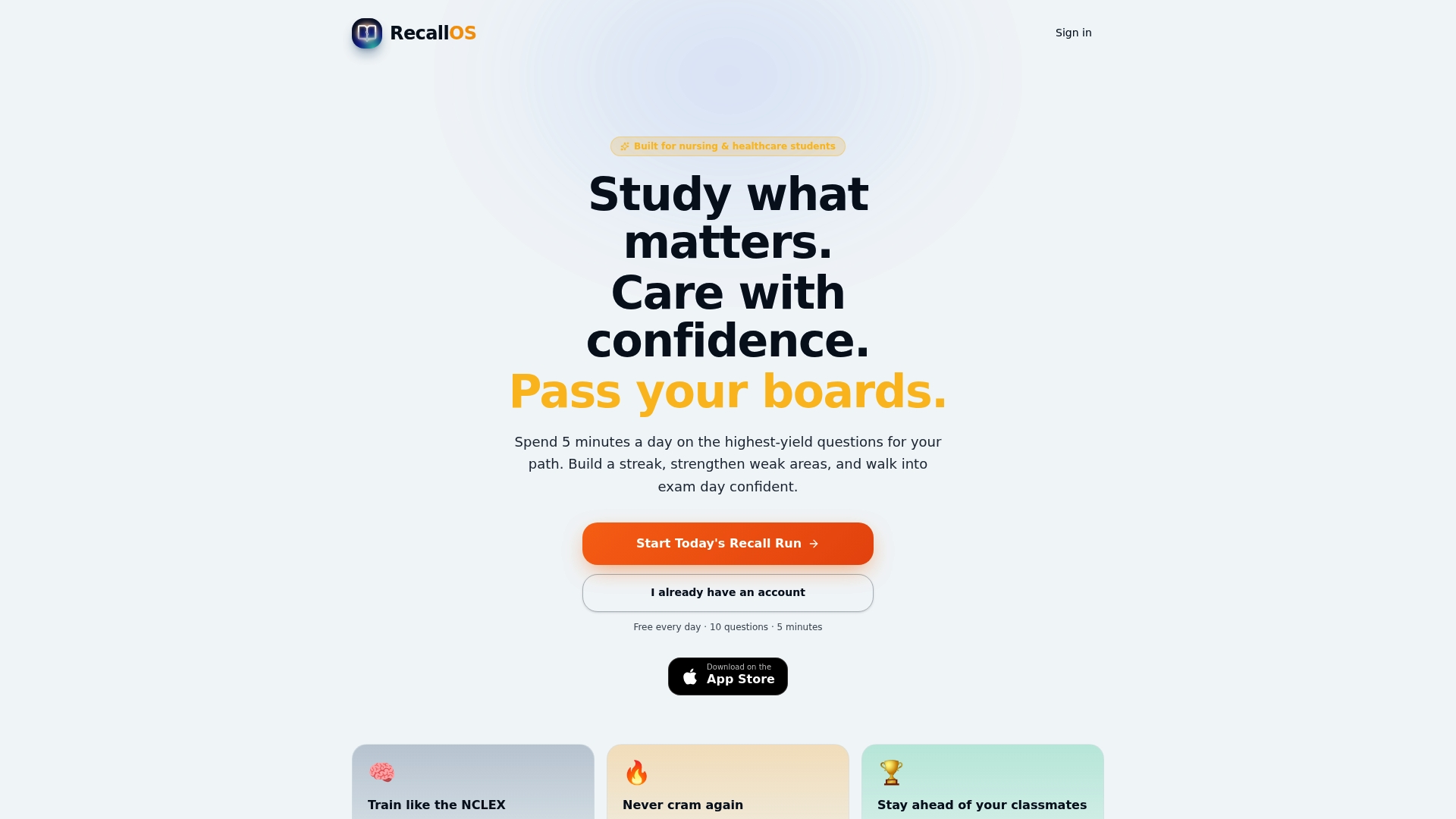
- Morning: a 10-minute Daily Recall Run targets your current weak spots before the day gets away from you.
- Evening: a shorter adaptive review consolidates whatever you encoded earlier, with instant rationales for anything you miss.
- Anytime: Upload Notes converts your own lecture material into practice questions, so review time stays tied to what you are actually being taught.
If you want to see how the full system fits your schedule, start with the NCLEX study app and try a session today.
FAQ
What is retrieval-to-criterion and why does it help with ADHD?
Retrieval-to-criterion means testing yourself on a concept until you get it right three consecutive times before moving on, rather than stopping after one correct answer. Research on college students with ADHD found this approach produced retention comparable to peers without ADHD.
Does retrieval practice alone fix weak NCLEX content areas?
No. A Frontiers in Psychology study found that retrieval practice helps students with ADHD, but it does not fully compensate for weak encoding. Pairing deliberate encoding with retrieval drills works better than retrieval alone.
Should I use whole-text or section-by-section recall for nursing content?
Use section recall first when a topic feels overwhelming, since it builds early confidence, then shift to whole-text recall once you have a basic scaffold like a concept map. Research comparing the two methods suggests whole-text recall tends to produce better long-term organization for complex material.
How long should a study session be if I have ADHD?
Short sessions of 10 to 25 minutes tend to work better than long blocks because they lower the effort it takes to start. Adjustable, timed practice sets, like the ones in RecallOS, let you match session length to your actual energy that day.
Is there one best study method for NCLEX preparation?
No single method is universally agreed upon. A 2023 scoping review of NCLEX preparation strategies found multiple approaches in use with no consensus best practice, which supports combining encoding, spaced retrieval, and adaptive review rather than relying on one tactic.