
Yes. Study streaks reliably boost motivation for most students, but only when the streak is built around a short, meaningful session and tracked somewhere visible. A 10 to 15 minute minimum session that includes real active recall works better than a vague "study for a while" goal. Streaks help most when you already study at least occasionally. The app builds its daily practice around exactly this design.
TL;DR:
- Study streaks are most effective when built around short, active sessions of 10 to 15 minutes with specific tasks like active recall, making daily practice feel more achievable.
- The motivation boost from streaks relies on loss aversion, identity reinforcement, and the goal-gradient effect, which promote consistent study behavior and reduce daily decision friction.
- Highlighting streaks on platforms increases engagement, especially after seven days, when the habit starts becoming automatic and effort feels less effortful.
- Flexibility, such as scheduled rest days or streak freezes, prevents streaks from causing anxiety or discouraging learners after missed days.
- Streaks promote effortful engagement but do not improve learning unless sessions include active recall and spaced review targeting knowledge gaps.
Table of Contents
- What Makes Study Streaks Motivating in the First Place?
- Does Research Actually Back Study Streaks?
- How Do You Build a Study Streak That Actually Sticks?
- Can a Streak Improve Learning, Not Just Attendance?
- When Does a Study Streak Turn Harmful?
- Applying Streaks to Nursing and Healthcare Exam Prep
- Study Streaks Built Around Nursing Exam Prep
- Primary Sources and Further Reading
- Sources
- FAQ
What Makes Study Streaks Motivating in the First Place?
A streak works because it quietly changes the question you ask yourself. Instead of "do I feel like studying today?" you start asking "am I really going to break a 12-day streak?" That shift from mood-based decisions to chain-protecting decisions is what behavioral economists call a commitment device, and it removes a surprising amount of daily friction.
Three mechanisms do most of the work.
- Loss aversion. Once you have five or ten days logged, that streak starts to feel like something you own. Breaking it registers as a loss, not just a missed opportunity, and people work harder to avoid losses than to chase equivalent gains.
- Identity protection. A visible streak becomes part of how you see yourself. "I'm someone who studies daily" is a harder identity to abandon than "I'm someone who's trying to study more."
- The goal-gradient effect. Motivation tends to climb as you approach a milestone. Day 18 of a 21-day goal usually pulls harder than day 3, which is why short, visible targets matter more than one distant deadline.
Researchers studying streak behavior describe this as building a higher-order goal, protect the streak, that replaces the daily negotiation with yourself with a single standing rule, according to research from the University of Delaware.
Pro Tip: Write your minimum session down somewhere you'll see it daily, like a phone lock screen note. "10 active recall questions" beats "study a little" because your brain can't argue with a number.
None of this holds up if the streak turns into a rigid obligation. When missing one-day feels like a personal failure rather than a scheduling hiccup, the same mechanisms that motivate you start to generate anxiety instead. That tension is worth taking seriously, and it's the whole reason flexible design matters later in this guide.

Does Research Actually Back Study Streaks?
It does, with an important caveat about who benefits most. A randomized field trial covering 60,000 students found that simply highlighting streaks on a learning platform increased engagement and produced modest but statistically significant gains in math achievement compared with a control group that saw no streak indicator.
The 3.6x threshold: Duolingo's platform data shows learners who hit a 7-day streak are roughly 3.6 times more likely to keep practicing than those who never reach that first week. Seven days appears to function as the point where a streak shifts from effortful to close to automatic.
A separate line of research adds a sharper mechanism. Six pre-registered studies with a combined 4,493 participants found that streak-style incentives increase persistence more than larger, stable rewards do, because the streak raises your commitment to hitting the next consecutive day, not just to the task itself.
The nuance worth remembering: the field trial's biggest gains showed up among students already engaging with the material, not students who were disengaged from the start. That lines up with education research showing active study strategies and spaced practice predict better exam outcomes, while cramming and passive review predict worse ones. Streaks amplify effort you're already putting in. They don't manufacture motivation out of nothing.
How Do You Build a Study Streak That Actually Sticks?
- Set a minimum viable session you can't talk yourself out of. Ten to twenty-five minutes of active practice, defined specifically ("10 practice questions with review," not "study a bit"), keeps the bar low enough for busy days while still counting as real work, a distinction recommended by this study plan template guide for exactly this reason.
- Track it somewhere visible. A calendar on your wall, a habit app, or an in-app streak counter all work. Visibility is what turns the streak into a psychological asset instead of a private mental note you can quietly forget.
- Attach the session to a fixed cue. Right after your morning coffee, right before your commute, right after your last class. A consistent weekly time block removes the decision of when to study, which is often the actual barrier, not motivation itself.
- Pair every session with active recall or spaced review, not passive rereading. This is where the streak's consistency starts paying off in actual retention rather than just attendance.
- Build in flexibility before you need it. A scheduled rest day, a "streak freeze," or partial credit for a five-minute session on a rough day all keep one bad Tuesday from wrecking three weeks of progress.
- Set short milestones with small rewards. Day 7, day 21, day 30. Early wins matter more than distant ones for keeping a new habit alive.
Pro Tip: Decide your rest-day policy on day one, not day fourteen when you're already exhausted and tempted to quit outright. A streak with a built-in freeze day survives; a streak with zero tolerance for imperfection usually doesn't.
Can a Streak Improve Learning, Not Just Attendance?
A streak that only tracks whether you opened an app doesn't guarantee you learned anything. The fix is making every session active by design, not by hope.
- Swap rereading notes for self-testing, flashcards, or practice questions. The act of retrieving an answer is what builds retention, not the act of seeing information again.
- Interleave subjects across your week instead of drilling one topic every single day. Spacing and mixing topics both show up repeatedly in education research as predictors of stronger exam performance.
- Track outcomes alongside attendance. A quick two-column log, date on one side, what you actually practiced on the other, lets you audit whether your streak is producing learning or just clicking a button.
This gap is addressed by an approach that pairs a short session with adaptive review of your weak areas, so the streak you're protecting is also quietly correcting the topics you actually miss on practice questions.
When Does a Study Streak Turn Harmful?
A streak stops helping the moment it starts generating dread instead of momentum. Watch for three warning signs: skipping sleep or rest days to protect an unbroken chain, feeling genuine anxiety on a day you can't study, or treating anything short of a "perfect" session as a failure.
- Shorten your minimum session temporarily. A rough week calls for five minutes, not twenty.
- Build in a partial-credit day or a streak freeze so one missed day doesn't erase weeks of progress.
- Schedule off-days on purpose rather than treating rest as a reluctant exception.
- Restart without ceremony. Log one small win today and move forward. The goal was never an unbroken number. It was consistent learning, and reframing the target after a break is often what makes the next attempt stick.
Applying Streaks to Nursing and Healthcare Exam Prep
Nursing students juggling clinicals, coursework, and NCLEX prep rarely fail from lack of effort. They fail from inconsistent, unfocused review squeezed between shifts. RecallOS builds around that reality: a short daily run, weak-area targeting, and a visible streak that rewards showing up on the days motivation is lowest, not just the easy ones. The mechanism that keeps a habit alive isn't willpower. It's a system that makes the next session obvious and quick.
— Caleb
Study Streaks Built Around Nursing Exam Prep
The streak can be treated as a means to an actual score improvement, not an end in itself. The daily sessions consist of genuinely short daily runs, built from high-yield questions aligned with relevant exam content rather than random trivia, so protecting your streak also means closing real knowledge gaps.
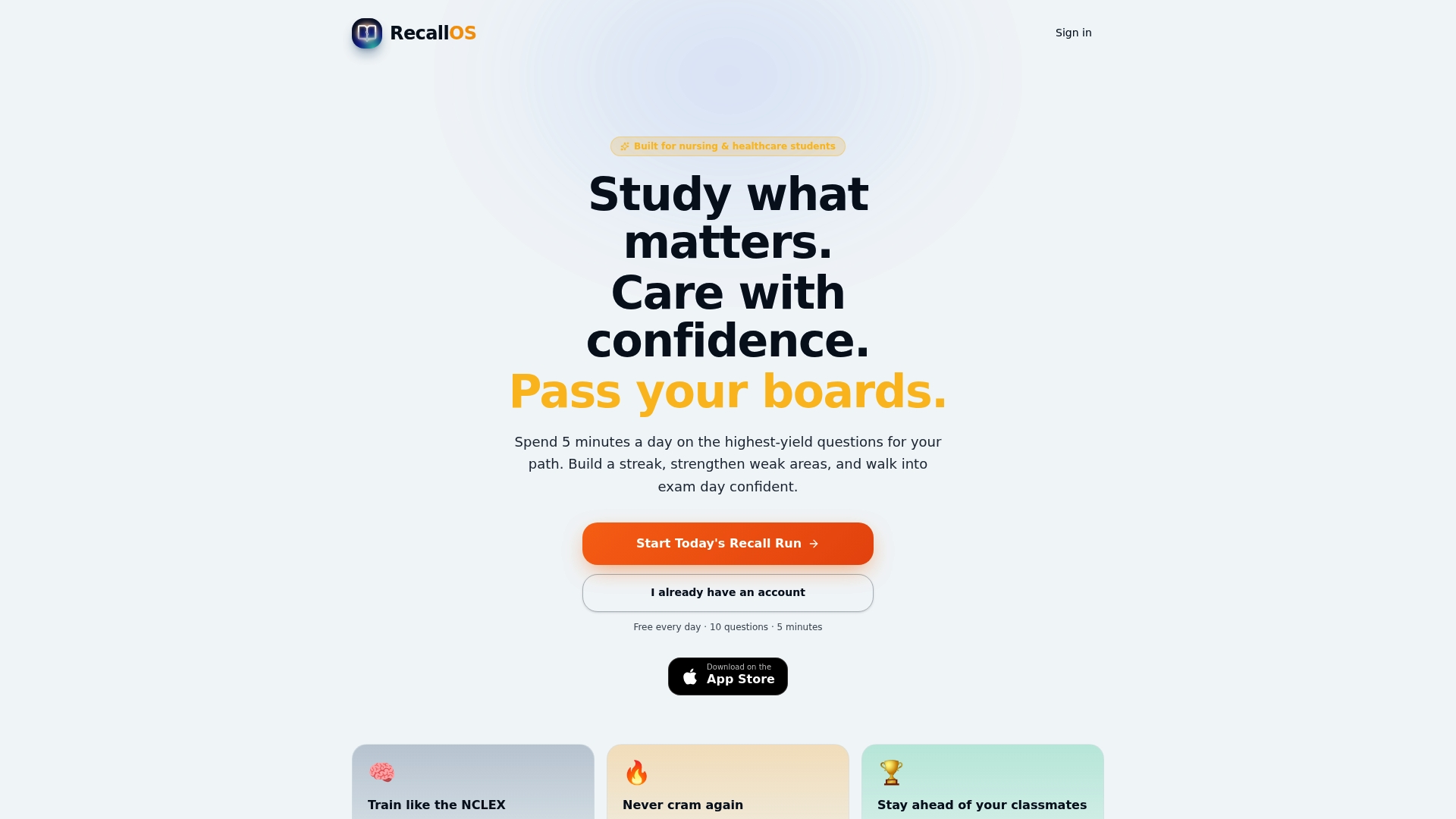
Every session feeds an adaptive review that surfaces the specific topics you keep missing, so your visible streak tracks improvement, not just logins. If you already have lecture notes or old quizzes sitting around, you can upload them and RecallOS turns them into daily practice questions built around your own material. Start with a single Daily Recall Run and see whether the streak and adaptive review actually change how consistently you study before your next exam block.
Primary Sources and Further Reading
- Streaking to Success (60,000-student field trial)
- The Duolingo Streak and Habit Research
- The Motivating Power of Streaks (OBHDP)
- UNC Learning Center: Motivation Tips
Sources
- Streaking to Success: The Effects of Highlighting Streaks on Student Effort and Achievement
- The Duolingo Streak Uses Habit Research to Keep You Motivated
- The motivating power of streaks: Increasing persistence is as easy as 1, 2, 3
- Study Habits, Skills, and Academic Performance (review)
FAQ
What Is the Best Motivation for Studying?
Consistent short-term wins tend to beat abstract long-term goals like "pass the exam." A visible streak built around a manageable daily session, paired with active recall, gives your brain a concrete, immediate reason to show up today rather than someday.
What Is the Biggest Killer of Motivation?
Vague, oversized goals kill motivation faster than almost anything else. "Study more" gives you nothing to act on, while a defined minimum session, like RecallOS's Daily Recall Run, removes the guesswork about what today's work actually looks like.
What Are the Top Motivations for Studying Consistently?
The most reliable drivers are protecting a visible streak, hitting short milestones (7, 21, 30 days), avoiding the loss of progress already made, pairing sessions with a fixed daily cue, and seeing measurable score improvement from weak-area review.
Are There Different Types of Motivation That Affect Studying?
Yes. Psychologists broadly separate intrinsic motivation, studying because you find the material interesting or meaningful, from extrinsic motivation, studying for grades, exams, or rewards. Streaks work as an extrinsic scaffold that can strengthen intrinsic habits over time once the routine becomes automatic.
How Long Does It Take for a Study Streak to Feel Automatic?
Platform data suggests the first major turning point comes around seven days, after which continued engagement becomes significantly more likely, according to Duolingo's streak research. Most habits keep strengthening through the three-to-four week mark.