
The NCLEX registration fee is currently $200, but NCSBN plans to charge $350 for registrations submitted on or after February 1, 2027. State application fees and background checks come on top. Before any prep spending, a first-time candidate in a low-fee state may pay about $343, and other states can push the upfront total higher.
TL;DR:
- Iowa’s $143 application includes its background check; Mississippi separately charges $100 for an RN application and $75 for screening, before exam or preparation costs.
- Changing your board or exam type after registration can cost extra; international scheduling adds a fee, and duplicate registrations or missed appointments are not refunded.
- If you can study independently, prioritize focused question bank practice and free official test plans; pay for live instruction only when you need scheduled structure.
- Retakers should budget for another exam registration and any state or scheduling charges, then choose a short remediation plan based on their lowest scoring areas.
Table of Contents
- What the NCLEX registration fee covers and what else Pearson charges
- State application and background check costs vary widely
- What NCLEX prep materials cost by format
- Estimate your total with three worked examples
- How to cut NCLEX costs without weakening your prep
- When you pay each fee and the mistakes to avoid
- Retake costs and how to budget for another attempt
- Plan this week, not next month
- RecallOS as a budget-friendly, exam-focused study option
- FAQ
- Sources
- Where to verify fees and state requirements
What the NCLEX registration fee covers and what else Pearson charges
The registration fee is the price of admission to the exam itself. According to the NCSBN NCLEX Examination Candidate Bulletin, the U.S. registration fee is $200. The fee covers the NCLEX registration. Check the candidate bulletin for details about what it includes.
It does not cover everything that touches your exam. The bulletin documents several other charges you may meet along the way:
- Changing your nursing regulatory body after you have registered carries its own fee.
- Changing your exam type after registration carries a separate fee.
- International scheduling adds a fee for candidates who test outside the United States.
- Duplicate registrations, missed reschedules and no-shows are not refunded, according to the Pearson VUE candidate bulletin.
The most important budgeting detail is timing. The fee you pay depends on the date you register, not the date you test. The official bulletin lists $200 today, and NCSBN states that registrations made on or after February 1, 2027 will be charged $350. A candidate who registers in January 2027 and tests in March keeps the lower fee. A candidate who waits until February pays $150 more for the very same exam.
If you plan to test late in 2026 or early in 2027, build both numbers into your spreadsheet and decide which date you can realistically hit.
State application and background check costs vary widely
Your state board of nursing, not Pearson, collects the fee for your license application. Many boards also require a fingerprint-based criminal background check (CBC), and you pay for it. These charges are separate from the NCLEX registration fee, and they are the reason two candidates can face very different upfront bills for the same exam.
Some states bill the application and the background check separately. Others fold the background check into one application fee. Here is how the published examples compare:
- Mississippi: the state board lists an RN application fee of $100, an LPN application fee of $60, a criminal background check of $75, and the $200 NCLEX fee as separate items.
- Iowa: the state licensing department requires a $143 non-refundable application fee that includes the criminal history background check. Your NCLEX registration is completed separately, and your name, address and email must match your licensure application.
- Maine: the Maine State Board of Nursing requires fingerprint-based checks for initial licensure and for endorsement. Applicants pay the CBC fee, which is $52 when paid to IdentoGo.
Adding the exam fee to those state charges shows how much the state alone can move your total:
Mississippi's official estimate totals $375 before study materials ($100 RN application, $75 background check and the $200 NCLEX fee), while Iowa's bundle plus the exam comes to $343. A $32 gap between two states is small, but it shows why you cannot budget from the NCLEX fee alone.
Those two figures are examples, not a national average. Your own board may charge more, less, or handle fingerprints through a different vendor. To find your exact numbers, open your state board's page for licensure by examination and look for three things: the application fee, whether a background check is included or billed separately, and who collects the fingerprints.
If your board publishes a "how much will everything cost" breakdown, as Mississippi does, copy those lines straight into your budget. If it does not, add a cushion for the fingerprint vendor, since that charge often goes to a third party rather than the board.
One more habit saves headaches: write down every payee. The state board, the fingerprint vendor and Pearson VUE are separate transactions, and a receipt from one does not satisfy the others.

What NCLEX prep materials cost by format
Mandatory fees are fixed, but prep spending is where your choices move the total the most. Candidates generally choose among several formats, and each trades price against structure.
- Mobile app subscriptions run on monthly or multi-month plans. They suit candidates who study in short daily sessions and want questions on a phone. The risk is paying for months you do not use.
- Question banks (Q-banks) give large pools of practice questions with rationales. They are the core of most study plans because the exam tests application, not recall of facts alone.
- Live review courses and boot camps offer instructors and a schedule. They usually cost the most, and they pay off mainly for candidates who need external structure.
- Textbooks and flashcards are the cheapest to borrow and the easiest to reuse. They work best as a supplement, since passive reading alone rarely builds exam readiness.
Exact prices change often, so rather than quote a number that may be stale by the time you read it, check current pricing directly. Our breakdown of what NCLEX prep apps charge compares subscription options in detail, and it is a good place to start when you are choosing between plans.
Subscription versus one-time pricing deserves a closer look. A short-term pass costs less up front and fits a tight timeline, while a longer package lowers the monthly rate but only helps if you will study through the whole term. Count the weeks until your test date, then buy only what that window can use.
Format also affects how much you need. Candidates who practice a little every day often need fewer months of access than those who cram, because spaced repetition builds retention faster per hour studied. Our guide to the NCLEX RN question bank explains how targeted question practice fits into a plan, and our daily NCLEX question routine shows how small sessions add up.
Pro Tip: Match your subscription length to your study calendar, then leave some flexibility in your plan as a buffer. Paying for a month you will not open costs more than a brief extension later.
Estimate your total with three worked examples
The simplest way to plan is a formula: mandatory fees (NCLEX plus state application plus CBC) plus your chosen prep cost plus a retake contingency equals your budget. The examples below use the published fees from above, with prep shown as a blank you fill in from current pricing. The inputs are illustrative, not market data.
- Low-cost candidate, bundled CBC. You live in a state like Iowa, where the application includes the background check, and you register before the fee change. Your mandatory fees are $143 plus $200, which is $343. Add one short app subscription and borrowed textbooks, and your prep spending stays small.
- Mid-range candidate, separate CBC. You live in a state like Mississippi, where fees are itemized, so your mandatory total is $375. Add a Q-bank subscription, then set aside a contingency as a cushion for a reschedule or fee surprise.
- Retaker. Your first attempt did not pass, so you pay the registration fee again, and possibly state or scheduling fees depending on your board's rules. If you register after the change, that single fee is $350. Add a targeted, shorter prep subscription focused on weak areas rather than starting from scratch.
Fill in your own numbers: write your state's application fee, your CBC cost, the NCLEX fee for your registration date, your prep choice, and a retake cushion. The total is your realistic budget, and it will almost always land above the NCLEX fee alone.
How to cut NCLEX costs without weakening your prep
Saving money does not mean studying less. It means spending where it counts and skipping what you will not use.
- Register before the increase if your timeline allows. NCSBN says registrations completed before February 1, 2027 are charged the current fee, so an earlier registration date can save $150.
- Pick a subscription length that matches your plan. Unused months are the most common waste.
- Favor focused Q-bank time over long, costly courses if your budget is tight and you can study independently.
- Ask about discounts. Some schools and programs offer student pricing or provide question sets and library copies of textbooks at no charge. Check your program's resources before buying anything.
- Use free official material. The official NCLEX preparation pages share test plans that show what the exam covers, so you can aim your study time at the right content.
Pro Tip: Prioritize daily, high-yield practice with spaced repetition over passive rereading. Candidates who retrieve information every day tend to need fewer weeks of paid access, which lowers total prep spending.
When you pay each fee and the mistakes to avoid
The order of payments matters because the pieces connect. In most states the sequence runs from your state application and background check to your Pearson registration, and then to any scheduling or change fees. Iowa's process, for example, has you submit the application first and register for the NCLEX separately, with matching personal details.
The date you register for the NCLEX is the date that sets your fee. Registering before February 1, 2027 locks in the $200 fee, even if your exam is scheduled afterward. Waiting past that date means the higher rate applies.
Watch for these common pitfalls:
- Double paying. Paying a vendor twice because a confirmation email was delayed.
- Duplicate registrations. These are not refunded, so confirm you have only one active registration.
- Missed reschedules and no-shows. These also carry no refund, so reschedule within the allowed window.
- Mismatched names or emails. Details that differ between your state application and your registration can stall your authorization to test.
If you realize you made a payment mistake, contact the relevant payee right away, whether that is the state board, the fingerprint vendor or Pearson VUE, and keep your receipts.
Retake costs and how to budget for another attempt
A retake means paying the NCLEX registration fee again, and, depending on your board's rules, possibly re-paying state or scheduling fees. If your retake registration falls after the adjustment date, the exam fee alone becomes $350 rather than $200.
A simple way to plan is to hold back a contingency based on your initial total and the possible costs of another attempt. If your first-attempt fees and prep come to a given amount, set aside an additional amount in a separate savings line so a retake does not become a financial emergency.
- Retake budget sample: NCLEX fee for your registration date, plus any state or scheduling fees your board requires, plus a short remediation subscription.
- Lower the odds: a targeted, short-term subscription aimed at your weak areas often beats repeating a full course.
- Review your results first. Spend your retake dollars on the content areas where you scored lowest.
Plan this week, not next month
My advice is to treat your budget as a short checklist rather than a research project. Open your state board's page today and note whether the background check is bundled into the application. Then pick a registration date with the February 2027 change in mind, and choose a prep subscription length that matches your calendar instead of your anxiety. I work with RecallOS, and our posts on app costs and exam practice questions are there if you want to compare options.
— Caleb
RecallOS as a budget-friendly, exam-focused study option
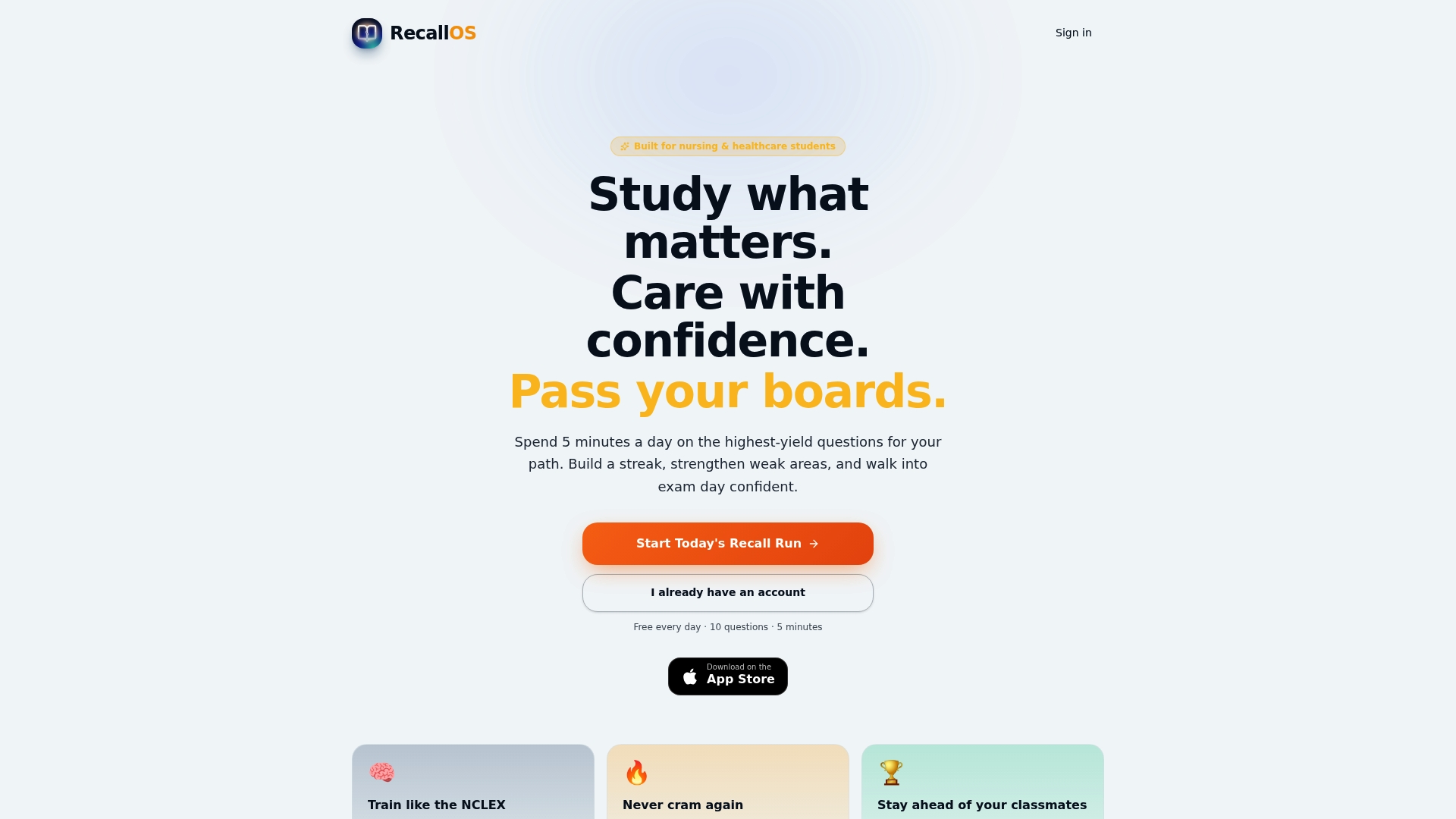
If you want daily practice without paying for weeks of live instruction, we built RecallOS around short, focused sessions. Our plans, Recall+ and Recall Pro, are priced through the app, and you can see current options before you commit. Here is what you get:
- Daily high-yield questions through our Daily Recall Run
- Adaptive review of your weak areas
- Streaks and rewards that keep you consistent
- Study material generated from your own notes with Upload Notes
Many candidates find a targeted subscription fits their budget better than a multi-week review course. Explore our NCLEX study app or compare plans on our homepage to find your next step.
FAQ
How much does the NCLEX registration fee cost right now?
The registration fee for U.S. licensure is $200. That covers one attempt and does not include your state application or background check.
Will the NCLEX fee go up?
Yes. NCSBN has announced that registrations submitted on or after February 1, 2027 will be charged $350. Registering before that date keeps the current fee.
What is the cheapest way to prepare for the NCLEX?
Combine free official test plans, borrowed textbooks and a short, targeted subscription instead of a long course. Matching subscription length to your study calendar prevents paying for unused months.
Are state application fees included in the NCLEX fee?
No. State boards charge separate application fees, and some bill background checks separately. Mississippi itemizes its application, background check and exam fee, while Iowa bundles the check into its application.
Sources
Where to verify fees and state requirements
Fees and rules change, so confirm every figure with the official source before you pay. These are the pages behind the numbers in this article, and they are the best places to check current requirements for your own state.
For exam fees and policies, start with the NCSBN candidate bulletin and the fee change announcement. For state costs, use your own board's licensure page, and compare it with the Iowa and Mississippi examples above. Official preparation pages also explain test plans and what the exam covers.