
The single highest-leverage move for the NCLEX is daily active practice, not passive rereading: answer questions, then read every rationale, right and wrong. Anchor your prep to NCSBN guidance and the Clinical Judgment Measurement Model (CJMM), and use a tool like RecallOS to track which areas keep tripping you up. What follows is the strategy list, a study plan, an NGN breakdown, and an exam-day checklist.
TL;DR:
- Answer at least 50 questions daily with full rationale review to maximize learning and identify weak areas through analytics.
- Practice applying the Clinical Judgment Measurement Model (CJMM) steps, especially with Next-Gen NCLEX item types like case studies and trend analysis.
- Use a consistent four-step routine for each question: restate the stem, identify priority cues, predict an answer, and eliminate distractors to improve speed and accuracy.
- Allocate 4 to 8 weeks for study, focusing on targeted weak spots with full timed simulations and a tapered review period before exam day.
- Prioritize active problem-solving and clinical judgment development over passive content rereading to adapt to the NCLEX's new format.
Table of Contents
- Test-Taking Strategies NCLEX Candidates Use to Pass
- Building a 4 to 8 Week NCLEX Study Plan That Fits Your Timeline
- Next-Gen NCLEX and CJMM: What the New Item Types Actually Test
- A Repeatable 4-Step Routine for Answering Any NCLEX Question
- Exam-Day Checklist and Pacing Reminders
- What Practitioner Experience Says About Study Habits That Work
- Common Pitfalls That Quietly Sink NCLEX Candidates
- Why Practice-First Beats Content-First Prep
- How RecallOS Fits Into Your NCLEX Study Plan
- Where to Verify These NCLEX Details Yourself
- Sources
- FAQ
Test-Taking Strategies NCLEX Candidates Use to Pass
Reading a review book cover to cover feels productive. It rarely translates into points on exam day. The candidates who pass consistently treat every practice question as a rehearsal for the real thing, then dissect the rationale afterward, whether they got it right or wrong.
Here's what actually works during study sessions and inside the testing room:
- Practice daily, review every rationale. Answering 50 questions without reading why the wrong choices are wrong wastes most of the value. The rationale is where the learning happens.
- Run a 4-step routine on each item: restate the question in your own words, find the priority cue, predict an answer before looking at the choices, then eliminate.
- Apply priority frameworks consistently. Safety comes before comfort. Airway, breathing, and circulation outrank almost everything else when two answers both look reasonable.
- Pace yourself at roughly two minutes per question, though some items (especially case sets) take longer and others take seconds.
- Use your two optional breaks to reset physically, not to ruminate on the last hard question.
- Don't panic if you get more questions than expected. On a computer adaptive test (CAT), the exam keeps giving you harder items as you answer correctly, so a longer test often means you're performing well, not poorly.
Anxiety management belongs in this list, not off to the side. Slow diaphragmatic breathing between items, standing and stretching during a break, and deliberately not counting how many questions you've answered all reduce the mental noise that causes careless misreads. The American Nurses Association's NCLEX guidance points to the same core idea from a different angle: practice exams and structured review beat cramming, every time.
Pro Tip: Read the last sentence of the question stem twice before you even look at the answer choices. That's usually where the actual question hides, buried after two sentences of clinical scenario.
Building a 4 to 8 Week NCLEX Study Plan That Fits Your Timeline
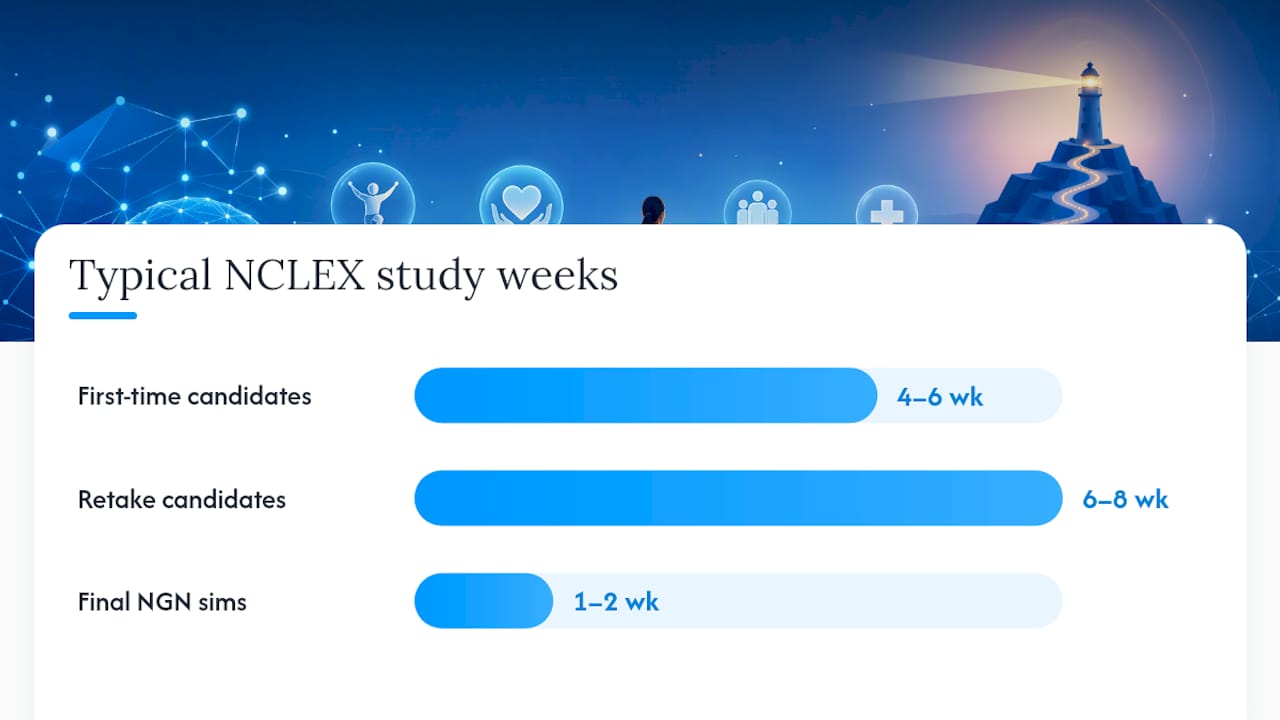
Your timeline depends on where you're starting. First-time candidates coming straight off their final semester typically need 4 to 6 weeks of focused prep. Retake candidates usually need 6 to 8 weeks because part of that time goes toward diagnosing what actually went wrong the first time, not just reviewing content.
A workable weekly structure looks like this:
- Daily blocks of 50 to 75 questions, each followed by full rationale review, not just a glance at the score.
- One weekly mixed-content simulation that pulls from multiple systems at once, since the real exam never stays in one lane for long.
- Rotation through CJMM skills (recognize cues, analyze, prioritize hypotheses, generate solutions, take action, evaluate outcomes) alongside content areas like pharmacology, maternal health, and mental health.
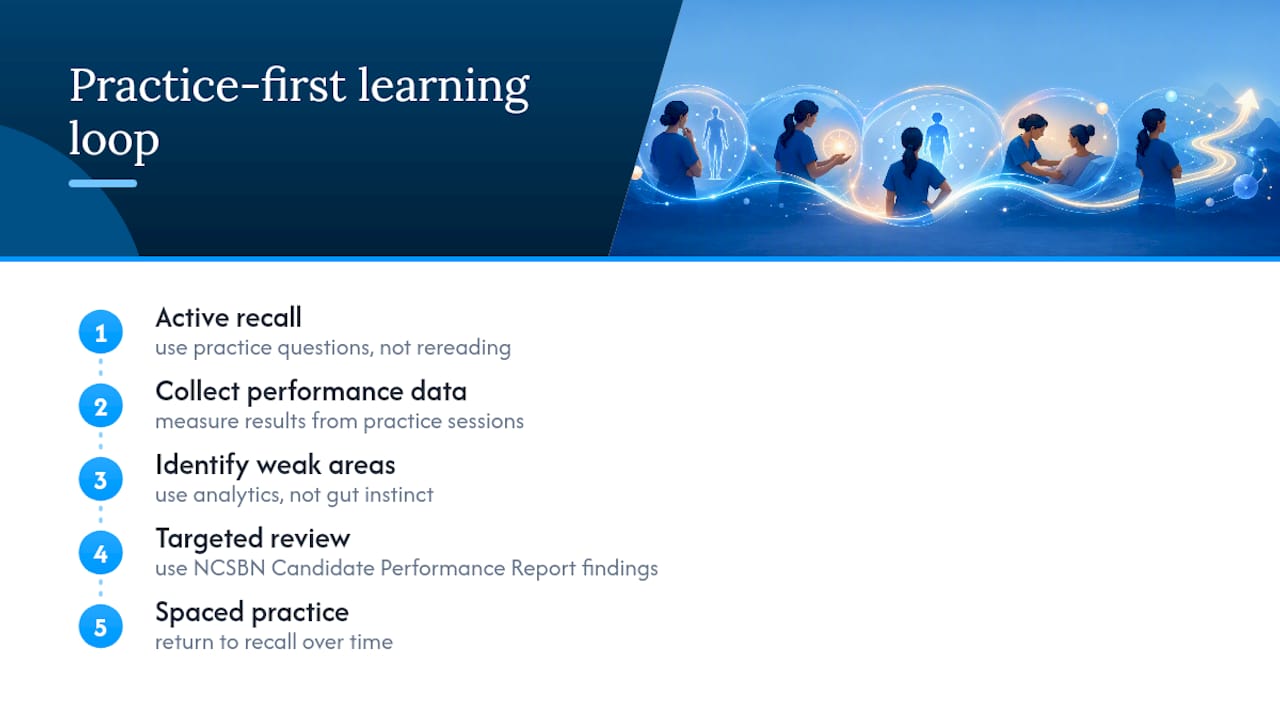
- Weak-area drilling based on analytics, not gut feeling. A structured retake plan built around a specific target, like getting a weak category up to 80%, gives you something concrete to chase instead of vague reassurance.
- Full timed NGN simulations in the final one to two weeks, then a taper: lighter review days as exam day approaches so you walk in rested instead of burned out.
Prep guides that emphasize structured planning generally agree on this shape: consistent daily reps, weekly stress tests, and a taper period. What separates a good plan from a wasted six weeks is whether the daily reps target your actual gaps.
Next-Gen NCLEX and CJMM: What the New Item Types Actually Test
The Next-Gen NCLEX (NGN) is built directly on the Clinical Judgment Measurement Model, a framework NCSBN developed to measure how candidates think through a patient scenario, not just what facts they can recall. That distinction changes how you should study.
CJMM breaks clinical judgment into a sequence: recognize cues, analyze cues, prioritize hypotheses, generate solutions, take action, and evaluate outcomes. NGN item types are built to test each step:
- Case studies present a evolving patient scenario across multiple questions, forcing you to track changes over time.
- Bow-tie items ask you to connect a condition, actions, and parameters in one structured response.
- Trend items test whether you notice a pattern developing across several data points, like vital signs drifting in one direction.
- Matrix and grid items ask you to sort multiple pieces of information at once, rather than pick a single answer.
Rather than memorizing facts in isolation, practice by running the CJMM sequence out loud on sample cases with techniques to summarize medical lectures: what am I noticing, what does it mean, what's the priority, what do I do, did it work. NCSBN's own sample NGN items are the closest thing to official practice material, and running through a set of next-gen practice drills mapped to CJMM before exam day helps the item format feel less foreign. Candidates who skip this step often report that the format threw them off more than the content did, since NGN items feel noticeably different from standard multiple choice.
A Repeatable 4-Step Routine for Answering Any NCLEX Question
Speed and accuracy under pressure come from having one process you run on every single item, so you're not reinventing your approach question by question.
- Read the full stem, then restate it in one sentence. If you can't summarize what's actually being asked, you're not ready to look at answer choices yet.
- Scan for safety or priority cues first. Words like "immediately," "first," or "priority" change what the question is really testing.
- Predict your answer before reading the choices, then eliminate. This stops you from getting talked into a wrong answer by a tempting distractor.
- Confirm your choice and move on. Second-guessing costs time and rarely improves accuracy, unless you misread the stem the first time. Only change an answer when you catch a genuine misread, not because a later question shook your confidence.
Multi-response (SATA) items and case sets need a slight adjustment to this routine: evaluate each option independently against the stem rather than comparing options to each other, and expect to spend more time on case sets since they carry multiple linked questions.
Pro Tip: If you find yourself re-reading the same stem for the third time, you've stopped processing and started panicking. Skip ahead mentally to your breathing, not to the next guess.
Exam-Day Checklist and Pacing Reminders
Exam day logistics trip up otherwise well-prepared candidates more often than content gaps do.
- Bring valid, matching ID and arrive early; NCSBN's candidate rules specify exactly what's permitted at the testing center and what isn't.
- The exam is computer adaptive with a maximum length of five hours and up to two optional breaks built in.
- Question counts run between 85 and 150. Shutting off near the 85 minimum can mean you're passing decisively, not failing. Don't read your own performance into the question count.
- Sleep and eat normally the night before. A heavy dose of new content the morning of the exam adds anxiety without adding retention.
- If anxiety spikes mid-test, take a scheduled break, breathe slowly for 60 seconds, and return to the routine you already practiced.
A detailed 24-hour exam-day checklist covers the smaller logistics worth locking down the night before.
What Practitioner Experience Says About Study Habits That Work
Active recall paired with spaced practice consistently outperforms passive rereading for exam readiness. Performance analytics, not gut instinct, reveal your real weak spots. If you don't pass, request your NCSBN Candidate Performance Report and build your next attempt around its specific findings, not a general re-study of everything.
Common Pitfalls That Quietly Sink NCLEX Candidates
Most failed attempts don't come from a lack of knowledge. They come from predictable, avoidable habits.
Overstudying content, understudying format. Spending weeks re-reading pharmacology notes while never touching an NGN case set means the exam format itself becomes the obstacle, not the material.
Treating every practice question the same way. Answering a question and immediately clicking "next" without reading the rationale, especially for questions you got right, throws away half the learning value of every practice session.
Ignoring analytics in favor of feelings. Candidates frequently believe they're weak in one area and strong in another based on how a session felt, not on actual data. A quiz platform with tracking built in exposes the gap between perceived and actual performance.
Cramming the final 48 hours. New content that late rarely sticks and mostly just raises anxiety heading into the test.
Skipping timed simulations. Practicing questions without a clock creates a false sense of pacing. The first time many candidates feel real time pressure is on exam day itself, which is exactly the wrong time to discover it.
Answer-changing out of anxiety rather than logic. Second-guessing a choice because a later, harder question shook your confidence, rather than because you spotted an actual misread, tends to convert right answers into wrong ones.
Why Practice-First Beats Content-First Prep
The research and guidance behind this article point to one conclusion: candidates who treat the NCLEX as a clinical-judgment test, not a trivia test, perform better. Conventional advice still leans heavily on content review, chapter by chapter, system by system. That approach made sense for the old exam format. It makes less sense now that NGN items are explicitly built around the CJMM sequence of reasoning through a scenario.
What's overrated: rereading notes and highlighting textbooks. What's underrated: sitting with a wrong answer long enough to understand exactly where your reasoning broke down. That's slower and less comfortable than passive review, which is probably why so few candidates do enough of it.
If you take one thing from this, prioritize volume of active questions with full rationale review over volume of pages read. Everything else, the pacing, the anxiety management, the exam-day logistics, matters. But it's secondary to whether your daily practice is actually training clinical judgment or just training recognition of familiar phrasing.
— Caleb
How RecallOS Fits Into Your NCLEX Study Plan
If your study plan above sounds right, but you're not sure how to execute it daily, using a study platform designed for nursing exam prep can help bridge that gap.
Instead of guessing which content area needs more attention, a study app that tracks your answers and surfaces your real weak spots, then serves focused daily drills, including NGN-style case items, can ensure your practice time goes where it matters. Features like streaks and peer challenges can help maintain consistent practice, addressing the common challenge of lapsing in NCLEX prep. None of this replaces the discipline of a real study plan. It's a supplement to disciplined practice, not a substitute for it. If you want to see how the daily practice format works, try the Daily Recall Run or upload your own notes to generate a tailored question set built around what you're actually studying.
Where to Verify These NCLEX Details Yourself
Every strategy above draws on official guidance, not guesswork. Three sources worth bookmarking:
- The ANA's NCLEX tips reinforce practice-based, evidence-backed study habits.
- NCSBN's quick results page explains how and when results get reported after you finish.
FAQ
What are test-taking strategies in nursing?
They're the specific techniques nursing students use to interpret questions accurately and choose the safest, most appropriate action under time pressure. That includes prioritization frameworks like airway-breathing-circulation, elimination of distractors, and pacing methods that keep you moving without rushing.
What are good signs you passed the NCLEX?
There's no single reliable in-exam signal, since the test is adaptive and difficulty shifts based on your answers. Some candidates report the exam shutting off closer to the 85-question minimum, which NCSBN notes can indicate a decisive pass, but the only certain confirmation comes from your official results.
Is there a trick to answering NCLEX questions?
The closest thing to a trick is a consistent routine: restate the question, spot the priority cue, predict an answer, then eliminate wrong choices before committing. Practicing this same sequence on every question, using a study platform for daily reps, builds the pattern recognition that makes real exam questions feel familiar.
Will the NCLEX be harder in 2026?
The exam itself isn't getting harder so much as it's testing differently, with Next-Gen item types built around the Clinical Judgment Measurement Model rather than straightforward recall. Candidates who only prepare with old-style multiple choice questions tend to find the case sets and bow-tie items unfamiliar, which is why practicing NGN-specific formats before test day matters more now than it used to.